
St. Petersburg isn’t just sun and surf – it’s a rising tech hub where 4K streams, smart homes, and daily video calls demand real bandwidth. If your connection still crawls, you’re leaving speed on the table.
In this guide, we’ll compare the city’s five fastest, most reliable gigabit options. You’ll see who serves your block, what each plan costs, and why fiber – or fiber-fast cable – can transform your online life. Think of it as the quick shortlist a neighbor hands you before you click “checkout” on a new plan.
How we picked and scored the top five
Choosing an internet plan comes down to numbers: speed, price, and coverage seldom carry equal weight. We built a clear rubric so you can see why each provider lands where it does.
First, we narrowed the field to services that sell a residential gigabit tier within St. Petersburg ZIP codes. That step removed legacy DSL, business-only circuits, and niche neighborhood networks too small for most readers.
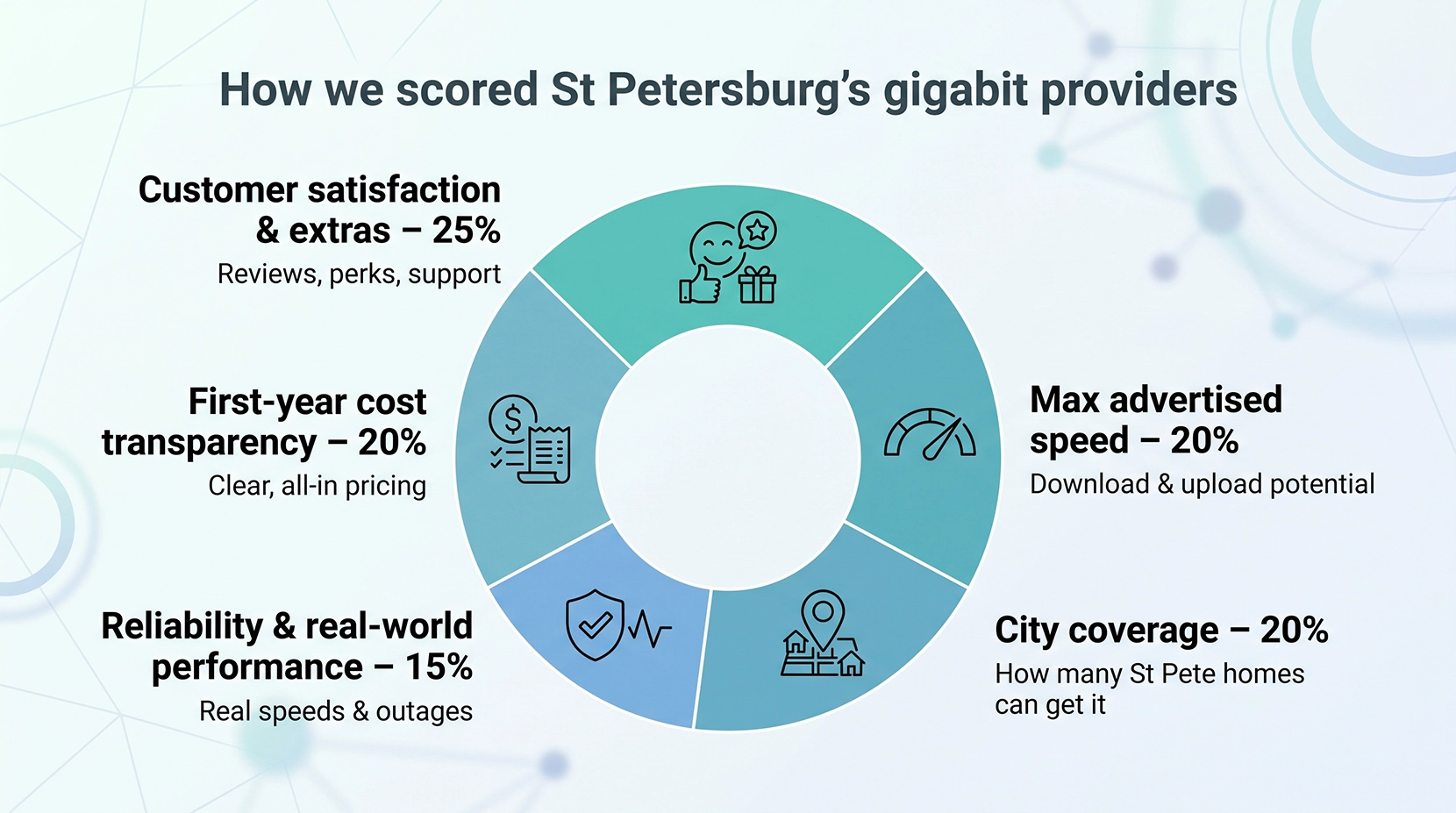
Next, we graded the finalists on five weighted factors:
- Max advertised speed (20 percent). Symmetrical gigabit connections earned top marks because fast uploads keep Zoom calls sharp and cloud backups quick. Cable plans with slower uploads scored lower.
- City coverage (20 percent). A fast network matters only if it reaches your block. We leaned on FCC data and local address checks to measure the share of St. Pete homes each provider can reach.
- First-year cost transparency (20 percent). We ignored teaser banners and tallied monthly rates, equipment fees, and install charges. Providers with clear, all-in pricing and no long contracts rose in the rankings.
- Reliability and real-world performance (15 percent). Median speed-test results, recent outage logs, and third-party satisfaction studies shaped this score. A gig label on paper must feel gig-fast at dinnertime.
- Customer satisfaction and extras (25 percent). National surveys and local reviews anchored this metric, and we added bonus points for perks like unlimited data, price-lock guarantees, or free mesh routers.
Each ISP earned a composite score out of 100. We then ranked them from highest to lowest so you can skim the winner first or jump to the runner-up if availability steers you elsewhere.
With the ground rules set, let’s compare the numbers side by side.
 Gigabit plans at a glance
Before we dive into individual winners, here’s a quick side-by-side view. Scan the rows, spot the deal that fits your priorities, and read on for the finer points.
| Provider | Connection | Advertised top speed (down / up) | First-year gig price* | Data policy | Contract? |
| WOW! | Hybrid cable + selective fiber | 1 Gbps / 50 Mbps (coax)<br>Up to 5 Gbps symmetrical in new fiber zones | $70 | Unlimited | None |
| Frontier Fiber | Fiber-to-the-home | 1 Gbps, 2 Gbps, 5 Gbps symmetrical | Frontier availability page – $49.99 | Unlimited | None |
| Spectrum | Fiber-powered cable (DOCSIS 3.1) | 1 Gbps / 35 Mbps | $60 online exclusive | Unlimited | None |
| AT&T Fiber | Fiber-to-the-home | 1 Gbps, 2 Gbps, 5 Gbps symmetrical | $80 | Unlimited | None |
| IQ Fiber | Fiber-to-the-home | 1 Gbps symmetrical (multi-gig coming) | $65–$75 | Unlimited | None |
*Prices reflect standard new-customer offers in July 2026. Equipment and installation promos are noted in each provider’s deep-dive section.
Frontier’s sub-$50 gigabit stands out. Spectrum counters with a sizable online discount. WOW! keeps coax competitive through promo pricing, while AT&T positions itself as the premium pick where available. IQ Fiber’s flat rate lands in the middle, giving early adopters a fresh option.
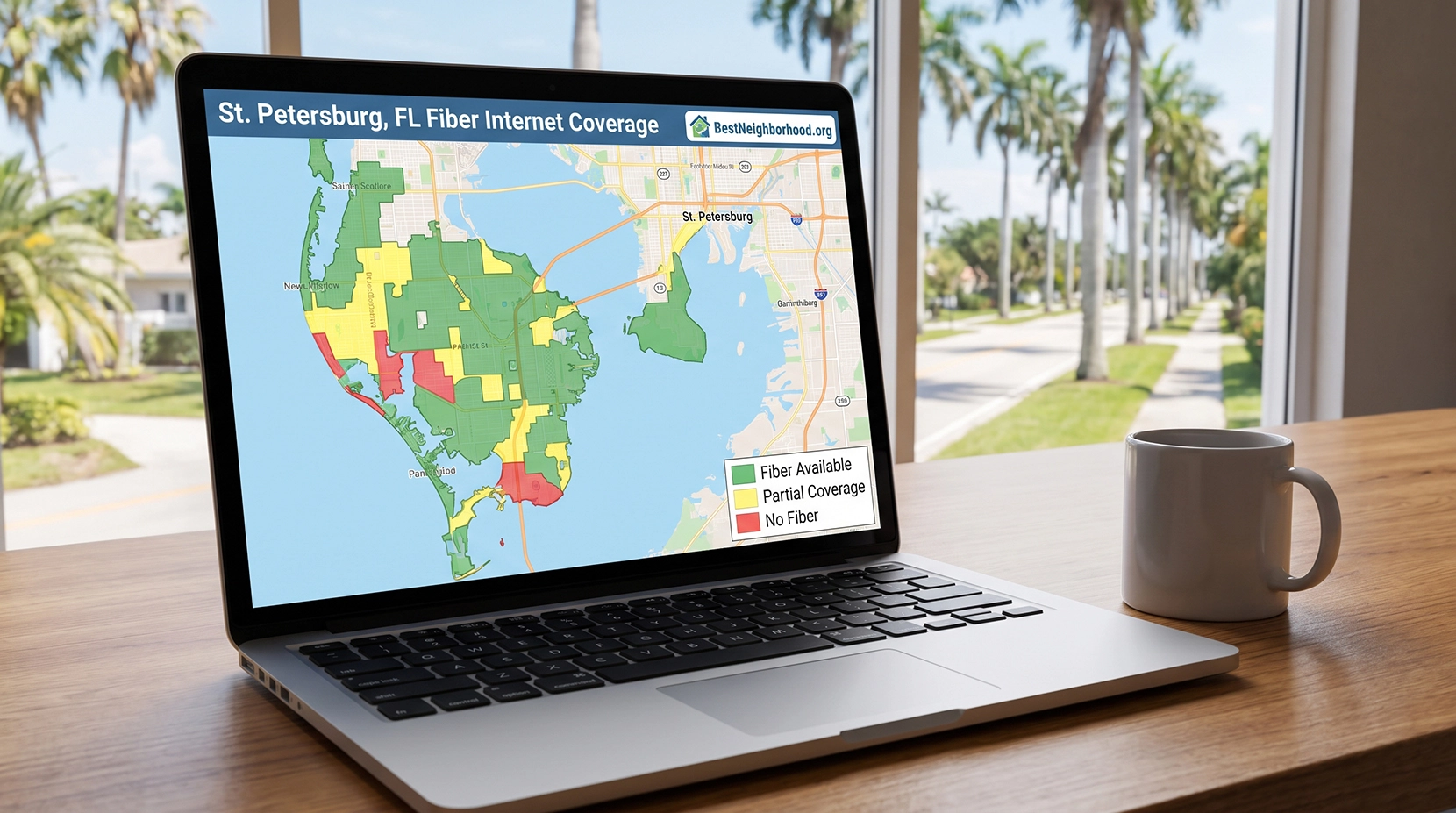
Coverage shapes the bigger story. According to BestNeighborhood.org, fiber-to-the-home (FTTH) availability sits at 50.5 percent of St. Petersburg households.
St Petersburg, FL fiber internet availability map with 50.5 percent FTTH coverage
Keep that stat in mind as we explore each neighborhood in the next sections.
1. WOW! – best local price-lock pick
Why WOW! tops the list
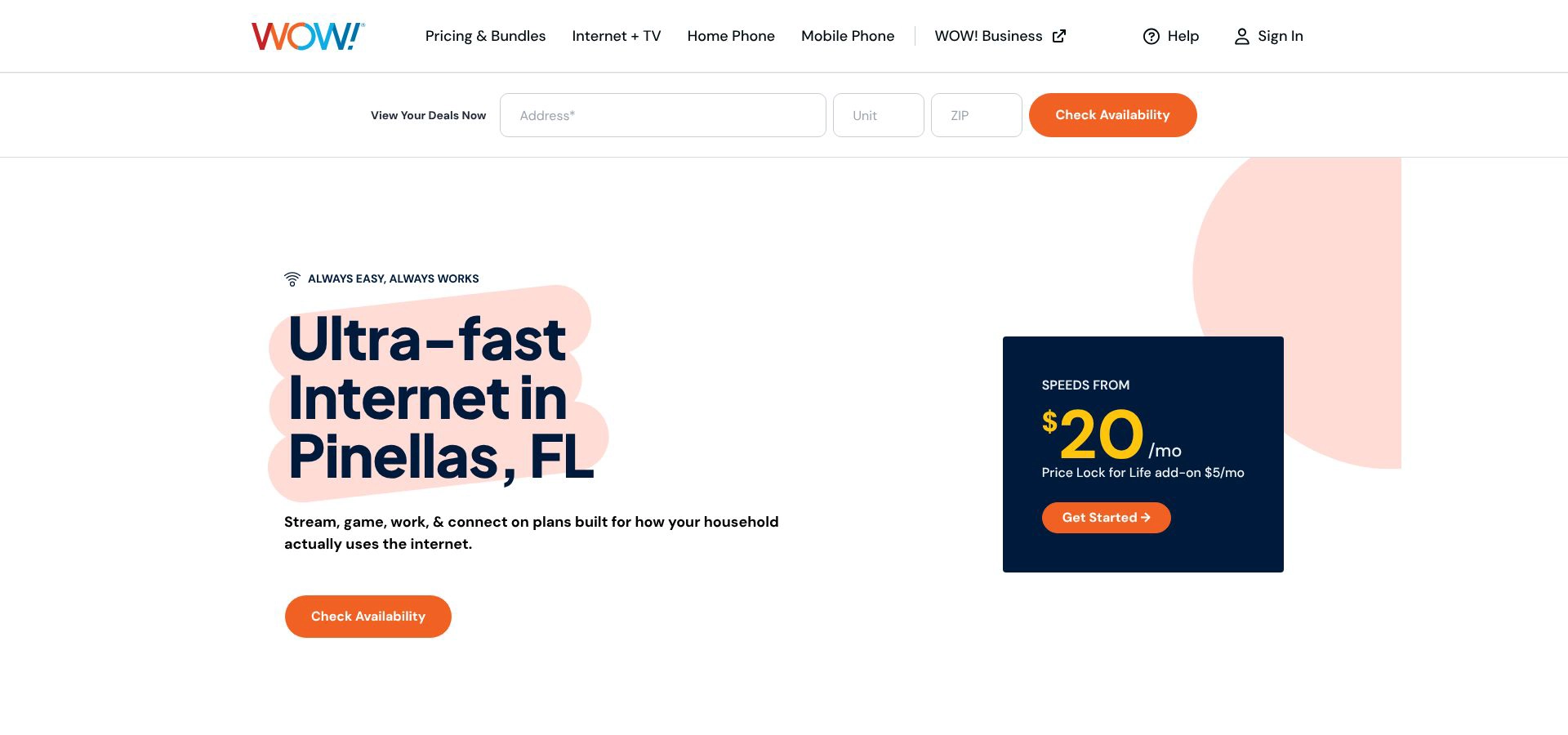
WOW! offers gigabit speed without the big-cable runaround. Almost half of St. Pete can already connect to its hybrid network, and WOW! fiber internet services now reach more homes every quarter. That reach, plus a first-year gig price near seventy dollars, makes WOW! the city’s most affordable path to gigabit service.
WOW Internet 1 Gig plan and price lock offer in Pinellas FL screenshot
Cost certainty sweetens the deal. Add a one-time five-dollar “price for life” rider, and your monthly rate stays flat while neighboring bills climb. Pair that with responsive local support, and WOW! becomes a strong challenger.
In short, WOW! earns the top spot for combining low entry cost, predictable long-term pricing, and a clear upgrade path as fiber expansion continues.
2. Frontier Fiber – widest pure-fiber footprint
Frontier inherited Verizon’s FiOS buildout and has spent the past three years trenching fresh glass across Pinellas. Today about one in two homes can order Frontier’s fiber-to-the-home service. If your address qualifies, you bypass coax and jump straight to symmetrical gigabit speeds.
The price is equally appealing. The Fiber 1 Gig plan still starts at $49.99 a month for the first year with autopay. That figure covers installation, an Amazon-branded Wi-Fi 6 mesh router, and unlimited data. After the promo, most bills settle near eighty dollars, competitive with cable yet twice as fast on uploads.
Frontier Fiber 1 Gig $49.99 plan official pricing page screenshot
Performance matches the spec sheet. Speed-test dashboards show 900-plus megabits up and down during prime-time hours, and latency stays in single digits. For remote workers moving large files or gamers chasing low ping, that stability turns “works” into “works flawlessly.”
Customer support remains the weak spot. Reviews have improved since Frontier left bankruptcy and refocused on fiber, yet hold times can still test patience. The upside: outages are rare, and the network’s resilience means you may not need to call often.
If Frontier Fiber is live on your street, it offers an easy, long-lasting upgrade for your home connection.
3. Spectrum – easiest to get, unlimited data built in
Spectrum is the line already hanging on most St. Pete walls. Its hybrid fiber-coax network reaches virtually every address, from beach cottages in Gulfport to high-rise condos downtown. That reach makes Spectrum the reliable fallback when other providers stop short of your block.
Speed is straightforward: the flagship Internet Gig tier tops out near 940 Mbps down and 35 Mbps up. Downloads fly, uploads stroll. For households that binge Netflix more than they post large videos, that split rarely matters. Latency stays low enough for online shooters, and evening slowdowns are uncommon thanks to recent node splits that eased congestion.
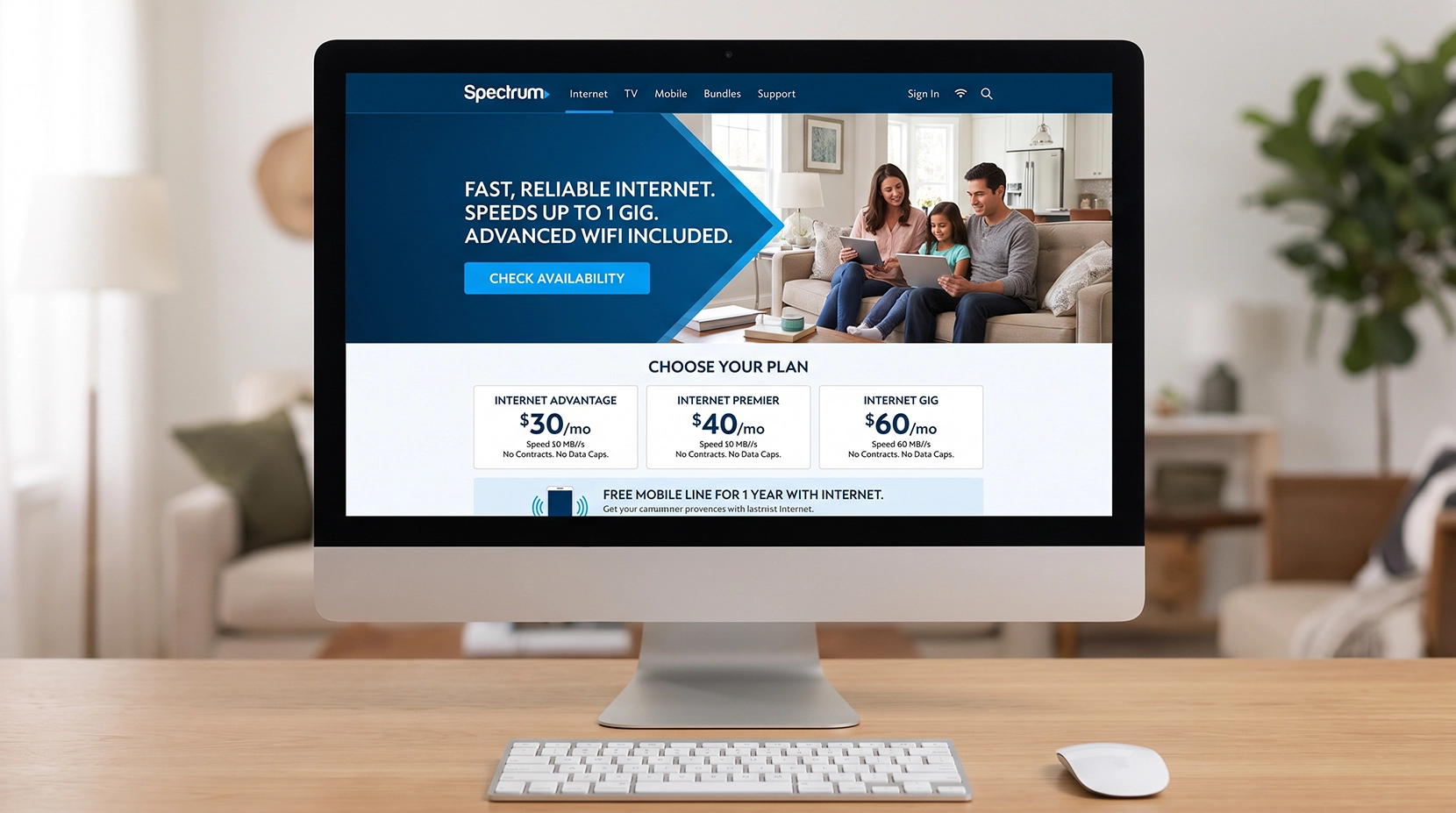
Price transparency is the pleasant surprise, at least for year one. Order online and the Gig plan lands at sixty dollars a month with the modem included. There’s no data cap, so you can stream, game, or back up without watching a meter. After twelve months, the bill often rises to about one-twenty, but Spectrum’s retention team is negotiable if you call before renewal.
Spectrum Internet Gig $60 online-only price and unlimited data screenshot
Customer service earns middling marks. Hold times can stretch, and the agent script feels corporate. Still, service calls are rare; the coax plant in Pinellas is hardened for hurricanes, and outages are typically brief. Plus, local Spectrum stores let you swap gear in person instead of shipping boxes.
When is Spectrum the right move?
- Your address lacks fiber today, and you need gigabit tomorrow.
- You upload sparingly and care more about unlimited streaming than symmetrical speeds.
- You prefer self-install simplicity and might bundle cable TV or mobile later.
If those bullets fit, Spectrum delivers an easy win: no contract, no cap, and a connection you can activate in an afternoon.
4. AT&T Fiber – premium speeds for the lucky few
AT&T’s fiber reputation speaks for itself: strong ACSI scores, near-perfect uptime, and multi-gig plans that reach about 5,000 Mbps in both directions. Coverage is the snag. Only a small slice of St. Pete – mainly select high-rise condos, newer subdivisions, and a few business corridors – can order service today.
If your address qualifies, you enter a higher tier of service. The Internet 1000 plan costs eighty dollars a month with equipment and taxes included, and the rate stays flat after the first year. Step up to the 2-Gig or 5-Gig tier, and AT&T includes a tri-band Wi-Fi 6E gateway plus mesh extenders that erase dead zones.
Performance matches the spec sheet. Speed tests often show 940-plus megabits up and down, and latency sits between two and five milliseconds. Because AT&T runs its own national backbone, cross-country latency stays low for cloud work and VPN traffic.
Customer care keeps the premium feel. Fiber subscribers reach a dedicated support line, and surveys report shorter waits and higher first-call resolution than AT&T’s legacy DSL wing. Installation is tidy: a two-hour window, a clean fiber run, and a technician who walks you through the Smart Home Manager app before leaving.
Choose AT&T Fiber when availability lines up, you want steady multi-gig potential, and you prefer set-and-forget pricing over chasing the lowest teaser deal.
5. IQ Fiber – hometown startup, solid from day one
IQ Fiber is new to St. Pete, but it arrived with a clear goal: build a full-fiber network that treats customers like neighbors, not account numbers. Crews began wiring north-central neighborhoods in 2025, and the first homes lit up earlier this year.
The rollout is still patchy, covering pockets of Kenwood, Fossil Park, and parts of Clearwater, yet expansion maps show lines moving south. If you spot orange conduit in your alley, service may be only weeks away.
Pricing follows a “what you see is what you pay” model. The gig plan sits in the mid-sixties and includes installation, a Wi-Fi 6 router, and unlimited data. No contracts. No teaser rates. No surprise equipment fees in month two. Billing stays refreshingly simple.
The brand-new XGS-PON network delivers. Early customers report 950 Mbps up and down with latency below five milliseconds. With few subscribers per split, evening congestion is absent for now. IQ Fiber says the plant can scale to multi-gig tiers when demand rises, so your line is already set for higher speeds.
Support is just as streamlined. Calls reach a Jacksonville team, and the small footprint means techs often arrive the same day for installs or troubleshooting. The experience feels more like calling a neighbor than working through a call center.
IQ Fiber is a strong pick if you live in its expanding footprint and want major-provider speed without extra headaches. Watch for door-hangers and neighborhood posts; once service goes live on your street, word travels fast.
Frequently asked questions
Is fiber available on every street yet?
Not quite. Latest FCC data shows pure fiber reaches just over half of St. Petersburg homes, with Frontier covering the largest share. Cable still serves most remaining blocks, though new fiber lights up more pockets each quarter.
Which provider is the fastest?
On paper, Frontier and AT&T tie with 5-gig tiers. In daily use, any symmetrical gigabit fiber plan feels instant for normal tasks, so weigh availability and price before chasing headline numbers.
Do I need symmetrical uploads?
If your routine is mostly Netflix and browsing, likely not. Remote workers, Twitch streamers, and households that back up large photo libraries will notice the difference; symmetrical fiber turns hour-long uploads into minutes.
Will 5G home internet replace cable and fiber?
Not soon. Local T-Mobile and Verizon 5G plans sit between 100 and 300 Mbps and swing more on latency. They work as a backup or budget option, but wired lines still win for dependable gigabit speed.
How can I lower my bill after the promo ends?
Mark month eleven on your calendar. Call retention, mention competing offers, and ask for a “loyalty” rate. Spectrum and WOW! often trim twenty to thirty dollars for customers who negotiate politely.
What equipment do I need for gigabit?
Start with the provider’s modem or ONT, then pair it with a Wi-Fi 6 or Wi-Fi 6E router. Hard-wire desktops or gaming rigs for the full 1,000 Mbps; even the best Wi-Fi lands a bit lower.
Can I keep my email address if I switch?
If you use Gmail, iCloud, or Outlook, nothing changes. If you rely on a provider-branded email (such as tampabay.rr.com), move to a free service before canceling. Once the old account closes, recovery is a headache.
Still have questions? Drop them in the comments or run your address through each provider’s checker for the latest availability map.
Pro tips for squeezing every megabit from your new line
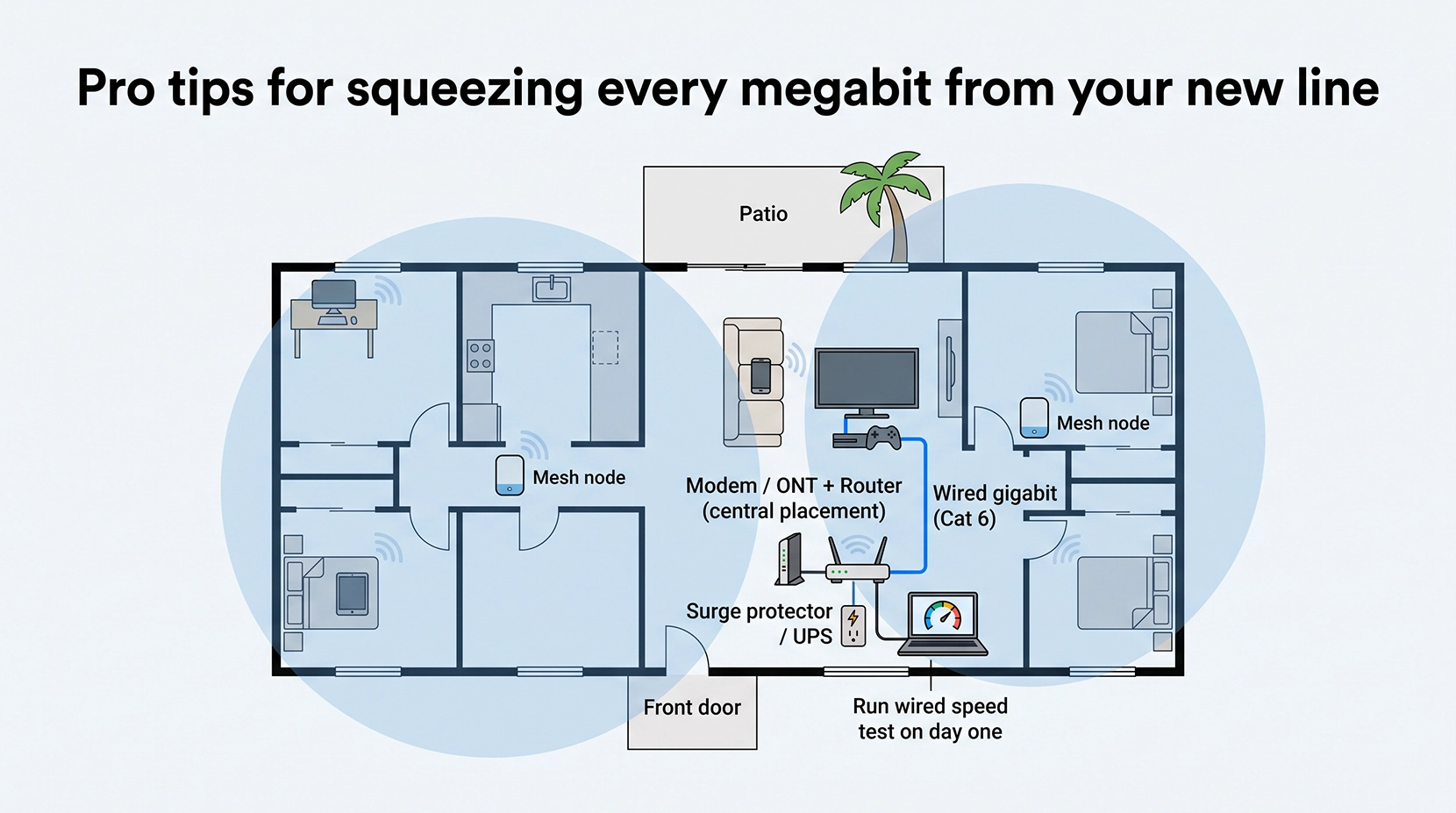
St. Pete homes are charming but not always Wi-Fi friendly. Block construction, lath-and-plaster walls, and long ranch layouts can choke signals. Place your router in the most central, open spot you can, usually not the linen closet where the cable tech left the jack.
Mesh kits shine in wide, single-story floor plans. Two or three nodes spaced along the hallway keep 5 GHz speeds strong from the front porch to the pool deck. If your provider includes free extenders, take them. If not, invest in a Wi-Fi 6 or 6E mesh system rated for at least 500 Mbps per node.
Thunderstorms roll through year-round, and lightning targets low power lines. Plug the modem, ONT, and router into a quality surge protector, or better, a small UPS. Ten minutes of battery lets you save work and stay on a video call during quick flickers.
Hard-wire whenever possible. A simple Cat 6 run to your gaming PC or smart-TV console delivers the full gigabit while freeing wireless airtime for phones and tablets.
Run a speed test on day one with a laptop cabled directly to the gateway and grab a screenshot. If performance slips later, that record helps during support calls. Most problems resolve with a firmware update or a fresh coax connector, but clear evidence speeds the chat along.
The bottom line
St. Petersburg is now a gigabit playground. Whether you lean toward WOW!’s price-lock promise, Frontier’s all-fiber reach, Spectrum’s near-universal coverage, AT&T’s premium speed, or IQ Fiber’s startup simplicity, you’re no longer stuck with a single option.
Run your address through each provider’s checker, compare the out-the-door price for the speed you need, and set a calendar reminder before any promo ends. With no contracts in the way, you hold the power. Switch when a better deal or faster line reaches your street, and let competition keep your connection fast and your bill low.
Happy surfing, St. Pete. See you on the next speed test.