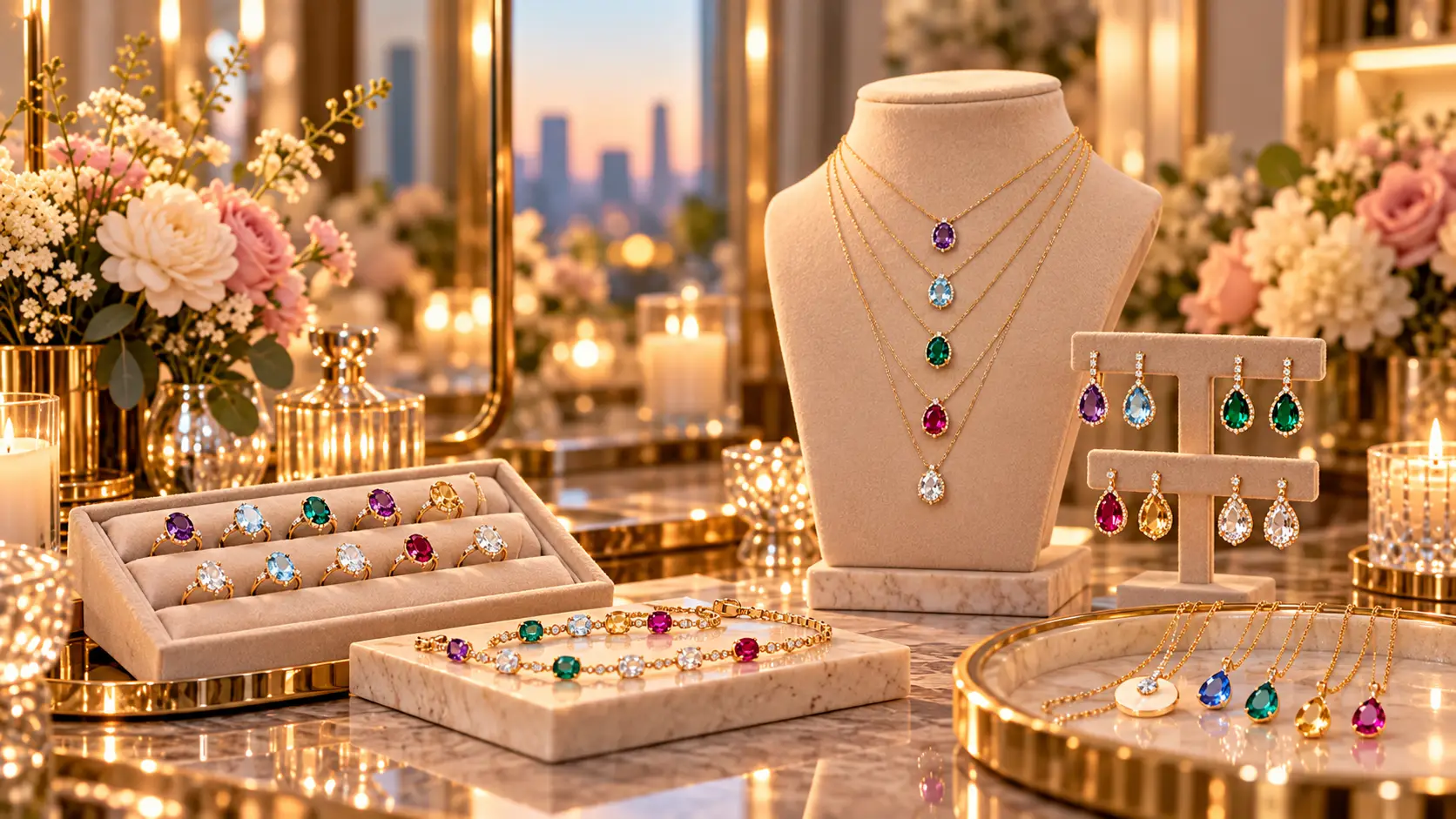
Walk through any jewelry feed, and you’ll see it: delicate necklaces with a single garnet, stacking rings set with tiny emeralds, ear climbers in opal and peridot. Birthstone jewelry — once the kind of thing a grandmother gave you at sixteen — has become one of the most popular ways to buy jewelry that feels personal rather than generic. Part of it is style. Part of it is something deeper: a growing preference for pieces that carry a story instead of just a logo.
If you’ve ever wondered why your birthstone is your birthstone, what it’s “supposed” to mean, or how to wear it without looking like a costume, here’s a practical, slightly nerdy guide.
Why meaningful jewelry is winning
There’s a broader shift behind the birthstone revival. Many shoppers have grown tired of fast, interchangeable accessories and are moving toward fewer, more considered pieces — ones they can explain when someone says, “I love that, where’s it from?” A birthstone gives you an instant answer. “It’s an emerald — my birth month — and my mom had it reset into this band.” That’s a conversation, not just a compliment.
Personalization is part of it, too. Initials, birth flowers, tiny charms, engraved coordinates — jewelry that says something specific about the wearer is having a long moment. Birthstones sit comfortably in that family, but they have one advantage the others don’t: they’re ancient. They come with centuries of folklore attached, which makes them feel less like a trend and more like an inheritance.
They’re also wonderfully gift-friendly. A birthstone solves the “I want to give something meaningful, but I don’t know her taste” problem, since the stone is already chosen by the calendar. That’s a big reason birthstone pieces show up in so many Mother’s Day, graduation, and new-baby gifts: the meaning is built in.
A short history of why you have a birthstone at all
The idea of assigning gemstones to people is old. A frequently cited starting point is the biblical description of the high priest’s breastplate, which was set with twelve stones — and early writers later linked those twelve stones to the months of the year and to the signs of the zodiac. Over the following centuries, different traditions paired stones with months in different ways, and for a long time there was no single agreed-upon list.
The version most of us grew up with is surprisingly modern. In 1912, a U.S. jewelers’ association standardized an official list of birthstones for each month, partly to make life easier for retailers and customers. Since then, the list has been updated a few times — tanzanite was added for December and spinel for August, among other changes — and many months now have more than one accepted stone.
That’s good news if you don’t love your “official” stone. There’s usually an alternative, and nobody is checking.
What each month’s stone is traditionally said to mean
Folklore varies from source to source, and none of this is science — it’s cultural symbolism that has accumulated over centuries. Think of it as the story a stone tells, not a promise. Here are the commonly cited associations:
- January — Garnet: protection, commitment, and steady energy; a deep red stone associated with devotion.
- February — Amethyst: clarity, calm, and good judgment; traditionally linked with keeping a clear head.
- March — Aquamarine (and bloodstone): courage and tranquility; the sea-colored stone was historically carried by sailors for safe passage.
- April — Diamond: endurance, clarity, and everlasting love — which is part of why it became the engagement stone.
- May — Emerald: renewal, growth, and hope; a stone long linked with spring and rebirth.
- June — Pearl (also moonstone and alexandrite): purity, integrity, and intuition; pearls in particular are tied to the moon and the sea.
- July — Ruby: passion, vitality, and courage; the “king of gems” in several traditions.
- August — Peridot (also spinel and sardonyx): warmth, abundance, and joy; a bright green stone once said to ward off bad dreams.
- September — Sapphire: wisdom, loyalty, and truth; long worn by royalty and associated with a clear conscience.
- October — Opal (also tourmaline): creativity, imagination, and emotional depth; its shifting colors make it a symbol of transformation.
- November — Topaz (also citrine): warmth, generosity, and confidence; golden stones associated with sunlight and optimism.
- December — Turquoise (also tanzanite and zircon): protection, friendship, and good fortune; a stone people have worn as a talisman in many cultures.
If a particular meaning doesn’t resonate with you, that’s fine. A stone you love looking at will always beat a stone with a “perfect” meaning that you never wear.
How to choose a piece that actually feels like you
Meaning is lovely, but you’ll only wear jewelry that works with your life. A few practical guidelines:
Start with how you’ll wear it. If you type all day or have a small child who grabs everything, an exposed, high-profile stone ring may be more heartbreak than joy. Necklaces, earrings, and bracelets tend to be safer for everyday wear, while a statement ring can be reserved for occasions.
Mind the hardness. Gemstones vary a lot in durability. Diamonds, sapphires, and rubies are very hard and hold up to daily wear. Softer stones — opal, pearl, turquoise, and emerald, which is hard but often fractured inside — need more gentle treatment and a protective setting. That doesn’t mean you can’t wear them; it just means a bezel setting and a “not at the gym” rule go a long way.
Think about your metal. Warm stones like garnet, citrine, and topaz often glow against yellow gold, while cooler stones like aquamarine, amethyst, and sapphire can look crisp in silver or white gold. Mixed metals are also very much in, so there’s no real rule — but if you’re unsure, hold the stone against your skin in different metals and see what your eye likes.
Consider lab-grown and alternatives. Many birthstones are available as lab-created or simulated stones at lower prices, with the same appearance. If budget or sourcing matters to you, that’s a perfectly reasonable choice — and often the best way to wear a showy stone like a ruby or emerald without a showy price tag.
Look beyond your own month. There’s no rule that you can only wear your own stone. Many women wear their partner’s, their child’s, or their mother’s stone, and layered necklaces with several birthstones — “my people” — are among the most popular ways to wear this kind of jewelry. A stack that includes everyone you love is a nice reason to buy something.
Choose the “secondary” stone. If your official stone doesn’t suit your style, use the alternative. A person born in October who finds opal too delicate may love the pink, green, or watermelon colors of tourmaline.
Birthstones, personality, and the fun side of the trend
The reason birthstone jewelry endures isn’t really gemology. It’s that people enjoy connecting objects to themselves. A stone connects to a birthday, a birthday connects to a family, and a family connects to a story. Add a little astrology — many people pair their birth month with their zodiac sign’s traditional stones — and you’ve got a pleasant, low-stakes ritual of choosing something that feels like “you.”
If you enjoy that kind of exploration, a few playful online tools can add to the fun. Wedding Serenity Club’s free Bride’s Birthstone Story tool, for instance, lays out a primary, secondary, and “bridal” stone for your birth month and suggests where each might be worn — a handy way to see your options in one place, even if you’re not planning a wedding. And if you’re curious about how stones connect to the zodiac, the free Gemstone Soulmate Match tool pairs birthstone meanings with a stone suggestion by sign. They’re entertainment rather than gemology, but they make a nice jumping-off point before you go shopping.
Caring for birthstone jewelry so it lasts
A few simple habits keep stones looking the way you bought them:
- Put jewelry on last and take it off first. Perfume, hairspray, and lotion can dull stones and pearls; apply them before you put your pieces on.
- Clean gently. Warm water, a drop of mild soap, and a soft brush work for many stones. Skip ultrasonic cleaners and harsh chemicals for porous or fractured stones like opals, pearls, turquoise, and emeralds.
- Store pieces separately. Harder stones can scratch softer ones, so keep each piece in its own pouch or compartment.
- Check settings periodically. A loose prong is a lost stone waiting to happen. A jeweler can tighten settings in minutes.
Frequently asked questions
What is the most popular way to wear birthstone jewelry?
Necklaces and stacking rings are two of the most popular formats, along with earrings. Layered necklaces featuring birthstones for several family members are especially popular as gifts.
Do I have to wear my own birthstone?
Not at all. Many people wear a partner’s, child’s, or parent’s stone, or simply a stone they like the look of. The tradition is a starting point, not a rule.
Are birthstones the same around the world?
Not exactly. The standardized list most people in the U.S. know was set in the early twentieth century, and other countries and traditions have their own variations. Some months have several accepted stones for that reason.
Which birthstones are the most durable for everyday wear?
Diamond, sapphire, and ruby rank among the hardest and best suited to daily wear. Softer stones like opal, pearl, and turquoise are lovely but benefit from protective settings and more careful handling.
Is there a “right” way to choose a birthstone gift?
The best birthstone gifts match the recipient’s real daily style — delicate if she’s minimalist, bold if she loves a statement — and use the stone as the meaningful detail. When in doubt, a necklace is the safest bet.
The takeaway
Birthstone jewelry endures because it combines two things people want from the things they wear: beauty and meaning. You don’t need to believe in any particular symbolism to enjoy it — the pleasure is in owning something with a story. If you’d like to explore more playful, tradition-inspired ideas, Wedding Serenity Club’s Magic Tools hub has a free collection to browse.