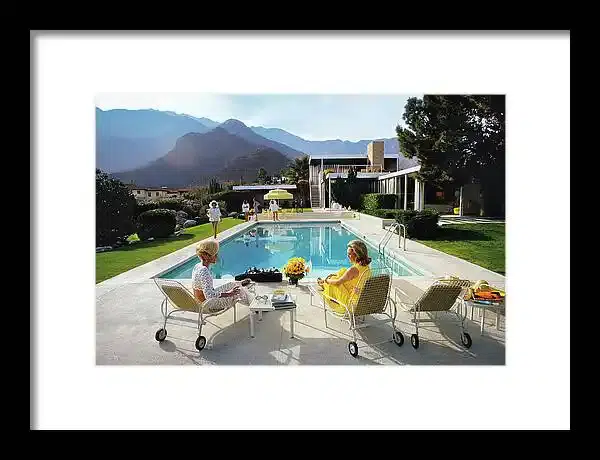
Few photographers have captured the essence of postwar leisure and privilege quite like Slim Aarons. His images—sun-drenched poolsides, elegant ski chalets, Mediterranean villas—document a world where style was effortless, and luxury was a way of life. Today, his work has found new relevance in contemporary interiors, where framed prints serve as both art and cultural artifact, bridging the gap between mid-century sophistication and modern design sensibilities.
The appeal of Aaron’s photography extends beyond mere nostalgia. His compositions offer something increasingly rare in our digital age: a sense of curated beauty and unhurried elegance. For homeowners and designers seeking to elevate living spaces, these prints provide an instant infusion of refinement—a visual shorthand for taste that transcends passing trends.
From War Zones to Poolside: Aarons’ Unlikely Journey
Aaron’s path to becoming the chronicler of the leisure class began in the most unlikely of places. As a combat photographer during World War II, he documented the brutal realities of warfare, an experience that profoundly shaped his artistic vision. After the war, he made a deliberate pivot, famously declaring his intention to photograph “attractive people doing attractive things in attractive places.”
This wasn’t escapism—it was a conscious artistic choice. Having witnessed the worst of humanity, Aarons dedicated his lens to capturing its most graceful moments. His work for publications like Holiday and Town & Country established him as the definitive visual chronicler of what he called “the good life.”
The Aarons Aesthetic: More Than Pretty Pictures
What distinguishes Aaron’s work from simple society photography is his compositional rigor and narrative instinct. His images aren’t candid snapshots but carefully constructed tableaux that reveal the codes and rituals of a particular social stratum. The poolside gatherings, the ski lodge après-ski scenes, the yacht club luncheons—each frame tells a story about aspiration, belonging, and the performance of leisure.
His most iconic images share common elements: vibrant color palettes dominated by azure blues and sun-bleached whites, geometric compositions that balance architecture with human figures, and an almost anthropological attention to the details of wealthy leisure.
This combination of aesthetic beauty and cultural commentary is what makes his prints so compelling in contemporary interiors. They’re conversation pieces that reward closer inspection, revealing layers of meaning beneath their glossy surfaces.
Selecting the Right Print for Your Space
Choosing a Slim Aarons print requires consideration beyond simple visual appeal. The right piece should resonate with your space’s existing character while introducing an element of surprise or contrast. Here’s what to evaluate:
- Print Quality and Provenance: Archival-quality prints on museum-grade paper ensure longevity and color fidelity. Look for authorized reproductions that maintain the vibrancy of Aarons’ original Kodachrome film.
- Scale and Proportion: Large-format prints (40×60 inches or larger) work as commanding focal points in spacious living rooms, while smaller prints (16×20 to 24×36 inches) integrate well into gallery walls or intimate spaces.
- Subject Matter and Mood: Consider whether you’re drawn to the social energy of poolside gatherings, the serene beauty of landscape compositions, or the architectural elegance of villa interiors. Each conveys a different emotional register.
- Framing Choices: Simple, clean frames in natural wood or matte black allow the image to dominate. Ornate frames can compete with Aaron’s already rich compositions.
For collectors seeking authenticated prints, galleries specializing in photography and vintage prints typically offer the most reliable sourcing. Collectors can select Slim Aarons prints from Leisure Piece, Getty Images Gallery, or Classic Stills for authenticated photography artwork.
Integrating Vintage Prints in Contemporary Spaces
The challenge and opportunity of incorporating mid-century photography into modern interiors lies in creating dialogue rather than pastiche. The goal isn’t to recreate a 1960s aesthetic but to let historical elegance inform contemporary design.
Successful integration strategies include:
- Contrast Through Minimalism: Pair the visual richness of Aaron’s colorful compositions with spare, minimalist furnishings. The juxtaposition allows the print to breathe while grounding the space.
- Tonal Harmony: Extract a color palette from the print—perhaps the turquoise of a pool or the terracotta of a villa wall—and echo it subtly in textiles or accessories.
- Architectural Alignment: Position prints to complement your space’s architectural features. A horizontal poolside scene works beautifully above a low-slung sofa; a vertical villa composition suits narrow wall spaces.
- Layered Narratives: Create gallery walls that place Aaron’s work in conversation with contemporary photography or abstract art, building visual complexity through juxtaposition.
Interior designers increasingly recognize that successful spaces tell stories through carefully chosen objects.
The Investment Case for Quality Prints
While Slim Aarons’ prints are available at various price points, investing in high-quality reproductions or vintage prints offers advantages beyond aesthetics. Properly produced archival prints maintain their color and clarity for decades, making them genuine heirlooms rather than disposable decor.
Consider these factors when evaluating quality:
- Printing Process: Giclée printing on archival paper offers superior color accuracy and longevity compared to standard digital prints.
- Limited Editions: Numbered, limited-edition prints typically hold value better than open-edition reproductions, though both serve different collecting goals.
- Authentication: Prints authorized by the Aarons estate or reputable galleries come with documentation that verifies their legitimacy.
- Framing Materials: Museum-quality framing with UV-protective glass and acid-free matting prevents deterioration and fading.
The market for vintage photography has grown substantially over the past two decades, with Aarons’ work particularly sought after. While not every print will appreciate significantly, quality pieces from recognized sources maintain their value and provide enduring visual pleasure—a combination that justifies the initial investment. To learn more, check out this detailed article on art as an investment.
Beyond Decoration: Cultural Resonance
What ultimately makes Slim Aarons’ photography so compelling in contemporary homes isn’t just its beauty but its cultural resonance. These images capture a specific moment in American and European social history—the postwar decades when jet travel, leisure culture, and conspicuous consumption reached new heights. They document a world that was simultaneously aspirational and exclusive, glamorous and deeply stratified.
Today’s viewers bring different perspectives to these images. Some see pure aesthetic pleasure; others recognize the complex social dynamics at play. This interpretive richness makes Aaron’s work endlessly fascinating. A print that initially attracts through its visual appeal reveals new layers over time—the architectural details, the fashion choices, the subtle hierarchies of social positioning.
In an era of digital imagery and constant visual stimulation, there’s something grounding about a physical print that rewards sustained attention. Slim Aarons’ photographs offer that rare quality: images that become more interesting the longer you live with them, revealing the depth beneath their glossy surfaces.