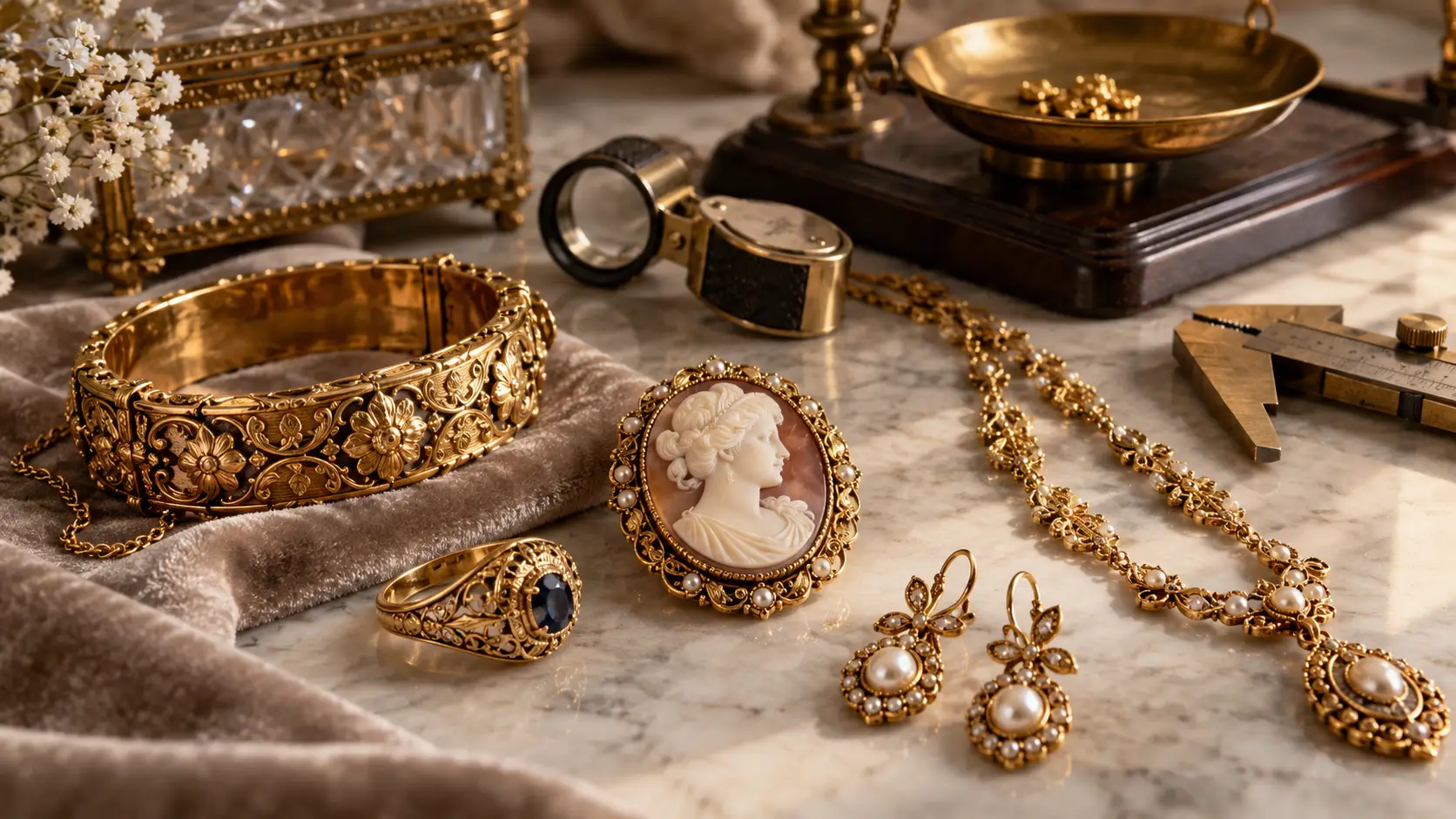
A vintage gold bracelet has a way of making its case before anyone mentions a number. The links move like water, the color has softened over the decades, and the clasp closes with a small, satisfying click. Then the seller names a price, and the practical part of the mind wants something firmer to hold on to.
Weight is usually the first thing people look at. It is a sensible instinct, and it can be genuinely useful, provided you know which question it answers. Weight speaks to the metal. It says very little about the rest of what makes a piece worth wanting.
What the scale is really measuring
A number on a scale only means something once you know what sits on it. Gross weight covers the whole object, which may include diamonds, colored stones, enamel, a steel pin stem, the spring inside a clasp, or other parts that are not gold at all. Before any figure carries weight of its own, you want the gold by itself, along with a purity that someone has confirmed rather than assumed.
Purity is expressed in karats. Pure gold is 24K. Mixing it with other metals can change its strength and color. An 18K piece is three-quarters gold by weight, which is why it may carry a fineness mark of 750, meaning 750 parts gold in every thousand. Most 14K pieces are marked 585. Those stamps are a helpful place to start, but they are not proof. A mark can be worn, misleading, or flatly wrong, and a heavy piece is not automatically a genuine one. Neither weight nor a hallmark settles whether something is authentic. If the seller’s evidence is thin, ask a qualified jeweler to examine the piece before agreeing to buy.
A hypothetical, worked through
Picture a bracelet with a confirmed 18K metal weight of 10 grams. That figure excludes gemstones and any parts made from other materials. Because 18K is 75 percent gold, that metal contains 7.5 grams of pure gold. Now borrow an invented rate of $100 per gram of pure gold. It exists only to keep the math tidy and has nothing to do with the market today. At that rate, the pure gold content comes to $750.
There is a second route to the same answer. A rate quoted per gram of 18K, rather than per gram of pure gold, already has the purity built in. In this example, that rate would be $75, and 10 grams at $75 also comes to $750. The trap is applying the 75 percent twice by multiplying the pure gold figure by an 18K rate. Do that, and you land at $562.50, which understates the metal by a quarter.
For a real benchmark, a published gold price per gram lets you repeat the same arithmetic with current figures. Before multiplying, check whether the rate in front of you refers to pure gold or to one karat such as 18K.
What a melt figure leaves out
All of that math produces a reference point for the metal and nothing more. It does not price the design, the handwork, the condition, or the maker. A melt benchmark cannot authenticate a piece or promise what it would bring on resale. Nor can it tell you what premium above the gold is fair.
That premium is where vintage jewelry earns its place. A bracelet with tight links, an original clasp that still closes securely, and engraving that has kept its edges is a different object from one with stretched links and a repaired catch, even when both weigh exactly the same. Design counts as well. A period silhouette you love, or the hand of a maker whose work you admire, carries meaning a scale was never built to register.
With the metal figure in hand, set it
Read the asking price
beside the asking price and look at the gap. A gap is not a warning sign by itself. It is just the share of the price that something other than gold has to justify, and a good seller should be glad to talk about it. It is fair to ask what the quoted weight includes and how the purity was confirmed, and to hear plainly about any repairs.
A piece can be modest in grams and still be the one you reach for every morning. Another can be heavy and quickly forgotten. Weight tells you what the gold is worth as gold. Whether everything else justifies the difference is a call for your own eye, ideally helped along by a seller willing to answer straight.