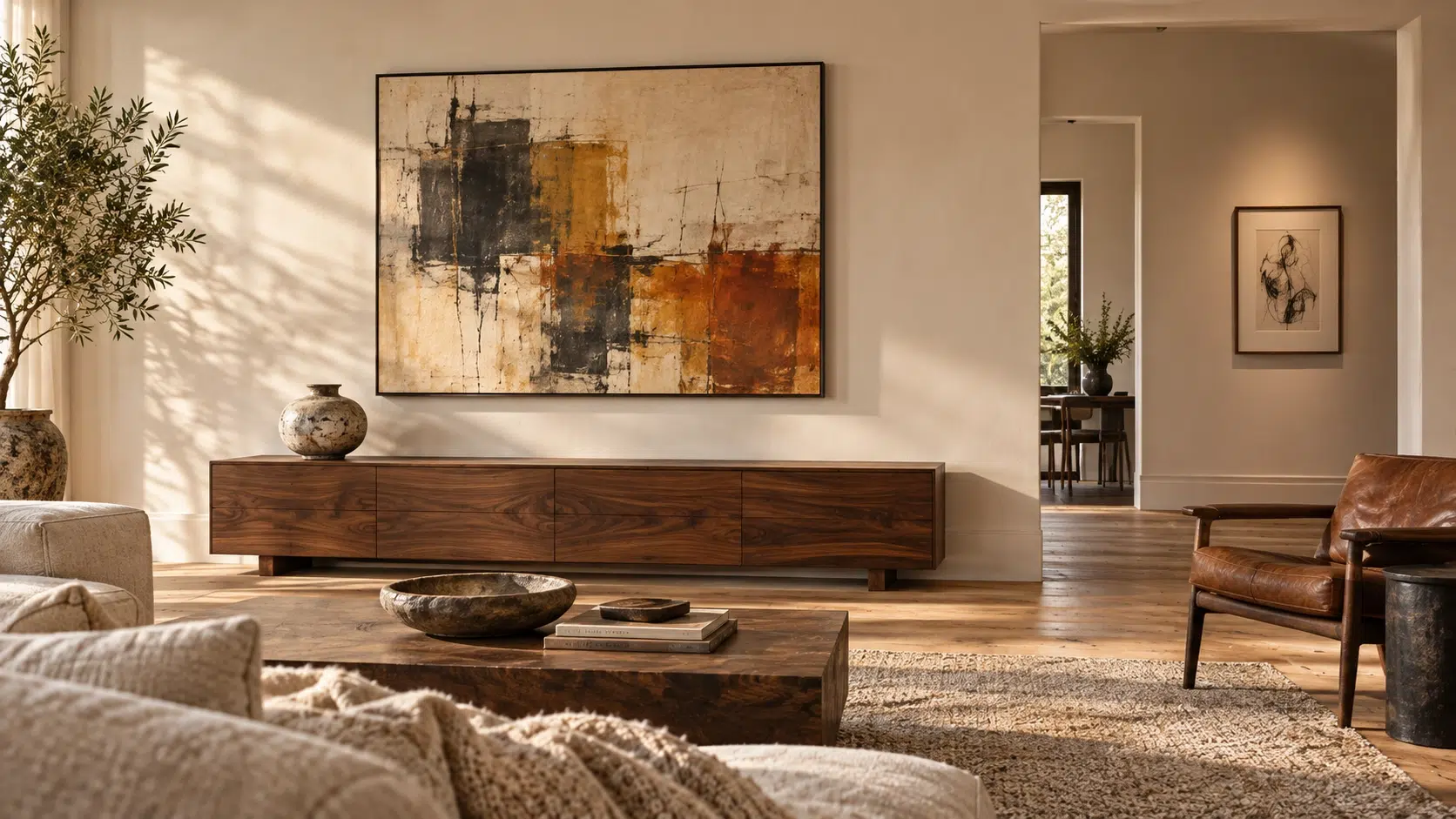
There is a quiet shift happening in well-appointed homes. The traditional approach of hanging a painting once and leaving it in place for decades is giving way to something more fluid. Homeowners who invest in art increasingly treat their walls as living spaces, where pieces rotate with the seasons; new acquisitions find a spotlight, and familiar works are rediscovered in fresh light.
The Problem with Permanent Placement
A fixed hanging arrangement carries an unspoken cost. Each time a frame moves, the wall pays for it. Nail holes multiply, plaster cracks, and patch-and-paint cycles become routine. In homes with hand-applied finishes, Venetian plaster, or specialty wallcoverings, repairs can be expensive and rarely invisible.
There is also a psychological cost. When moving a painting feels like a renovation project, people simply stop doing it. A collection that once sparked conversation slowly becomes part of the furniture, noticed by guests but overlooked by the people who live with it every day.
Rotation as a Design Philosophy
Museums have long understood that rotation keeps a collection vital. Curators move works between galleries, store fragile pieces to protect them from prolonged light exposure, and reinterpret familiar art through new groupings. Private collectors are borrowing this mindset.
Rotating artwork offers practical benefits beyond novelty. Works on paper and photographs are sensitive to light, and giving them periods of rest can help preserve them. Seasonal changes allow a home to feel warmer in winter with rich, deep-toned canvases and lighter in summer with airy abstracts or coastal photography. Rotation also gives a growing collection room to breathe, since not every acquisition needs a permanent wall.
How Track Systems Changed the Equation
The tool making this lifestyle possible is the gallery-style rail. A slim track mounts near the ceiling line, and artwork hangs from adjustable cables or cords fitted with hooks. Once the rail is installed, frames can be added, removed, raised, or shifted sideways without putting
another hole in the wall. Modern profiles are discreet enough to blend into crown molding or disappear against a painted ceiling edge, which matters in interiors where clean
architectural lines are part of the design intent. An AS Hanging click rail track is one example of this snap-in approach, designed so the rail clicks into place over its mounting hardware for a clean finish.
For homeowners, the appeal is controlled. Adjusting a frame by a few inches to center it over a new sofa becomes a two-minute task rather than an afternoon with a level, a tape measure, and spackle.
Planning a Flexible Display
A few considerations help a rail system serve a collection well. Placement matters, since a track running the full length of a wall offers the most freedom for future arrangements. Weight capacity deserves attention, as heavier framed pieces may need additional cables or hooks to distribute the load. Cable material is also a factor: clear nylon nearly vanishes against the wall, while stainless steel delivers strength and a more architectural look.
Lighting should be planned alongside the rail. Adjustable track lighting or picture lights work best when they can be repositioned as easily as the art itself.
A Home That Evolves
The most memorable interiors rarely feel finished. They reflect the people who live in them, changing as tastes mature and collections grow. Flexible display systems support that evolution, turning the act of rearranging art from a chore into a ritual. When walls are free to change, a collection stays meaningful, and the home remains a place worth looking at closely.