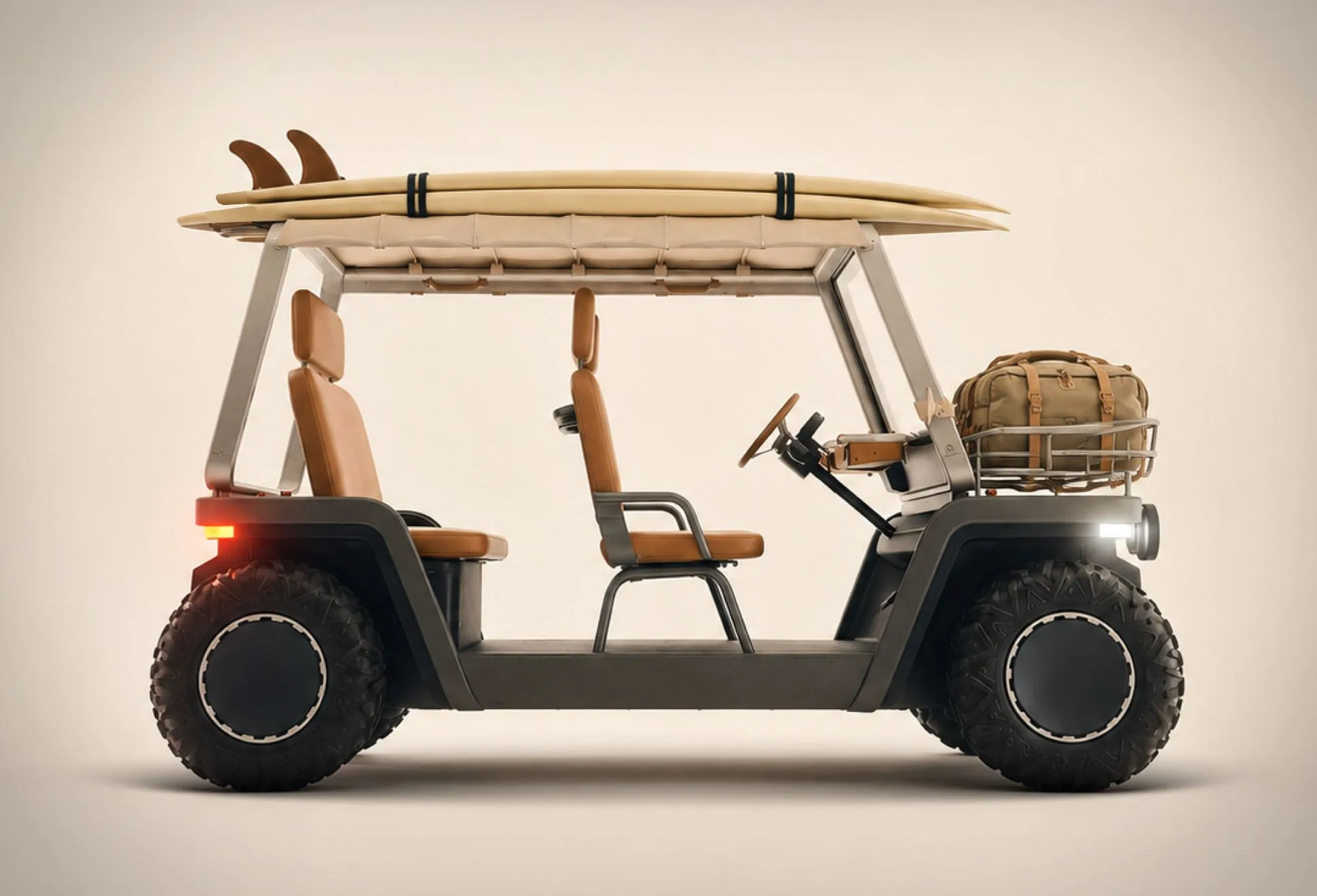
The Amble One looks as though it has rolled out of a lunar expedition and stopped for lunch at a Mediterranean beach club. Its body is skeletal, its wheels oversized, and its open-air cabin almost defiantly free of the screens, doors, and visual weight that have come to define the modern automobile. Yet this is not a concept vehicle destined to remain beneath exhibition lights. It is a compact, street-legal electric machine designed for the places where a conventional car often feels excessive: private estates, coastal communities, island resorts, vineyard roads, and sun-bleached towns where the journey is measured in minutes rather than miles.
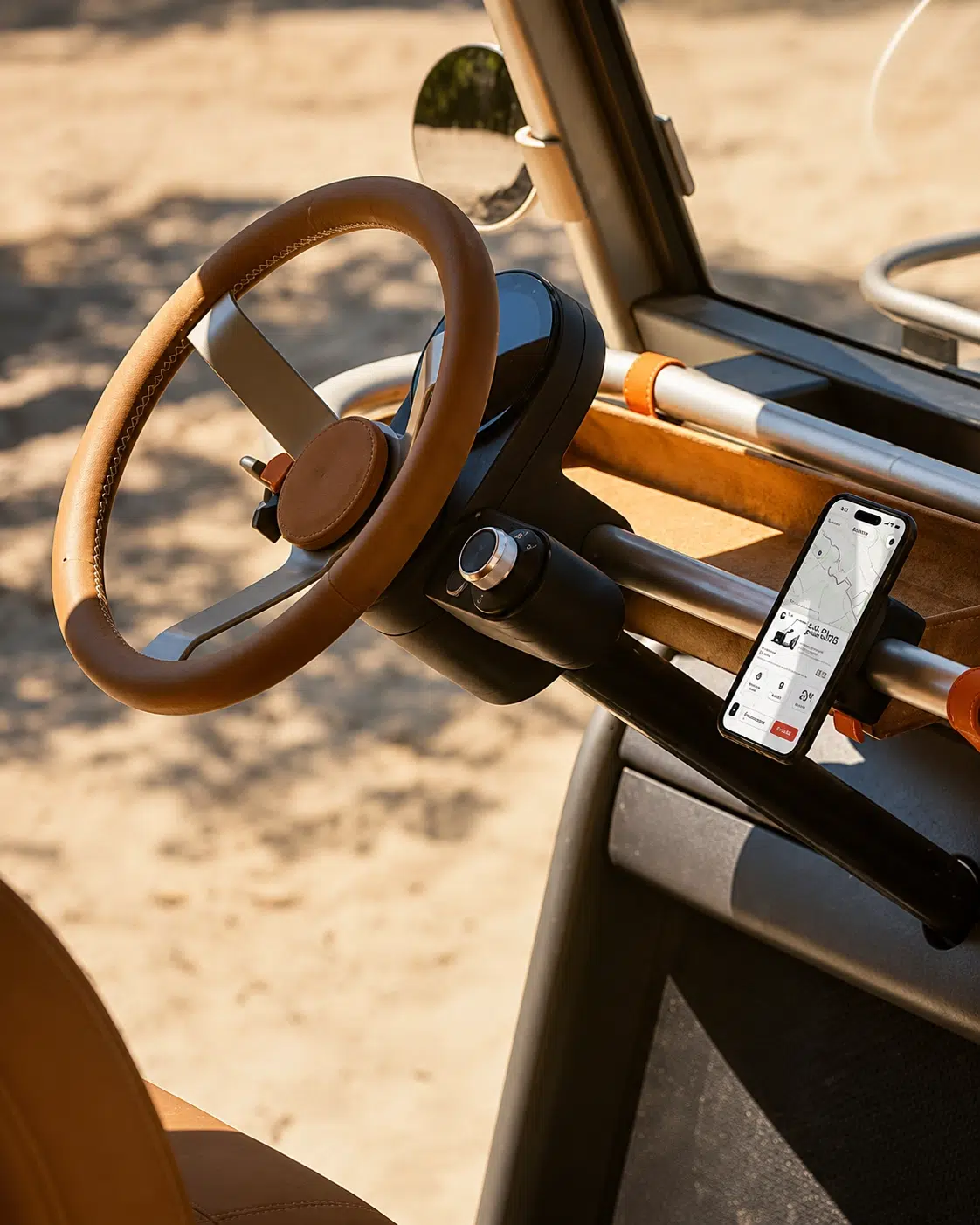
Amble describes its first vehicle as something beyond the familiar categories of car and golf cart, and that ambiguity is part of its appeal. The One is intended to make short-distance travel feel less insulated and more connected to its setting. There are no doors sealing passengers away from the landscape, and no oversized digital dashboard competing for attention. Instead, the vehicle presents the road, weather, and surrounding scenery as part of the experience.
Its resemblance to a moon buggy is not merely the product of clever marketing. The tall, narrow structure, exposed aluminum frame, substantial 28-inch wheels, and minimal bodywork give the One an unmistakably exploratory stance. It appears engineered to move lightly across a landscape rather than dominate it, with a silhouette that is simultaneously utilitarian and unusually charismatic.
That visual confidence reflects the backgrounds of the people behind it. Amble’s founding team draws on experience in automotive design, consumer technology, electric bicycles, and hospitality, bringing together disciplines that rarely meet within a single vehicle. The result is less concerned with replicating a reduced automobile than with reconsidering what personal mobility might look like when speed, isolation, and excess are no longer the primary objectives.
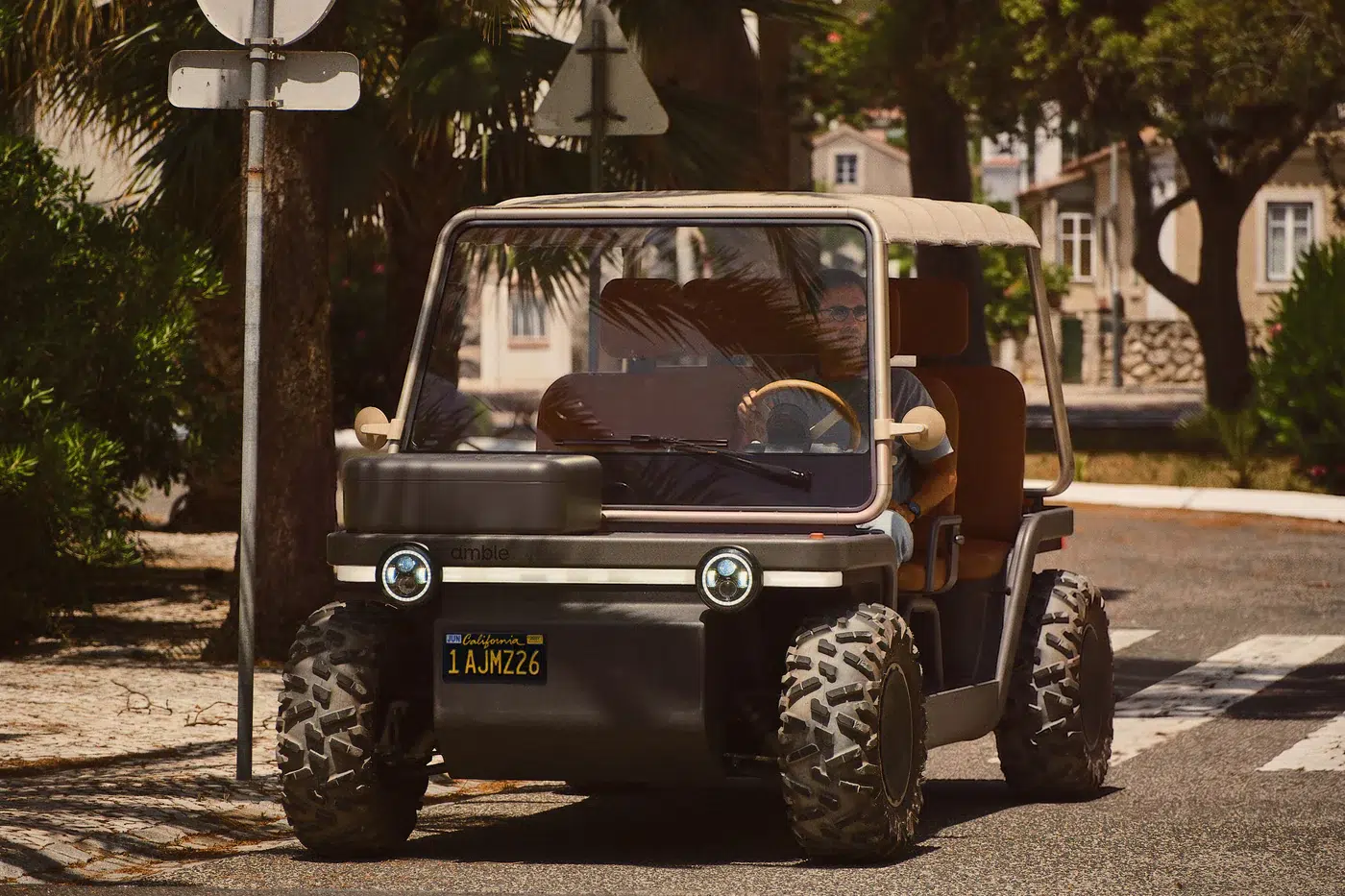
There is a certain Cupertino-like restraint to the One, but its material language is warmer and more tactile than the usual technology product. The aluminum frame and recycled polymer body are paired with organic cork, marine-grade canvas, outdoor fabrics, and a waterproof soft top. These are materials chosen not only for durability in sun, wind, and rain, but for the way they feel and weather over time. Rather than disguising the vehicle’s exposure to the elements, Amble has made that exposure part of its character.
Inside, the cabin accommodates four people in a simple, open arrangement. Supportive seats with headrests, physical controls, and an intuitive cockpit preserve a degree of comfort without allowing complexity to overwhelm the experience. This is not an electric lounge filled with touchscreens and ambient-light settings. Its luxury lies in clarity, ease, and the quality of the materials passengers actually touch.
The modular frame adds a practical dimension to the design. Baskets, cargo boxes, rear straps, weather protection, and back-of-seat storage can be attached through a hand-operated system that requires no tools. The vehicle can therefore shift from carrying guests and picnic supplies to transporting luggage, groceries, or equipment without losing the disciplined simplicity of its form.
Beneath the playful exterior is a more serious piece of engineering than the golf-cart comparison might suggest. The Amble One uses a 12-kWh lithium-ion battery and a 15-kW rear-mounted electric motor, with independent suspension and rear-wheel drive. It has a claimed road speed of up to 65 km/h, or approximately 40 mph, and a range exceeding 100 kilometers, or 60 miles, on a charge. A full recharge is expected to take around five and a half hours from a standard 220- or 230-volt household socket.
At under 450 kilograms, or roughly 990 pounds, the One is dramatically lighter than a conventional electric vehicle. Its compact footprint measures approximately 126 inches long and 58 inches wide, allowing it to navigate resort paths, narrow lanes, and private roads that would feel constrained in a full-size SUV. Amble also claims a 25 percent grade capability at 15 km/h, along with acceleration from zero to 30 km/h in under 2.5 seconds—figures that suggest a machine with considerably more composure and responsiveness than its leisurely name implies.
Its most natural habitat may be luxury hospitality. Across sprawling resorts, guest movement is often treated as a logistical necessity rather than part of the experience. Conventional golf carts can feel anonymous and underwhelming beside carefully considered architecture, interiors, and landscaping. Amble sees an opportunity to turn that overlooked journey from villa to beach, lobby to spa, or suite to restaurant into an extension of the property’s identity.
For hotel and resort operators, the One will be offered in passenger, pickup, and cargo configurations, with larger five- and six-seat layouts available for fleet clients. A connected management platform is planned to monitor vehicle location, readiness, diagnostics, and maintenance, while remote servicing and property-specific branding are intended to support commercial fleets in coastal, desert, and mountain settings.
Yet the One may prove equally compelling as a privately owned vehicle. In gated communities, island enclaves, equestrian estates, and compact coastal towns, many daily journeys do not require two tons of metal, glass, software, and battery capacity. The Amble offers an alternative that feels less like a compromise than a deliberate change in pace. It is transportation stripped to the essentials, but those essentials have been treated with the care normally reserved for a well-designed piece of furniture or a finely detailed boat.
Its open architecture also restores something that modern cars increasingly remove: a sense of place. In the One, the smell of salt air, the shift in temperature beneath a grove of trees, or the sound of gravel under the tires is not filtered through laminated glass and climate control. The vehicle does not attempt to create a private world separate from its surroundings. It is designed to make the surroundings more vivid.
There are practical limitations. The model shown remains a pre-production vehicle, and final details may change as testing and certification continue. Amble expects the One to be categorized as an L7e vehicle in Europe and as a low-speed vehicle in the United States, with licensing and road-use rules varying by jurisdiction. Consumer reservations are open for 2028 deliveries, with pricing beginning at €20,000 plus VAT in Europe and approximately $25,000 for fleet customers in the United States, depending on configuration and delivery.
That places it well above the price of an ordinary golf cart, but the comparison misses the point. The Amble One is attempting to define a more considered category of small electric vehicle, one in which design, durability, and emotional appeal matter as much as utility.
The automobile has spent more than a century becoming faster, heavier, quieter, and more insulated. Amble proposes a different direction: lighter, slower, simpler, and more exposed to the world outside. The One may resemble a machine built for the moon, but its real ambition is decidedly terrestrial: to make the roads between home, beach, hotel, and village feel worth noticing again.