In the rarefied upper reaches of luxury, objects no longer exist to serve function.
They exist to embody obsession.
At this altitude, a watch does not announce the hour. It conceals it.
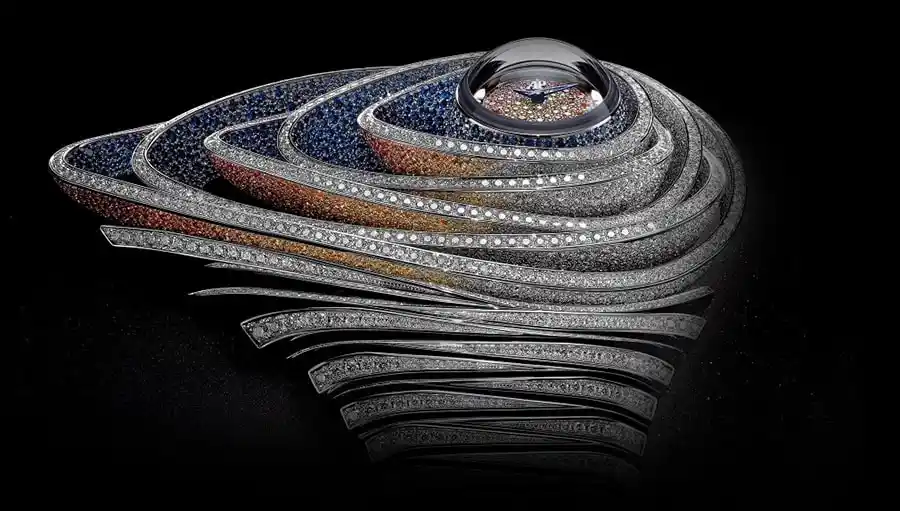
The Sapphire Orbe by Audemars Piguet is not, in any conventional sense, a timepiece. It is a sculptural jewel composed of more than 12,000 sapphires and diamonds, arranged in fluid arcs of deep blues, pale violets, and crystalline whites. Somewhere within this gem-set constellation lies a hidden dial, discreetly embedded like a secret only its wearer is meant to know.
Priced north of $1 million, the Sapphire Orbe occupies a category of luxury so rare it barely registers as commerce. It belongs instead to the realm of collectible art—where horology dissolves into haute joaillerie, and time becomes a private, almost philosophical experience.
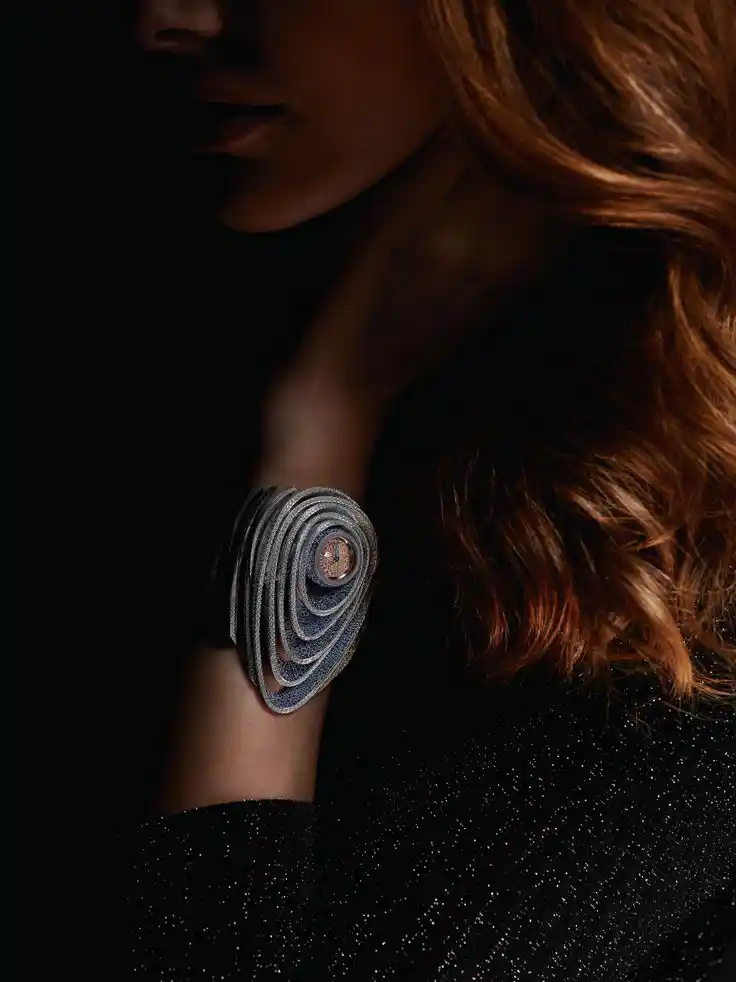
At first glance, it reads as an extravagant high-jewelry bracelet. Its surface is meticulously paved with sapphires that shift tonally from midnight to glacier, punctuated by diamonds that catch light like frozen sparks.
There are no hands. No visible dial. No overt complication.
Only upon closer inspection does the piece reveal its quiet provocation: a discreetly integrated time display hidden beneath the gemstone surface, accessible through a subtle mechanical gesture.
This is horology as whisper, not proclamation. It belongs to the same rarefied lineage as Jacob & Co.’s sapphire-crystal minute repeater, another extreme experiment in turning mechanical watchmaking into sculptural spectacle.
Each sapphire was individually selected not merely for clarity and cut, but for precise tonal placement within a carefully calibrated color gradient. The stones were then hand-set into white gold using traditional haute joaillerie techniques that demand microscopic tolerances and thousands of hours of labor.
Nothing about the piece is automated. Nothing about it is efficient.
The bracelet’s architecture had to support both thousands of gemstones and the hidden mechanical movement embedded within. The tolerances between gem setting and horological engineering were so fine that any error would compromise either aesthetics or function.
The price of the Sapphire Orbe is not branding. It is the arithmetic of impossibility.
Start with the raw materials: thousands of sapphires in matched chromatic gradations, flawless diamonds, and precious-metal architecture. Add the labor of master gem-setters, micro-engineers, and horological specialists. Then factor in the reality that this object was never meant to be scalable or repeated.
It exists because Audemars Piguet wanted to prove that it could.
Perhaps the most radical aspect of the Sapphire Orbe is not its price, nor its gem count, nor even its hidden dial.
It is its philosophy. This is not a watch for being seen. It is a watch for being known.
In a cultural moment defined by quiet luxury, stealth wealth, and post-logo affluence, the Sapphire Orbe replaces spectacle with intimacy. It transforms timekeeping into a private ritual.
To wear it is to opt out of performance. To choose secrecy over status. To carry a million-dollar complication that no one else may ever notice.
There are watches that tell time. There are jewels that signify wealth.
And then there are objects like the Sapphire Orbe, which exist in a category entirely of their own.
It is part watch.
Part jewel.
Part artwork.
Part philosophical provocation.
It asks a quiet but unsettling question:
If you no longer need to show the time to the world…
What does a watch become?
For Audemars Piguet, the answer is a seven-figure secret—wrapped in sapphires, hidden in plain sight, and worn only by those who understand that the ultimate luxury is no longer visibility.
It is invisibility.