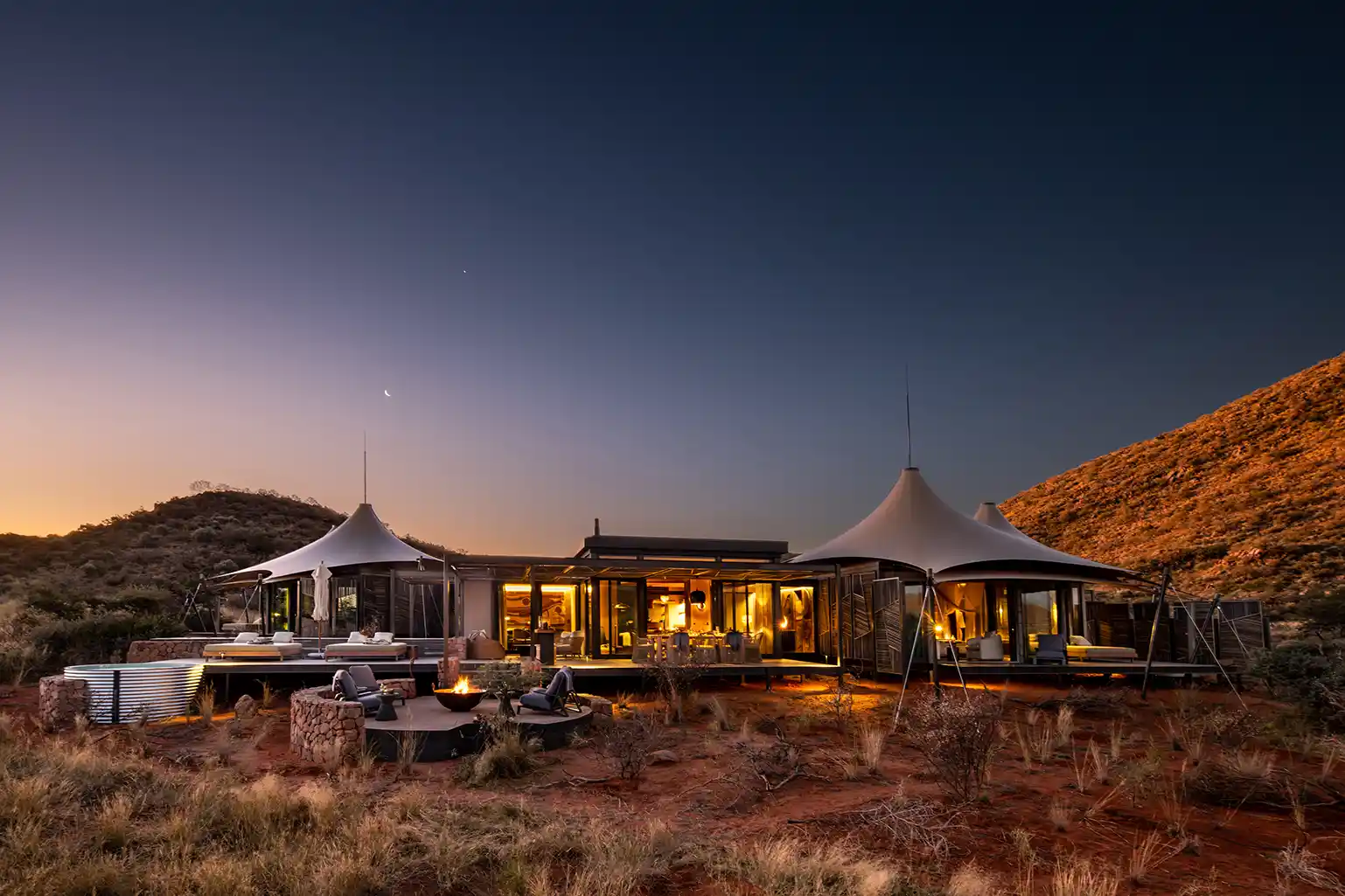
Meaning ‘the space below the clouds’ in South Africa’s local Setswana language, it’s no surprise that the setting of Tswalu’s Loapi camp not only showcases the clouds, but the starry skies on a clear Kalahari night.
It is just before midday on a Monday at Cape Town’s Signature Aviation. Waiting in the comfortable amenities lounge for my private charter to the heart of the southern Kalahari, Captain Achim announces that they’re ready to depart. Navigating the four steps into the Pilatus PC12, excitement washes over me as I’ve been dreaming of visiting Tswalu’s spectacular Loapi camp since it first opened in 2023. Taking flight, Achim steers the single-engine turboprop aircraft in a southerly direction, and flying at 27,000 ft, the views over the Cape Peninsula are absolutely magnificent.
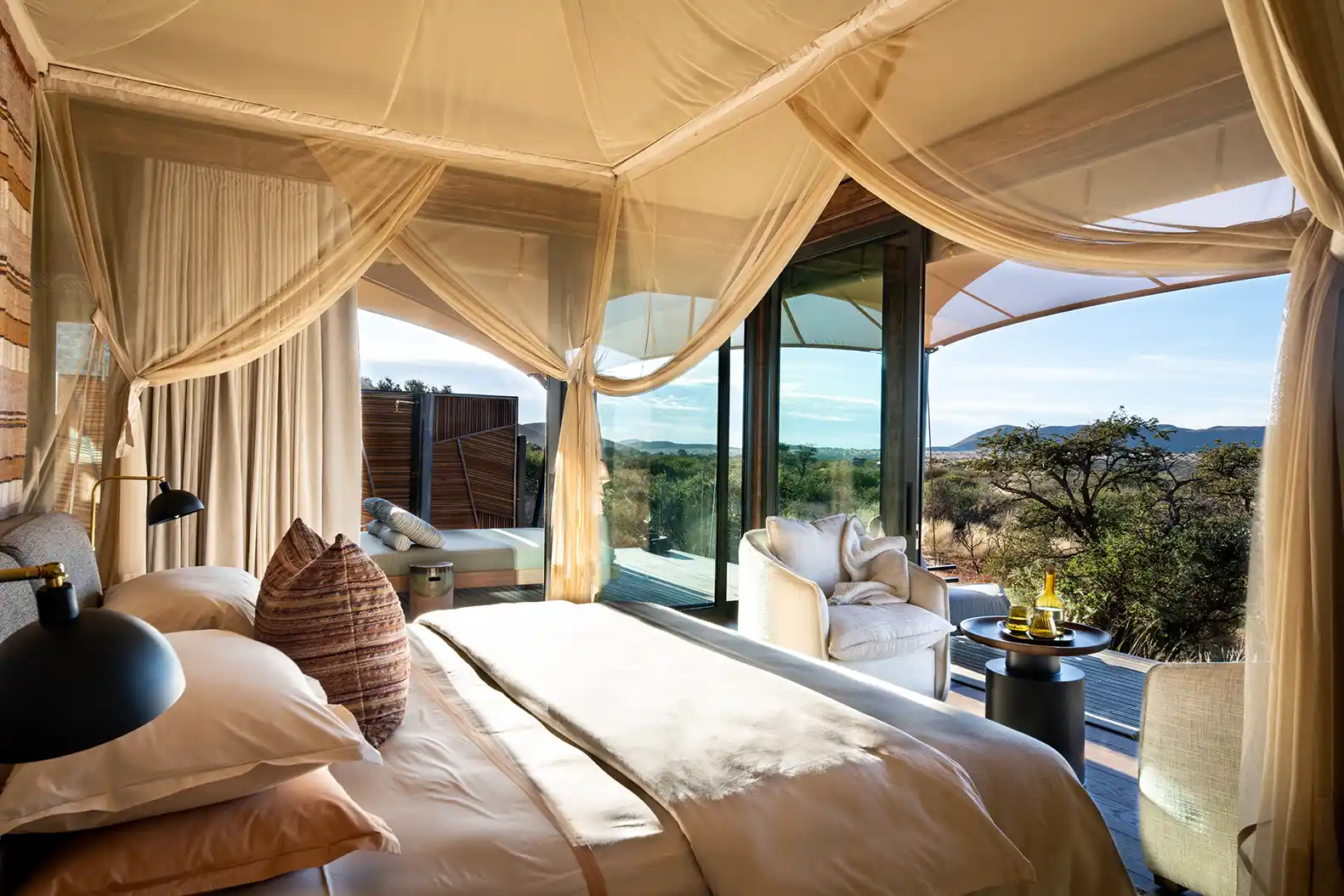
A mere two hours later, we land at Tswalu’s private airstrip, and I am warmly welcomed by Guide Marius and Tracker Piet. The drive from the airstrip takes between ten and fifteen minutes, depending on whether you encounter wildlife along the way. I’m staying in Loapi number 3, a stunning one-bedroom home, and my private house manager, Andries, and chef Mpho await my arrival. Sized at an impressive 3,200 sq. ft., the home consists of a dining area, lounge, interactive kitchen, study, bedroom, en-suite bathroom with double vanities, a wardrobe, and a flush loo.
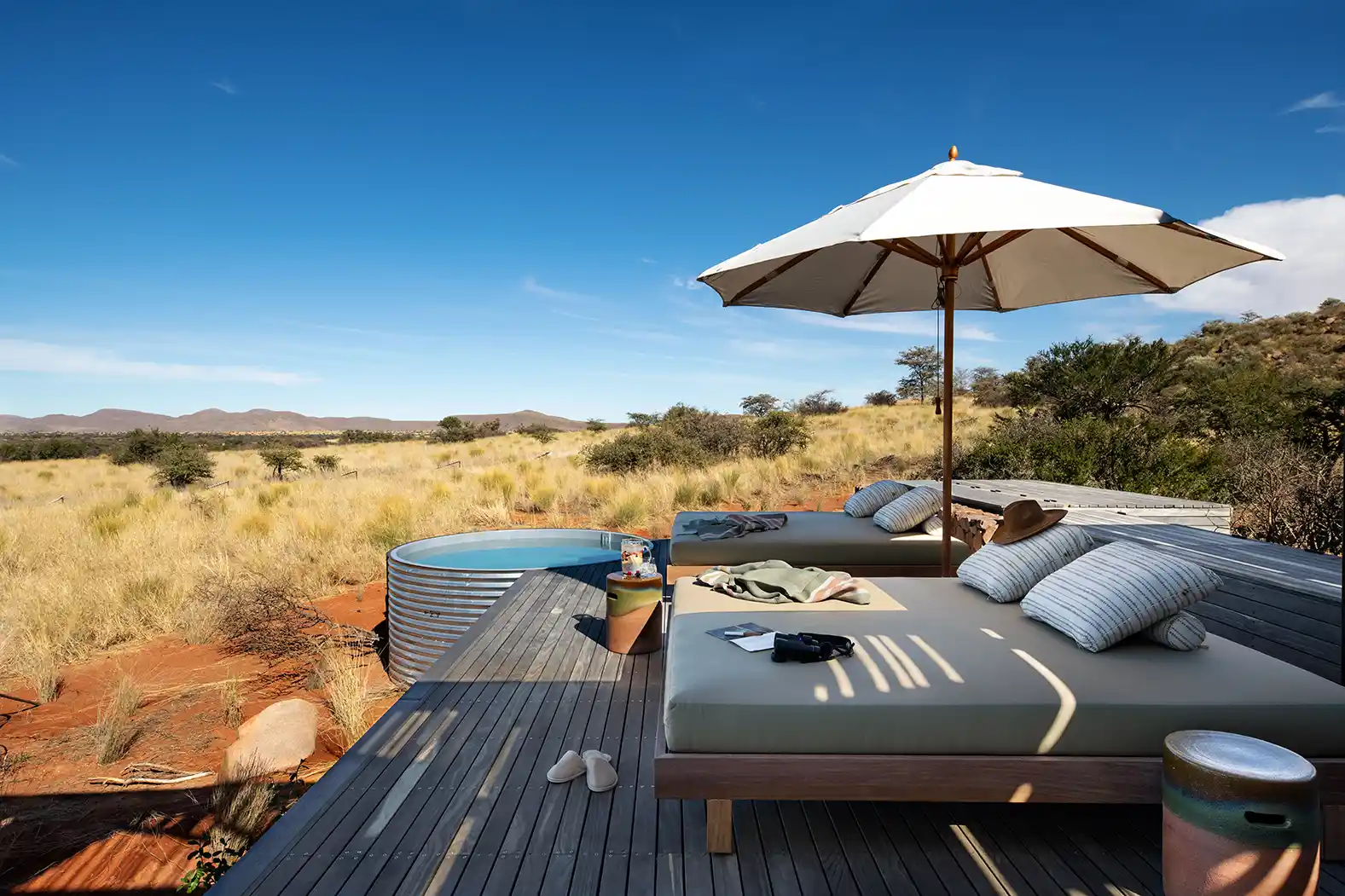
The outdoor deck has been designed with intention, and encompasses a lounging area outside the bedroom, an outside shower, a seating section adjacent to the lounge, a dining space next to the interactive kitchen, a plunge pool with sun loungers, and a fire-pit. Set at least 165 ft. apart from each other for extra privacy, there are only six homes, adding a sense of exclusivity. Mpho is preparing a delectable chicken salad for lunch, and guests can tailor-make their meals according to what they enjoy eating, and all dietary and allergen considerations are considered.
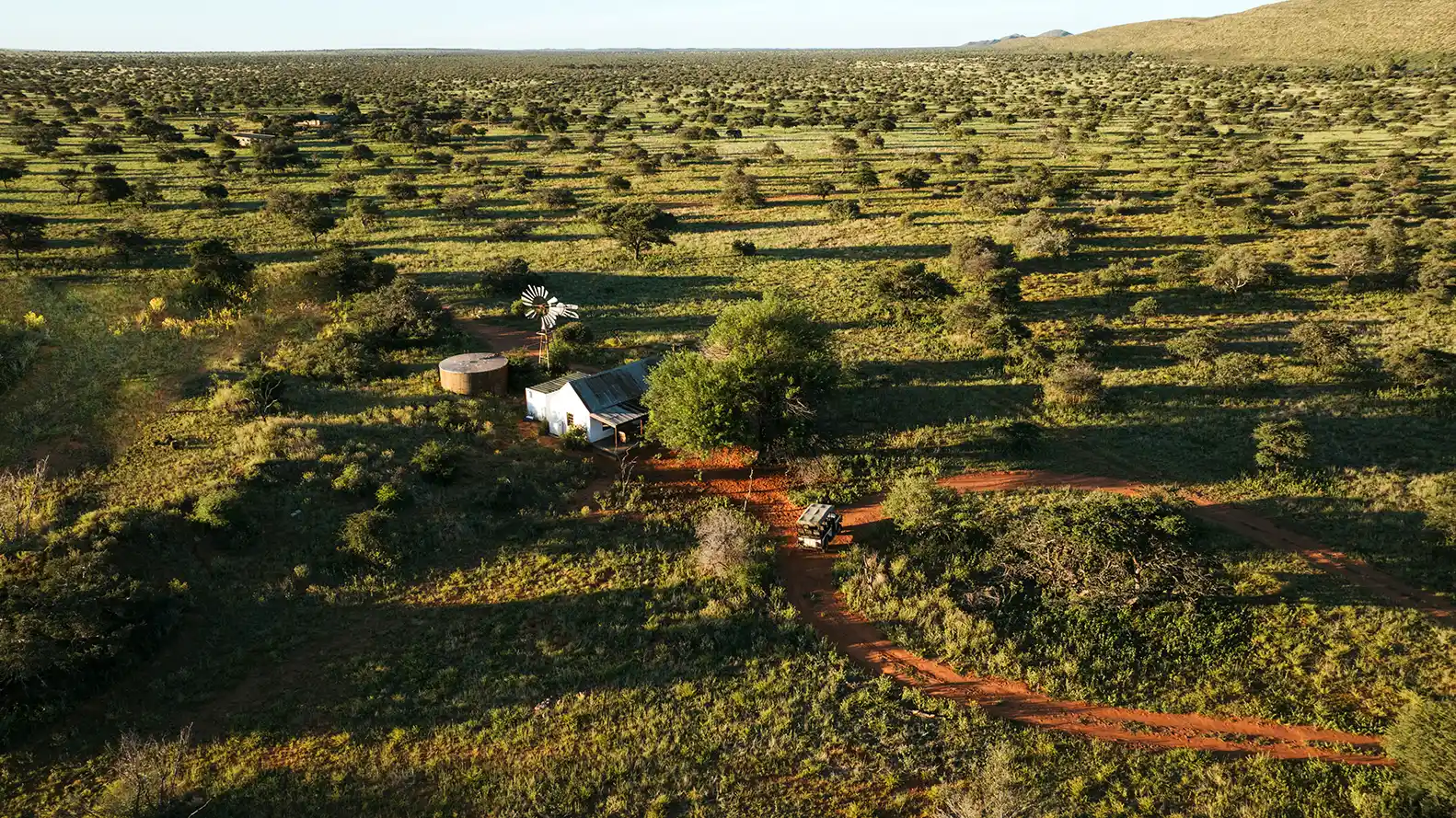
Following a tasty meal, Marius and Piet collect me for my afternoon safari. The dynamic duo goes in search of the northern pride of lions, which they successfully find after tracking them on foot. We can’t linger too long as I’m dining at Boscia House tonight, a restored early-1900s farmhouse, which serves as a pop-up restaurant for guests staying at Tswalu for a minimum of two nights. Chef Jeanre and waitress Edna are ready to show me to the verandah, where Megan performs a handwashing ritual with devil’s thorn. Pouring warm water over the plant makes it turn into a soapy substance. The seven-course fine dining experience is skillfully presented, and the main course is delicious. Driving back to Loapi, I look up to see the night sky scattered with stars.
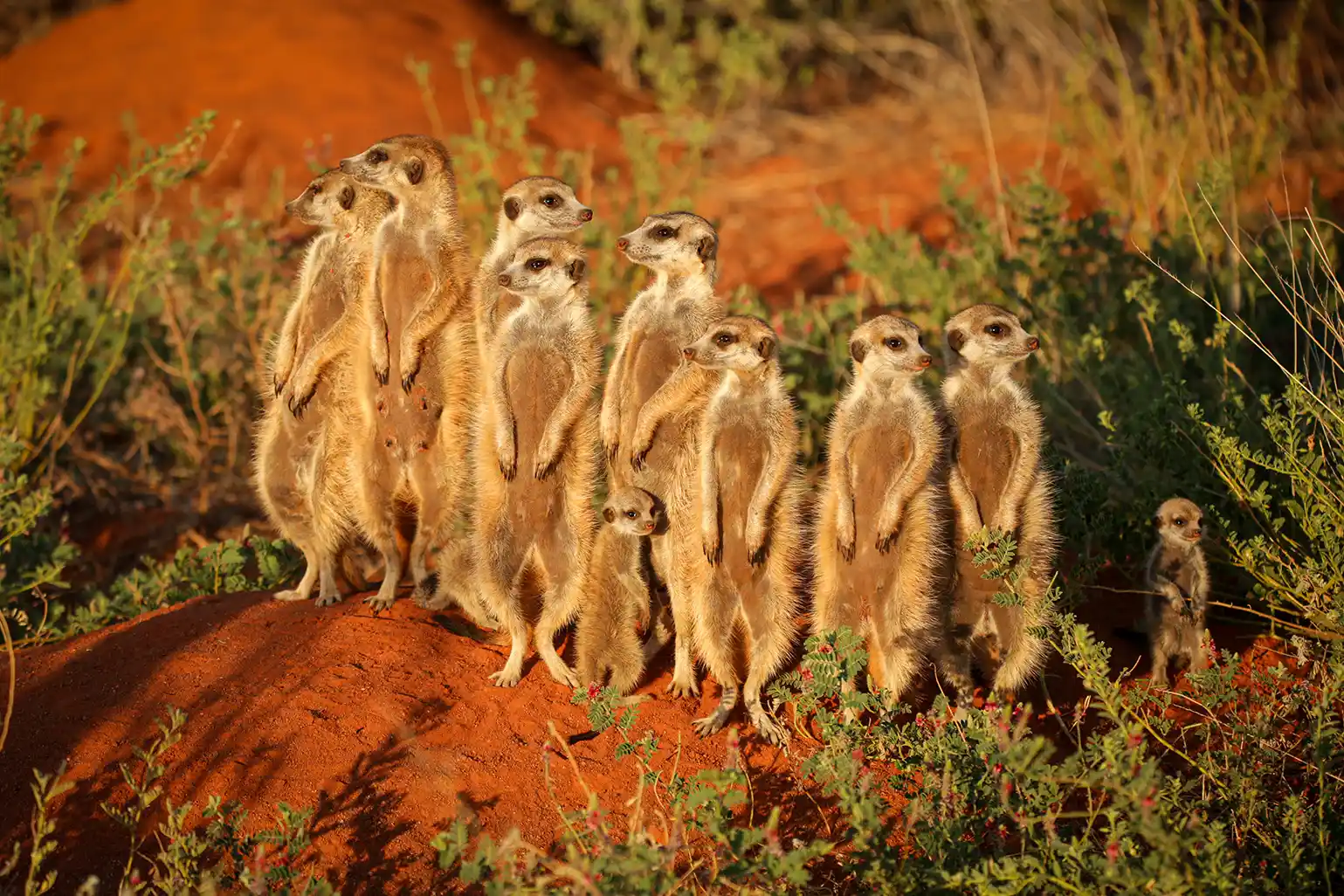
After a great night’s sleep, it’s time for the morning safari. Today, we are visiting a colony of habituated meerkats. We have to be there just as the sun starts to rise, as these precious creatures love warming themselves up in the early rays. A few of them are foraging for insects, and it’s fascinating to see the interaction between the different age groups and the alpha female. Much to our delight, a number of tiny pups emerge from the burrow. They are probably about a month old, and there are five of them. Standing at the tallest point against the red sand makes for a beautiful contrast.
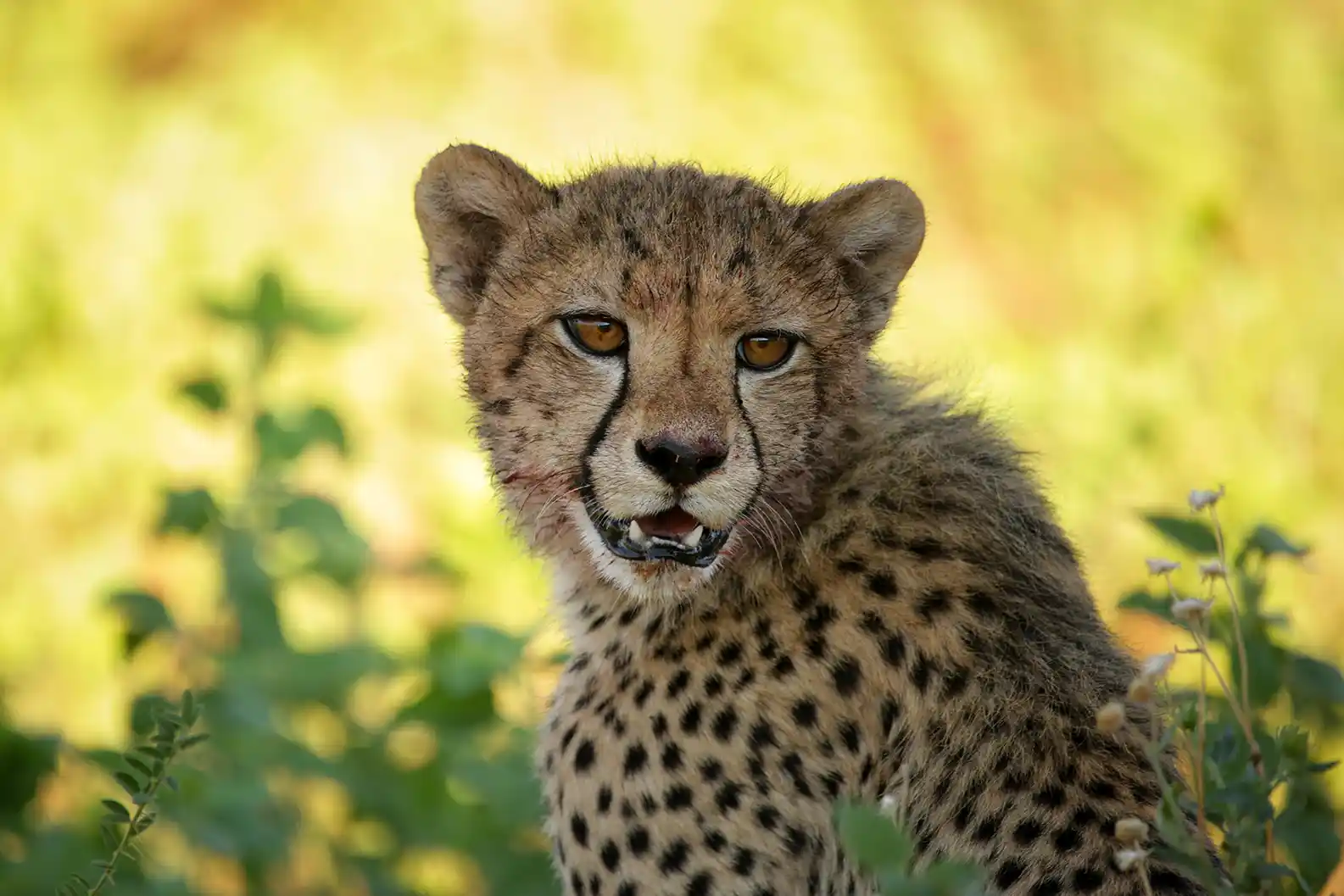
As we are already in the western part of the reserve, Marius and Piet decide to track the family of four cheetahs, consisting of a female and her three cubs. They have taken refuge close to Motse, and since conservation is a cornerstone of Tswalu, ecologist Dr. Wendy Panaino explains that due to the arid nature of the area, they host naturally low herbivore population densities. On the reserve, they also host low predator densities. This is done in order to manage predators such as cheetahs across a vast area such as Tswalu, and they make use of satellite collars where possible (only on those that they are not able to locate and view regularly) to monitor them and support ongoing cheetah research. They monitor diet, breeding, and movements. This helps them understand response to available prey, tracking the population and survival success, and assists them in grasping habitat selection, home ranges, and the cheetahs’ response to other predators and prey. These are all crucial aspects for the survival and increase of the cheetah population.
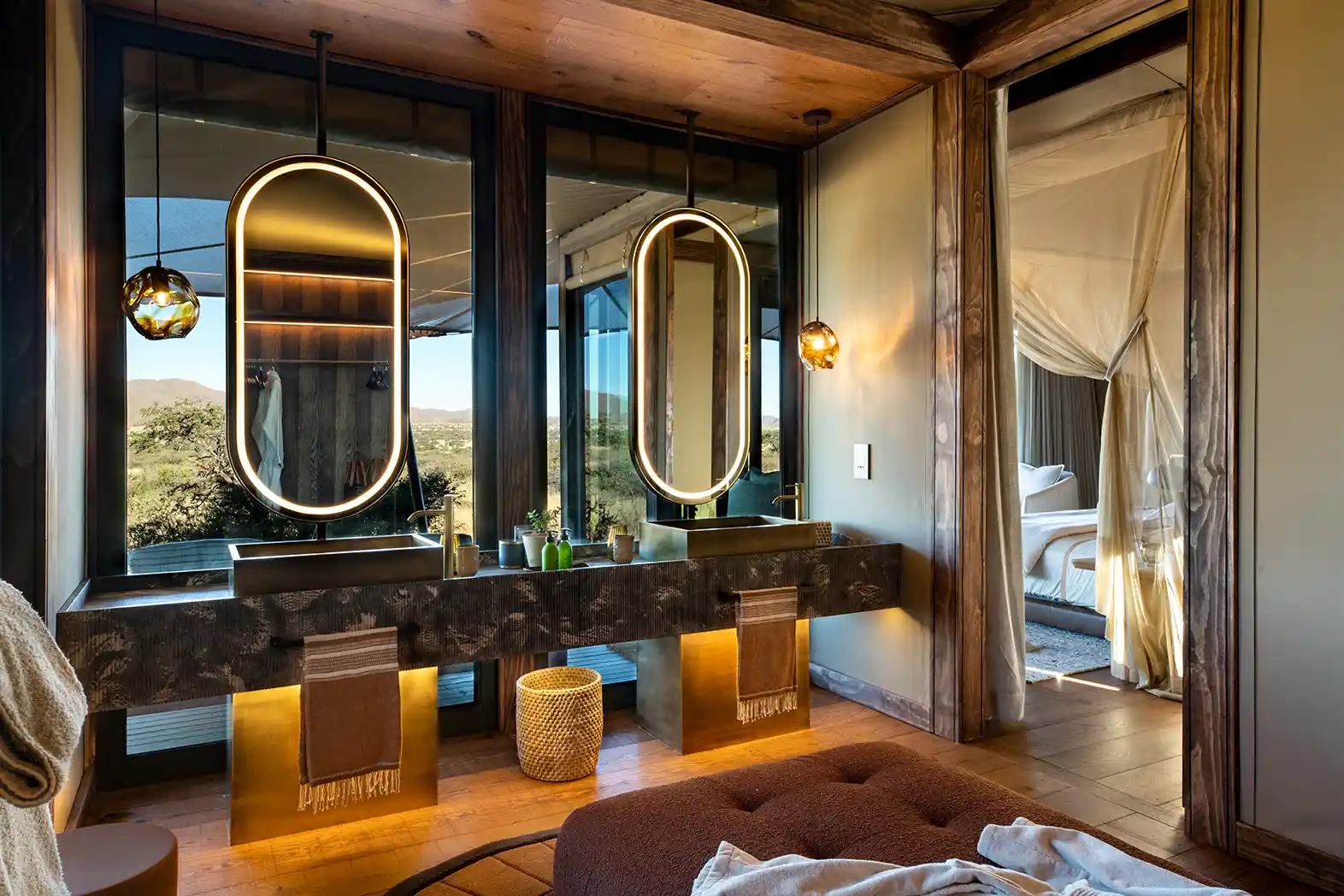
Back at my safari home, I take in the magnificence of the dwelling. Tasked with the interiors was Cape Town firm Gregory Mellor Design, with founder Greg Mellor and partner Marc du Toit heading up the project. “The client wanted the new property to reflect their attitude towards sustainability and conservation,” Greg tells me. “It needed to be something very different from their other accommodation offerings at Motse and Tarkuni. The concept of having individual villas was quite novel, so we had to factor that in. And they’re tented, so that drove a point of difference from that aspect. We designed and crafted a concept for them, which really was in response to the setting, as well as the tent and pavilion architecture by Sally Tsiliyiannis from GAPP Architects & Urban Designers. The interior contents being something that felt heavier and more weighted in contrast to the tents, which felt light and delicate.”
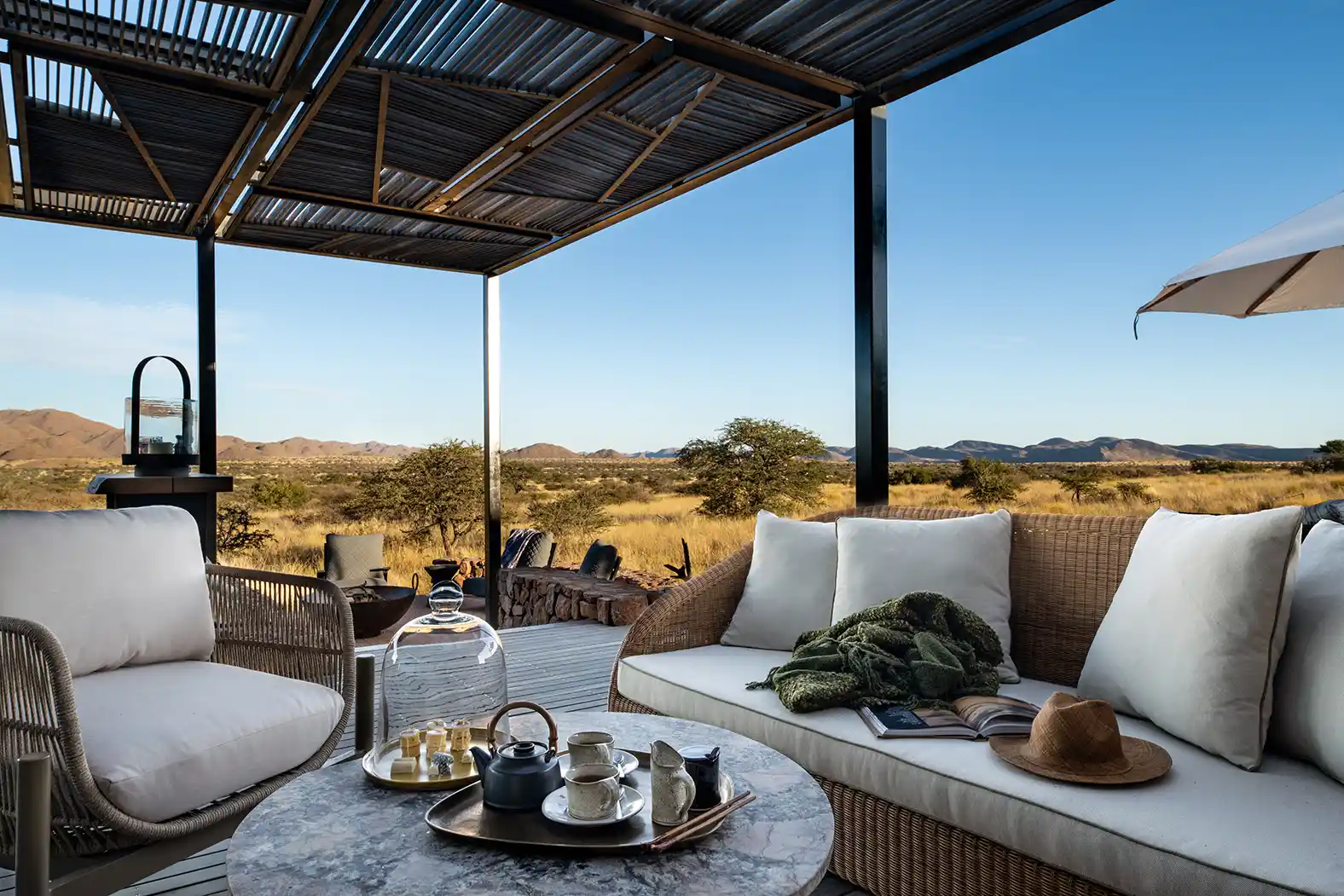
It’s clear that Greg and his team took inspiration from the surroundings, so rather than fashion items with lots of fine details, they designed lots of exaggerated, robust, and curved shapes. Sitting on the sofa in the lounge, I notice lots of oversized organic shapes. They allowed a lot of space between objects, which was a deliberate thought of not cluttering it by having bold elements and not lots of small fiddly bits. The big boulders – they wanted a sense of celebrating the scale of the natural elements and the vastness of the landscape.
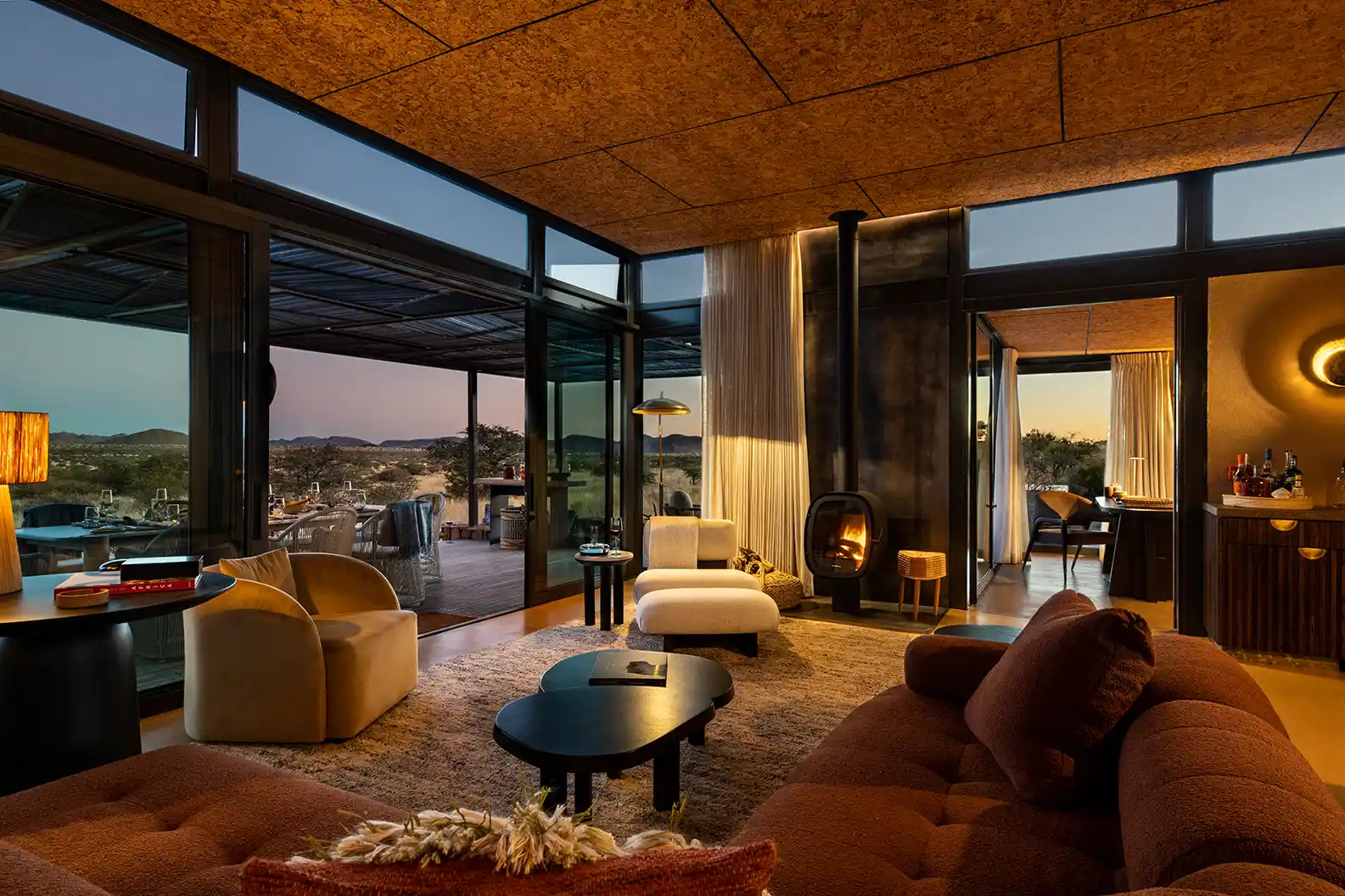
With a purposeful color palette integrating the various shades of the green Kalahari – not extremes – blacks or greens, but a celebration of the mid-tones, I look around to see the clever use of varying shades. The colors of the grasses – straw, pale green, and the red soil is obviously something they were unable to ignore, so that was incorporated. They also concentrated on the materiality – brass, rock, wood, and earth elements.
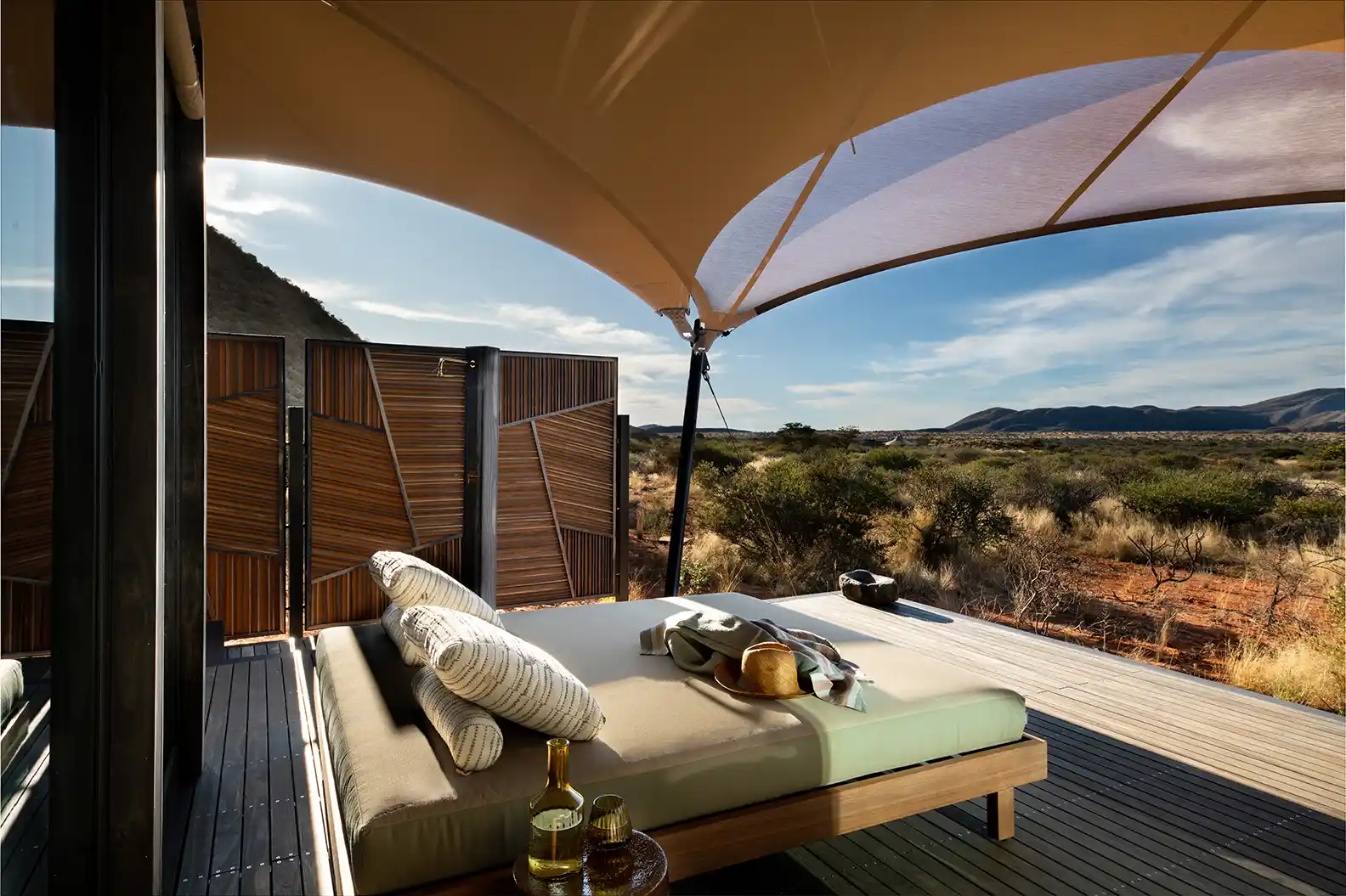
“We rather wanted to be inspired by the shapes of nature, not mimic them,” Greg continues. “Everything is more engineered. We made our own pieces, enthused by what we saw. We felt that when it’s hot, the interior should feel cool, and when it’s very cold, it needs to feel warm. That’s a challenging contradiction to deal with. To give shade from the sun and light from the shadows. We amplified textures – we took the woven elements and expanded them. If there’s a joint or a junction in the furniture, we embellish it. That is the link to the landscape rather than trying to imitate it literally. We softened sharp corners, celebrating the effect of the passage of time on elements in nature.”
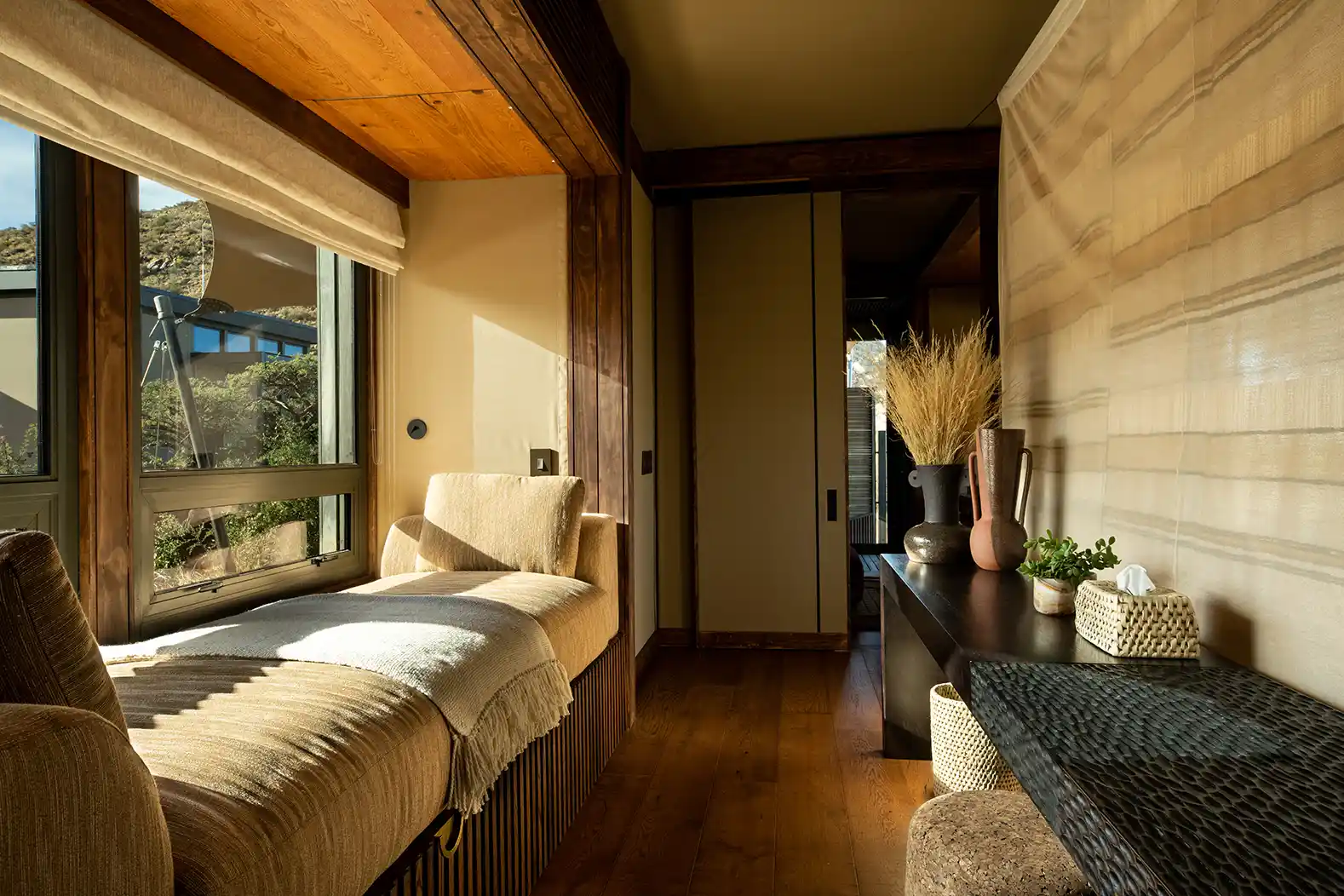
Conservation and sustainability sit at the core of Tswalu, shaping every decision and defining how they operate. The interior design crew had to look for materials that embodied this ethos but also would withstand a harsh environment. This was quite a struggle as everything had to last without warping and splitting while still feeling natural. It was a huge part of their brief, research, and design development. For fabric choices, they opted for ones that could endure heavy use in a commercial environment. It also needed to be reflective of their general concept towards the design, which was embellished textures. Chunky linens rather than very refined fabrics such as silk, for example. Lots of woven mohair elements because it felt appropriate.
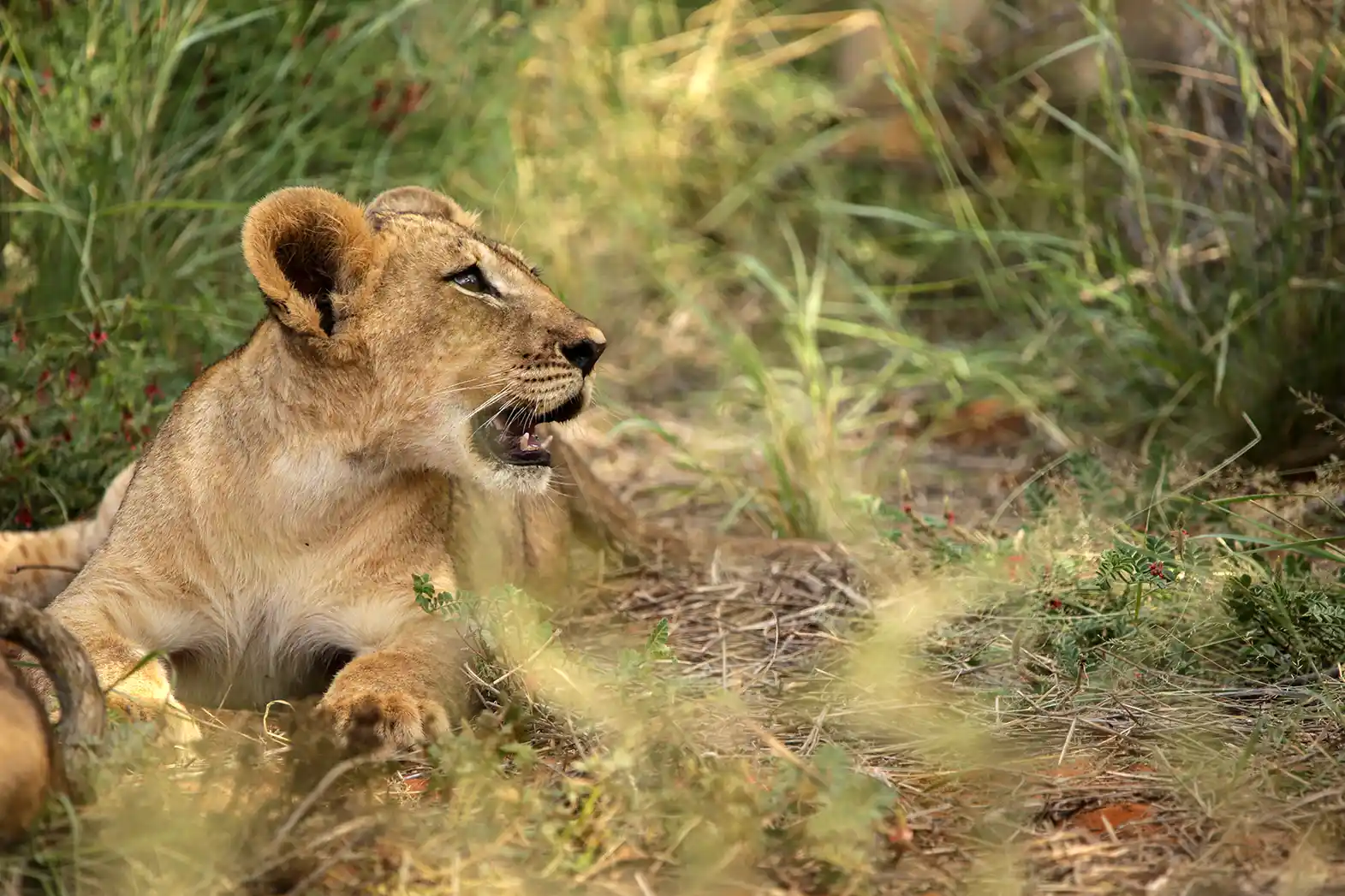
Having spent a fair amount of time in my magnificent surroundings, I’m looking forward to the afternoon safari. Marius and Piet are keen to find the northern pride, and as luck would have it, they are resting in the shade of a tree. The two lionesses are there, together with their eight cubs! There is no sign of the two black-maned male lions in spite of Piet seeing their footprints on the morning safari. The cubs are in a playful mood, but the moms are getting agitated as the day has warmed up substantially, and they would prefer to sleep. Which doesn’t deter some of the youngsters from indulging in mock-fighting. Sitting with them for the entirety of the safari, since there is no set schedule at Tswalu, makes me fully appreciate the wonder of nature. And the honor to spend it here at Tswalu Loapi is a privilege I do not take for granted.