A well-designed house has a place for almost everything. The wine has a cellar, and the television sinks into the millwork when nobody is watching. The things that would be hardest to replace are the usual exception. Watches sit in a dresser drawer, and the passports and deeds live in a file box at the back of the study.
When a safe does arrive, it often follows a burglary down the street and goes wherever there is space. It works far better when it is chosen for what it will hold and planned with the room around it.
Begin With the Contents
A safe built to resist a burglar’s tools may do little in a fire, and a document safe with a good fire rating may barely slow down a pry bar. So the contents decide. Jewelry and cash call for burglary protection, while passports and deeds need protection from heat.
Call the insurer before looking at a single catalog. British insurers link the cash and jewelry they will cover at home to the grade of the safe, and they will name the grade they expect.
What the Eurogrades Mean for Insurance
The European standard for burglary-resistant safes is EN 1143-1, and safes certified to it are known as Eurograde safes. Independent testing labs attack samples with specified tools, scoring each attempt by the tools used and the minutes they took. Grades start at 0, and each step up demands a higher score.
Each grade carries a typical cash rating in Britain. A Grade 0 safe is usually accepted for £6,000 in cash and a Grade 1 for £10,000. Grade 3 takes that to £35,000, and Grade 5 to £100,000. Jewelry is normally covered to ten times the cash figure, so a Grade 3 safe is generally good for about £350,000 of watches and jewelry. These are typical figures, and the policy itself has the final say.
Below Grade 0 sit the lighter S1 and S2 safes, which are tested to EN 14450 and suit smaller sums. A certified safe carries its testing lab’s label, usually inside the door, and a reputable seller will show the certificate. SafeRight, a British specialist, lets buyers filter its Security Safes by cash rating, which turns an insurer’s letter into a short list.
In the United States, the marks to look for come from UL, and a TL-15 or TL-30 label means the door and front face resisted attack with tools for fifteen or thirty minutes of working time.
Fire Ratings, Measured in Minutes
Fire ratings are quoted in minutes, and the figure records how long the interior stayed cool enough in a furnace test for the contents to survive. A paper rating keeps the inside below the point at which paper chars, which is still hot enough to ruin a hard drive or a memory stick. Digital media needs a data rating, which holds the interior far cooler and drier. The American benchmark for paper is UL 72 Class 350, named for the 350°F ceiling it sets on the interior.
Burglary and fire protection can come in the same safe. Some graded safes carry a 30-minute paper rating as well, and combined fire and security safes often offer an hour or more, which suits jewelry and original documents kept in one place.
Where It Goes and How It Stays Put
The closet off the primary bedroom is the obvious place for a safe, and that bedroom is usually the first room a burglar searches. A closet off a guest room or a study may serve better, provided the floor can take the weight.
Larger high-grade safes can weigh half a ton. The ideal base is a concrete slab at ground or basement level, and an upper floor needs its structure checked. Measure the route as well, from the front steps to the tightest turn in the stairs.
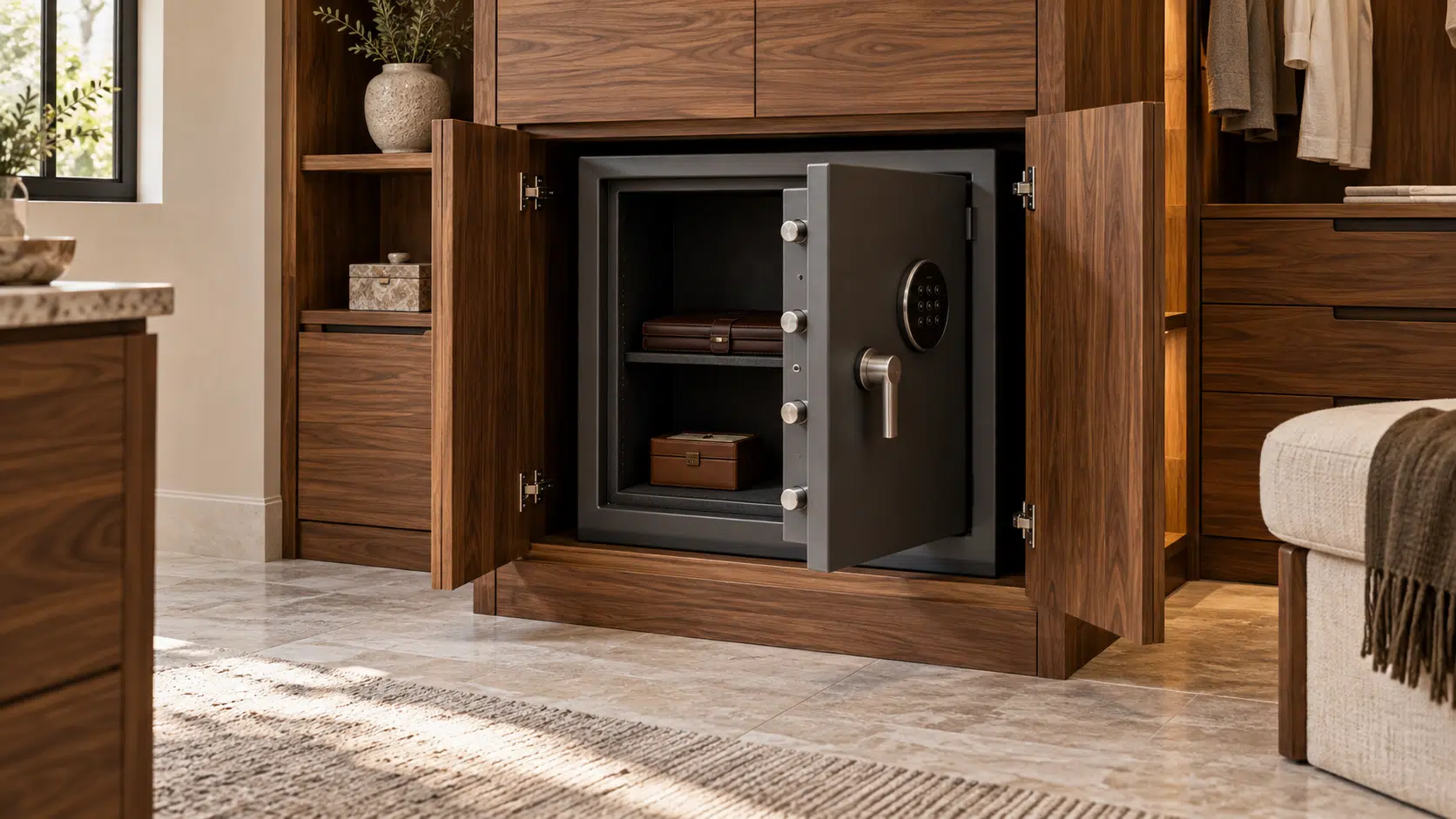
A wall safe needs solid masonry around it, and a floor safe is set into concrete, so a renovation is the moment to plan either one. If the safe is going into custom millwork, the cabinetmaker needs its exact dimensions and the full sweep of its door before drawing anything.
Wherever it stands, a graded safe must be anchored as its manufacturer specifies, usually with bolts into concrete, before an insurer will honor its rating. An unanchored safe can be levered onto a dolly and opened somewhere quiet. Specialist installers will position it and bolt it down, and they will want to hear about steps and narrow doorways first.
Choosing the Lock
Key locks are simple and need no batteries. Their weakness is the key, which has to live somewhere a burglar would never think to look, and never beside the safe. Electronic keypads remove that problem. Codes can be changed whenever the household staff or the contractors change, and better commercial locks add a time delay or log every opening. They run on batteries, so heed the low-battery warning.
Fingerprint readers open fastest, which suits a dressing-room safe used every morning. Fitted to a certified safe, they are a pleasure to live with. Many cheap fingerprint safes have never been tested at all, and the reader on the front says nothing about the steel behind it.
Locks have their own European standard, EN 1300, and each Eurograde calls for a minimum lock class. Higher grades usually carry two locks, both of which must be opened.
The Home Office and the Small Business
A home office brings paper and data into the house, and sometimes petty cash. If that cash belongs to the business, its insurer may set a different grade from the one on the household policy.
Stores and restaurants face a different risk, which is the moment the safe stands open. Deposit safes let staff drop the day’s cash inside without opening the door, and a time-delay lock makes a holdup at closing time slow and unappealing. A locked key cabinet keeps the spare keys to vehicles and rental units together and out of reach.
For a house or business in Britain, a specialist in Home and Business Safes will ask what is going inside and how much coverage the insurer allows, and the answers narrow the choice quickly. The remaining decisions belong to the architect and the cabinetmaker, who can then draw a closet around a safe whose size and weight are already known.