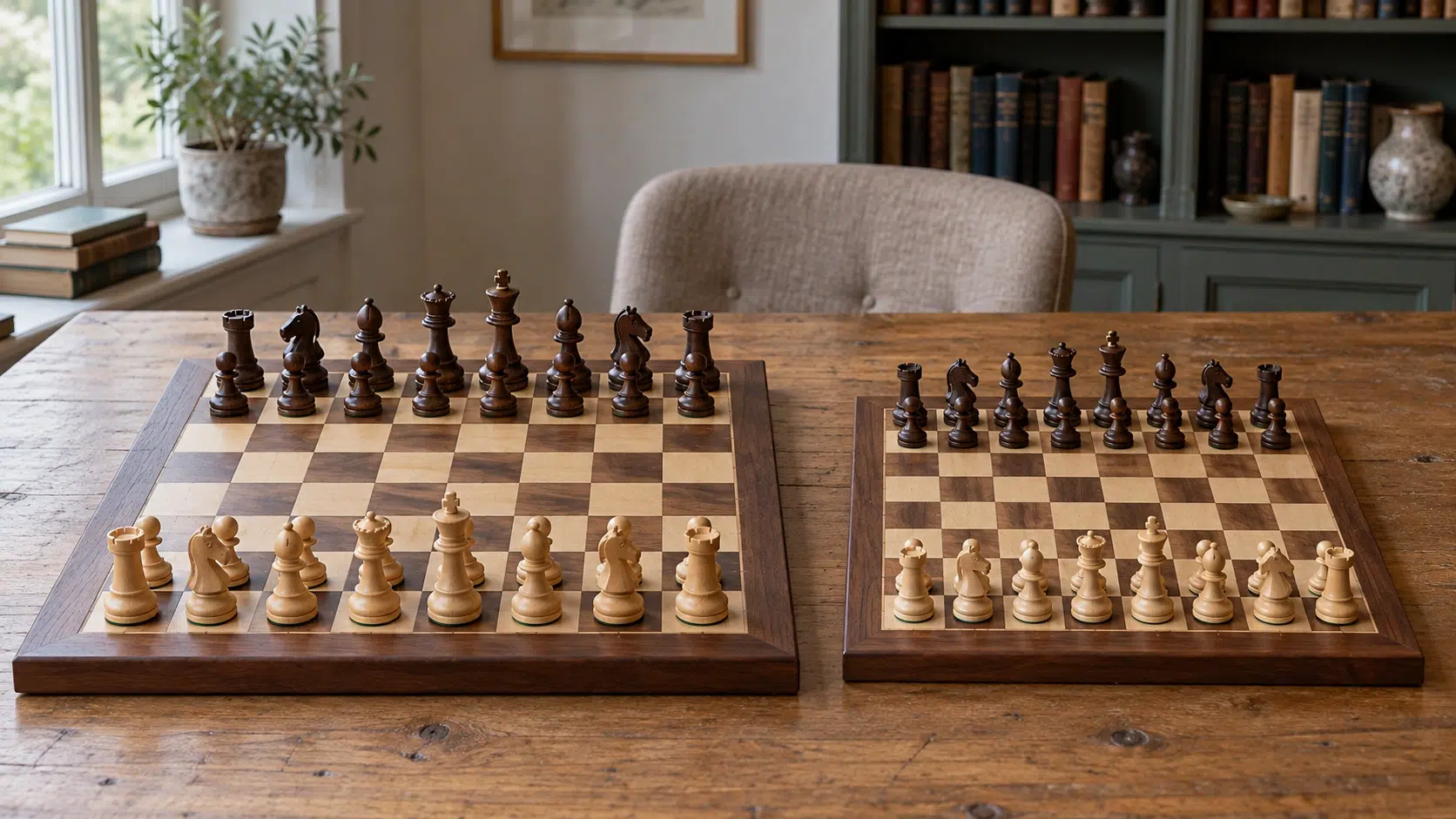
The awkward thing about choosing between the Championship and Studio is how similar they can look in a thumbnail. Same recognisable family of pieces, very different amount of table occupied. I’d stop enlarging the photographs for a moment and get a ruler. There are twelve centimetres between the widths of the two boards discussed here, and that might settle the whole question.
By Championship, I mean the World Chess Championship Set in the Walnut Edition. The smaller one is the Official World Chess Studio Set. Check those names when you open the listings. Another edition, or an offer for pieces without a board, would need its own comparison. This is easy to muddle when several tabs are open.
Start with the numbers
The Walnut Championship board is listed at 50 by 50 centimetres, with 5-centimetre squares. For the Studio, the figures are 38 by 38 centimetres and 45-millimetre squares. Here’s the bit I’d underline: eight squares make playing areas of 40 and 36 centimetres respectively. Much of the difference in outside width is therefore outside the playing squares themselves.
Does the extra border bother you? It wouldn’t bother me on a large dining table. On a desk shared with a laptop, I’d want to know exactly what it displaced. Put down a paper outline of each board and leave the laptop where you normally use it. Don’t make room by putting everything on the floor; that’s cheating your own experiment.
There’s a tournament-size distinction as well. FIDE’s equipment specifications give a range of 5–6 centimetres for squares on the relevant non-electronic tournament equipment. The Championship’s listed squares fall within it, while the Studio’s are smaller. If the purchase is for a particular event, I’d still ask the organiser. For evenings at home, you can simply decide how much that difference matters to you.
What changes when you pick up the pieces?
The Championship listing describes handcrafted boxwood pieces with triple weighting, a 3.75-inch king and two extra queens. I’d compare that king with the set you already find comfortable. You don’t have to own it: take measurements at the club, if you’re allowed, and write them down. A familiar piece gives those numbers some meaning.
The Studio listing puts its pieces at 87% of the original design’s size, supplies extra queens, and pairs the pieces with a folding wooden board. That’s a fairly specific change. I’d be wary of assuming that smaller automatically means easier to use. It frees up space, yes, but your fingers haven’t shrunk along with the knight.
If you can handle either set before buying, do. Lift the knight from behind the pawns, try a capture, and check how the bases sit. No sample available? A photograph beside a ruler can help you judge scale. It won’t tell you what the felt feels like. I’d leave that question open rather than inventing an answer from the pictures.
The folding board needs its own check
A folding board sounds ideal when the dinner table has to become a dinner table again. But where does it go once folded? I’d check the packed dimensions, what holds the pieces, and whether a box or bag is actually included. “Portable” can cover quite a lot of territory, from something that slips into a work bag to something you carry separately with both hands.
For the Championship, I’d measure the proposed shelf as carefully as the table. A 50-centimetre board needs a place when you’re not playing. Behind a chair is a possible answer, but not one I’d be happy with for a wooden board without protection. Ask about suitable storage before buying a separate case that might be the wrong size.
Keep the comparison on one page
This is the short version I’d keep beside the two listings. Fill in anything missing before comparing the final prices.
- Board footprint: Championship 50 × 50 cm; Studio 38 × 38 cm.
- Square width: Championship 50 mm; Studio 45 mm.
- Pieces: compare the stated king dimensions with a set you know.
- Packing: confirm the folded or boxed dimensions and included storage.
- Contents: check the exact edition, board, and extra queens.
- Delivered cost: include any accessories and applicable delivery charges.
If you started with a search for the best chess set, the World Chess Shop catalogue gives you both of these options to examine. Keep their exact names beside your notes. Otherwise, it’s surprisingly easy to compare the price of one edition with the measurements of another, especially after following a sale link.
I wouldn’t award points for every feature and add them up. A board either fits the available space or it doesn’t. Once both pass that test, you can think about handling and appearance. And if you simply love one of the designs, that’s a reason too. There’s no need to pretend the purchase will improve your calculation.
When the Studio is the easier fit
For a desk that serves as an office until six and a chess table afterwards, I’d look closely at the Studio. The smaller footprint is something you can use every evening, rather than a feature you admire once on arrival. Try the outline with your lamp, book and notebook still in place. Can you actually sit and play there?
Taking it to a friend’s home is another question. A smaller wooden set still needs protection, and the packed weight matters if you travel by bus or train. I’d compare it with a plain plastic set for that job. The Studio might be the one you prefer; just don’t let the word “compact” make the luggage decision for you.
When the Championship has room to work
With a dedicated table, I’d give the Championship more room in the decision. You can use its larger format without clearing away your working day first, and its square width is closer to the cited tournament range. That seems a sounder reason to choose it than the assumption that the bigger model must be the better one.
Try the whole evening on paper before ordering: two seats, clock, somewhere for captured pieces, then packing up. Which version leaves the less awkward arrangement? If both work, the remaining choice can be fairly personal. I’d be content to choose the pieces I most wanted to pick up, once I knew where the board and box were going to live.