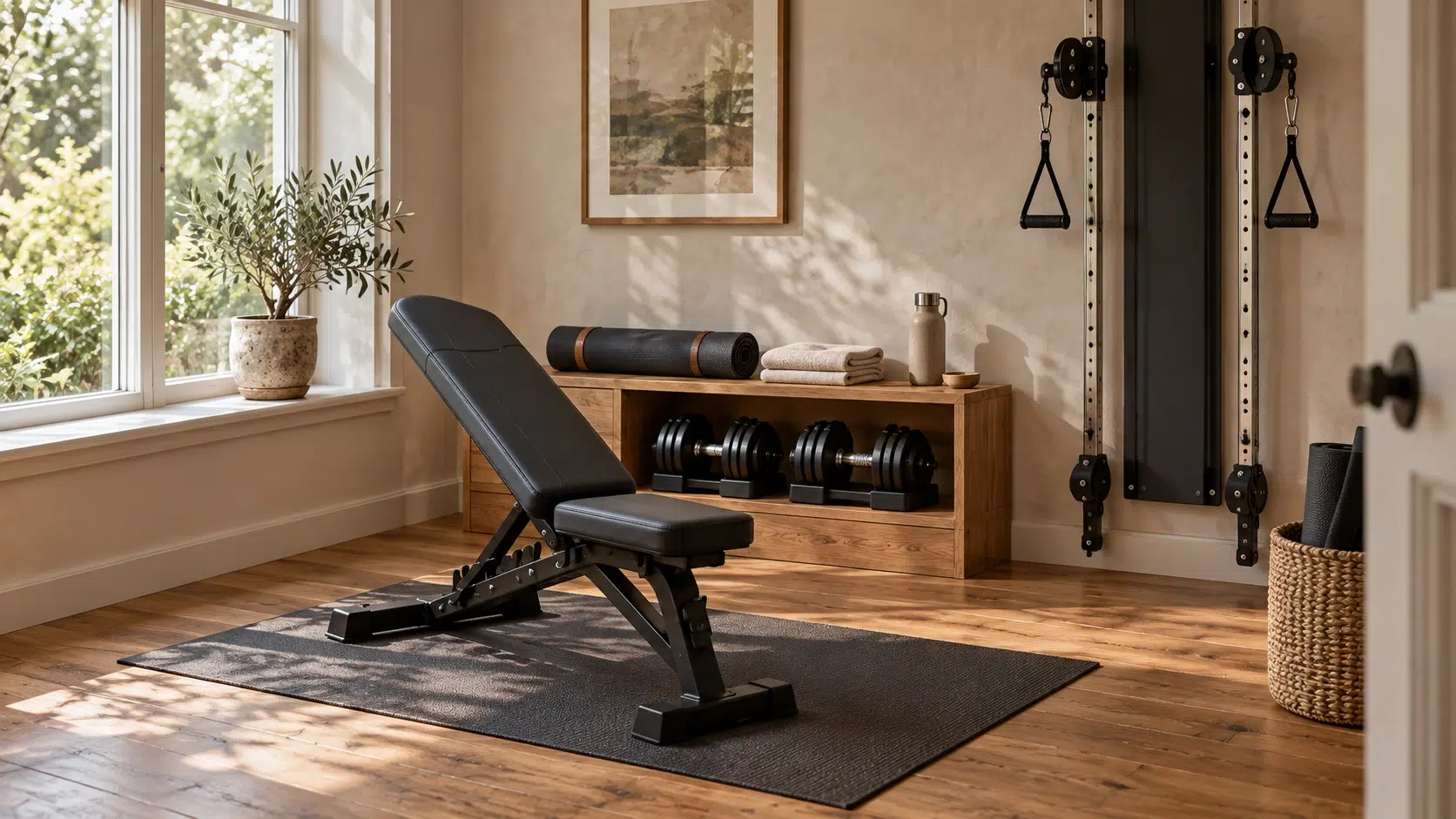
For years, the measure of a serious home gym was square footage. A finished basement with rubber flooring, a wall of chrome dumbbells, and a commercial treadmill that took three people to carry in. That picture still exists, but it’s no longer what many design-minded homeowners ask for.
The new brief is quieter. People want a home gym treadmill that earns its place in a room used for other things, delivers a hard workout in half an hour, and folds out of sight when guests arrive. Space still matters. It’s simply being asked to do more than one job.
Why the Dedicated Gym Room Is Losing Its Appeal
Every room in a well-planned home now competes for a purpose. The spare bedroom doubles as a study. The lower level hosts a media lounge, a wine wall, or visiting family. Handing one of those rooms to a single bulky machine feels like a poor trade, even in a large house.
Then there’s how the equipment looks. A full-size commercial treadmill reads as a gym fixture wherever it stands. In a room with plaster walls, oak floors, and carefully chosen lighting, it can overpower everything around it. Homeowners who spend months choosing a sofa are reluctant to let a fitness machine set the tone of the room.
Time has changed math too. Many professionals now train in short blocks between calls or before the household wakes up. A machine that sits ready in the corner of a study tends to get more use than one at the far end of the house.
What Upscale Households Now Ask of Home Gym Equipment
For buyers furnishing a high-end home, the checklist has shifted. Size matters less than how hard a machine can work in a small footprint, and how well it lives with the rest of the house.
- Footprint in use and in storage: A machine that folds or stands upright can share a room instead of claiming it.
- Intensity per minute: Short sessions need a way to raise the effort quickly, without the long deck and high speeds of a full-size running machine.
- Quiet operation: Early workouts shouldn’t wake anyone, and a brushless motor helps keep running noise down.
- Finish and form: Clean lines, metal tones, and a restrained console sit better in a furnished room than exposed plastic and bright graphics.
- Simple controls: A dial or app that changes speed in a second gets used more than layers of menus.
That last point is easy to underrate. Equipment that’s quick to start gets used on busy days, and busy days are where most of a home gym’s value is won or lost.
Incline: How a Compact Home Gym Treadmill Gets Harder
Raising the deck is the most space-efficient way to make a treadmill workout harder. Walking uphill asks more of your heart, lungs, and legs than walking on the flat at the same pace. That means you can reach a demanding effort at a speed that never calls for a long running deck, while your glutes, hamstrings, and calves take on more of the work.
Incline also changes how a hard session feels. A brisk walk at a steep grade can leave you as out of breath as a run, with less of the pounding that comes from fast running on a flat belt. For people who’ve logged years of miles on hard surfaces, that trade is often the reason they start climbing instead.
This is the idea behind the WalkingPad G5i Treadmill, a foldable treadmill built around incline training. Its deck rises automatically to an 18% grade across 25 levels, so a 30-minute session can move from a gentle warm-up to a steep, sustained push. When you’d rather run, it reaches 10 mph. The 51.2″ × 19.7″ running area leaves room for a natural stride, and a SpeedDial knob on the console changes speed with one turn.
Three Compact High-Intensity Sessions Worth Trying
A steep grade turns even a short window into a real workout. These three formats suit a home setting because none of them depends on high speed. If incline training is new to you, start at a lower grade than you think you need and build up over a few weeks.
| Session | How it works | Time |
| Hill intervals | Alternate 2 minutes at a steep grade with 2 minutes at a low grade, at a brisk walking pace | 24 to 30 minutes |
| Incline pyramid | Raise the grade every 2 minutes up to your peak, then step it back down the same way | 30 minutes |
| Steady climb | Hold one challenging grade at a pace where you’re breathing hard but can keep going | 20 to 40 minutes |
Try to keep your hands off the handrails during the climb, since holding on takes work away from your legs. Spend about 5 minutes warming up and cooling down on a flat or near-flat deck.
Building the Rest of a Compact Home Gym
A treadmill rarely stands alone, even in the smallest setup. The compact approach works best when every other piece follows the same rule: it either folds, stacks, or looks good enough to stay out.
- Strength: A pair of adjustable dumbbells replaces a full rack, and a folding bench can lean against a wall between sessions.
- Mobility: A good mat and a foam roller cover warm-ups, stretching, and recovery in a few square feet.
- Storage: A closed cabinet or a woven basket keeps a small kit out of sight, so the room reads as a study or lounge first.
Pairing two or three of these with an incline treadmill gives you cardio, strength, and recovery in one corner. You can finish a hill session, move straight into a short strength circuit, and have the room back to normal before breakfast.
Where a Folding Treadmill Fits in a Well-Designed Home
The right place for a compact machine is the one where you’ll actually use it: a study with a view, the corner of a guest suite, a lower-level lounge near the screen. Choose the spot first, then check the measurements.
The G5i folds to 10.2″ thick and has built-in wheels and a transport handle, so you can roll it from its training spot to a closet corner or stand it upright against a wall. A few setup details are worth planning before it arrives:
- Floor: Lay a treadmill mat to protect wood floors and soften vibration.
- Power: Plug into a wall outlet rather than an extension cord.
- Clearance: Leave open space behind the deck and on both sides, and route cords and furniture away from that zone.
- Ceiling height: Measure for your own height plus the raised deck at full incline, especially in a basement.
If your household will mostly walk and jog rather than climb, the range of foldable treadmills designed for home gyms includes slimmer, lighter formats that fold away just as easily.
What the Shift Says About How Affluent Buyers Spend on Fitness
Smaller equipment reflects a clearer idea of what a home gym is for. The goal is consistent training that fits real schedules, in rooms that still feel like home. Buyers are paying for engineering that delivers intensity in less space, for finishes that sit comfortably beside good furniture, and for machines that fold out of sight when the session ends.
If you’re planning a home gym now, start with the room you already enjoy spending time in. Then look for a treadmill that can work hard there and step aside when the room has other plans.
*Disclaimer: This article is provided for general informational purposes and is not a substitute for professional medical advice, diagnosis, or treatment. Individual health needs and responses to exercise can vary. If you have a medical condition, concerns about your health, or are considering changes to your exercise, diet, sleep, or daily activity, consult a qualified healthcare professional first.