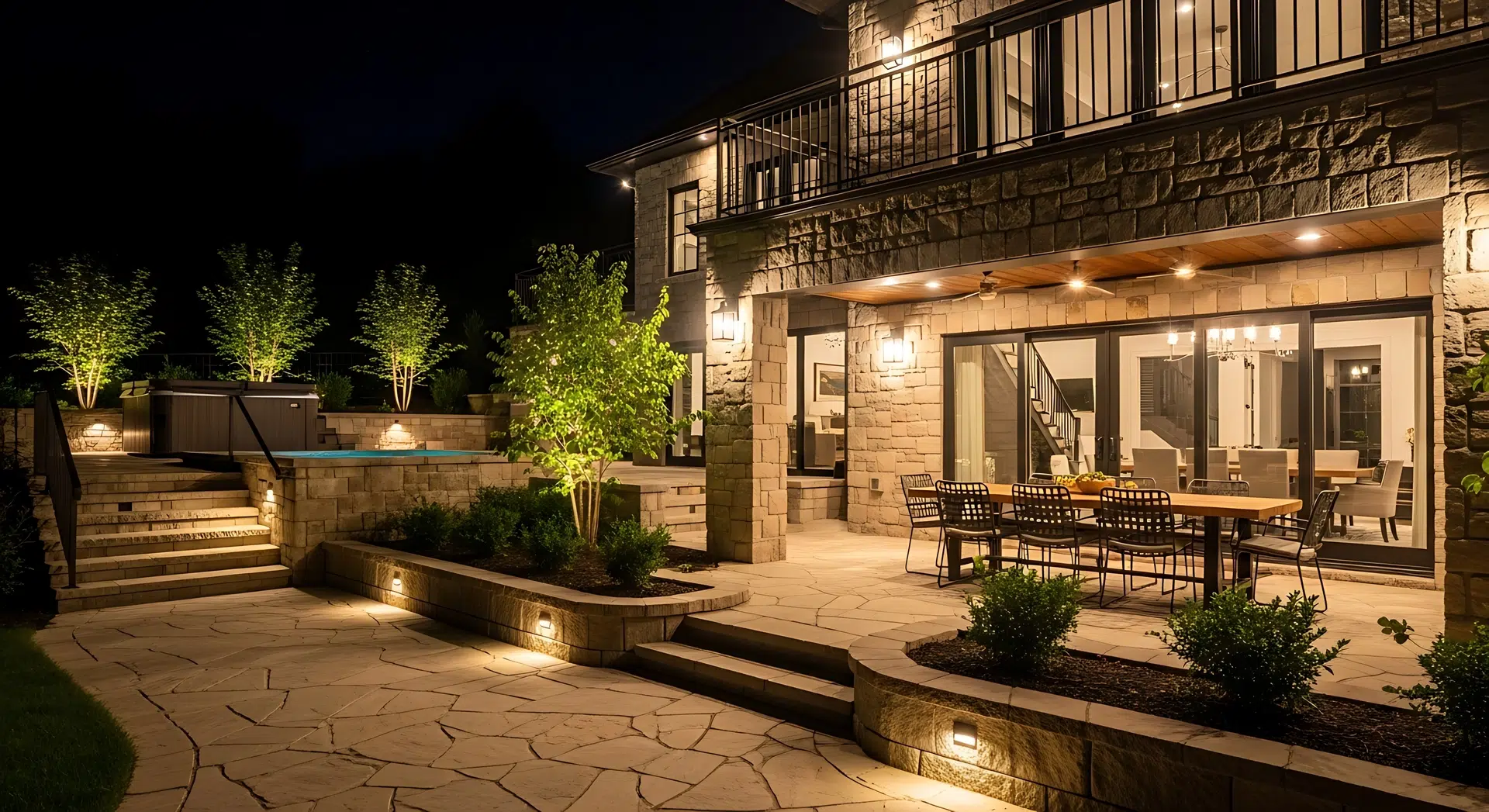
Outdoor lighting has quietly shifted from a decorative afterthought to a serious line item in home operating costs. The transition to LED step and landscape fixtures is a key reason, not only because LEDs sip electricity, but because they make it easier to light with precision. Homeowners are increasingly comparing wattage, beam angles, and control options with the same scrutiny they once reserved for kitchen appliances. In that sense, outdoor lighting has become less about showing off and more about engineering a reliable perimeter of comfort and safety. The modern yard is expected to work at night without turning into a floodlit stage.
Energy efficiency is now defined as much by design discipline as by the diode itself. A thoughtful plan uses light only where it is needed, at the level it is needed, for the hours it is needed. Step lights, for example, succeed when they guide a foot rather than illuminate an entire stairwell. Landscape fixtures perform best when they model a tree canopy, wash a wall, or outline a path without glaring into windows. LEDs support this precision because they can be paired with optics and shields that shape the beam and limit spill. The result is a brighter experience that often uses fewer total lumens.
There is also a subtle lifestyle shift behind the trend. Outdoor spaces have become extensions of the interior, with patios, walkways, and garden edges treated like rooms with boundaries and circulation. That change rewards fixtures that feel architectural and restrained, not theatrical. LEDs, available in low-profile step formats and compact landscape bodies, fit that restraint. They also align with the growing preference for low maintenance, since quality LEDs reduce relamping cycles and keep lighting consistent over the years. In practice, the best energy savings come from combining efficient hardware with a plan that avoids excess.
Understanding LED Step Lights and What They Do Best
Step lights are engineered for one job: to make elevation changes legible in the dark. They are typically mounted on risers, retaining walls, deck faces, or adjacent posts to cast a controlled pool of light onto treads. The most effective step lights avoid hot spots and instead create even illumination across the walking surface. That evenness matters because harsh contrasts can be as disorienting as darkness. When homeowners complain that their stairs feel “glary,” the culprit is usually an overly bright fixture or one with poor shielding.
In energy terms, step lighting can be remarkably frugal because it succeeds at low output. A stair does not need to be bright enough to read a newspaper; it needs enough light to show edges and depth. LEDs make that easy, since they deliver usable light at low wattage and hold color stability over time. Many step fixtures also allow warm color temperatures that soften the look without sacrificing visibility. That warmth is not just aesthetic, since it can reduce perceived glare and make the space feel calmer at night. Good step lighting is a form of subtle infrastructure.
Placement is where efficiency and performance meet. A common mistake is spacing step lights too far apart, prompting the homeowner to choose brighter fixtures to compensate. A better approach is to place fixtures at consistent intervals and keep each one modest. Another mistake is mounting them too high, which increases shadowing and throws light into the eyes. The most efficient systems use the smallest output that still produces uniform coverage, then rely on smart timing so the lights are not running all night. Step lights reward restraint, and LEDs make restraint practical.
Landscape Fixtures as Precision Tools, Not Floodlights
Landscape lighting used to be synonymous with blasts of light aimed at shrubs, facades, and trees. The LED era has helped reshape the category into something closer to a set of instruments. Spotlights, well lights, path lights, and wall washers each have a role, and the best outcomes come from assigning a clear job to each fixture. A narrow beam can sculpt a trunk, while a wider wash can soften a fence line. When fixtures are selected with intent, the system often uses fewer watts overall because there is less redundancy. The yard looks brighter and more composed, even though the electrical draw is lower.
Optics are central to this precision. Lens design, beam angle, glare control, and shielding determine whether a fixture illuminates a target or wastes light into the sky. With LEDs, manufacturers can pair chips with dedicated optics so the light goes where it is supposed to go. That reduces the temptation to overpower a feature just to make it visible. It also supports layered lighting, where multiple low-output fixtures create depth instead of relying on one high-output unit. Layering reads as sophisticated, but it also tends to be more efficient because each fixture is optimized for its job. The practical takeaway is that careful selection can reduce both wattage and visual noise.
As homeowners take outdoor lighting seriously, the buying process begins with research, not a showroom visit. They compare beam spreads, color temperatures, and fixture finishes on a phone, then look for a supplier that backs specifications with inventory, discipline, and help if something arrives damaged. That search can lead to established online retailers such as BuyRite Electric, serving DIYers since 1986 with lighting, electrical supplies, and tools. After narrowing down a plan to LED step lights for safer transitions and a few landscape accents for depth, it pays to browse its low-profile outdoor accent fixtures and match optics to the job. Well-aimed, low-watt choices preserve ambience, cut glare, and keep spill off windows without sacrificing visibility on stairs, paths, and entries.
The Real Efficiency Gains Come From a Lighting Plan
The biggest waste in outdoor lighting is not the technology; it is the absence of a plan. Without one, fixtures get added incrementally, aiming to fix dark spots one at a time. That approach tends to stack light upon light, increasing wattage while producing a chaotic look. A plan begins with circulation and safety, then moves to accent and atmosphere. Walkways, steps, and transitions come first, because they define how the space is used at night. Once those are addressed, landscape accents can be layered in with modest outputs.
A sensible plan also accounts for lines of sight. Lighting that looks fine from the driveway can become intrusive from a bedroom window. Positioning fixtures to avoid glare is both a comfort issue and an efficiency issue, because glare often leads homeowners to dim the system down or switch it off entirely. Shielded fixtures and careful aiming reduce those problems. The yard can stay gently lit without being visually aggressive. That means the system is more likely to be used as intended, rather than abandoned in frustration.
Calculating energy use becomes straightforward once the plan is set. Total wattage is simply the sum of fixtures, but operating cost depends on hours, controls, and seasonal habits. A modest system that runs for four hours each evening can cost less than a smaller system that burns all night. Planning includes deciding where motion activation makes sense, where dimming is appropriate, and where lights can be grouped into zones. The most effective outdoor systems behave like interior lighting scenes, with different settings for arriving home, entertaining, and late-night security. LEDs are the hardware foundation, but the plan is the operating system.
Controls, Sensors, and Scheduling That Keep Watts in Check
Outdoor lighting is often wasted during the quietest hours, when no one is outside, and the yard is serving mostly as scenery. Controls solve that problem in a way that feels almost invisible. Astronomical timers, which track sunset and sunrise, align lighting with natural conditions rather than fixed clock settings. Motion sensors can add light only when it is needed, especially near gates, side yards, and service paths. Photocells can ensure lights do not run during bright evenings or in early dawn. These devices reduce runtime, which is often the fastest path to lower energy bills.
Zoning matters as much as the control type. Grouping step lights on one circuit, pathway lighting on another, and accent lighting on a third allows homeowners to tailor output to the moment. During an evening gathering, accents can run longer while step lights remain steady for safety. After the event, the system can shift to a lower setting where only circulation lighting remains. This is also where dimming earns its reputation as an efficiency tool rather than a luxury. Lower output not only reduces energy use but can extend the perceived comfort of a space by reducing glare and harsh contrast.
Smart systems have pushed this further, though they work best when kept simple. App-based controls can provide schedules, scenes, and remote shutoff, but complexity can lead to underuse. The most effective setups offer a few dependable presets and allow manual overrides that anyone in the household can operate. Security lighting often benefits from motion activation and a late-night schedule, while hospitality lighting benefits from dimmed scenes and predictable shutoff times. The goal is to make efficiency automatic, not a nightly chore. When controls are tuned correctly, LEDs become even more economical because their low wattage is paired with fewer hours of operation.
Color Temperature, Glare, and the Comfort Side of Efficiency
Efficiency is often discussed in watts and lumens, but comfort is the metric that determines whether lighting will be used correctly. Color temperature plays an outsized role. Warmer light tends to feel calmer and more residential, especially for step lighting and pathways close to living spaces. Cooler light can appear brighter at the same lumen output, but it can also feel clinical and increase perceived glare. Homeowners sometimes choose cooler light to compensate for poor placement, which can lead to a brighter system that still feels uncomfortable. A better approach is to use warm or neutral tones and rely on good optics and spacing.
Glare is an energy issue because it drives overcorrection. If a fixture produces a harsh point of light, the instinct is to add more fixtures elsewhere or to increase output to balance the scene. That reaction increases wattage and often worsens the visual experience. Shielded step lights and landscape fixtures with proper cutoffs reduce glare while still illuminating targets. The eye can adapt more comfortably, and the yard can be navigated safely without the feeling of staring into headlights. Comfort and efficiency are not separate goals; they reinforce each other.
There is also the question of light trespass and the night sky. A well-designed LED system can reduce wasted upward light and keep illumination within property boundaries. That reduces nuisance while preserving the mood of outdoor spaces. When the light is contained and properly aimed, less is required to achieve the same practical effect. Many homeowners find that once glare and spill are controlled, they can reduce brightness without losing visibility. The yard looks more refined, and the energy savings arrive as a byproduct of better design choices. In outdoor lighting, elegance tends to be efficient.
Installation, Voltage Choices, and Long-Term Maintenance Economics
Installation decisions often determine whether an outdoor lighting system remains efficient over time. Low-voltage systems are common in residential landscapes, offering flexibility for placement and expansion. They can be safer to work around and easier to adjust as a garden matures. Line voltage fixtures may be appropriate for certain architectural applications, but they typically demand more planning and professional installation. The best approach depends on the property, the scope, and the homeowner’s willingness to modify the layout over time. Regardless of voltage, proper connections and weatherproofing are essential to prevent corrosion and performance loss.
Voltage drop is a practical factor that can undermine performance and efficiency in low-voltage installations. If cable runs are too long or undersized, fixtures at the end of the line can dim, prompting homeowners to increase transformer output or choose higher-wattage fixtures. That is the wrong fix, and it can raise energy use while still producing uneven lighting. The right fix is appropriate wire gauge, balanced runs, and thoughtful zoning. Transformers sized with a margin and loaded sensibly tend to last longer and keep output stable. A stable system resists tinkering, which is good for both performance and consumption.
Maintenance economics are where LEDs often justify themselves. High-quality LED fixtures can reduce relamping labor and replacement costs, but only if the fixtures are built to withstand moisture, temperature swings, and soil contact. Cheap housing can degrade, leading to water intrusion, flicker, and early failure, which erodes the savings. Homeowners should consider the full cost of ownership, including durability, warranty, and replaceable components. Cleaning lenses, checking connections, and adjusting aim seasonally can keep output consistent without raising wattage. A system that performs well year after year is, by definition, an efficient one.
A Practical Checklist for Choosing Step and Landscape LEDs
The purchase decision is easiest when it is reduced to a checklist rather than a catalog scroll. Start with the purpose of each zone: steps and elevation changes, pathways and circulation, accents and focal points, and perimeter or security. For step lights, look for even distribution, shielding, and a beam pattern that lands on the tread rather than the eye. For landscape fixtures, match beam angle and output to the target, and prioritize housings that can handle outdoor exposure. Efficiency improves when the fixture matches the task, because the system does not need extra brightness to compensate for misfit hardware.
Next, evaluate controls and expandability. A system with timers, sensors, or smart scheduling can cut runtime without sacrificing usability. Zoning capability will matter more than most homeowners expect, because outdoor lighting needs vary by occasion. Pay attention to transformer sizing and the ability to add fixtures later without overloading. Also consider color temperature consistency, since mismatched tones can make a yard look patchy even when wattage is low. The goal is a cohesive scene that feels intentional and calm.
Finally, think about the long view. Outdoor lighting is exposed to weather, irrigation, and the slow shifting of plant growth and soil. Fixtures with durable finishes and serviceable components tend to retain performance, which is an overlooked form of efficiency. Documentation, clear specifications, and reputable sourcing reduce the risk of buying mismatched pieces that force a redesign. A well-chosen set of LED step and landscape fixtures can deliver safety, atmosphere, and lower bills at once, but only when the selection is made with patience. In outdoor lighting, efficiency is rarely a single product choice; it is a disciplined system choice.