Few diamond shapes have been this instantly recognisable across multiple generations than the emerald cut.
Its elegant angles and modest sparkle have made it a popular choice among couples who appreciate understated sophistication. However, the emerald cut shape itself has seen a significant evolution in terms of how it is presented and incorporated into an engagement ring.
At present time, an emerald cut diamond ring can appear wildly different based on the setting, orientation, metal and additional details of the design.
A ring with an Art Deco-inspired setting will likely appear quite different from a modern minimalist-style band.
The evolution of the emerald cut shapes can be seen as a part of a larger movement: couples are seeking greater personalisation in their jewelry than ever before.
This has resulted in a new wave of emerald-cut engagement rings that embrace the elegance and sophistication of yesteryear while simultaneously evoking a modern sensibility.
The Emergence of Emerald Cut in the Art Deco Style
The look of the emerald cut has been inextricably linked to the era-defining style of the Art Deco period.
During the Roaring Twenties and into the 1930s, the fashion world gravitated toward geometric patterns, intricate symmetry, clean lines and balanced proportions.
The angular lines and elongated silhouette of an emerald cut diamond were ideally suited for this particular aesthetic.
The emerald-cut engagement rings of the Art Deco period typically showcased this same angularity through baguette-shaped accents, geometric flourishes and other motifs that paid homage to the style of the decade.
The emphasis was on achieving structural beauty rather than dramatic sparkle as an engagement ring’s centrepiece.
Although the emerald-cut style of the Art Deco period is unmistakable, it is by no means a relic of the past.
Designers working with emerald cut diamonds continue to draw inspiration from the architecture and aesthetics of this era.
The difference is that modern approaches are not bound by the limitations of historical style. A contemporary take on the emerald cut can borrow details from the Art Deco period while utilising a simpler band or a different setting.
Moving Away from Ornate Details Toward Simplicity
In a similar vein, the emerald cut has been incorporated into engagement ring designs that feature far fewer embellishments.
Modern couples who favour a minimalist aesthetic find that the clean lines of an emerald-cut diamond lend themselves very well to this approach in engagement rings.
An emerald cut can be quite fetching when set into a simple band or juxtaposed against minimal detailing around the band itself. This is due in part to the fact that this style of cut does not possess the same level of brilliance as other cuts, such as a princess cut. Instead, the emerald cut offers flashes of brilliance and an overall sense of mystery due to its unique facet structure.
When placed against a simple band, an emerald cut can appear even more refined and elegant, especially when set into platinum or white gold.
While a yellow gold band would not be as striking, it could add a nice degree of contrast and warmth.
Due to this increasing appeal, the emerald cut has become a go-to style for minimalist engagement rings.
East-West Emerald Cuts Are Gaining Popularity
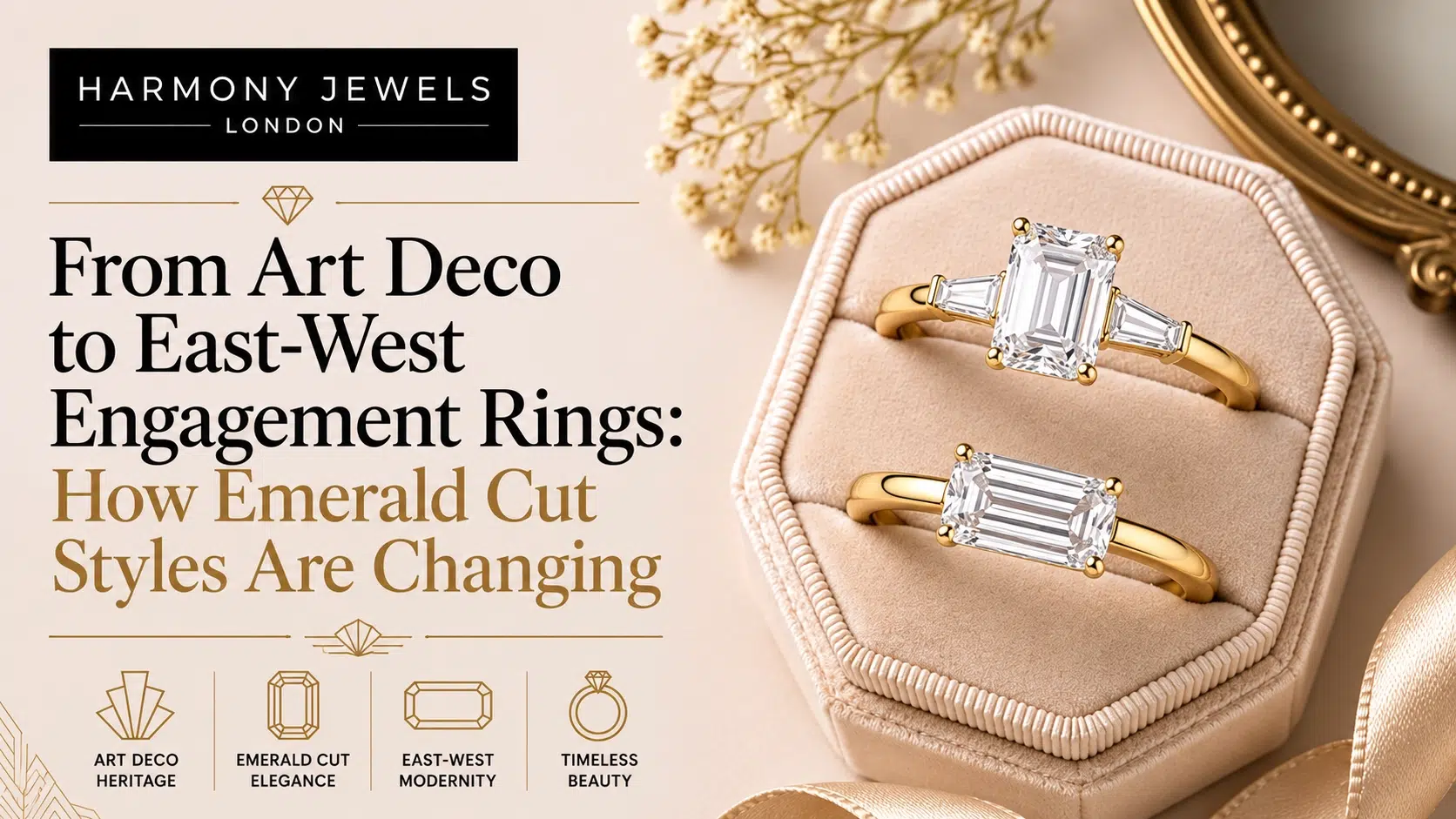
One of the most surprising evolutions of the emerald cut in recent years has been the rise of the east-west setting for this cut of diamond.
By and large, the emerald cut has traditionally been set vertically, along the length of the finger.
An alternative approach involves rotating the diamond so that its length is horizontal to the finger, rather than vertical.
While the diamond itself has not changed, its new orientation lends the ring a very different appearance.
Due to this subtle but meaningful change, an east-west emerald-cut engagement ring will possess a more contemporary feel.
While it retains the same sense of sophistication that has long been associated with this cut, it appears more modern and unconventional in its presentation.
As the east-west orientation suggests, this style of engagement ring is designed to make a statement.
Due to the change in diamond orientation, these rings tend to have a broader surface coverage than rings that utilise a traditional vertical setting.
As such, an east-west emerald cut engagement ring can be seen as a more adventurous take on this long-standing style of ring. Overall, the east-west movement has been a part of a larger shift, in which couples are seeking to reinterpret classic styles of engagement rings.
They do not necessarily want to abandon long-standing conventions, but they do not wish to feel beholden to them either. Instead of choosing between a traditional or contemporary style of ring, couples can opt to reinterpret tradition in a manner that speaks to their sensibilities.
Rather than completely reinventing the wheel with regard to the engagement ring, the east-west emerald cut achieves this by making a relatively small but very meaningful change to the orientation of the centre stone.
Yellow Gold Is Making a Comeback in Emerald Cut Engagement Rings
An additional way in which the emerald-cut engagement ring has evolved is the use of different metals for the band. While white metals have traditionally been favoured for their ability to complement near-colourless diamonds in an engagement ring, yellow gold is steadily making a comeback, thanks to its warm, rich undertones.
The interplay between the two can create a very striking effect in the right context, due in part to the cool appearance of the emerald-cut diamond and the warm appearance of yellow gold.
This change in metals can affect the way in which the proportions of the ring are perceived as well.
Rather than appearing quite narrow, a yellow gold band can lend the ring a certain amount of heft.
Meanwhile, a wider yellow gold band could make the ring appear even more contemporary, thanks to the broader presence that it lends the ring as a whole.
Rose gold is yet another viable option for metal in an emerald-cut engagement ring, as it strikes a pleasing balance between the warmth of yellow gold and the cooler tones that are typically associated with platinum and white gold.
Bezel Settings Are Enhancing the Contemporary Appeal of Emerald Cut Diamonds
Another way in which the emerald-cut engagement ring has been reimagined recently is the introduction of bezel settings.
Rather than using individual prongs to hold the diamond in place, a bezel setting makes use of a band of metal to secure the diamond within the ring. When applied to an emerald cut, this produces a very neat and sophisticated look that is very much in keeping with the aesthetic of the Art Deco period.
It is not difficult to see why an engagement ring that utilises a bezel setting would be very popular. Due to the way in which it accentuates the straight lines and rectangular shape of the emerald cut diamond, it lends the ring as a whole a very neat, contemporary appearance.
However, the appeal of a bezel setting is not strictly limited to its purely aesthetic qualities: it also serves a functional purpose, as it helps to protect the edges of the diamond from damage.
This makes it a very practical choice for someone who wishes to obtain a more contemporary ring but does not wish to sacrifice practicality.
Much like the other elements of the engagement ring, a bezel setting is not an immutable choice.
Depending upon the choice of metal and the overall design of the ring, a bezel setting could make the ring appear quite minimalist or rather vintage-inspired, depending upon the choices that have been made.
Three Stone Engagement Rings Are Being Reinterpreted
The three-stone style of engagement ring is yet another example of how this particular cut of diamond is being creatively reinterpreted for the modern era.
As the name suggests, this style typically makes use of three stones: two side stones and one centre stone. The two side stones typically appear on either side of the larger centre stone.
While this is a very classic style of engagement ring, and one which utilises an emerald-cut shape, contemporary reinterpretations tend to depart from this in interesting ways.
Due to the way in which an emerald cut is shaped, it can lend itself particularly well to a minimalist style of ring band. This effect is accentuated if the other two stones are not cut in the same way, or if the overall arrangement is quite restrained.
This could take the form of a larger centre stone, paired with two smaller emerald-cut stones or two stones that have been cut in a different manner altogether. Alternatively, the three stones could be arranged in a more triangular formation. The possibilities are by no means limited to this, but restraint is a factor that should be taken into consideration when creating a three-stone engagement ring in the style of an emerald cut.
Sculptural Bands Are Transforming Emerald Cut Engagement Rings
The cut of the diamond is arguably the most important element of an engagement ring, as it defines the ring as a whole. However, the ring band plays an equally important role, as it can dictate the character of the ring as a whole.
A perfectly straight band will produce a very classical appearance. A wider band can give the ring a greater sense of heft and presence.
However, a more sculptural band can produce an altogether different look and feel for the ring.
This is particularly true for an emerald-cut engagement ring, due to the very distinctive shape of the diamond. While this may appear to some as quite a rigid choice for a ring band, the addition of sculptural elements can lend the ring as a whole a greater sense of dynamism and motion.
Hidden Personalisations Are Becoming More Popular
It is not strictly necessary to alter the ring band or the setting in order to transform an emerald-cut engagement ring into something truly unique.
In fact, one of the simplest ways in which to accomplish this is to utilise hidden personalisation in some capacity.
This could take the form of an engraving on the inside of the band, or it could involve the use of a hidden gemstone or diamond. In any case, the alterations that have been made will not be readily apparent to the naked eye.
This is a particularly good choice for those who wish for their ring to retain an air of classic elegance, but who do not wish for others to perceive the ring as unremarkable or generic.
The Appeal of an Emerald Cut Diamond Has Remained Relatively Constant
Considering all of the changes that have been discussed above, it may seem as though the appeal of an emerald cut diamond has changed rather dramatically over the years.
However, this is not the case: the qualities that have made the emerald cut so appealing have remained relatively constant throughout its history.
Due to the elegance and restraint that it embodies, an emerald-cut diamond can lend itself to a ring that utilises a vintage-inspired setting or a minimalist band.
This makes it very versatile in terms of its application.
This versatility also means that an emerald cut can straddle the line between a vintage-inspired and a contemporary engagement ring. Due to this, it is not necessary to choose between a vintage or contemporary-style ring: an emerald cut can satisfy both sensibilities at once. Rather than representing a choice between two options, it encompasses both.
While this cut of diamond is far from being a novelty due to its long history, its versatility enables it to satisfy the sensibilities of contemporary couples, who wish for their jewelry to be truly unique.
Choosing the Perfect Style for an Emerald Cut Engagement Ring
If a couple is considering obtaining an emerald-cut engagement ring, it is important that they consider this type of ring from a holistic perspective.
They should examine the possibilities presented by the diamond itself before moving on to the possibilities presented by the band and any additional embellishments.
An important consideration is the shape of the ring itself: does a traditional vertical setting appeal to the tastes of the prospective bride and groom, or would an east-west setting be preferable? What about the choice of metals? Does a white gold band appeal more to one’s sensibilities or does one favour yellow gold? Does one prefer a minimalist solitaire or would a more geometric arrangement be preferable?
They should also consider what kind of jewelry they tend to wear in their everyday lives: an engagement ring should reflect this, rather than appearing as something that is completely unrelated.
Finally, one should also consider how one intends for the ring to interact with a future wedding band.
The Evolution of the Emerald Cut Diamond Engagement Ring
With that being said, the emerald-cut diamond has seen a very interesting evolution in terms of its design and presentation.
From the geometric stylings of the Art Deco period to the contemporary appeal of an east-west setting, this cut of diamond can lend itself to a variety of different styles of engagement ring.
What makes it so interesting is the fact that it does not need to be radically altered in order to achieve this effect.
A relatively small change to the orientation of the diamond or the choice of ring band can produce vastly differing results.
Due to the versatility of this cut of diamond, it is the perfect choice for anyone who wishes to obtain an engagement ring that is not only unique but also appeals to one’s sensibilities.
With that being said, the most interesting modern engagement rings are not those that are trying to adhere to every single trend that has emerged. Rather, they focus on combining the elegance of a more traditional approach with the ingenuity and individualism of a more contemporary approach.
Harmony Jewels specialises in creating bespoke engagement rings in Hatton Garden, London, wherein the choices that are available to the prospective bride and groom are not restricted to the diamond cut, its setting and other embellishments.
Instead, they are encouraged to view the ring as a whole, rather than as a collection of individual elements.