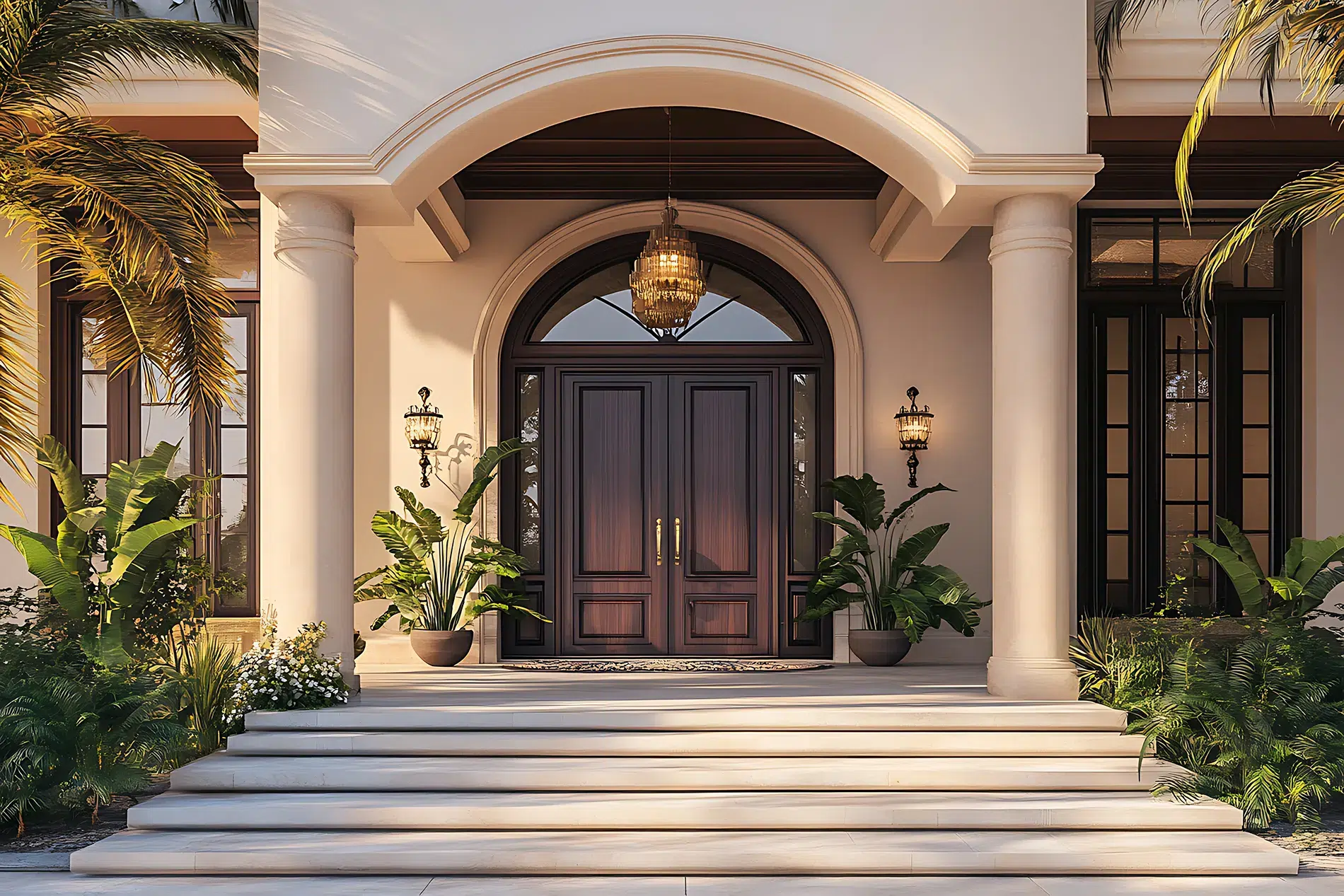
During a spec review for a $4 million coastal new build, the architect had a ten-foot pivot door, hand-selected veneer, and custom sidelites on the schedule.
The hardware line showed a builder-grade tubular latch set from a standard catalog.
That single mismatch would have weakened every decision around the opening. The feel in hand, the security, and the weather seal all would have suffered because of one overlooked line item.
The front door is the first physical proof of a home’s quality. When you get it right, you add curb appeal and measurable return. In the 2024 Cost vs. Value Report, steel entry door replacement delivered an average 188% return on investment nationally, one of the highest ROIs of the year.
Get it wrong, and even strong architecture can feel unfinished.
Affluent buyers notice real materials, tight gaps, and the hand-feel of a Grade 1 mortise set. Poor seals, flimsy hardware, and mismatched finishes pull the whole facade down.
Start with the climate, then match the slab, hardware, finish, and procurement plan to it.
Use this as a spec-first playbook, not an inspiration board.
Key Takeaways
A luxury entry works when design, hardware, and weather protection are specified as one system.
- Curb appeal pays. Entry door replacement posted one of 2024’s highest national ROIs. A well-specified custom entry adds design impact, security, and performance at the same time.
- Hardware is not decoration. Builders Hardware Manufacturers Association, or BHMA, Grade 1 mortise sets and multipoint locks improve security, durability, and weather sealing across the full height of the door.
- Finish choice is a performance choice. PVD-coated hardware stands up far better in salt air than clear-lacquered plated finishes. Pick finishes for the site, not just for the mood board.
- Comfort is engineered. Insulated slabs, full-perimeter gaskets, and automatic door bottoms reduce drafts and noise in a way buyers can feel on day one.
- Smart locks need standards. Specify Apple Home Key or Matter compatibility where it fits, verify UL 294 when access control is involved, and keep a keyed override.
- Procurement prevents rework. Finalize handings, backsets, finishes, and labels early so installers are not making field decisions at the front door.
What Makes a Custom Entry Door “Luxury”?
Luxury shows up in measurable details, not just a higher price tag.
Think of the entry as a full system: slab, frame, threshold, weather seals, hardware, glazing, and controls. Each part affects appearance, security, comfort, and service life. Miss one, and the system underperforms.
The material palette sets the tone. Wood brings warmth but needs an overhang and regular care. Steel offers strength and slim sightlines, but it needs a thermal break to slow heat transfer. Fiberglass stays stable through seasonal swings and can carry convincing wood-grain veneers. Sidelites, transoms, and decorative glass should use laminated or insulated glazing for better sound and energy control.
Hardware defines the feel. A mortise set, which houses the lock body inside a pocket cut into the door edge, gives you weight, serviceability, and a more precise action than a tubular latch. That difference is easy to feel the first time someone opens the door.
Performance labels matter too. Specify National Fenestration Rating Council, or NFRC, labels on glazed doors so you can compare U-factor and solar heat gain coefficient, or SHGC. Choose an ENERGY STAR certification that matches the climate zone. For hardware, specify BHMA-tested products under ANSI/BHMA A156 standards so security, durability, and finish quality are verified, not assumed.
3 Big Benefits of Custom Entry Doors
A custom entry earns its keep in resale value, daily security, and comfort.
1. Curb Appeal That Appraises
A strong entry upgrade changes how the whole house reads from the street. National data support the resale lift, and custom doors add a level of distinction that stock products rarely match.
A traditional facade, for example, can look far more expensive with a dark satin-finished door, refined hardware, good lighting, and house numbers that share the same finish language. Zillow’s design research links black front doors with higher resale prices than several other door colors. Good entry design also photographs well, which matters long before an appraiser walks the site.
2. Security, Control, and Peace of Mind
Grade 1 locks, reinforced strikes, and multipoint compression reduce forced-entry risk and improve day-to-day use.
Specify a Grade 1 mortise set with a one-inch throw deadbolt and reinforced strike plate at the main entry. BHMA Grade 1 locksets are tested through as many as 800,000 latch and unlatch cycles, which signals the highest residential performance tier. For tall slabs and double doors, multipoint locking adds hooks or bolts at the top and bottom as well as at the center. That system pulls the slab tight to the frame at several points instead of just one.
Smart access can help, but only when standards are clear. Apple Home Key allows tap-to-unlock from a supported iPhone or Apple Watch. Matter helps devices work across major smart-home platforms. Where the lock ties into a larger access-control system, verify UL 294 listing and keep a mechanical keyed override in the spec.
3. Comfort, Efficiency, and Quiet
Most air and noise leaks happen at the edges of the door, not through the slab itself.
A solid-core door with good perimeter seals and a quality bottom seal usually reaches a sound transmission class, or STC, of about 30-35. Fully gasketed acoustic assemblies can reach STC 40-50, where speech privacy becomes much more realistic. Most steel and fiberglass-clad entry doors offer about R-5 to R-6, not counting glazing. Verify U-factor and SHGC with NFRC labels, and confirm ENERGY STAR eligibility if the owner plans to claim the federal 25C tax credit, which covers 30% of product costs up to $250 per door and $500 total per year.
What to Specify (So Your Entry Performs Like It Looks)
Start with the mechanics and seals, because the prettiest slab cannot cover weak hardware or a poor weather seal.
Locking architecture. Mortise sets deliver longer service life, easier repair, and a better feel in use than tubular latches. Look for products tested to ANSI/BHMA A156.13. Reserve tubular latches for interiors or secondary doors where traffic and exposure are lower.
Multipoint versus single-point. Specify multipoint locking on doors eight feet or taller, on double doors, and on entries in windy or coastal zones. The pull-in compression helps keep tall slabs straight and improves both air and water sealing.
Hinges versus pivots. Hinged doors are easier to seal and simpler to service. Pivot doors make a stronger visual statement and support heavier slabs, but they need more discipline in the details. Engineered pivots such as the FritsJurgens System M+, rated for doors up to 500 kg, add latch control to help the door close correctly. In very airtight homes, a leaking entry door can account for a large share of measured air leakage, so thresholds, seals, and adjustments cannot be an afterthought.
Finishes and base metals. In coastal settings, specify physical vapor deposition, or PVD, coated brass or stainless steel, or step up to 316 stainless. PVD-coated hardware can withstand more than 1,000 hours of salt-spray testing under ASTM B117. Clear lacquered plated finishes may last only 24-48 hours in the same test range, so they are a poor choice near the ocean. In urban settings, PVD black, satin bronze, and unlacquered brass can all work well if the owner accepts the patina. Match visible fasteners and accessories, and require a sample board sign-off.
Smart and standards. Where smart access matters, choose supported platforms early and confirm power, lock prep, and trim compatibility before ordering. If the system connects to broader access control, verify UL 294 compliance and keep a keyed override.
Where Custom Doors Shine (Materials, Form Factors, and Climate Choices)
Material should follow exposure, not trend.
Wood offers unmatched warmth, but it needs overhang protection, marine-grade finish systems, and a real maintenance plan. Steel gives you strength and slim profiles, but it needs thermal breaks and factory corrosion protection. Fiberglass brings strong insulation and dimensional stability, which makes it a practical choice in climates with wide swings in heat and humidity.
Oversized pivots can work beautifully, but they need help controlling air leakage. Use continuous seals, automatic door bottoms, and latch control, then verify the results during commissioning with a blower-door test, which measures whole-house air leakage. Keep NFRC and ENERGY STAR labels in the project file so performance and incentive claims can be checked later.
Where to Source: Trade vs. Retail (Procurement, Lead Times, and Quality Checks)
Buy the entry as one coordinated package so the slab, frame, hardware, glazing, and controls fit on day one.
Once you know the exact slab thickness, handing, multipoint prep, finish stack, and label requirements, it helps to compare complete door packages from trade suppliers rather than mixing catalogs, since consistent prep and clearer lead times reduce rework later; at that stage, many teams review options, pro pricing, and lead times at doors for pros before issuing final approvals.
Trade channels usually offer deeper hardware catalogs, stronger mortise and multipoint support, and better finish matching across accessories than a retail showroom. Ask for shop drawings, a complete hardware schedule, finish samples, and copies of NFRC, ENERGY STAR, and BHMA documentation before release.
For quality checks, require a factory or bench-assembled test fit for mortise and multipoint sets. Confirm handings, backsets, prep patterns, and strike locations before the slab leaves the shop. That step can feel slow during procurement, but it is much faster than field rework after paint and trim are complete.
How to Measure Impact (Value, Comfort, and Reliability)
Performance is easiest to defend when you measure value, noise, and air leakage after installation.
For resale, compare local comps and keep the Cost vs. Value data on file. For quiet, take before-and-after readings in the foyer with a smartphone sound meter app and look for a five to ten decibel reduction from better seals and glazing. For airtightness, confirm perimeter seal performance during a blower-door test and adjust strikes or automatic bottoms as needed.
Make Your Entry a Signature Statement (Without Sacrificing Performance)
The best entries look distinctive because they are specified with the same rigor as the rest of the envelope.
Finalize the hardware schedule before framing closes up. Require multipoint locking on tall and double doors. Choose PVD or 316 stainless for marine exposure. Verify smart-lock standards early. Demand labels, samples, and a physical mockup when the project warrants it.
A custom entry door connects design ambition to daily experience. When you spec it with the same care as the facade and the building envelope, it returns curb appeal, comfort, security, and long service life.
FAQ
These questions cover the last decisions that usually slow down approval or ordering.
Do Pivot Doors Always Leak More Than Hinged Doors?
Not always. Large openings are harder to seal, but engineered pivots with latch control, continuous gaskets, automatic door bottoms, and careful threshold details can perform very well. The key is to verify the assembly during commissioning, not to assume it is airtight because it looks precise.
What Is the Difference Between BHMA Grade 1 and Grade 2 for Luxury Doors?
Grade 1 is the highest performance level for security, durability, and finish under BHMA standards. It is the right default for a luxury primary entry. Grade 2 can work at a lower-use secondary door, but it is not the best choice for the main front door.
Are Smart Locks Secure Enough for a Luxury Home?
They can be, if the hardware is reputable and the spec is disciplined. Choose supported platforms such as Apple Home Key or Matter where they fit the owner’s ecosystem, verify UL 294 where access control applies, and keep a keyed mechanical override for backup.
What Finishes Hold Up Best Near the Ocean?
PVD-coated hardware and 316 stainless hold up far better than clear-lacquered plated finishes in salt-heavy air. Unlacquered brass will change quickly in that environment, so either accept the patina as part of the design or choose a more stable finish system.
What STC Should I Target for a Quiet Foyer?
For most homes, an STC of 30-35 is a solid target for the entry assembly. If the site sits near traffic, shared drives, or heavy wind exposure, push higher with laminated glass, full gasketing, and an automatic door bottom.
Wood vs. Steel vs. Fiberglass: What Is Right for Me?
Choose based on exposure, upkeep, and design intent. Wood brings warmth but needs maintenance. Steel brings strength and slim profiles but needs thermal and corrosion control. Fiberglass offers strong stability and insulation, which makes it a dependable option in demanding climates.