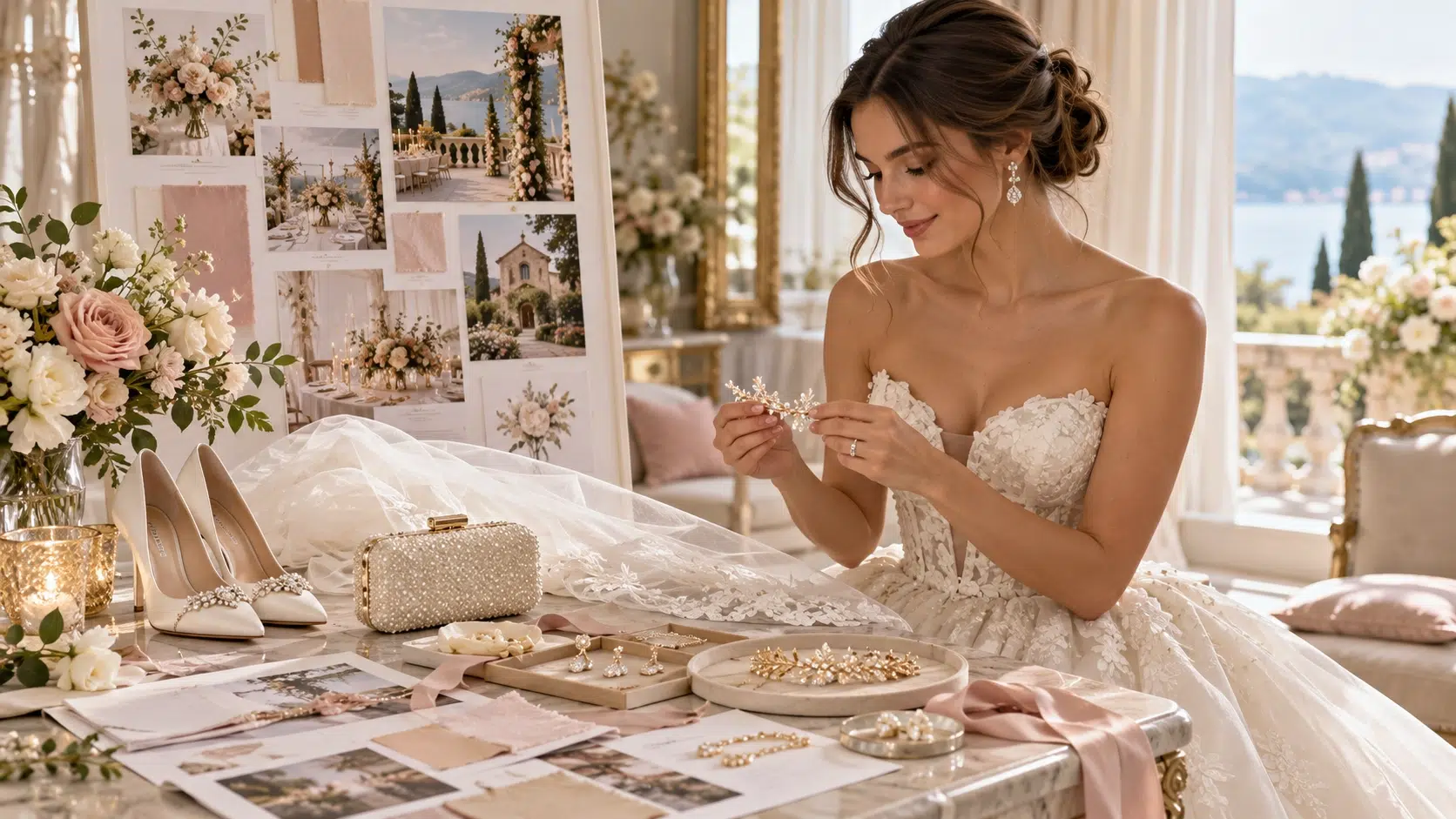
Wedding accessories do far more than decorate an outfit. They shape the overall silhouette, influence how photographs turn out, and affect comfort during what is often a very long day. The right pieces support the dress, the hairstyle, and the wearer’s personality instead of competing for attention. For many brides, choosing bridal earrings is one of the first and most personal decisions in building out a complete accessory plan—one that also includes hairpieces, necklaces, bracelets, and sentimental items passed down from family. This article lays out a practical framework for making those choices, grounded in proportion, material safety, comfort, coordination, and proper care.
Start With the Dress and Overall Silhouette
Assess the Neckline
The neckline and sleeve design help determine how accessories should be scaled. Higher necklines, modest collars, and layered necklines generally pair well with simple necklaces or carefully chosen earrings, helping the overall look feel balanced. A pendant can complement a V-shaped design when the outfit provides appropriate coverage, while a simpler neckline may look elegant without a necklace. Coordinating earrings, a hairpiece, or a bracelet with the dress offers a polished result without relying on exposed shoulders or revealing cuts. These are flexible styling guidelines, and comfort, modesty, and personal preference should guide the final choice.
Consider Fabric and Embellishment
Lace, satin, silk, beading, embroidery, and sequins each create their own distinct visual texture. Heavily embellished fabric can easily clash with accessories that carry equally busy detailing, resulting in a cluttered look once the photographs come back. Rather than trying to match every design element literally, it’s often more effective to repeat just one subtle detail—a pearl finish, a particular metallic tone, or a recurring geometric shape—so the whole look feels cohesive without becoming repetitive.
Match Accessories to Proportion
Dress volume, train length, sleeve detail, and individual body proportions all play a role in how large or small an accessory should feel. Instead of choosing each piece in isolation, it helps to evaluate the complete outfit together in a full-length mirror. Aim for balance, not perfect matching.
Coordinate Accessories With Hair, Makeup, and Face Shape
Account for the Hairstyle
Updos, short hair, braids, and loose waves each change how visible and how mobile an accessory will be throughout the day. Larger or more detailed pieces tend to stand out more when the hair is pulled back and away from the face. It’s worth trying on accessories with the planned hairstyle well before the wedding, rather than assuming they’ll look the same as they did on a hanger.
Use Face Shape as a Flexible Styling Aid
Face-shape guidance can be a useful starting point, but it shouldn’t feel like a restriction. Elongated, rounded, angular, or mixed face shapes may interact differently with drop, hoop, cluster, or linear earring designs. At the end of the day, though, comfort, personal taste, and how a piece photographs matter far more than any generalized rule.
Consider Makeup and Veil Details
Reflective metals and stones can behave unpredictably once highlighter, shimmer products, and camera flash enter the picture. A trial run with the veil, hairpins, and full makeup look is the best way to catch tangling, visual clutter, or unwanted glare before the actual event.
Key takeaway: Accessories should complement the dress and remain comfortable throughout the entire event.
Choose Materials With Comfort and Skin Sensitivity in Mind
Check Metal Composition
Before committing to a piece, it’s worth verifying the metal content and plating, especially for anything that sits directly against the skin. Nickel and cobalt are common culprits behind jewelry-related allergic dermatitis, particularly around the earlobes. The term “hypoallergenic” isn’t a universally regulated guarantee, so verify materials when skin sensitivity is a concern.
Plan for Extended Wear
Weight, closure security, sharp edges, and earring-post length all affect how comfortable a piece remains over several hours. Wearing something similar for an extended stretch beforehand can reveal pressure points that never show up during a quick fitting.
Comfort checklist:
– Confirm metal composition and plating
– Check weight and pressure points after extended wear
– Test closures for security and ease of use
– Pack spare backs and a small storage case
Include a Health-Safety Caveat
Persistent itching, redness, swelling, blistering, or scaling near jewelry contact points can signal a metal allergy. Anyone noticing these symptoms should stop wearing the triggering item and consult a qualified healthcare professional; patch testing can help pinpoint the specific allergen involved.
Create a Cohesive Metal and Color Palette
Select a Dominant Finish
Warm, cool, and mixed-metal palettes each produce a different effect, and none is inherently the “right” choice. Metal selection can tie into the dress color, wedding bands, hair accessories, and even shoe hardware. When mixing metals on purpose, repeating the secondary finish somewhere else in the look helps it read as an intentional choice rather than an inconsistency.
Use Pearls and Gemstones Thoughtfully
Pearls, clear stones, colored gemstones, and crystals each carry their own level of formality and contrast. Sentimental or inherited pieces are always worth considering, as long as their color and scale genuinely suit the outfit rather than being worn simply out of obligation.
Test the Full Look Before the Wedding
Conduct a Practical Fitting
Trying on the dress, shoes, veil, hairstyle, makeup, and accessories all together surfaces issues that isolated fittings tend to miss. Checking the outfit under natural light, indoor lighting, and in photographs can reveal tangling, unexpected noise, or pieces that shift with movement.
Pre-wedding test checklist:
– Wear the full look for several hours in ordinary conditions
– Photograph front, side, and seated angles
– Check for tangling with hair or veil fabric
– Confirm reflective pieces don’t cause unwanted glare
Prepare a Backup Plan
Packing spare fasteners, a small repair kit, and a secure case—and assigning one trusted person to look after the accessories on the day itself—goes a long way toward avoiding last-minute stress.
Care for Accessories Before and After the Event
Clean According to the Material
Following the maker’s specific care instructions is always safer than applying a one-size-fits-all cleaning method. Many colored gemstones tolerate mild soap, lukewarm water, and a soft brush just fine, while more delicate materials call for gentler handling. Cleaning should never happen over an open sink, where small components can easily slip away and get lost.
Protect Pearls and Delicate Surfaces
Pearls are especially sensitive to perfume, hairspray, and harsh chemicals. Wiping them gently after each wear and storing them separately in a soft pouch helps preserve their surface over time. With frequent wear, a professional inspection may eventually be worthwhile, depending on how the piece is constructed.
Store and Inspect Properly
Keeping pieces separated prevents scratching and tangling, and checking clasps, posts, and settings before each wearing helps catch small issues early. Apply fragrance and hairspray before putting on jewelry.
Final Perspective
Choosing wedding accessories works best as a sequence: start with the dress, coordinate with hair and makeup, evaluate material safety and comfort, test the complete look, and care for each piece properly afterward. When these steps line up, the result is a look that supports confidence, ease of movement, and photographs worth keeping. Building the full look several weeks in advance—and testing it on an ordinary day—leaves plenty of room for small adjustments before the wedding itself.