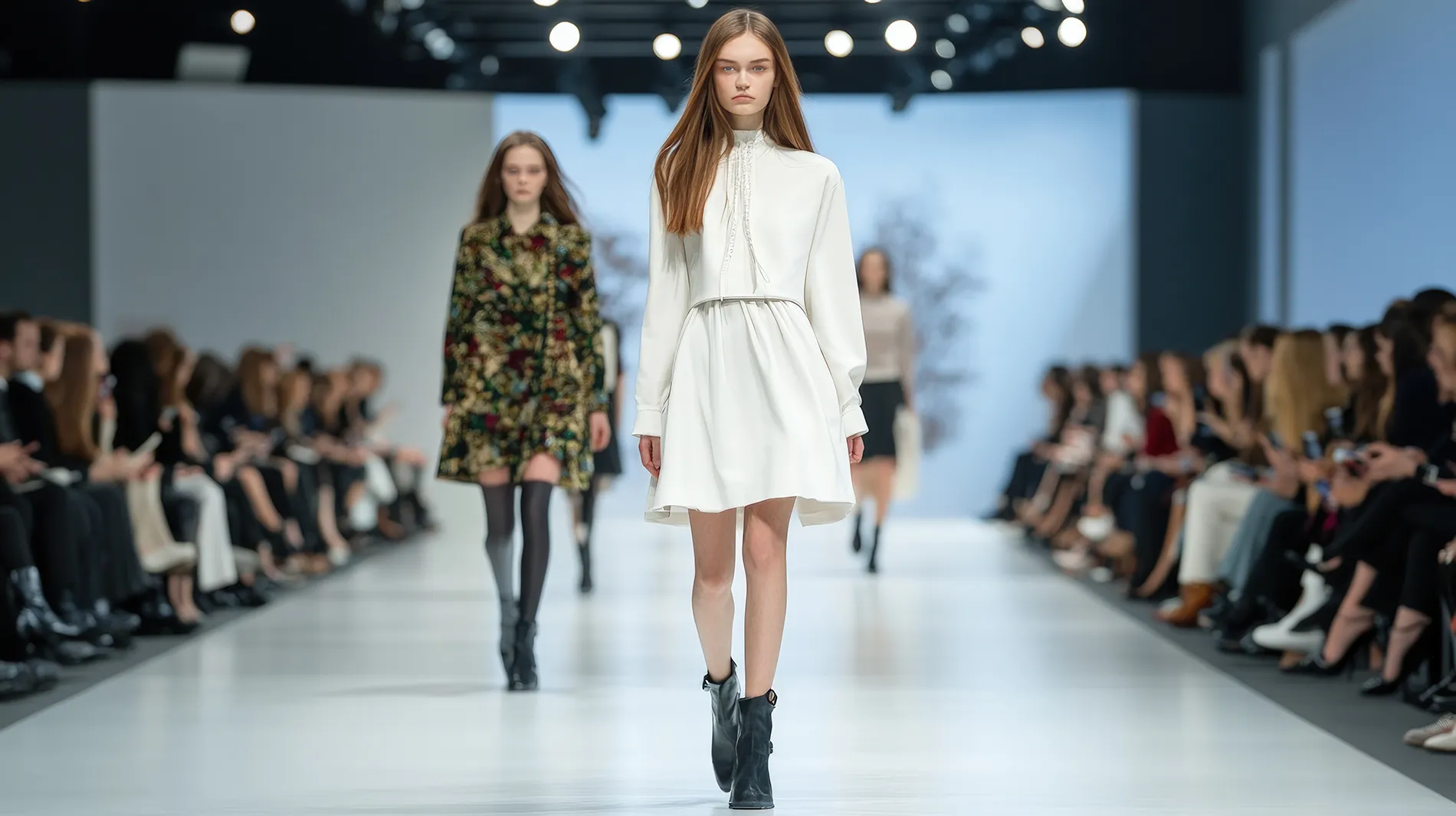
For decades, the fashion industry has thrived on a delicate balance of art and commerce. The ethereal beauty of a haute couture gown and the gritty realism of a streetwear drop were traditionally promoted through instinct, exclusivity, and human taste. But the velvet rope is being pulled back by an unlikely bouncer: Artificial Intelligence.
What was once a buzzword reserved for tech conventions has become the creative director’s newest assistant, the media buyer’s secret weapon, and the stylist’s digital muse. From generating hyper-personalized lookbooks to predicting the next “viral” color before it trends on TikTok, AI is not just changing how fashion sells; it is fundamentally rewriting the rules of aesthetic persuasion.
This article explores the seismic shift in fashion marketing, examining how generative AI, predictive analytics, and computer vision are creating a new era of efficiency, creativity, and controversy.
The End of the Generic Advert: Hyper-Personalization
The first major disruption AI brings to fashion promotion is the death of the “one-size-fits-all” campaign. Traditional marketing relied on broad demographics—women aged 18-35, urban dwellers, etc. Today, AI allows brands to speak to the individual.
Consider the “skinny mirror” evolution. AI-powered visual recognition tools can now analyze a customer’s past purchases, browsing behavior, and even social media activity to generate a unique video advertisement in real-time. If a customer has been looking at “Y2K flared jeans” and “chunky sneakers,” the AI will automatically serve them a campaign video featuring those exact items styled together, rather than a generic shot of a trench coat.
Levi Strauss & Co. experimented with this using AI models to increase the diversity of product representation without massive photoshoots. While controversial, the marketing logic is sound: AI allows for hyper-segmentation. A single campaign can generate thousands of variations—different skin tones, body shapes, and backgrounds—to ensure the consumer sees themselves reflected in the product. This level of personalization is proven to lift conversion rates by double digits, as the friction between “seeing an ad” and “seeing my style” disappears.
Generative AI: The Infinite Lookbook
The most visible trend in 2024-2025 has been the rise of Generative AI (GenAI) tools like Midjourney, DALL-E 3, and Stable Diffusion. Fashion marketers are no longer limited by physical samples or location scouting.
For lookbook creation, the workflow has been compressed from weeks to hours. Instead of flying a team to a desert in Morocco, a creative director can now prompt: “Fashion editorial, autumn collection, minimalist tailoring, soft pink lighting, foggy Seoul street, cinematic, 8K.” Within minutes, the AI generates a series of plausible, high-res images.
This isn’t just for scrappy startups. Luxury conglomerates are using GenAI to test concepts. A marketing team can generate 500 different visual concepts for a new handbag launch and use eye-tracking AI to determine which composition, color scheme, or model pose generates the most emotional engagement before a single real photograph is taken.
Furthermore, AI is revolutionizing the copywriting of fashion promotion. Tools like Jasper and ChatGPT are being fine-tuned on luxury brand guidelines. They can now generate 1,000 unique product descriptions—from the technical “water-resistant nylon” to the emotional “a silhouette that whispers confidence”—in seconds. This allows brands to optimize descriptions for SEO without losing the poetic voice required for high-end fashion.
Predictive Analytics: Forecasting the “It” Factor
Fashion is notoriously fickle. What is “in” at 9:00 AM is “out” by 2:00 PM. Traditionally, brands relied on runway shows and trend forecasters like WGSN. Now, they rely on scraped data.
AI-driven predictive analytics scans millions of data points: Reddit threads, TikTok hashtags, Pinterest saves, and even the background colors of Instagram stories from influencers. The AI identifies micro-trends before they explode.
For example, during the “Coastal Grandmother” aesthetic trend of 2022, AI algorithms detected a statistical anomaly in searches for “linen,” “rattan,” and “Beige” three weeks before the media named the trend. Marketers who used these AI insights were able to pivot their paid social campaigns immediately, bidding on keywords related to “quiet luxury” before their competitors.
This extends to pricing and inventory promotion. AI dynamic pricing tools adjust promotional offers in real-time. If a particular jacket is getting high engagement on Instagram but low sales, the AI might automatically generate a “limited time” 15% off code to that specific Instagram audience segment, or bundle it with a trending accessory to boost average order value (AOV).
Virtual Try-Ons and The Augmented Storefront
The Achilles’ heel of online fashion marketing is the return rate. With online purchases averaging a 30% return rate (and up to 40% for apparel), the cost of promotion is nullified by logistics nightmares. AI is solving this through Augmented Reality (AR) and Virtual Try-On (VTO).
AI-powered VTO has evolved past the clunky Snapchat filters. Using Neural Rendering, AI can now accurately simulate how a silk dress drapes over a moving body or how a wool sweater textures against different lighting. Brands like Gucci and Warby Parker have integrated this into their ad units directly on Meta and Google.
This changes the marketing message. Instead of “Buy this shirt,” the ad becomes “See yourself in this shirt.” The interactive nature of AI-powered ads increases “dwell time”—the amount of a user stares at an ad—by 400%. For marketers, dwell time is a primary signal of intent. By allowing the consumer to play with the product via AI, the brand bypasses rational objections and taps into the emotional, tactile desire that physical stores excel at.
The Ethical Velvet Rope: Diversity, Deepfakes, and Data
Of course, the rise of AI in fashion promotion is not without its backlash, and marketers must tread carefully. The “controversy” mentioned earlier regarding Levi Strauss is a case study in modern PR risk. Levi’s partnered with AI company Lalaland.ai to create digital models to supplement human models, aiming to show more diverse body types and skin tones quickly.
The internet reacted with fury. Critics argued that AI models would replace plus-size, elderly, or disabled models who already struggle to find work. Others called it a “digital blackface” if the AI generated a Black model without the cultural context. Levi’s quickly backtracked, stating they would not scale the pilot.
This highlights the golden rule of AI fashion promotion: Transparency. Marketers must disclose when an image is AI-generated. If consumers feel deceived—believing they are looking at a real human in a real garment when they are not—trust evaporates. The European Union’s AI Act and platform policies from TikTok and Instagram now require labeling of synthetic media.
Furthermore, data privacy is paramount. The “hyper-personalization” described earlier requires vast amounts of consumer data. Fashion marketers must navigate the post-cookie world and iOS privacy updates. The most successful AI campaigns will be those built on zero-party data (data the customer willingly gives, like style quizzes) rather than shadowy tracking.
Case Study: The AI Influencer vs. The Human Curator
Perhaps the ultimate expression of this shift is the rise of the virtual influencer. Meet Aitana Lopez, a pink-haired AI model from Spain who earns over $11,000 per month and has tens of thousands of Instagram followers. She is entirely synthetic.
Brands like Pull&Bear and Bulgari have used AI influencers for sponsored posts. The marketing benefits are obvious: they never age, never get into scandals, never show up late to a shoot, and can be photographed wearing 50 outfits in one simulated day.
However, data suggests that while AI influencers drive initial curiosity and high engagement rates (likes/comments), they struggle with “trust conversion”—actually getting the user to click “buy.” Human influence relies on aspirational empathy (“I want to look like her”). AI influence relies on spectacle (“That’s cool, but it’s fake”).
The winning strategy appears to be hybrid. Human creative directors use AI tools to generate mood boards, while human models remain the face of the brand. AI handles the boring stuff (retargeting ads, inventory recommendations, email subject lines) while humans handle the emotional connection (brand storytelling, ethical production claims, community management).
The Future: Real-Time Reactive Fashion
The next frontier is real-time “reactive” fashion marketing. Imagine a live television event—say, the Met Gala. As Zendaya walks the red carpet in an iconic look, an AI system is already scraping that image, generating a “dupe” or “inspired” product page, creating a 15-second video ad, and serving it to users who have searched for “red carpet dresses” in the last hour. The latency between “cultural moment” and “marketing activation” will shrink to zero.
Additionally, AI will move from image generation to video generation. Sora by OpenAI has already hinted at a world where high-definition video campaigns are rendered entirely from text. The cost of producing a 30-second Super Bowl ad—traditionally millions of dollars—could drop to near zero, democratizing fashion promotion for independent designers but flooding the market with noise.
Conclusion: The Algorithm and the Aesthetic
The rise of AI in fashion promotion is not the death of creativity; it is the decoupling of creativity from budget constraints. A solo designer in a bedroom can now access the visual firepower that once required a team of 20. A global luxury house can now serve a bespoke ad to a customer in Tokyo that feels like it was made just for them.
However, fashion marketing will always remain a human-centric endeavor. AI can predict the trend, generate the image, and place the bid, but it cannot feel the fabric or desire the status. The brands that win will be those who use AI to handle the scale, speed, and mundane repetition of promotion, freeing up the human marketers to focus on the illogical, beautiful, and risky human emotions that make fashion an art form.
The catwalk is still there. It is just now being lit by code.