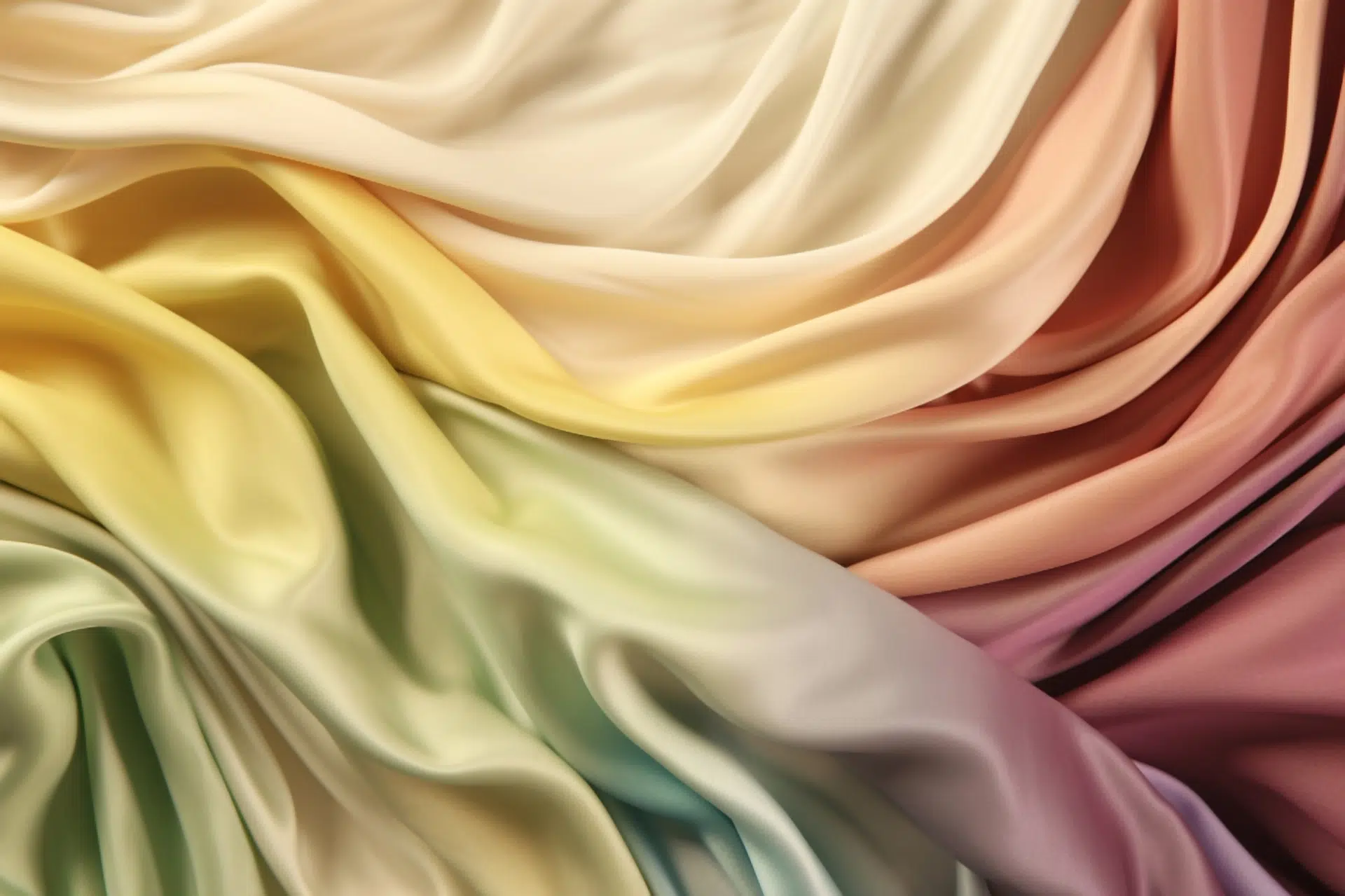
There is a quality that separates premium fabric from ordinary textile — and it is not always obvious to the eye. It lives in the depth of colour, in the way light plays differently across the surface of the same garment, in the subtle dimensional quality that makes a luxury piece feel alive rather than flat. Much of this effect comes not from dye alone, but from the fibre itself.
Cationic dyeable polyester is one of the textile industry’s best-kept technical secrets — a modified polyester fibre engineered to accept a fundamentally different class of dye than standard polyester. When woven or knitted alongside regular polyester in the same fabric, a single dyeing process produces two distinct colours simultaneously on the same cloth. The result is a two-tone or mélange effect achieved at the fibre level, with a depth and consistency that surface printing or yarn-dyeing cannot replicate.
This technology underpins a significant proportion of the premium fabrics appearing in contemporary luxury fashion and high-end home textiles — in the iridescent weaves, tonal knits, and space-dyed textiles that define the more considered end of the market.
Why Fibre Specification Matters in Luxury Goods
For discerning consumers of fashion and interiors, the conversation rarely extends to the yarn specification behind the finished product. But it should. The choice of fibre — its denier, its twist, its dyeability — determines not only how the fabric looks but how it behaves over time: whether colour holds its vibrancy after repeated washing, whether the hand feel remains consistent across a production run, whether the two-tone effect reads as intentional precision or accidental variation.
Cationic dyeable polyester works by accepting cationic (basic) dyes instead of standard disperse dyes. When combined with regular polyester in a single fabric, the two fibre types absorb different dye molecules simultaneously — producing two distinct colours in one dyeing pass, at no additional dyeing cost compared to a standard single-colour process. For manufacturers producing premium textiles, this efficiency at the dyeing stage translates directly into tighter colour control and more consistent results across production runs. Yaakan
The Cationic Series in Practice
Yaakan’s cationic series covers ECDP DTY from 30D to 200D, CD SD DTY from 20D to 600D, CD Bright DTY from 50D to 300D, CD Bright FDY at 50D/24F, and Composite CD+SD from 50D to 300D — a range that spans the full spectrum of luxury fabric applications, from lightweight fashion knits to structured woven textiles and premium home furnishing fabrics.
The composite CD+SD variant is particularly significant for luxury application: by combining cationic and standard polyester components within a single yarn structure, it delivers the two-tone effect at the yarn level rather than requiring separate fibre integration at the weaving or knitting stage. The result is a more controlled, more consistent colour separation — and a fabric that reads as precisely engineered rather than incidentally decorative.
Colour as a Material Quality
In luxury goods, colour is not merely aesthetic. It is a signal of craft, of intention, of the technical depth invested in the product. The difference between a two-tone textile produced through cationic fibre engineering and one achieved through surface treatment or blended dyeing is not always visible in a single glance — but it is felt in the hand, seen in the light, and experienced in the way the fabric holds its character over time.
For those who choose their textiles and fashion with genuine attention to what goes into them, understanding the technology behind the surface is part of the appreciation. And increasingly, that technology begins at the fibre.