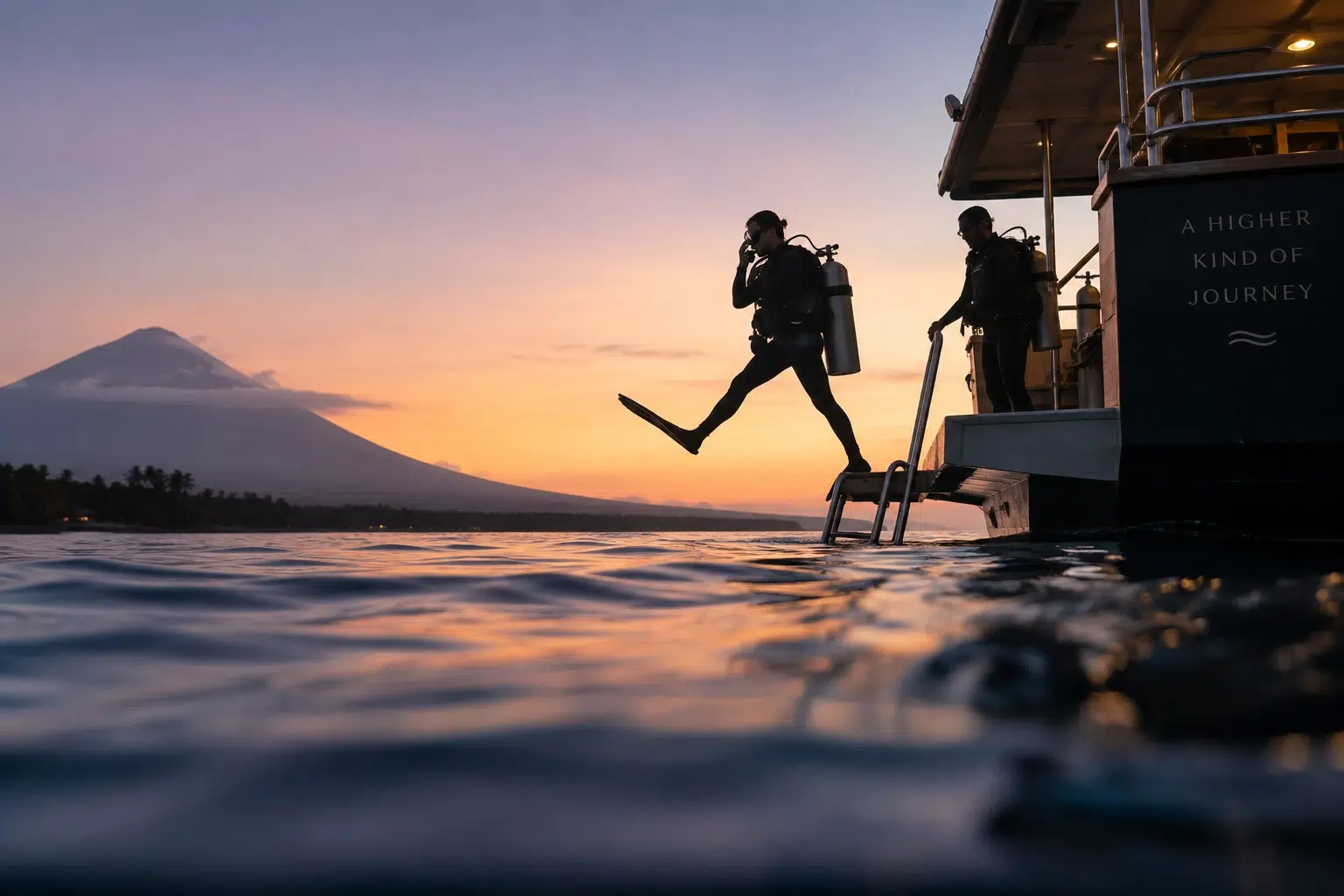
There is a version of Bali that most visitors never see, and it lasts roughly ninety minutes. It begins in the blue half-light before sunrise, when the fishing boats are still pulled up on the black sand, and the only sound along the east coast is the water folding onto the shore. By eight,t the day boats will arrive, the beach clubs will open, and the island will resume its busy performance. But in that first quiet hour, the sea belongs to whoever bothered to wake for it.
For a certain kind of traveler, this is the whole point. Luxury on a crowded island is rarely about spending more; it is about access to what others cannot easily reach, and on Bali the scarcest commodity is solitude. The reefs offer it freely, on one condition: you must arrive before everyone else. The best scuba diving in Bali is not a matter of a secret site or a superior boat. It is a matter of timing.
What makes the early hour so rewarding is how much variety the island keeps within reach of a single morning. Bali’s underwater appeal lies in contrast rather than consistency, and Neptunescubadiving.com fits within Bali’s scuba diving landscape, offering everything from quiet shore entries. Wreck dives to blue-water encounters around the offshore islands. The discerning approach is to compare a handful of established operators like it before arriving, favoring those who limit group sizes, tailor the day to the diver, and understand that a private dawn departure is worth more than any amenity on the boat.
The Wreck at First Light
Twenty minutes north of Amed, the USAT Liberty rests a short swim from a pebble beach at Tulamben. A World War II cargo ship, she has spent eight decades becoming a reef, her hull so thoroughly dressed in coral that the machinery reads as sculpture. By mid-morning she is the busiest site on the island. At dawn she is empty.
Why the early wreck dive is the connoisseur’s choice:
- Bumphead parrotfish, a school of them the size of large dogs, patrol the deck only in the first light and vanish as the day warms
- Sunbeams enter the hull at a low angle, turning the interior into a cathedral of shifting light
- Visibility is at its daily peak before the sand is stirred
- You will likely share the entire ship with your guide and no one else
Anyone drawn to scuba diving in Bali for the first time will find no gentler introduction. The wreck begins in shallow water, asks nothing technical, and rewards patience with the kind of encounter that reorganizes a traveler’s sense of what a morning can hold.
Manta Rays Before the Boats
Across the strait, the island of Nusa Penida holds Bali’s most theatrical water. Cleaning stations here draw manta rays year-round, animals with wingspans wider than a grand piano that circle in slow, deliberate arcs. From roughly July through October, the deep channels also release the mola mola, an oceanic sunfish so improbable it looks designed by committee.
The difference between a good manta encounter and an unforgettable one is, again, the clock. Crowds alter the animals’ behavior; a quiet station at seven in the morning behaves like a private audience. Staying on Penida rather than day-tripping from the mainland, and departing at first light, is the single most effective upgrade available.
For those who prefer the surface:
- Bali snorkeling at the calmer manta bays delivers the same rays from above, with nothing more than a mask and a guide
- Snorkelers and divers can share a private boat, so a couple with different comfort levels loses nothing
- The morning light through shallow water flatters everything, including photographs
The Slow Coast
The east coast villages of Amed and Tulamben are where Bali diving takes on the texture of a retreat rather than an excursion. Quiet villas sit meters from the water. Mornings are spent beneath the surface, afternoons surrendered to massages, long lunches of grilled fish, and the particular pleasure of having nowhere to be.
A well-chosen Bali dive center functions here less like a tour operator and more like a private concierge for the sea, reading the season, the tide, and the diver’s mood to decide where the morning should go. On a day of glassy water, the volcanic slopes of Amed’s coral gardens. On a day of appetite, the offshore blue. The variety is the luxury, dispensed one quiet dawn at a time.
A Morning, Properly Composed
The ritual writes itself once you understand the rhythm.
- Rise before five, coffee on the terrace as the horizon pales
- Enter the water at first light, whether a shore wreck or a private boat to the offshore islands
- Surface by eight, the sea already returning to everyone else
- Breakfast at nine with the satisfaction of having seen the island’s finest hour while others slept
- The rest of the day at complete leisure, the way the best days in Bali are meant to be spent
Then, an unhurried certification for the uninitiated, three to four days woven gently into a longer stay, opens all of it: the wreck, the mantas, and the standing invitation to return.
The Rarest Luxury
Bali will always be busy. Its beach clubs will always fill, its sunset tables will always be booked, and its most photographed viewpoints will always come with a queue. The sea, however, has kept an arrangement that money alone cannot alter and that only discipline unlocks: arrive early, and it is yours.
That is the quiet hour’s gift. Not a better view than everyone else’s, but the same extraordinary world, experienced entirely alone. For the traveler who collects moments rather than things, few possessions compare to a shipwreck at sunrise with no one in it but you.