
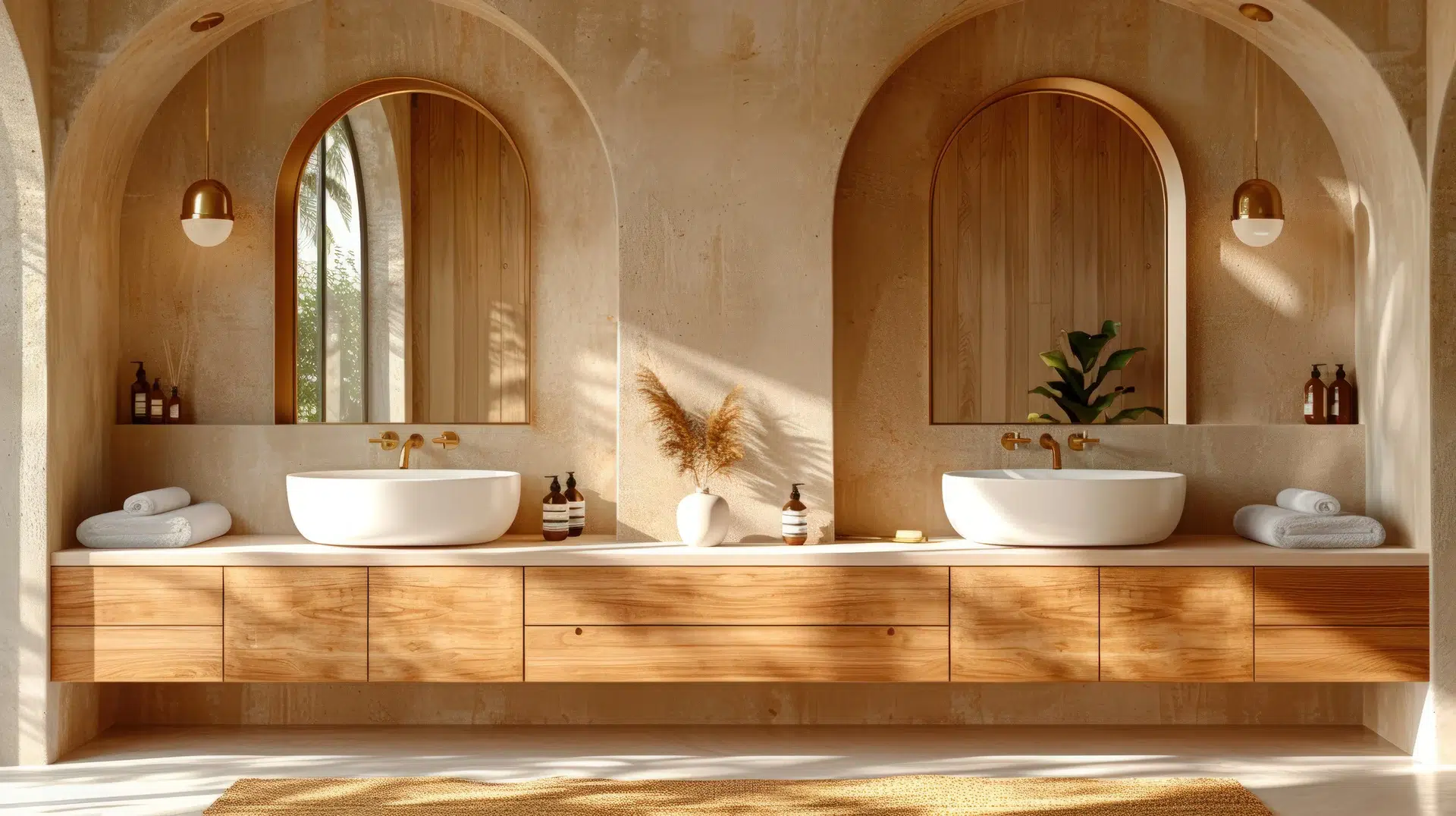
Wooden vanities can make a bathroom feel warmer, more substantial, and more “built-in” than many other materials—but they’re also less forgiving when something is even slightly off. A vanity that’s 1″ too deep can pinch your walkway. A tiny plumbing mismatch can force ugly cutouts. And humidity that lingers day after day can shorten the life of real wood faster than people expect. The good news: most problems come from a small set of predictable mistakes. Avoid these, and your vanity upgrade will look better, function better, and stay that way longer.
1. Mistake: Measuring only the cabinet box and ignoring real clearance
A common “it fits on paper” problem is forgetting that the countertop edge—not the cabinet face—controls the usable space in front of the sink. Planning guidance recommends at least 30″ of clear floor space from the front edge of fixtures to the next obstacle, while 21″ is often cited as a minimum requirement in front of a lavatory (Source: NKBA Bath Planning Guidelines).
Also, remember the countertop usually overhangs the cabinet. A workmanship standard notes that overhangs should typically be consistent, from 0.500″ to 1.250″ beyond the outermost cabinet face (Source: ANSI/AWI 1236-2022).
Fix: Measure from the finished wall, tape the full vanity footprint on the floor, then add a second tape line for the countertop overhang.
2. Mistake: Forgetting door swing and drawer pull-out zones
Even when the vanity fits, it can fail the “daily-use test” if a drawer hits the bathroom door or a cabinet door bangs into a toilet or wall. This is especially common in compact layouts where every inch matters.
Fix: Use painter’s tape to map:
- the bathroom door swing arc,
- the vanity door swing,
- The full extension of drawers.
If you can’t open a door or drawer comfortably while standing at the sink, you’ll feel that mistake every morning.
3. Mistake: Measuring before the room is truly “finished”
If the walls are getting tile, a new backsplash, or fresh drywall, your measurements can change—sometimes enough to cause problems with countertop fit, side fillers, or mirror/medicine cabinet alignment.
Fix: Take final measurements from finished surfaces whenever possible. If the project is mid-renovation, build in a small buffer for out-of-square walls and plan for a scribe strip or filler where needed.
4. Mistake: Not matching the vanity plan to plumbing reality
Many headaches come from assuming the drain and shutoff valves will “work themselves out.” They won’t. If your drain is off-center or your shutoffs sit high/low compared to the cabinet opening, installers may be forced into oversized cutouts or awkward rerouting.
Fix: Measure plumbing from the finished wall:
- drain centerline height from floor,
- drain centerline offset from a side wall,
- hot/cold shutoff heights and offsets.
If you’re choosing a top separately, confirm faucet hole drilling (for example, 4″ centers vs. 8″ widespread) before you order—because a beautiful countertop with the wrong drilling is an expensive mistake.
5. Mistake: Treating humidity as “normal bathroom stuff” instead of a wood issue
Wood tolerates moisture best when humidity is controlled. Indoor relative humidity should be kept below 60%, ideally 30%–50% if possible (Source: U.S. EPA).
Ventilation matters too: a common sizing approach is 1 CFM per sq ft of bathroom area, and 50 CFM is recommended as a minimum for bathrooms 50 sq ft and smaller (Source: Home Ventilating Institute).
A humidity meter is often an inexpensive tool (about $10–$50) that helps you spot problems early (Source: U.S. EPA).
Fix: Run the fan during showers and long routines, and keep humidity in the target range. If steam hangs around, your wood vanity is “marinating” in damp air.
6. Mistake: Assuming “solid wood” means every panel is solid—and ignoring emissions compliance
Many “wood” vanities use a solid wood frame but include plywood, MDF, or particleboard in side panels, drawer bottoms, or back panels. That’s not automatically bad—stable panels can be smart in humid rooms—but you should still ask about indoor air quality and compliance.
EPA TSCA Title VI sets formaldehyde emission limits for key composite wood products: hardwood plywood 0.05 ppm, MDF 0.11 ppm, thin MDF 0.13 ppm, particleboard 0.09 ppm (Source: U.S. EPA).
Fix: Look for TSCA Title VI compliance statements on specs or invoices, and prioritize better panel choices in moisture-prone areas (quality plywood is often a safer bet than bargain particleboard).
7. Mistake: Skipping leveling, support, and wall anchoring
Wooden vanities can be heavy—especially fully assembled models with stone or cultured marble tops. If the floor is uneven and the vanity isn’t shimmed and leveled correctly, doors won’t align, drawers can bind, and countertop seams may crack over time.
Fix: Plan for:
- leveling shims,
- a flat wall surface (or a scribed back edge),
- anchoring into studs or properly rated wall anchors.
If the vanity rocks even slightly before the top goes on, stop and fix it. That wobble gets worse, not better.
8. Mistake: Letting water behave like it’s harmless
Wood doesn’t usually fail from one big splash—it fails from repeated small wetting at seams and edges: around the sink cutout, along the backsplash line, or where water drips off hands onto cabinet faces.
Water efficiency can help reduce splash and constant wetting. WaterSense-labeled bathroom sink faucets use a maximum of 1.5 gpm and can reduce flow by 30% or more compared with the standard 2.2 gpm (Source: U.S. EPA WaterSense).
Leaks are another quiet destroyer. Household leaks can waste 180 gallons per week, and toilets are often a culprit (Source: U.S. EPA WaterSense).
Fix: Seal backsplash joints, wipe pooled water, and fix small leaks immediately. Wood is durable—until it sits wet.
9. Mistake: Overstuffing storage and trapping moisture inside the cabinet
A vanity packed to the back wall with bottles, wet towels, and closed bins becomes a humidity pocket. That can lead to odors and faster finish wear, especially under the sink, where airflow is already limited.
Fix: Create “wet” and “dry” zones:
- Wet zone: daily wash items on a removable tray that you can wipe.
- Dry zone: backups and paper goods in breathable bins.
Leave a small air gap behind organizers so cabinet walls can dry out.
10. Mistake: Using harsh cleaners that slowly damage finishes
Many wood finishes handle light cleaning well, but repeated exposure to aggressive chemicals or soaking wet cloths can dull topcoats and weaken edge protection.
Fix: Use gentle cleaners, wipe spills quickly, and avoid letting water sit on door bottoms and seams. If you see finish wear at corners, address it early—touch-ups are far easier than replacing swollen panels later.
A fast “before you buy” checklist
- Front clearance from countertop edge: target 30″ when possible (Source: NKBA).
- Countertop overhang planned: 0.500″–1.250″ typical standard range (Source: ANSI/AWI 1236).
- Humidity plan: keep RH below 60%, ideally 30%–50% (Source: U.S. EPA).
- Fan sizing check: 50 CFM minimum for many small baths; 1 CFM per sq ft rule of thumb (Source: HVI).
- Composite wood compliance: TSCA Title VI emission limits verified (Source: U.S. EPA).


