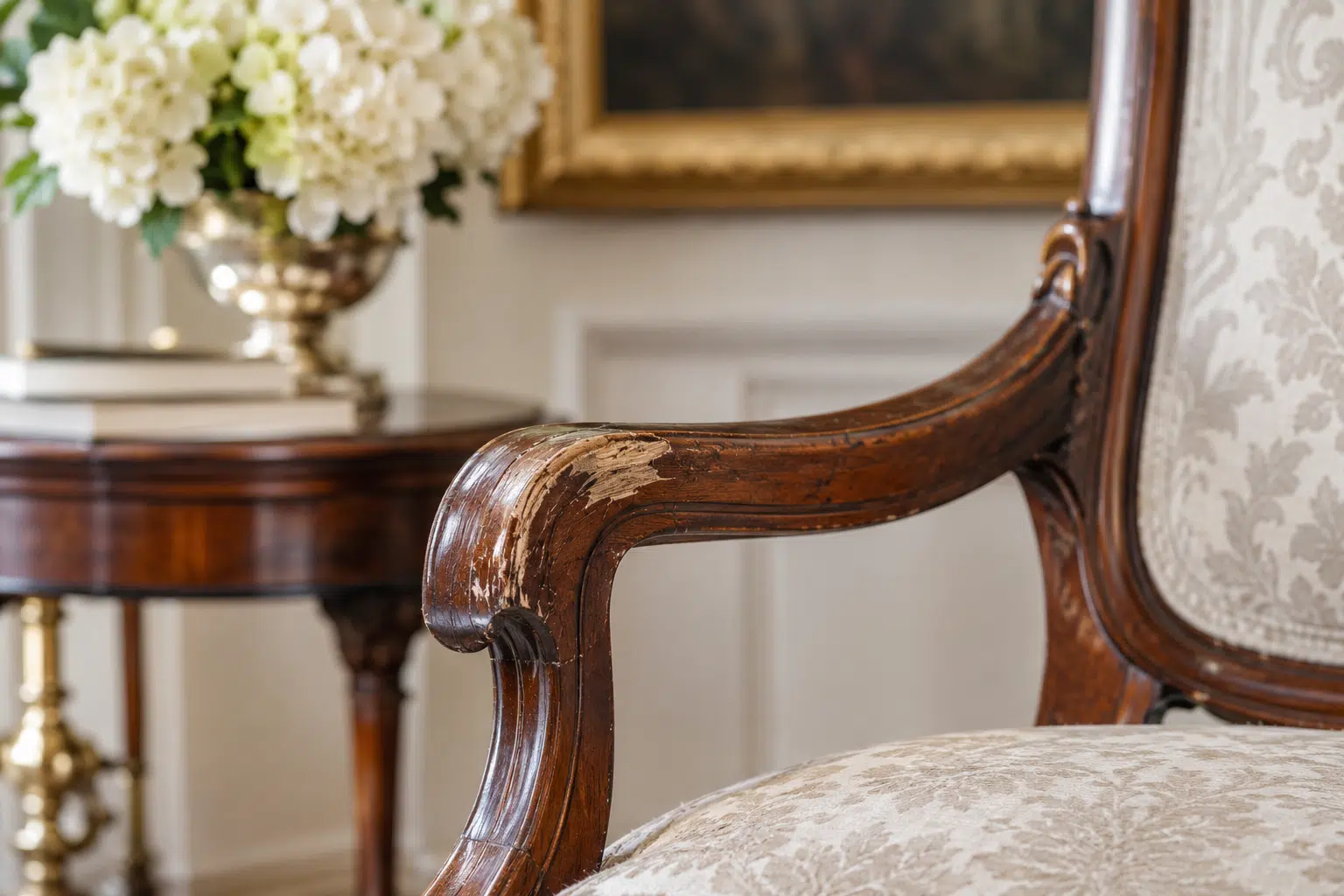
A burst pipe in an upstairs bathroom. A storm that pushes water under a back door. A removalist who sets a wardrobe down too hard. Damage to antique furniture almost never happens on purpose, and it usually happens fast.
The hours straight afterwards matter more than most people realise. What you do in that window affects how much of the piece can be saved and how much your insurer will pay toward it.
The good news is that old furniture is far tougher than it looks. Pieces that appear ruined are often repairable, and in many cases restoring costs less than replacing. Here is what to do, in order.
What Should You Do First When Antique Furniture Is Damaged?
Photograph everything before you move or clean anything. Your own photos are the single most useful piece of evidence in an insurance claim.
Insurers appoint an assessor or loss adjuster who takes their own photographs during an inspection. Those images become part of the official claim file. If the assessor visits days later, after things have dried out or been tidied, the damage they record may look far milder than what you actually saw.
Take wide shots showing the room and the source of the damage. Then take close-ups of each affected piece—capturing the water line, the lifted veneer, the swollen joint, or the split panel. Photograph the underside and the back as well, since damage often shows there first.
Note the date and time, and keep any evidence of what caused the incident, such as a failed hose or damaged roof section, until the assessor has inspected it.
What Not to Do in the First 24 Hours
- Do not run a heater or hair dryer on the piece: Forcing timber to dry quickly causes splitting and lifting veneer, turning recoverable damage into permanent structural harm.
- Do not sand, strip, or touch up anything: Any work carried out before assessment can be treated as altering evidence and can reduce the value of an antique.
- Do not throw anything away: Broken fragments, loose veneer, and detached mouldings are often reusable during repair—once discarded, they cannot be matched identically.
- Do not apply furniture polish or oil: On a wet or compromised finish, oils and waxes trap moisture underneath and worsen clouding or lifting.
Simply move the piece away from the water source, blot standing water gently with a soft dry cloth, and allow the room to air-dry naturally at ambient temperature.
Does Home Insurance Cover Antique Furniture?
Usually yes, though often not for the amount an owner expects. Standard contents policies cover furniture based on documented value, and most policies cap payouts for any single valuable item unless it has been specified separately on the schedule.
This is where most disputes begin. Owners assume their total contents sum insured covers everything inside the home, whereas insurers apply per-item limits that genuine antiques frequently exceed.
A case heard by the Australian Financial Complaints Authority illustrates how wide that gap can be. An owner had antique furniture insured for up to fifty thousand dollars under a special contents benefit, and a burst laundry pipe damaged three pieces. The insurer valued them at nine thousand seven hundred dollars.
When the owner supplied quotes for comparable-looking furniture, AFCA found those quotes were not a reliable measure of value because the items differed in size, shape, colour, and style from the damaged antiques—and the owner lost the dispute. Comparable-looking furniture is not evidence of value; documentation specific to your actual pieces is.
What to Have on File Before Anything Happens
- A written valuation from a qualified valuer for any piece of significant worth
- Clear photographs of each piece in good condition, including maker’s marks and labels
- Receipts, auction records, or provenance papers where available
- A record of any previous restoration work and the specialist who carried it out
Compiling this record takes very little time on a quiet weekend, and it removes valuation guesswork entirely if you ever need to lodge a claim.
Can Damaged Antique Furniture Actually Be Restored?
In most cases, yes. Traditional timber furniture is repairable in ways that modern mass-produced furniture is not, because it was built to be disassembled and conserved.
Older pieces were constructed with mortise-and-tenon joinery and reversible hide glue rather than staples and particleboard. Joints can be released, cleaned, and reglued; original veneer can be relaid; split panels can be closed; and traditional French-polished finishes can be seamlessly revived.
Water damage is the most common—and most misunderstood—type of harm. A white bloom across a tabletop looks alarming, yet usually sits within the surface polish rather than the timber itself. Swollen joints often settle as wood dries gradually, and lifted veneer can frequently be re-adhered using the original timber leaf.
| Damage | How It Usually Looks | Typical Outcome |
|---|---|---|
| Water on the surface | White bloom or cloudiness | Usually fully removable |
| Standing water | Swollen joints, stuck drawers | Often recovers as it dries slowly |
| Lifted veneer | Bubbling or peeling edges | Usually relaid rather than replaced |
| Impact damage | Split panel, broken moulding | Repairable if original fragments are kept |
| Fire and smoke | Blackened or scorched finish | Often far more recoverable than it appears |
The pieces that genuinely cannot be saved are typically those where the structural timber itself has been destroyed through prolonged submersion, active rot, or deep charring.
Why Insurers Often Prefer Restoration Over Replacement
Restoring a fine antique is frequently far more economical for an insurer than paying out its full replacement value, which is why specialist conservation is a standard part of contents claims.
In one documented claim where an upstairs tap left running collapsed a ceiling onto a bureau, a drinks cabinet, and a fireplace mantel, specialist restoration came in roughly sixty-five per cent below the cost of replacing the damaged pieces.
That distinction matters even more to owners. A cash settlement leaves you with money and an empty space where a family heirloom stood, whereas skilled conservation returns your actual piece intact. In Sydney, antique furniture restoration for insurance claims is carried out on site at the owner’s residence wherever possible—avoiding the added risk of transporting fragile, compromised timber.
How the Claim Process Works in Australia
Your insurer appoints an assessor or loss adjuster to inspect the damage, document its cause, and recommend repair, replacement, or settlement. Most contents claims follow five clear steps:
- Lodge the claim with your insurer as soon as the damage occurs, attaching your initial wide and close-up photographs.
- The insurer appoints an assessor or loss adjuster—either an internal specialist or an independent firm.
- The assessor inspects the damage on site, takes measurements and photographs, and confirms that the damage aligns with the reported event.
- For antiques and fine furniture, the insurer may engage a specialist valuer or restorer to assess worth and repair viability.
- The insurer confirms whether it will authorize specialist restoration, replacement, or a cash settlement.
You are also entitled to obtain your own independent restoration report or valuation if you disagree with an assessor’s recommendation—and having clear pre-loss records alongside prompt first-day photographs puts you in the strongest position to preserve both your claim and your furniture.