Living in a high-rise apartment in New York City comes with a particular kind of lifestyle appeal that is hard to replicate anywhere else. The views, the proximity to everything, the energy of a building that is always active, the sense of being embedded in the city rather than adjacent to it. What that lifestyle does not come with is the straightforward cleaning access that a detached house provides, and the difference matters more than most high-rise residents realize until they try to manage it.
Cleaning a high-rise apartment is not simply a scaled-down version of cleaning a house. It is a fundamentally different logistical and environmental challenge that affects everything from how dust behaves to how cleaning professionals access the building, move through it, and work within the space itself. Understanding those differences helps high-rise residents make better decisions about how their apartments get cleaned and why certain problems keep recurring despite regular cleaning effort.
Elevator Access and the Logistics of Getting There
In a house, a cleaning professional parks outside and walks in. In a high-rise apartment building, the cleaning process begins with navigating a set of building-specific logistics that add coordination requirements that simply do not exist in any residential house context. Freight elevator reservations, doorman coordination, building access protocols, service entrance requirements, and, in many buildings, designated cleaning windows that restrict when service providers can operate are all part of the reality of cleaning in a high-rise that residents either manage or hand off to a cleaning service experienced enough to handle them without prompting.
Buildings that require freight elevator reservations for service providers create scheduling constraints that affect how cleaning appointments are structured. A cleaning crew that arrives at a time when the freight elevator is already reserved by a moving company or another service provider faces delays that affect the entire day’s schedule unless the building’s logistics have been navigated in advance. First-time service providers in a building often discover these requirements at the point of arrival rather than before it, which is a source of friction that experienced high-rise cleaning services eliminate through familiarity with specific building protocols before the first visit.
Doorman buildings require communication between the resident, the building staff, and the cleaning service that goes beyond simply leaving a key. Residents need to authorize their cleaning service explicitly with building management, ensure that the authorization is on file rather than verbal, and confirm that the cleaning team will be admitted consistently on each scheduled visit without requiring the resident to be present or reachable every time. Getting this coordination right from the beginning saves recurring friction that compounds over time into a genuinely frustrating service relationship.
How High-Rise Living Changes Dust and Particulate Accumulation
One of the least intuitive aspects of high-rise apartment cleaning is how differently dust behaves at altitude compared to ground-level residences. High-rise apartments experience different airflow patterns than houses, both through the building’s ventilation systems and through the window and door dynamics that altitude creates, and these airflow patterns affect where particulate matter settles, how quickly it accumulates on different surfaces, and which areas of an apartment develop the most significant dust buildup between cleaning visits.
Apartments on higher floors tend to have more air movement through the unit when windows are open because wind speeds increase with altitude and the surrounding buildings provide less deflection at higher elevations. This increased air movement carries particulate matter through the apartment more actively than lower-level residences experience, depositing dust on surfaces that might seem unlikely candidates for rapid accumulation based on their position in the room. Electronics, horizontal surfaces near windows, and areas that receive direct airflow from HVAC supply registers accumulate dust at rates that surprise residents who moved from houses with more predictable dust patterns.
HVAC systems in high-rise buildings serve many units from central equipment, which means the particulate load in the air supply is influenced by conditions throughout the building rather than just within the individual apartment. Dust and particulate matter from hallways, common areas, and other units enter individual apartments through the building’s air distribution system in ways that a house with its own independent HVAC equipment does not experience. This shared air supply is a continuous source of particulate introduction that cleaning frequency needs to account for rather than assuming that a clean apartment will remain clean at the same rate as a comparable house.
Space Constraints That Affect Cleaning Approach
High-rise apartments, particularly in New York City where square footage is at an absolute premium, present space constraints that affect cleaning approach in ways that open-plan houses do not. In a house, furniture can be moved to access the floor beneath it relatively easily. In a studio or one-bedroom apartment where every piece of furniture serves multiple functions and spatial relationships between pieces are carefully calibrated, moving anything meaningfully disrupts the entire arrangement.
Cleaning in constrained spaces requires a different sequencing and technique than cleaning open spaces, particularly for floor care. Vacuuming and mopping around furniture that cannot be moved requires extended-reach equipment and careful attention to the edge areas along walls and under low-clearance furniture that are easy to miss when working in tight quarters. These are exactly the areas where particulate matter accumulates fastest because foot traffic avoids them, which means they can go unaddressed for extended periods while the center of the floor receives adequate attention.
Kitchen spaces in high-rise apartments are frequently galley configurations where two surfaces face each other across a narrow working corridor. Cleaning both surfaces thoroughly while also addressing the floor beneath and around appliances in a galley kitchen requires working in a sequence that accounts for the spatial constraint rather than the unrestricted movement that a larger kitchen allows.
Building Rules That Affect What Cleaning Products Can Be Used
High-rise apartment buildings sometimes have specific rules about cleaning products and equipment that residents and their cleaning services must follow, and these rules are not always communicated clearly at lease signing. Some buildings prohibit certain chemical products because of concerns about drain system impact or air quality in shared ventilation systems. Others have restrictions on wet/dry vacuums or steam cleaning equipment in upper floor apartments because of concerns about water damage to units below.
These building-specific product and equipment restrictions are a dimension of high-rise cleaning compliance that does not exist in any form for houses and that cleaning services unfamiliar with a specific building’s rules may violate without realizing it until a building management complaint surfaces. A cleaning service with extensive experience in high-rise buildings in a specific city develops familiarity with the kinds of restrictions different building types impose and approaches each building with the awareness needed to identify and comply with any restrictions before they become a problem.
For New York City apartment residents looking for a cleaning service nyc provider who understands the specific logistics and constraints of high-rise apartment cleaning from the first visit rather than learning them through friction, the difference between a cleaning service built for NYC apartment realities and one that simply offers cleaning shows up immediately in how the service is coordinated, how the building is navigated, and how the apartment is cleaned within the constraints that high-rise living imposes.
Window Cleaning in High-Rise Units
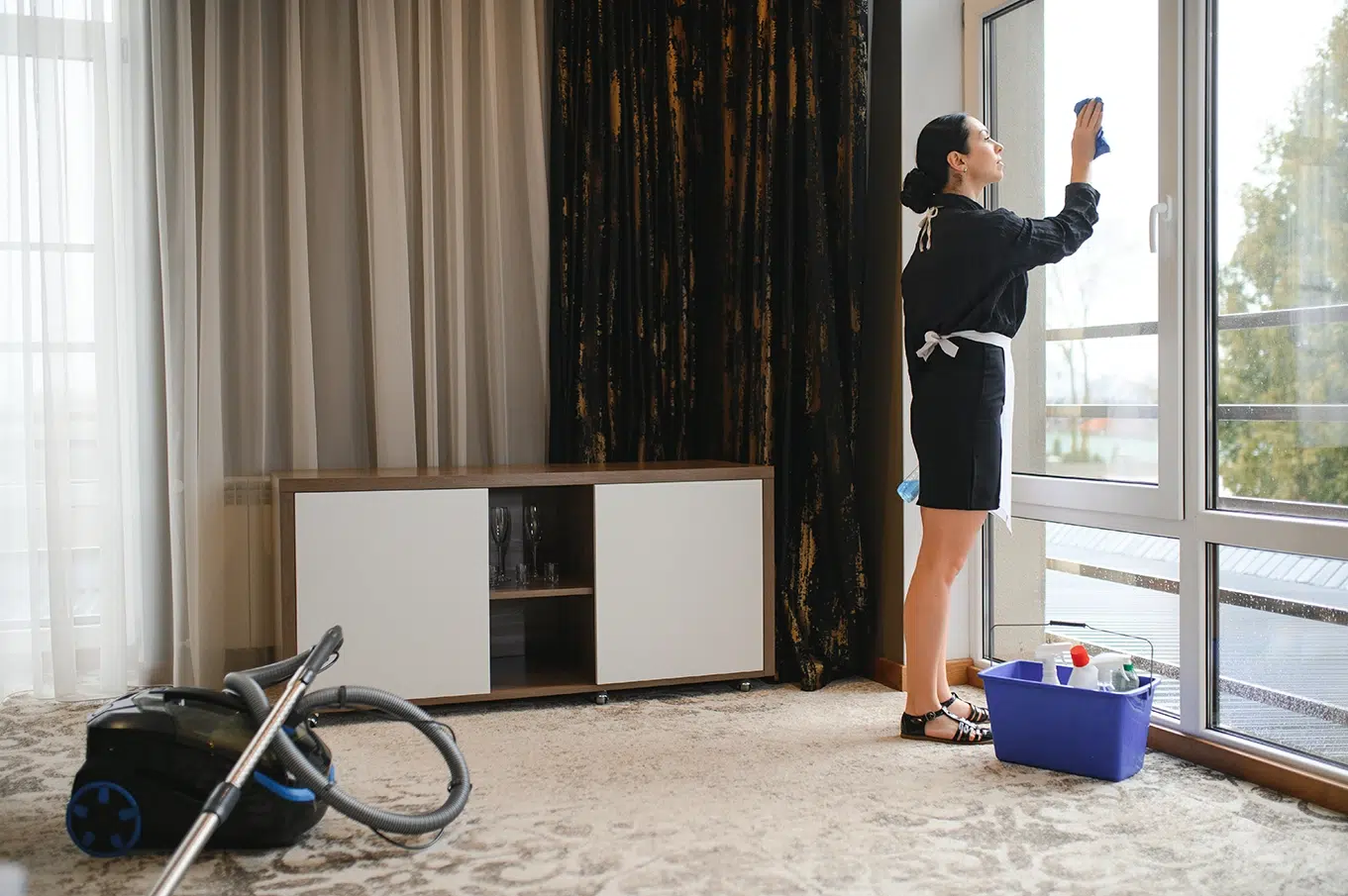
Window cleaning in a high-rise apartment presents safety and access considerations that have no equivalent in house cleaning. Exterior window surfaces on upper floors are inaccessible without professional window cleaning equipment and the safety training and certification that its use requires. Interior window surfaces are accessible but require careful attention to the window frame, sill, and track components that accumulate dust, debris, and moisture-related contamination in ways that ground-floor windows do not.
High-rise windows experience condensation patterns related to the temperature differential between the heated or cooled interior and the external conditions at altitude, which can be more extreme than at ground level. This condensation deposits mineral residue on glass surfaces and promotes mold growth in window frame channels that requires specific attention during cleaning visits rather than a simple glass wipe that addresses only the visible surface.
The Service Relationship That High-Rise Living Requires
Cleaning a high-rise apartment successfully over a long-term recurring relationship requires a service provider who treats the building-specific logistics as a permanent part of the service rather than an initial inconvenience to get through. The freight elevator reservation that needs to happen before each visit, the doorman who needs to see a familiar face rather than a rotating cast of unfamiliar cleaners, and the building management that needs consistent professional behavior from anyone entering their building on a resident’s behalf are all dimensions of the ongoing service relationship that determine whether high-rise apartment cleaning works smoothly over time.
SQKY Cleaning has built its NYC service model specifically around these realities, treating the building logistics as the starting point of every service relationship rather than an afterthought that clients are left to manage themselves. The coordination that makes high-rise cleaning work smoothly is part of what SQKY Cleaning provides rather than a burden that gets transferred to the client to handle independently every time a cleaning visit approaches.