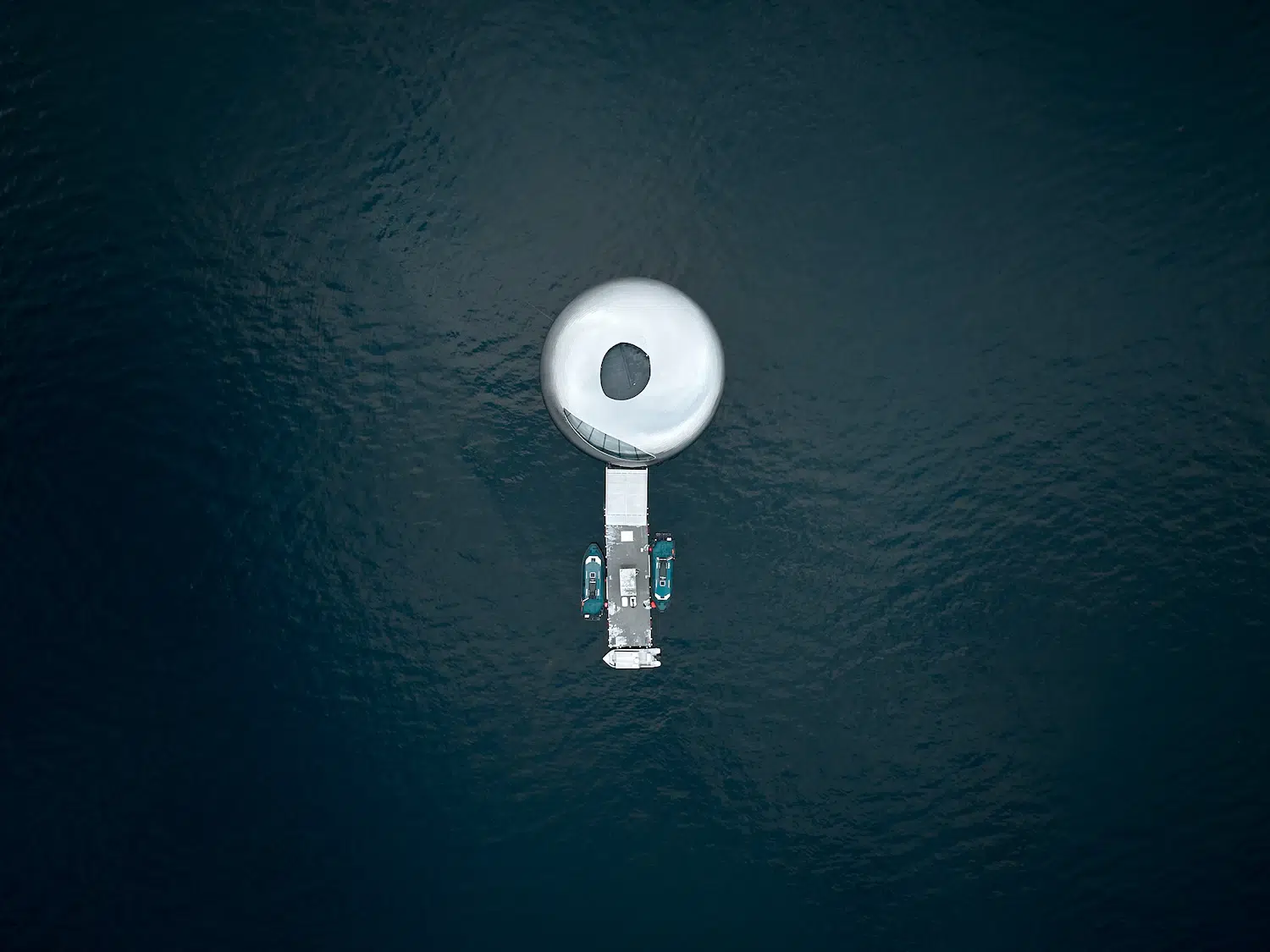
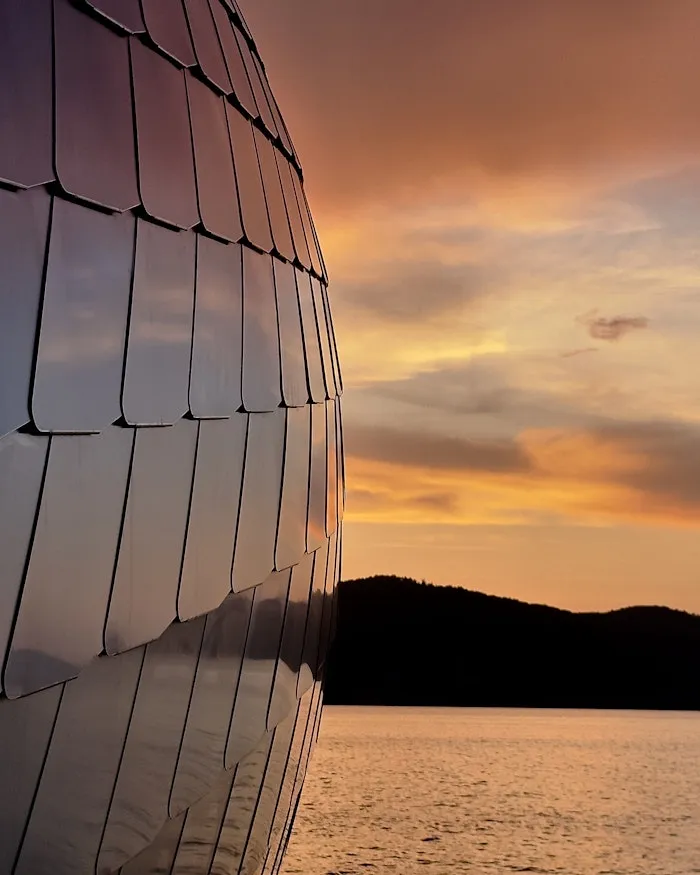
Suspended above the still waters of Norway’s Hardangerfjord, the elliptical structure known as Salmon Eye appears less like a restaurant than a futuristic sculpture adrift at sea. Wrapped in thousands of stainless-steel scales that shimmer against the shifting Nordic light, the floating installation quickly became one of Scandinavia’s most visually arresting destinations—and home to one of the most ambitious dining concepts in contemporary gastronomy.
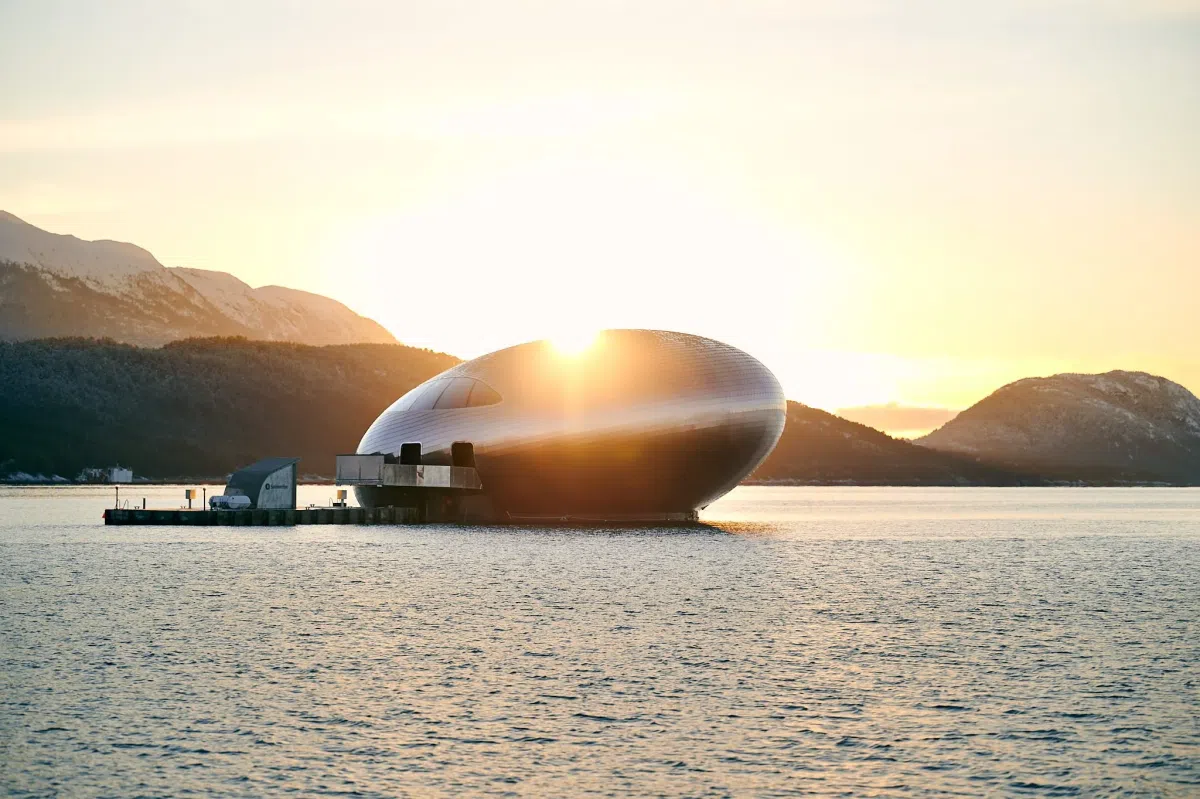
Inside the mirrored orb was Iris Restaurant, an immersive fine-dining experience that blurred the boundaries between cuisine, architecture, environmental dialogue, and destination travel. Reaching it was part of the ritual itself. Guests departed by boat through the fjord before arriving beneath the reflective structure, where dramatic mountainsides, glacial waters, and drifting Nordic clouds formed a cinematic prelude to the evening ahead.
The transition felt intentional, almost theatrical, distancing diners from ordinary rhythms long before the first course arrived.
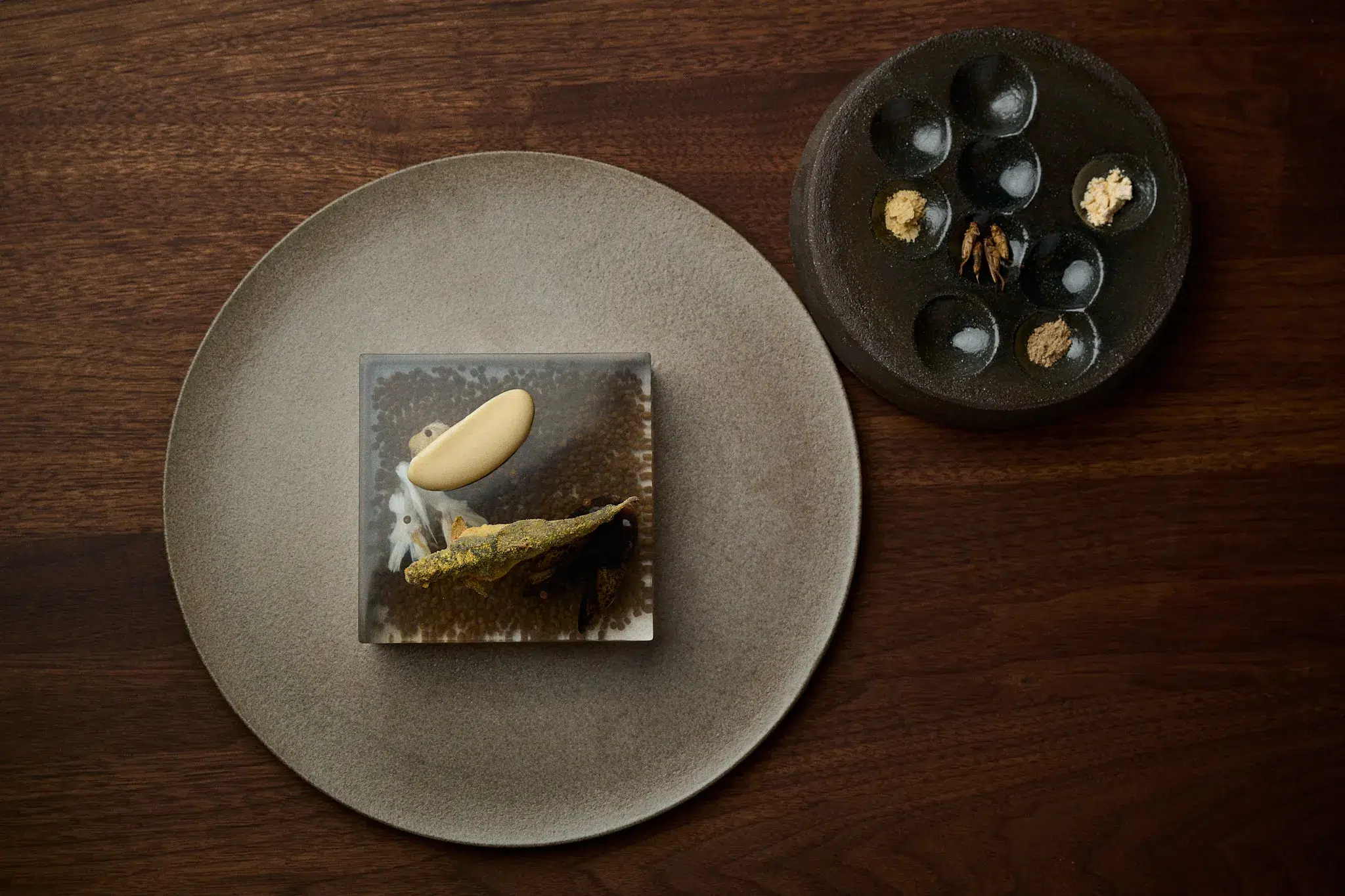
At the center of the experience was Chef Anika Madsen, whose cuisine unfolded less as a traditional tasting menu and more as a narrative exploration of the future of food. Each course examined the evolving relationship between sustainability, aquaculture, and the oceans surrounding Norway’s western coastline, pairing hyperlocal ingredients with restrained technique and striking precision.
Rather than relying on spectacle alone, the experience favored atmosphere and emotional resonance. Seafood drawn from Norway’s cold waters arrived with remarkable clarity and restraint, while the surrounding fjord became an ever-changing backdrop to the evening. Light shifted softly across the water outside, reflecting through the metallic shell as conversations unfolded beneath the curved architectural lines of the dining room. At moments, the experience felt closer to immersive installation art than conventional fine dining.
That distinction helped set Iris apart in a global dining landscape increasingly defined by theatrical excess. The concept behind Salmon Eye was never simply about luxury hospitality, but about creating a platform where architecture, sustainability, and gastronomy could coexist with unusual elegance. The result was an experience that felt intellectually engaging as much as visually spectacular.
Earlier this year, Iris temporarily paused operations as its owners began developing a new concept for the Salmon Eye platform, adding a further layer of intrigue to a destination that had already become one of the culinary world’s most closely watched projects. Even in hiatus, the experience continues to resonate across luxury travel and fine dining circles—not merely as a restaurant, but as a glimpse into where immersive gastronomy may be heading next.
That lingering impact speaks to a broader shift within modern luxury itself. Increasingly, travelers are seeking experiences rooted not solely in exclusivity, but in meaning—places capable of offering aesthetic beauty, narrative depth, and emotional connection in equal measure.
Few destinations embodied that evolution more completely than Iris.
As twilight settled across the fjord and Salmon Eye glowed softly against the darkening Norwegian landscape, the structure seemed to dissolve into the surrounding water entirely. What remained was less the memory of a meal than the feeling of having briefly stepped inside another vision of luxury altogether.