From the polished avenues bordering Central Park to the tree-lined streets surrounding the Brooklyn Botanic Garden, two of New York’s most influential institutions are quietly reshaping the cultural conversation around fashion. At The Metropolitan Museum of Art and the Brooklyn Museum, clothing is no longer treated as an ornament or accessory to art history. Instead, fashion emerges as a language through which identity, power, beauty, memory, and the body itself are interpreted.
Together, the exhibitions reveal a larger truth: fashion without context is merely fabric. Fashion with context becomes cultural expression.
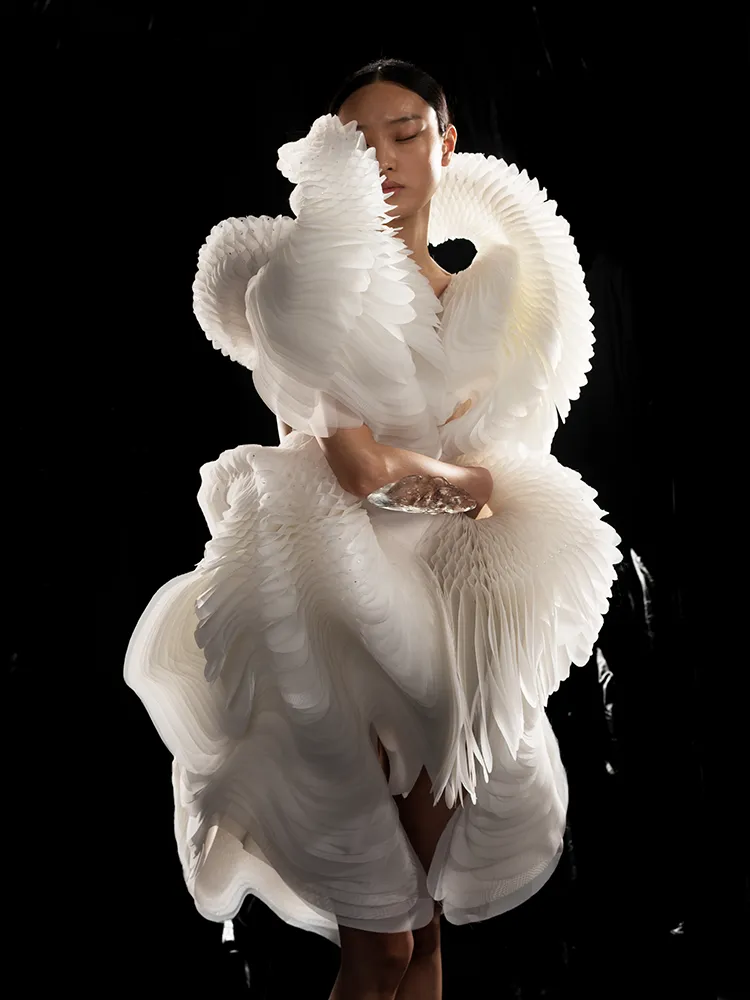
At the Brooklyn Museum, Iris van Herpen: Sculpting the Senses offers the more emotionally immersive of the two experiences. The Dutch couturier, whose avant-garde creations have long dissolved the boundaries between technology, nature, and the human form, transforms the gallery into something between laboratory, atelier, and dreamscape. More than 140 pieces are presented alongside contemporary artworks, scientific artifacts, fossils, coral specimens, and architectural design objects, positioning couture not as decoration, but as a living interdisciplinary art form.
Born in Wamel, the Netherlands, Iris van Herpen developed an early fascination with the natural world and classical dance, two influences that continue to shape her work with unmistakable precision. After studying at ArtEZ University of the Arts and working under Alexander McQueen, she launched her own label in 2007 before joining the Chambre Syndicale de la Haute Couture in Paris just four years later. She would soon become internationally recognized for introducing the first 3D-printed dress to the runway with her Crystallization collection, forever altering the vocabulary of modern couture.
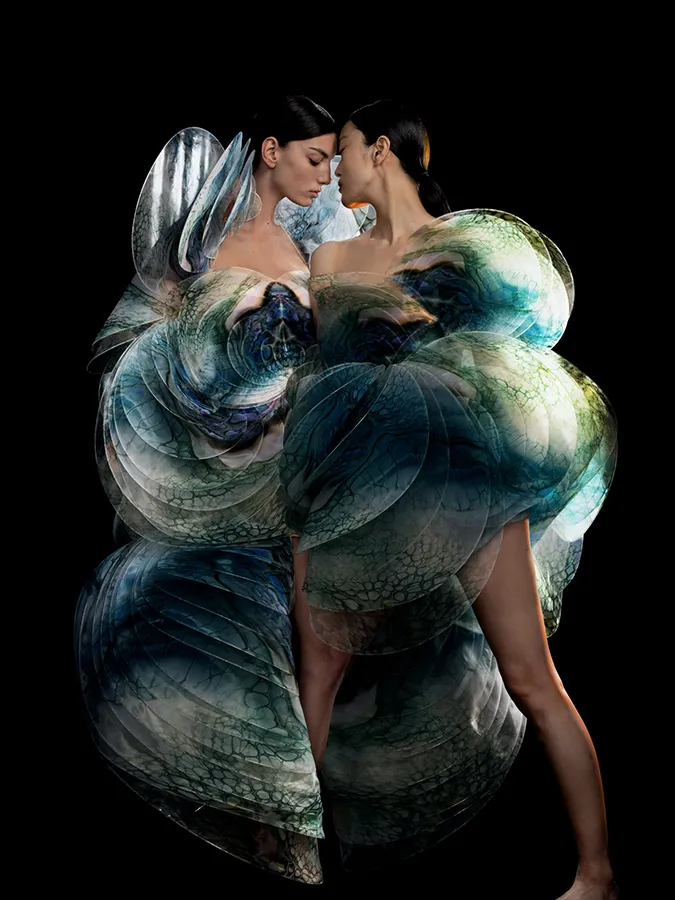
Throughout the exhibition, Van Herpen’s fascination with water becomes a recurring visual language. Rippling waves, translucent mist, hydrozoan jellyfish, coral ecosystems, and microscopic marine organisms are translated into sculptural garments through laser cutting, blown glass, thermoformed Plexiglas, embroidery, and kinetic textures. Whether liquid, frozen, or vaporous, water appears not merely as inspiration but as philosophy, simultaneously representing fragility, movement, chaos, and rebirth.
What makes Sculpting the Senses so compelling is not simply its technological innovation, but its humanity. Van Herpen’s garments do not conceal the body; they extend it. The silhouettes pulse with motion and vulnerability, suggesting organisms evolving in real time. Fashion becomes less about dressing and more about transformation itself.
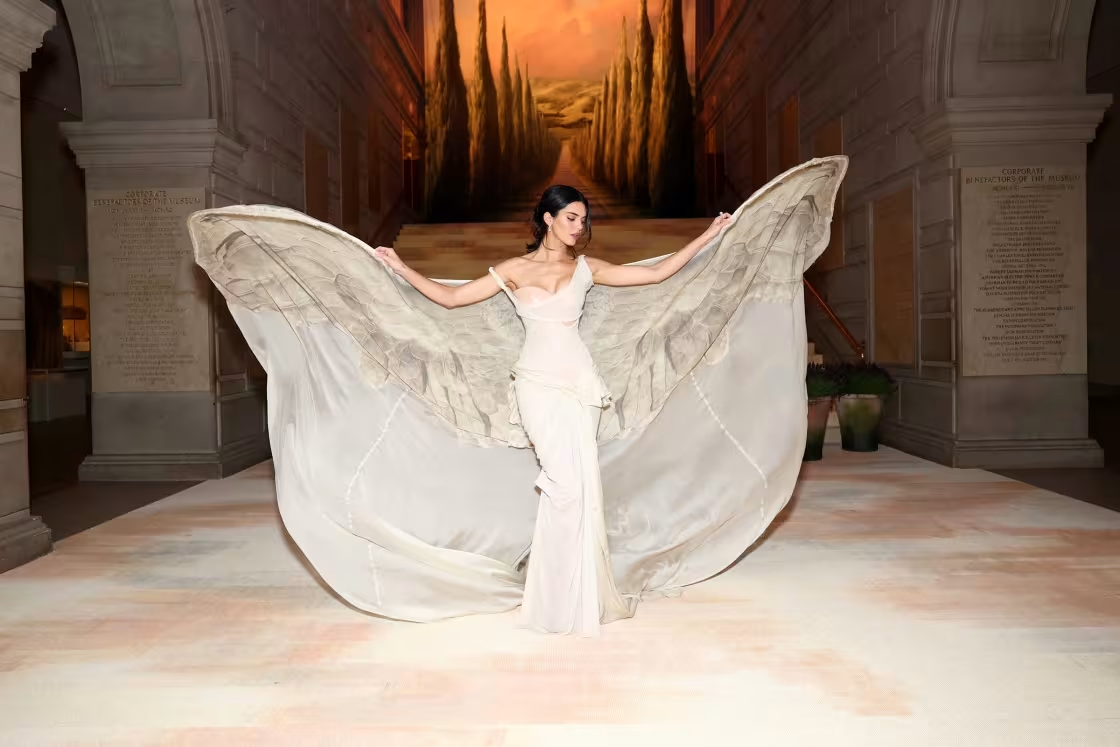
If Brooklyn’s exhibition feels intimate and atmospheric, the Metropolitan Museum of Art approaches fashion through historical magnitude. Its latest Costume Institute presentation situates the dressed body within more than 5,000 years of artistic production, tracing how clothing has shaped perceptions of class, morality, gender, vulnerability, and power across civilizations.
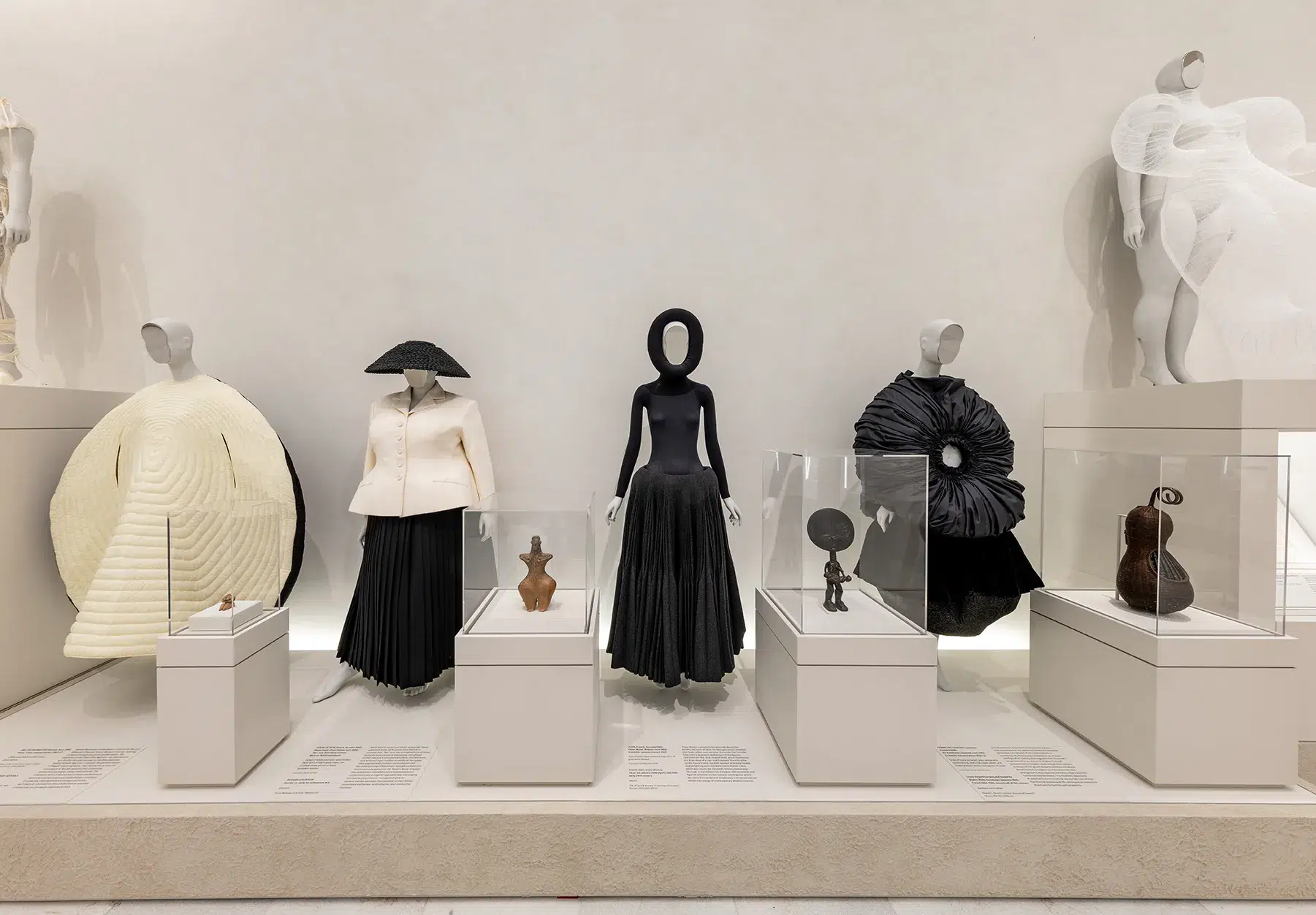
Rather than treating garments as isolated objects of beauty, the exhibition positions fashion in direct dialogue with sculpture, painting, decorative arts, and photography. A 2022–23 design by Glenn Martens for Jean Paul Gaultier appears alongside classical marble statuary. A Comme des Garçons ensemble enters conversation with modernist abstraction. Elsewhere, historical mourning jewelry, nineteenth-century tailoring, and contemporary couture are connected through the universal language of the body itself.
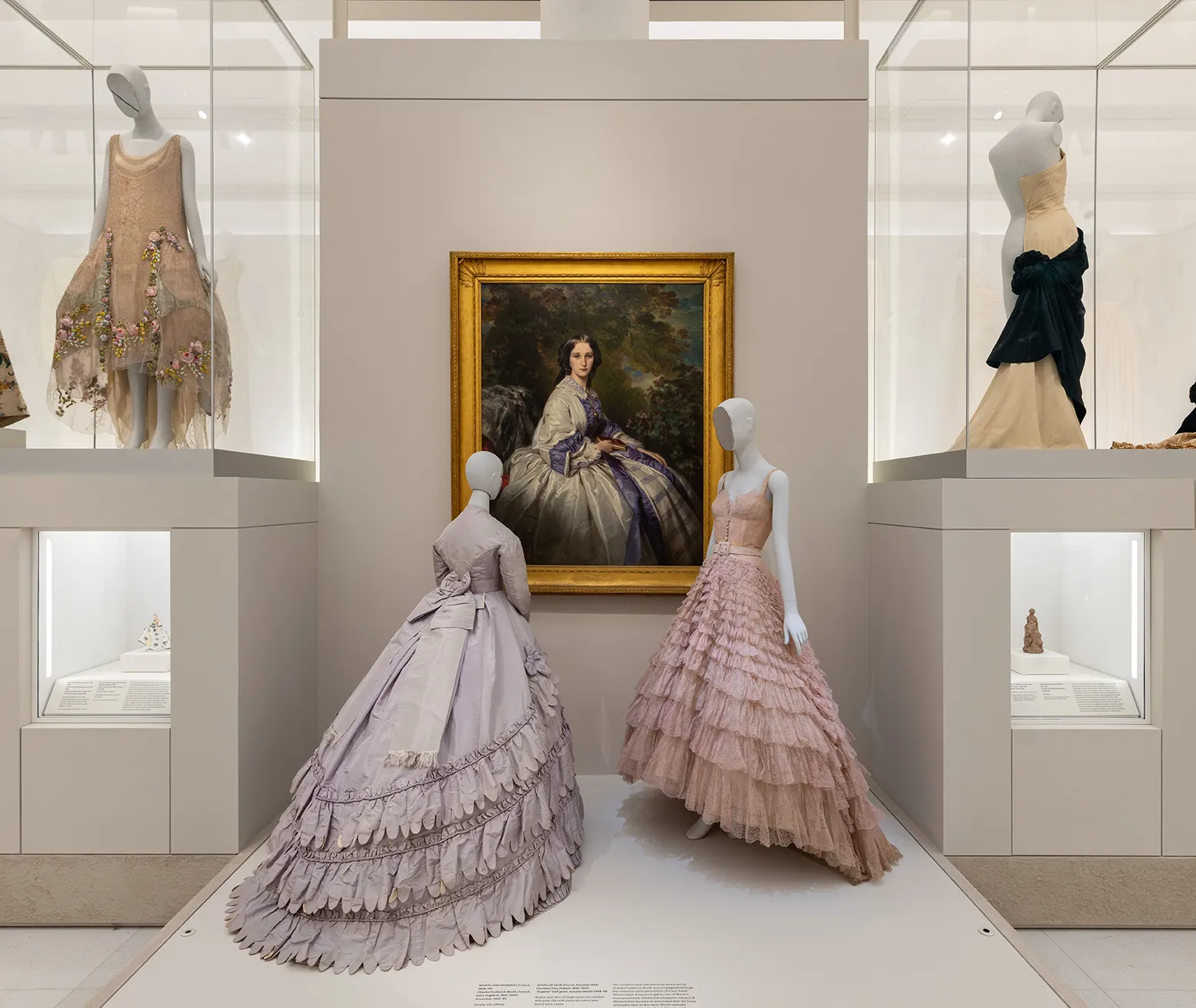
Central to the exhibition is the idea that the body is never neutral. Fashion mediates how exposure is understood, how modesty, sensuality, authority, aging, and identity are culturally constructed. The exhibition’s thematic structure explores these tensions through categories such as the “Naked Body,” the “Classical Body,” the “Pregnant Body,” and the “Mortal Body,” reframing fashion not as surface adornment, but as embodied experience.
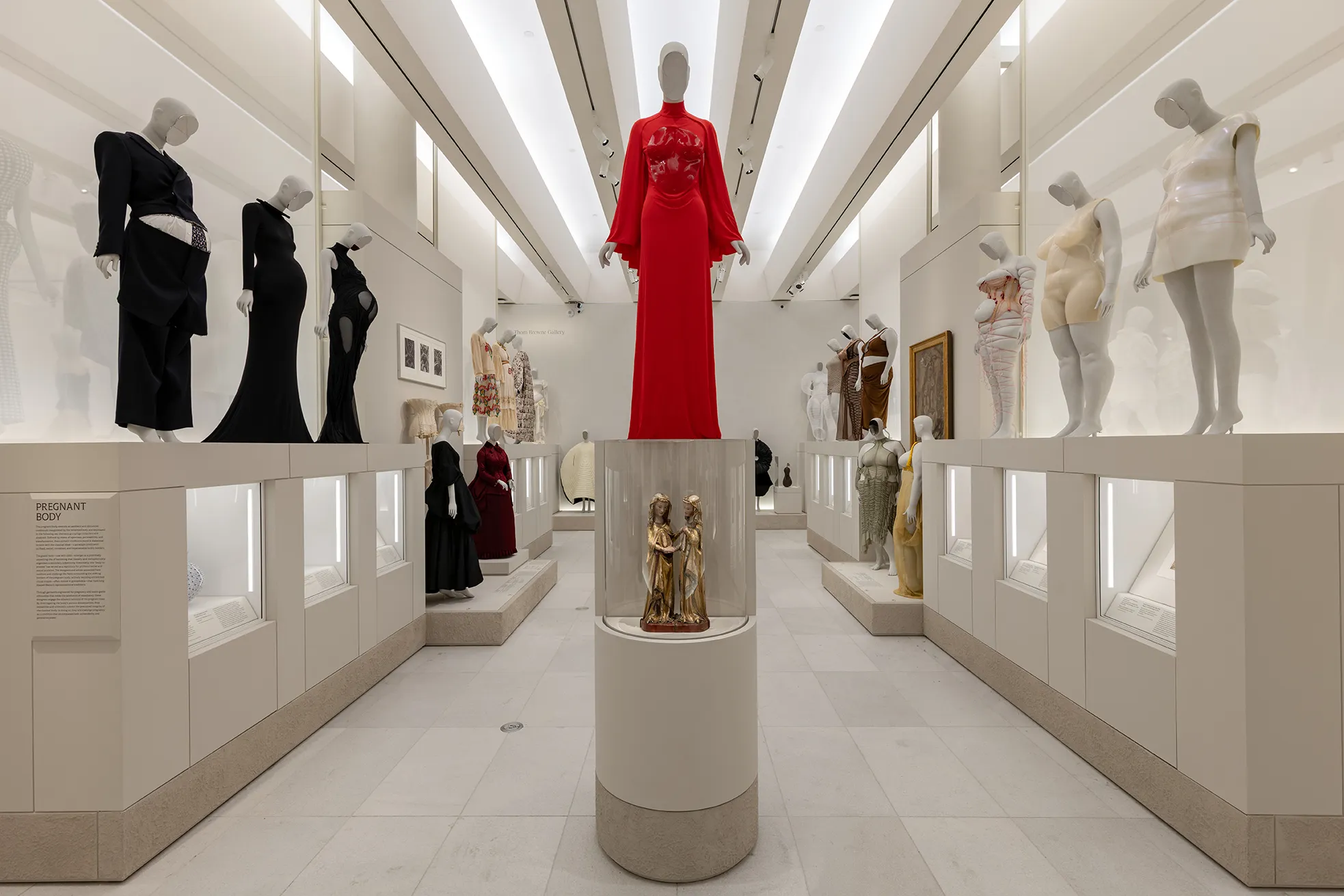
What unites both institutions is their refusal to isolate fashion from the wider creative disciplines that shape it. Architecture, sculpture, science, photography, beauty, poetry, and design all converge within these exhibitions, reinforcing the idea that couture has evolved far beyond the runway. Fashion today exists as one of the most sophisticated forms of interdisciplinary expression, a medium through which craftsmanship and cultural commentary coexist.
That evolution feels particularly significant at a moment when technology increasingly accelerates visual consumption. Against the speed of digital imagery and algorithmic trends, both exhibitions return attention to materiality, process, and human imagination. Handwork matters. Construction matters. Time matters.
And perhaps that is the deeper message resonating through both museums. Fashion is not simply about garments. It is about the stories bodies carry through space, history, emotion, and transformation. Some forms of meaning resist over-explanation. They are felt instinctively, in texture, silhouette, movement, and presence.
In New York this season, fashion is no longer standing beside art.
It is the art.