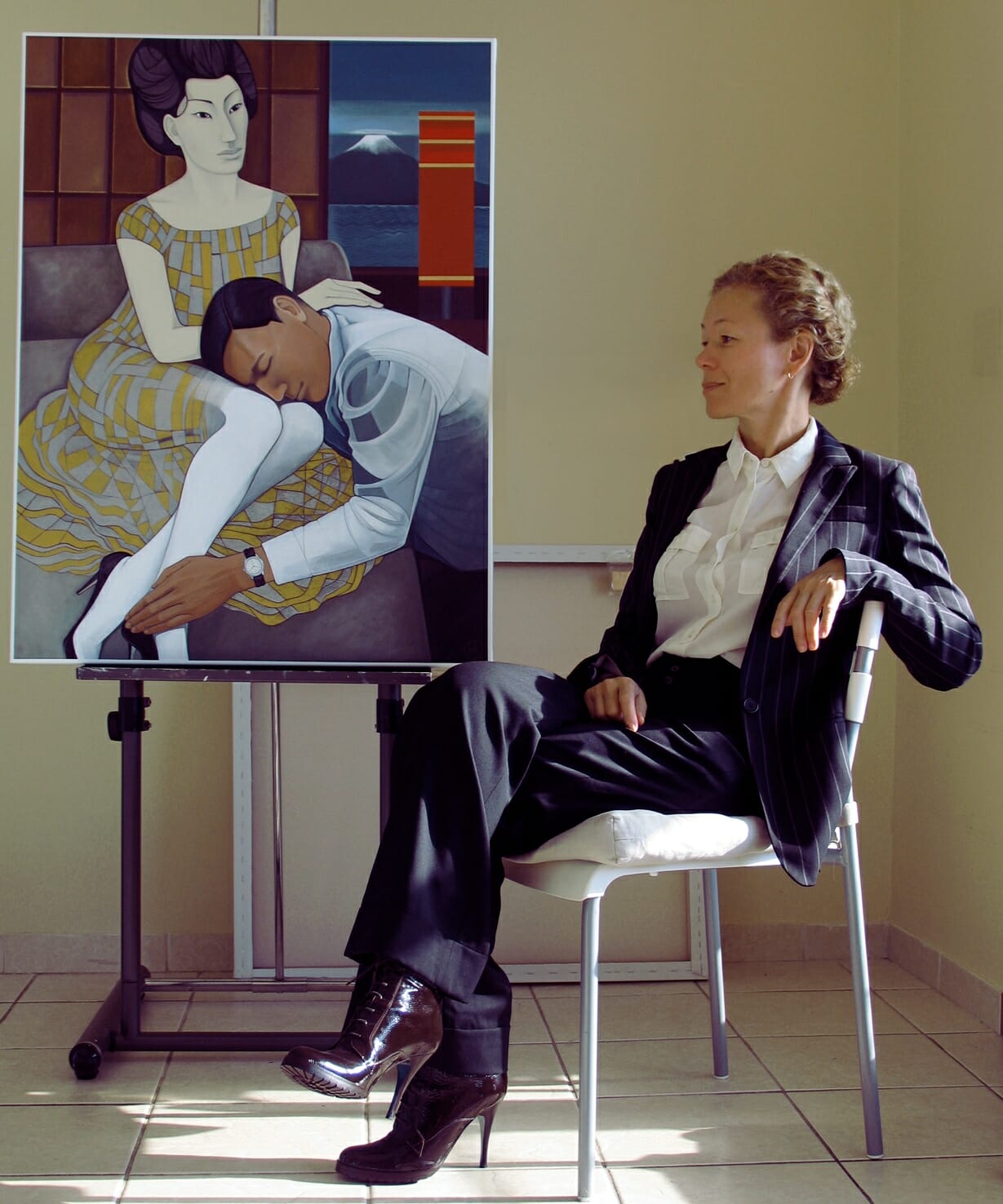
One of the quiet privileges of publishing a luxury magazine is the opportunity to encounter artists whose work stops you before you know precisely why. Olga Nenazhivina is one of them.
Years ago, her invitation was characteristically simple: “I would like to invite you to join my world.” It was not a grand declaration, but it was enough to open the door.
What followed was an introduction to an artist whose work felt at once disciplined and dreamlike, poised between East and West, between observation and imagination. There was a refinement to the line, but also a certain mystery. Her compositions seemed to hold the elegance of illustration, the emotional pull of poetry, and the restraint of someone who understood exactly how much to reveal.
Nenazhivina’s artistic life began early. Born in Saratov, Russia, in 1966, she grew up in a family in which art was not an abstraction but part of daily life. Her father, Valery Nenazhivin, became a respected sculptor and Merited Artist of Russia, while her mother was also artistically inclined. By childhood, Olga’s own instinct to draw was already unmistakable.
Her family later moved to Vladivostok, the Russian port city overlooking the Sea of Japan, and it was there that her visual language began to absorb a broader world. Vladivostok sits at a cultural crossroads, shaped by Russian, European, and Asian influences, and that geography left a lasting imprint on her work.
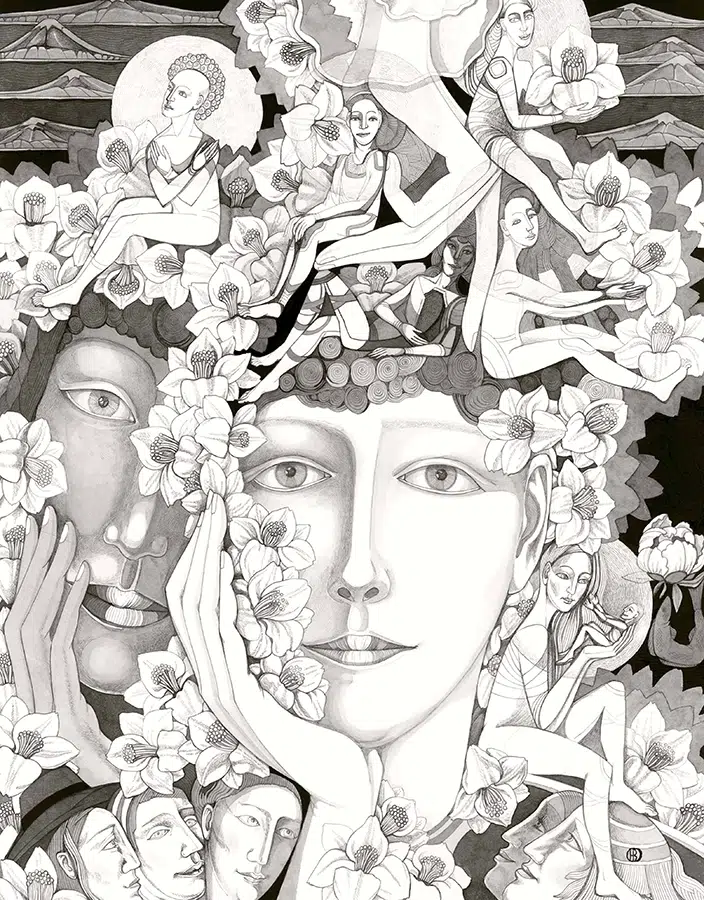
Nenazhivina would go on to study at the Vladivostok College for Arts, graduating in 1985. Over time, she developed a practice defined by the elegance of line and the expressive possibilities of ink and paper, materials she continues to regard as among her most trusted.
When we first encountered her work, what stood out was not simply technique. It was atmosphere.
There was a particular poise to her imagery, a sense that the figures, gestures and forms belonged to a world just slightly removed from the ordinary. Her work could be intricate without feeling crowded, delicate without appearing fragile. There was always control, but never rigidity.
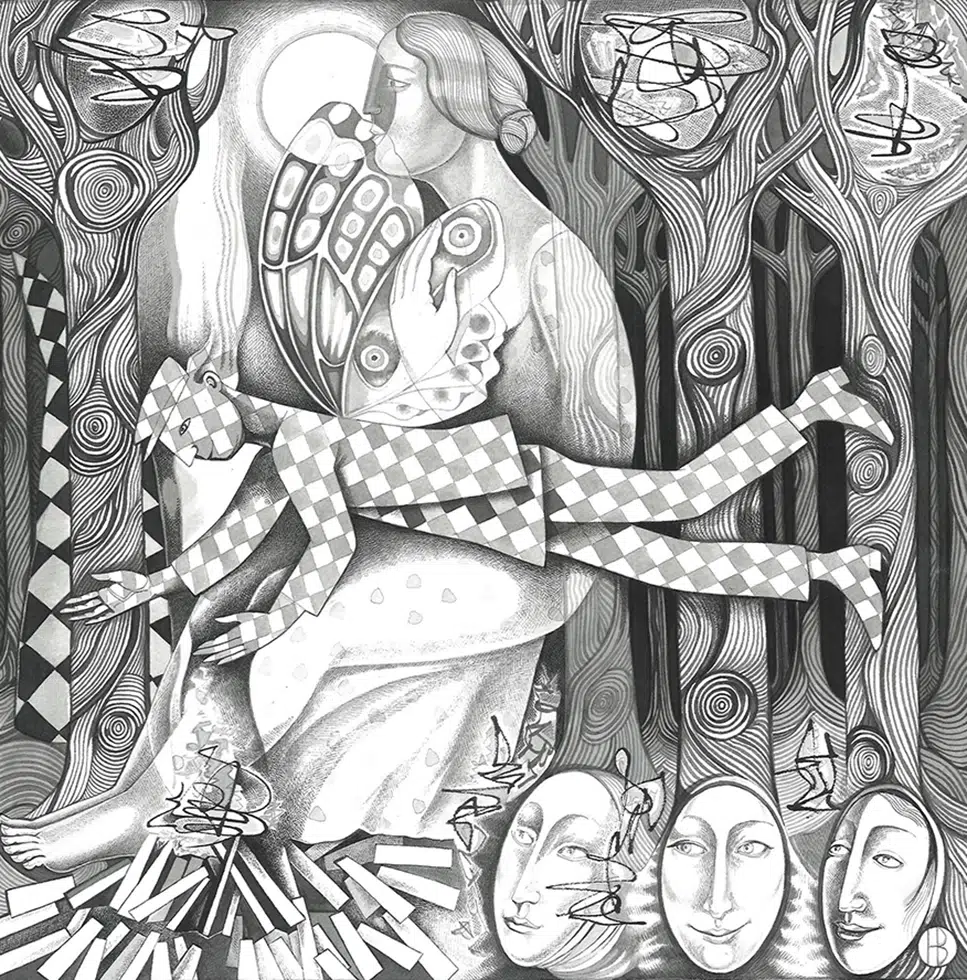
That balance may explain why her work so often seems literary. It is easy to think of her not only as a painter and draftsman, but as a kind of visual poet.
When asked years ago whether she possessed the soul of a poet or a painter, Nenazhivina answered with characteristic clarity: “One cannot separate the poet from the painter . . . the artist within the artist.”
The line still feels revealing.
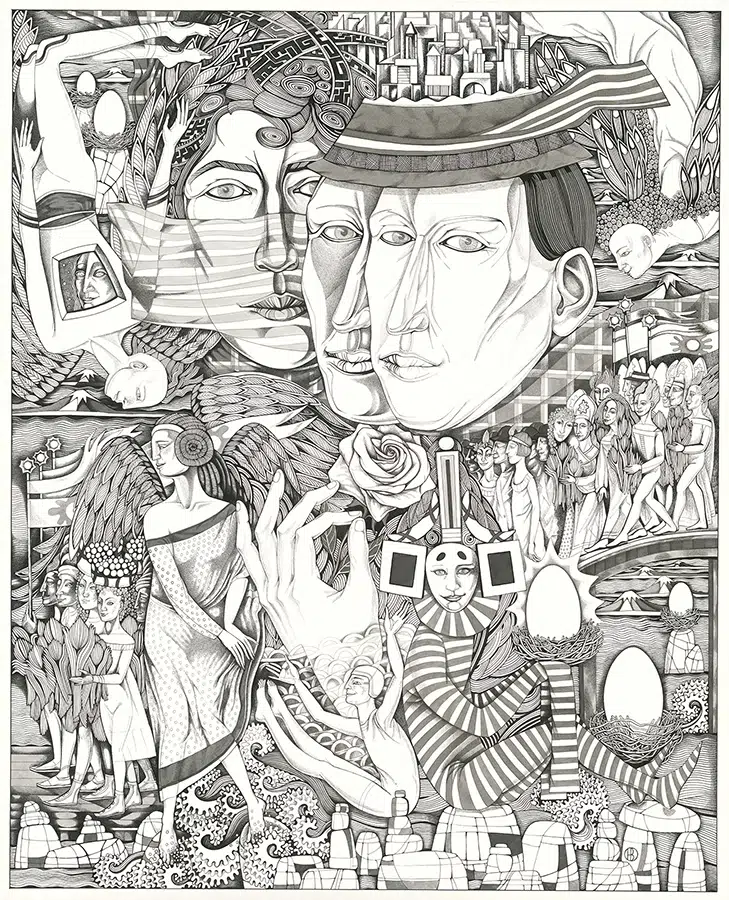
Her drawings often function less as literal descriptions than as meditations. They suggest memory, gesture, mythology and human emotion without closing themselves off to interpretation. The effect is intimate rather than didactic. Viewers are invited to enter the work rather than simply decode it.
That quality has remained central as her career has continued to evolve.
Over the past decade, Nenazhivina’s work has continued to appear in exhibitions across the United States. Recent presentations have included Ink on Paper at The Kirkland Art Center in 2024, Watercolor & Ink at Ocean City Arts Center in 2025, and Pictorial Essay at Oyster Point Gallery in 2025. In 2024, she also received Best in Show at the New Hope Art Festival.
The recognition is welcome, but it is not what gives the work its staying power.
What remains most compelling is the consistency of her vision. Nenazhivina has continued to explore an artistic vocabulary that feels distinctly her own, shaped by cultural memory, technical discipline and an enduring fascination with line.
There is also something refreshingly resistant to fashion in her practice.
Contemporary art can often become entangled with scale, spectacle or conceptual provocation. Nenazhivina’s work does not depend on any of those things. Its power comes from something quieter: the hand, the eye, the line, and the intelligence behind them.
That restraint is precisely what makes it luxurious in the truest sense.
Luxury in art is not excess. It is distinction. It is the sense that something has been made with such clarity of intention that it could not easily belong to anyone else.
Nenazhivina’s work carries that distinction.
Looking back at the first encounter now, what is most striking is how accurately that original invitation described the experience of her art. To spend time with one of her drawings is, in fact, to enter a world, one shaped by elegance, memory, cultural intersection and a deeply personal visual rhythm.
More than a decade after Upscale Living Magazine first encountered Olga Nenazhivina, the work remains compelling not because it has become louder, but because it has remained true to itself.
And that may be its greatest strength.