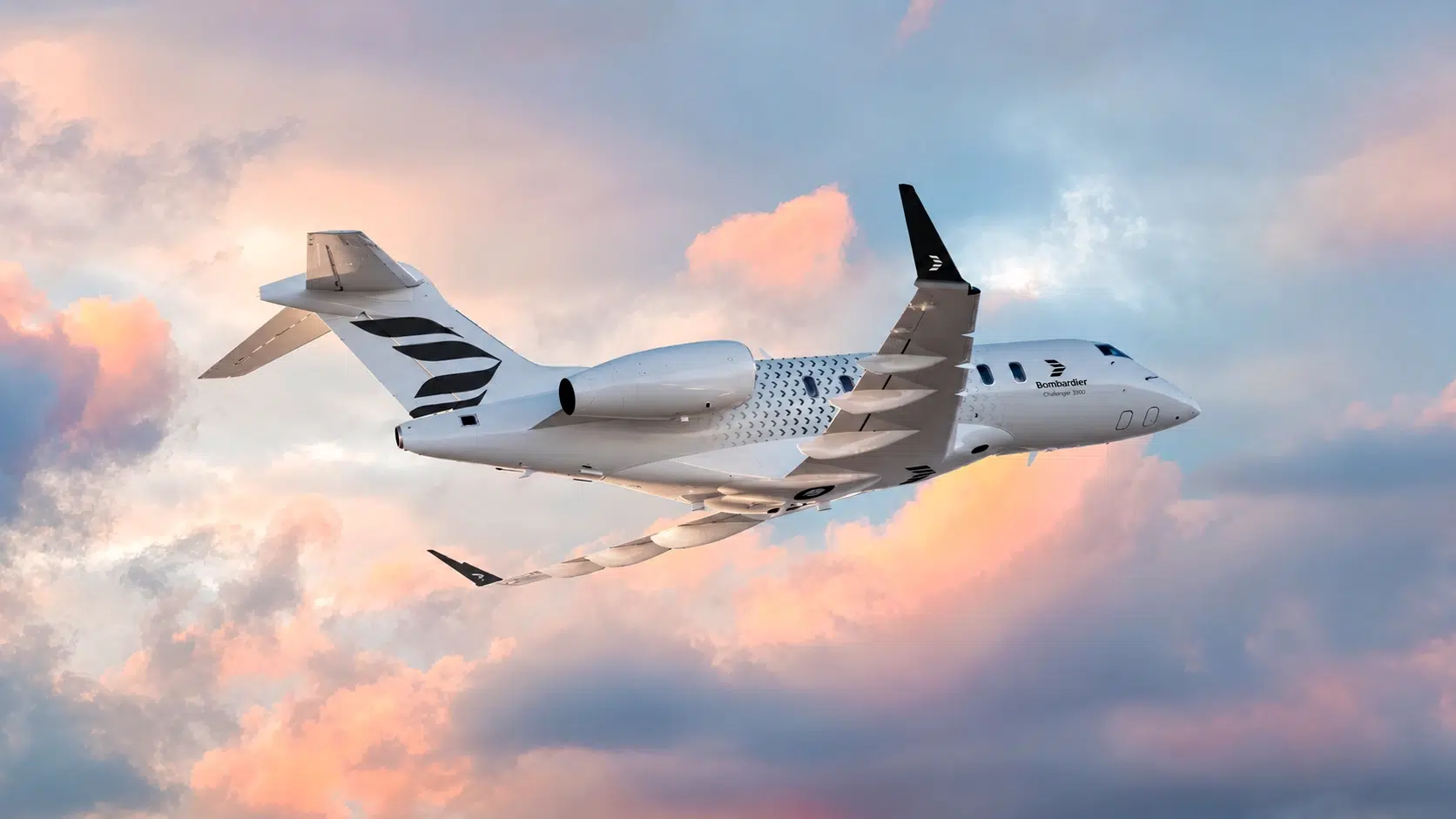
For a man whose family name is inseparable from speed, engineering, and Formula One, Piero Ferrari’s latest acquisition feels remarkably well judged. The vice chairman of Ferrari has taken delivery of Bombardier’s 200th Challenger 3500, a milestone aircraft expected to carry him to Grands Prix and other business engagements around the world.
The pairing is almost inevitable. Ferrari represents one of the most recognizable names in performance motoring; Bombardier has spent decades refining the private aircraft equivalent of a grand tourer, fast enough to cross continents efficiently, comfortable enough to make the journey restorative, and discreet enough to serve as a working environment between destinations.
Delivered on July 27, 2026, Ferrari’s aircraft marks an important moment for the Challenger 3500 program. Bombardier reached the 200-delivery threshold less than four years after the jet entered service. The manufacturer also says the model has outdelivered every other business aircraft in the medium and large categories since its first full year of deliveries in 2023.
That commercial momentum matters because the super-midsize category is among business aviation’s most competitive. These aircraft are expected to offer much of the range and comfort associated with larger jets while retaining more favorable operating economics and greater access to smaller airports.
The Challenger 3500 approaches that brief with the confidence of an established platform rather than a clean-sheet experiment. It is the latest evolution of Bombardier’s Challenger 300 family, a lineage that has become a fixture among corporate flight departments, private owners, and fractional operators.
Ferrari’s new jet has a maximum range of 3,400 nautical miles when flown under specified conditions with four passengers and two crew members. That puts destinations such as London and Dubai, or much of Europe and the Middle East, within reach from northern Italy, depending on weather, payload, and routing. A top speed of Mach 0.83 and maximum operating altitude of 45,000 feet provide the performance expected of an aircraft designed around demanding international schedules.
For Formula One travel, range is only part of the equation. The championship’s calendar moves relentlessly between Europe, Asia, the Middle East, and the Americas, often leaving little time between races and corporate obligations. A private aircraft becomes less an indulgence than an instrument of control, allowing departure times, airport choices, and working hours to be shaped around the passenger rather than an airline schedule.
Bombardier has not disclosed the precise interior specifications selected by Ferrari. The standard Challenger 3500, however, accommodates nine passengers, with certification for as many as 10. Its flat-floor cabin is designed to support both work and relaxation, with separate seating zones, large windows, substantial baggage capacity, and an enclosed lavatory.
The most distinctive element may be the Nuage seat, adapted from Bombardier’s larger Global 7500. Unlike conventional business-jet seating, it incorporates a deep-recline system intended to distribute weight more evenly and provide a more natural lounging position. On a succession of race-weekend journeys, that detail may prove more valuable than any decorative flourish.
The Challenger 3500 also introduced what Bombardier describes as the industry’s first voice-controlled business-jet cabin. Passengers can use spoken commands to manage elements of the environment rather than reaching for a handset or touchscreen. The technology complements a cabin designed around connectivity and productivity, allowing the aircraft to function as a private office at altitude.
It would be tempting to frame Ferrari’s acquisition solely through the romance of two performance marques. Yet the more compelling connection lies in their shared approach to refinement. Neither a Formula One car nor a business jet succeeds through headline power alone. Aerodynamics, packaging, reliability, ergonomics, and thousands of less visible decisions determine whether the finished machine performs as intended.
The Challenger 3500’s appeal also rests on operational pragmatism. Bombardier promotes the model as offering the lowest direct operating costs in its class, alongside short-field capability and the versatility to serve destinations that might prove less convenient for larger aircraft. The company has attracted commitments from operators including NetJets, VistaJet, and BOND, buyers for whom dispatch reliability and cost control are every bit as important as cabin design.
Ferrari’s jet is significant beyond its celebrated owner. Bombardier delivered the 100th Challenger 3500 in October 2024; fewer than two years later, that figure had doubled. The speed of that expansion suggests that the model has moved beyond early adopter enthusiasm and secured a durable position in the market.
The aircraft also carries an Environmental Product Declaration, which documents environmental impacts across its life cycle using standardized reporting principles. Such a declaration does not make private aviation environmentally neutral, but it does provide greater transparency around manufacturing, operation, maintenance, and eventual end-of-life considerations.
For Piero Ferrari, the Challenger 3500 appears to offer an especially appropriate balance. It is not Bombardier’s largest or longest-range aircraft, nor is it intended to compete with an airborne penthouse. Instead, it occupies the more nuanced territory between capability and restraint.
That may be precisely why it suits him. The aircraft can move quickly between races, corporate meetings, and private commitments without sacrificing the cabin comfort required for productive travel. It has the performance credentials associated with the Ferrari name, yet its luxury is expressed through engineering, efficiency, and thoughtful detail rather than theatrical excess.
The 200th Challenger 3500 is therefore more than another private jet delivered to a prominent owner. It is a meeting of two industrial cultures built around the same elusive objective: making exceptional performance feel effortless.