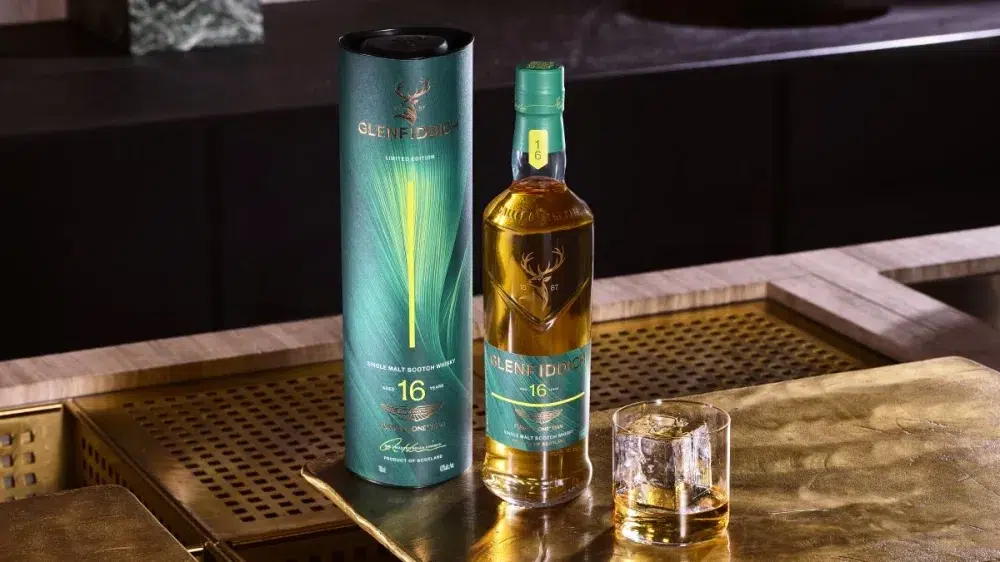
Some luxury collaborations feel engineered in a boardroom. Others reveal a genuine affinity between the partners involved. Glenfiddich and the Aston Martin Formula One Team belong firmly in the latter category, united by an appreciation for heritage, precision, and the instinct required to transform technical mastery into something memorable.
Their latest creation is the Glenfiddich x Aston Martin Formula One Team 16-Year-Old Release No. 2, a limited-edition Speyside single malt shaped through five distinct cask influences. Scheduled to reach retailers in August 2026 with a reported price of approximately $80, the whisky represents the second annual 16-year-old expression born from the brands’ multiyear partnership.
That age statement alone makes the bottle noteworthy at its price. Yet the more compelling story lies in its maturation. Release No. 2 draws from whisky aged in first-fill bourbon barrels, Port pipes, Oloroso sherry casks, and red-wine casks before incorporating Fino sherry butts for the first time in the collaboration. The five-part composition gives Glenfiddich Malt Master Brian Kinsman a broader palette than that used for the inaugural edition, allowing him to introduce greater depth and structure while retaining the distillery’s familiar fruit-led character.
The resulting profile is expected to be richer than its predecessor. Stewed fruit, floral notes, and marzipan appear on the nose, followed by buttery toffee on the palate and a dry, oak-influenced finish. Those layers suggest a whisky designed to evolve rather than announce itself all at once—the liquid equivalent of a grand tourer whose most impressive qualities emerge over distance rather than in a single burst of speed.
The Fino component is particularly intriguing. Fino is the driest of the traditional sherry styles, generally associated with delicacy, savory character, and a clean finish. Used judiciously, its casks can provide a counterpoint to the darker fruit and sweetness imparted by Port, Oloroso, and red-wine wood. Here, it appears to sharpen the whisky’s structure rather than simply add another layer of richness.
That measured complexity distinguishes Release No. 2 from the first Glenfiddich 16-Year-Old created for the Aston Martin F1 partnership. The original whisky relied on American oak wine casks, new American barrels, and second-fill bourbon casks. Bottled at 43 percent ABV, it offered notes of maple syrup, caramelized ginger, toasted oak, fresh fruit, Chantilly cream, and sustained sweetness.
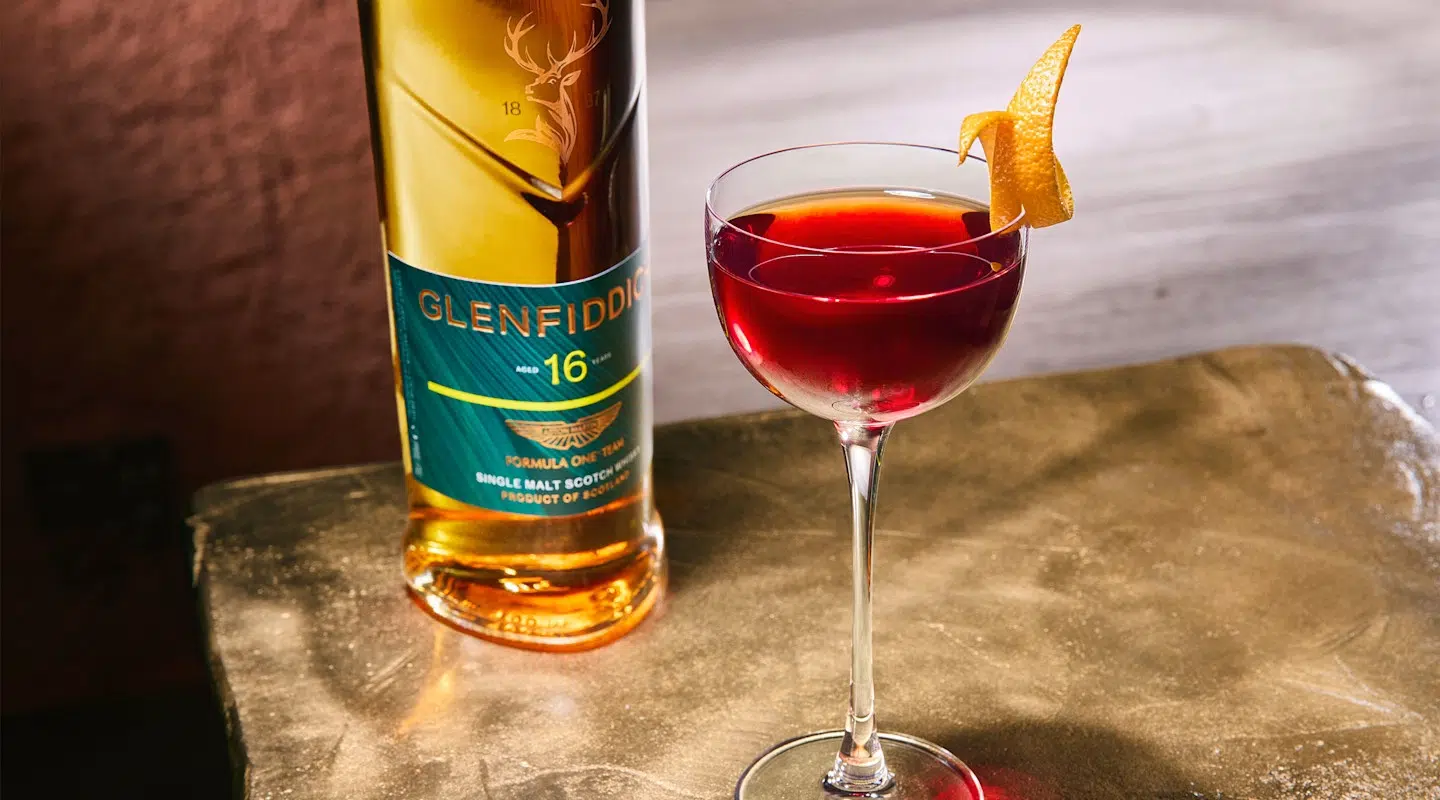
The new edition appears conceived as a more contemplative successor. Rather than repeat the first release with revised packaging, Glenfiddich has treated the partnership as an opportunity to explore a different style of maturation. It is a meaningful choice in a category crowded with co-branded bottles whose distinctions often extend little beyond the label.
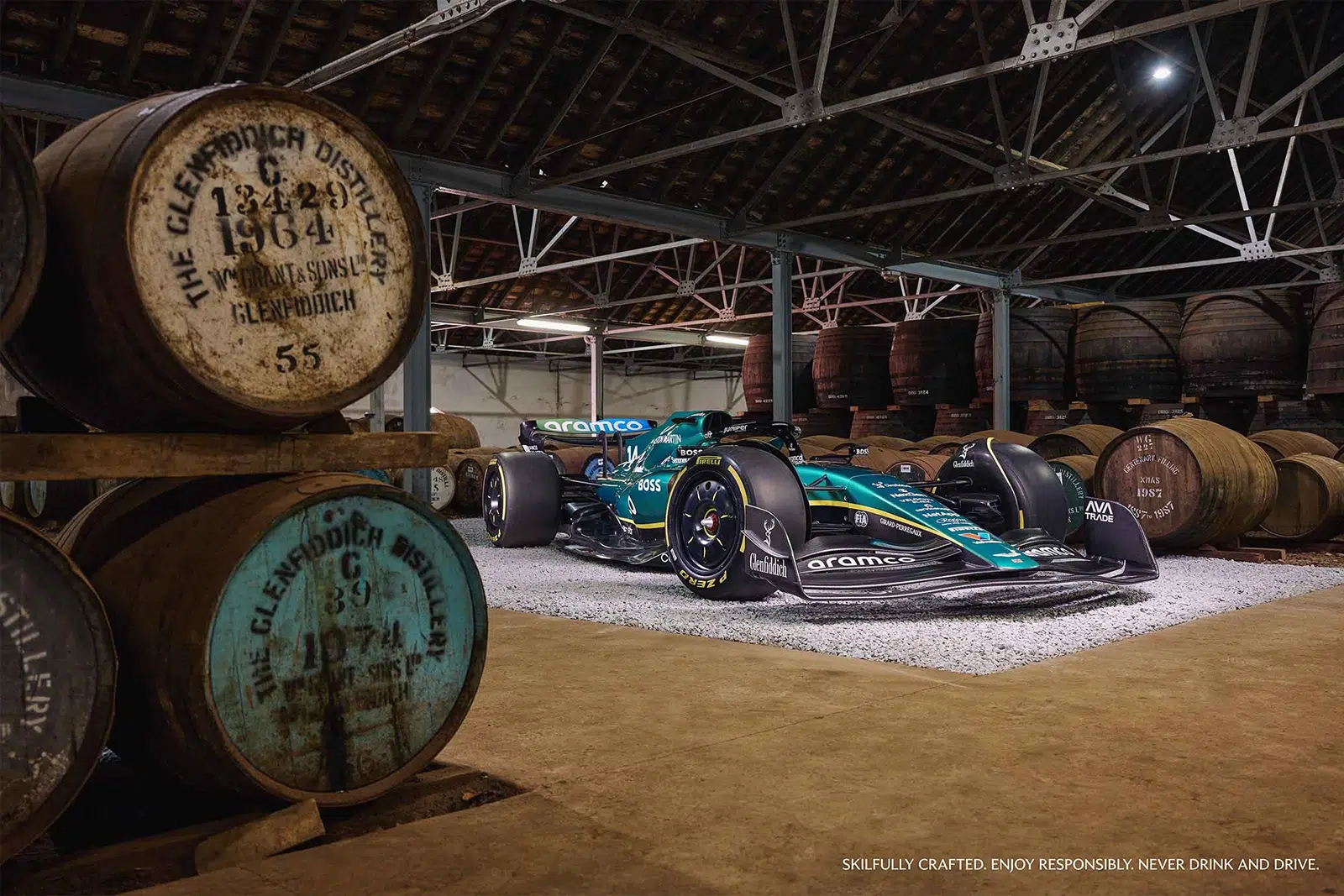
Glenfiddich and Aston Martin F1 formally announced their multiyear global partnership at the 2024 Las Vegas Grand Prix. The relationship was framed around shared values of innovation, craftsmanship, and performance, with both brands seeking to create experiences and products that reach beyond conventional sponsorship. A rare Glenfiddich cask from 1959—the year Aston Martin made its Formula One debut—was selected to commemorate the beginning of the alliance.
Since then, the collaboration has expanded through special bottlings, trackside tastings, hospitality events, and public activations. The first 16-Year-Old was celebrated at Grand Central Terminal in New York and later poured during a Formula One weekend event in Austin. For Glenfiddich, the partnership has become a platform for presenting whisky culture within the international world of motorsport without diluting the liquid’s importance.
There is a natural symmetry between the disciplines. Formula One depends upon extraordinary technical control, yet races can turn on judgment, feel, and decisions made in fractions of a second. Whisky making is slower, but it carries a similar tension between precision and intuition. Distillers can select wood, monitor maturation, and control blending with meticulous care, but the individual behavior of a cask remains influenced by time, climate, and organic variation.
Kinsman has spoken openly about that unpredictability, describing the character imparted by wood, warehouse conditions, and maturation as an essential part of whisky’s magic. His task is usually to manage variation in the pursuit of consistency; special releases provide an opportunity to celebrate it instead.
Release No. 2 also occupies a particularly appealing place in the whisky market. Collectible spirits increasingly arrive with four-figure prices and scarcity designed more for display cabinets than drinks trolleys. A 16-year-old single malt at approximately $80 offers a more democratic proposition: mature enough to feel special, limited enough to interest collectors, yet accessible enough to open and enjoy.
The appropriate setting need not be a paddock suite or members’ club. Its combination of mature fruit, toffee, wine-cask richness, and dry oak should make it well suited to an unhurried pour after dinner, served neat or with a few drops of water.
Speed may have inspired the collaboration, but this is a whisky built around patience. Five cask types, 16 years of maturation, and the judgment of an experienced malt master have created something more substantial than branded memorabilia. Glenfiddich and Aston Martin F1 have produced a bottle that earns its place in the glass—not merely beside a scale model of the car.