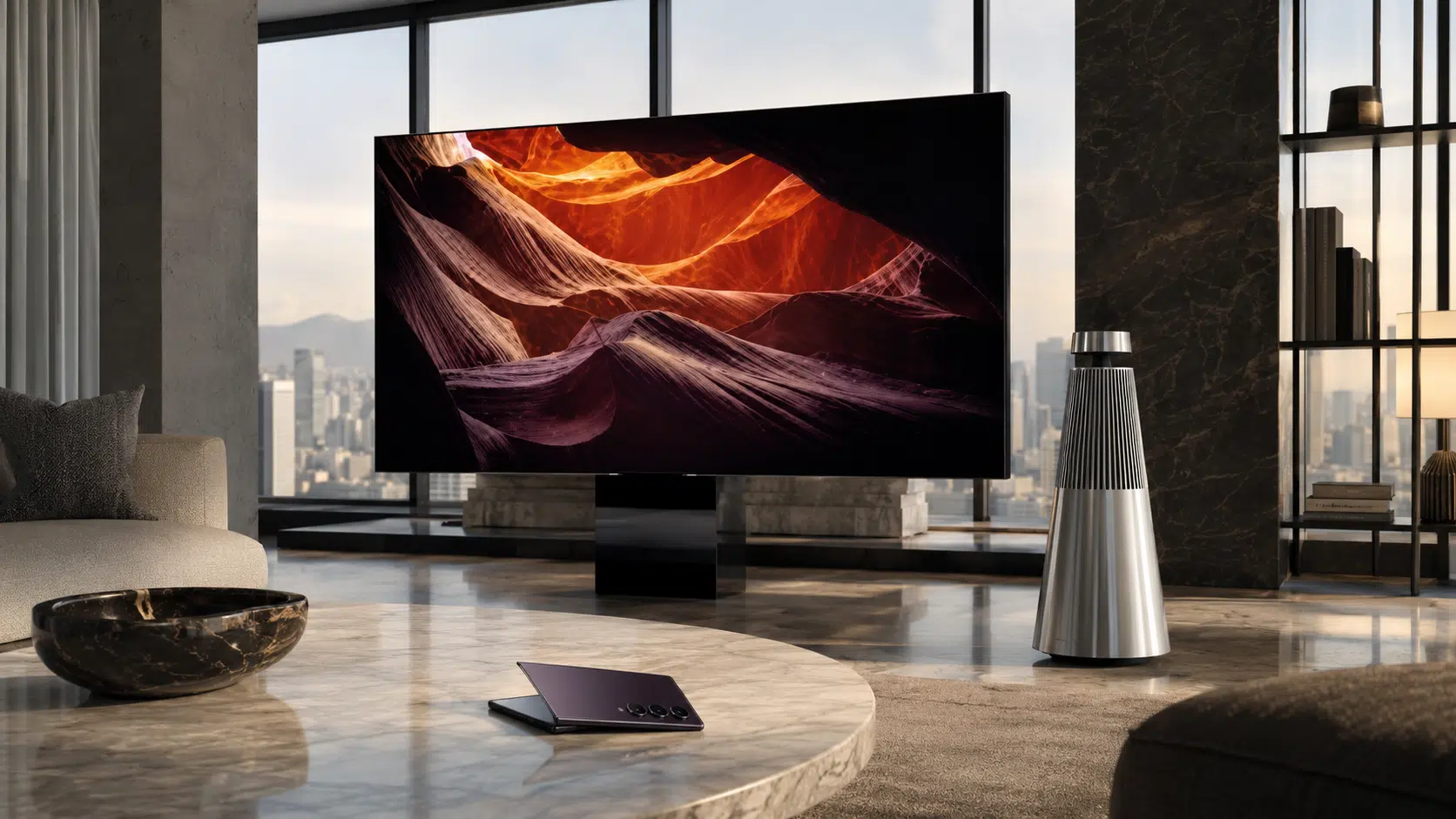
Luxury technology has moved well beyond the era when owning the latest smartphone was enough to make an impression. Today, the most compelling devices are not merely useful; they are sculptural, architectural and increasingly designed to become part of the way a room looks and feels.
The best examples sit somewhere between industrial design and performance. They solve practical problems, but they also command attention. From a speaker that behaves like a piece of metal sculpture to a television that physically unfolds itself into a cinematic wall and a smartphone that transforms in the hand, these are three pieces of technology that make their presence known before they are even switched on.
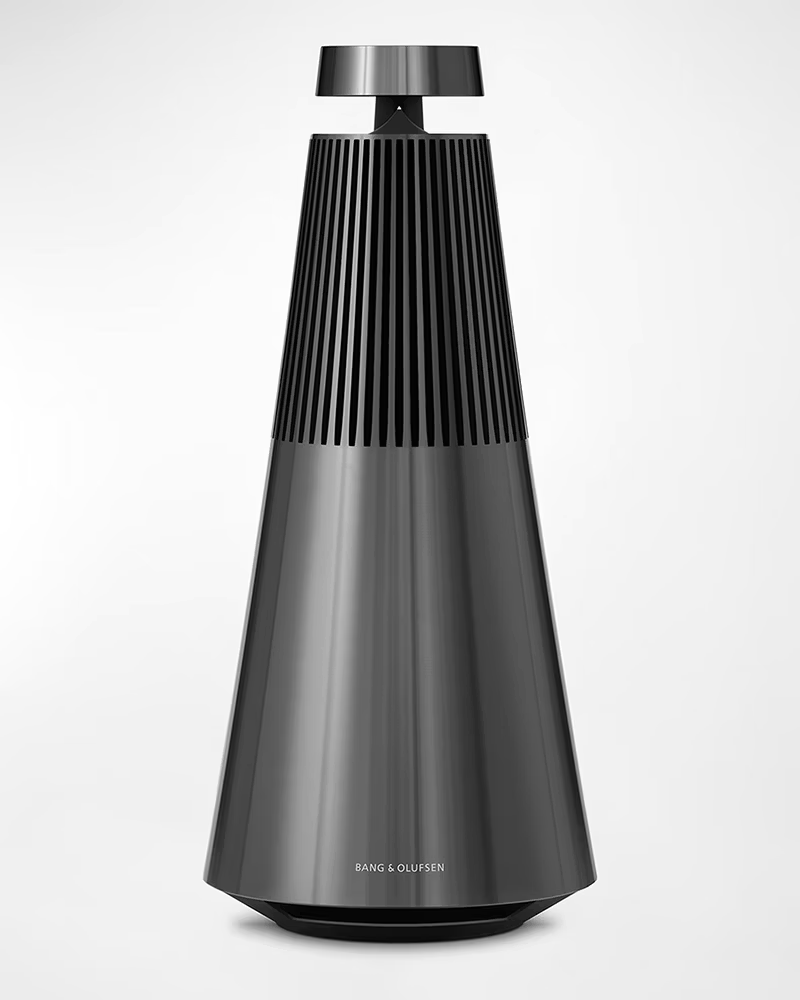
Bang & Olufsen Beosound 2
Few audio products have aged as gracefully as Bang & Olufsen’s Beosound 2. Its tapered aluminum body still looks more like an object designed for a gallery than a conventional wireless speaker, which may explain why it remains in the Danish brand’s collection years after its introduction.
Machined from aluminum and designed to distribute sound through 360 degrees, Beosound 2 uses Bang & Olufsen’s Acoustic Lens Technology to spread high frequencies evenly throughout a room rather than directing them toward a conventional listening position. Active Room Compensation further adapts the speaker’s performance to its surroundings, making placement considerably less restrictive than with traditional hi-fi equipment.
The visual simplicity disguises a surprisingly sophisticated acoustic package. A dedicated tweeter, dual midrange drivers and a substantial woofer are integrated into the slender body, while contemporary streaming and multiroom capabilities allow it to function as part of a broader connected audio system.
Bang & Olufsen currently offers Beosound 2 in finishes including Natural, Gold Tone and Black Anthracite, with pricing beginning at $4,000 in the United States. Special editions push the design further, but even the standard version has the quality that has always separated the brand’s best work from ordinary consumer electronics: it looks intentional even when silent.
This is not a speaker designed to disappear into a bookshelf. It is meant to occupy space confidently, turning audio equipment into part of the interior architecture.
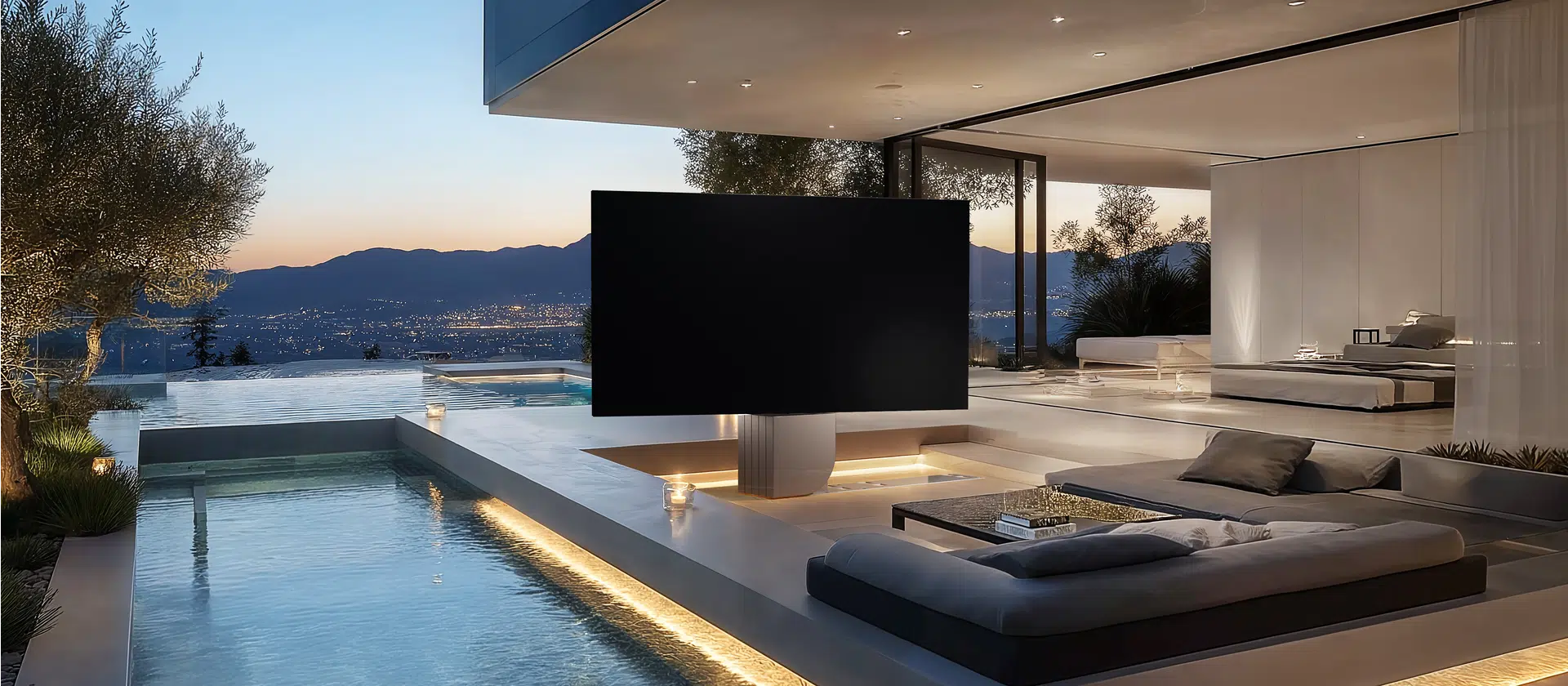
C SEED N1
If Beosound 2 treats technology as sculpture, the C SEED N1 treats it as theater.
At rest, the N1 resembles an elongated piece of contemporary furniture. Activate it, however, and a massive MicroLED display rises from the base before unfolding into a seamless screen. Depending on configuration, buyers can specify versions measuring 110, 137 or an extraordinary 165 inches.
The transformation is the point.
Large televisions have traditionally created an interior-design problem. Even the most elegant screen becomes a vast black rectangle once switched off, dictating furniture placement and often competing with architecture, artwork and views. C SEED approaches the problem differently by allowing the television to disappear into its own sculptural base when it is not being used.
The N1 is freestanding, which removes the need for a supporting wall and gives architects far greater freedom in rooms defined by glass, artwork or open-plan layouts. Once deployed, the screen can rotate, allowing its position to change depending on seating or orientation.
The result feels less like conventional home electronics and more like mechanical choreography. Panels rise, unfold and align until the furniture-like object has transformed into a private cinema.
That spectacle is precisely why the N1 belongs in this conversation. Luxury technology is increasingly about eliminating compromises between performance and interiors, and few products make that ambition more literal.
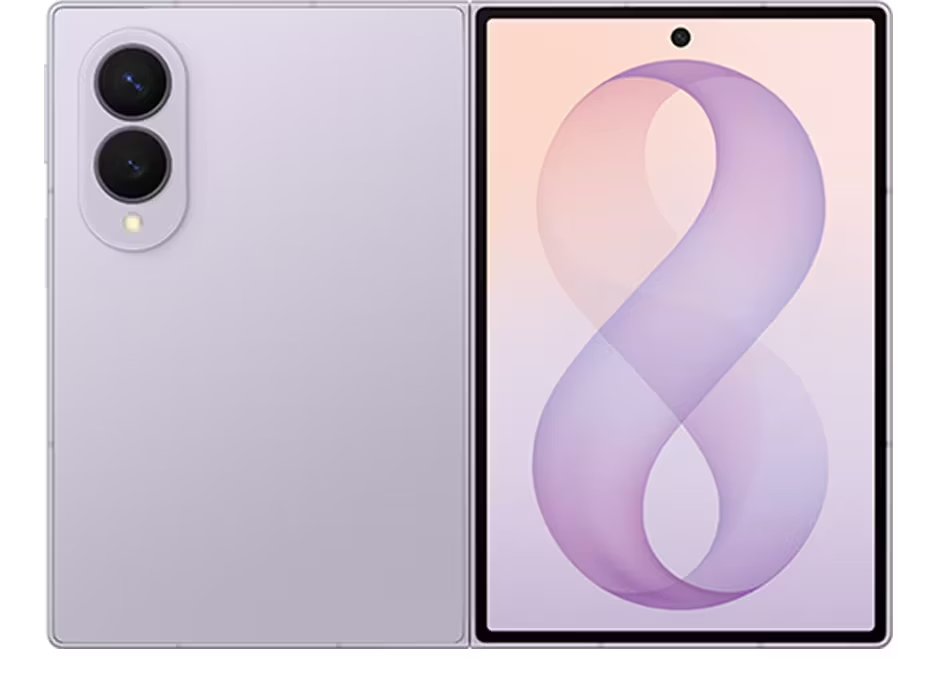
Samsung Galaxy Z Fold8
The third device operates on an entirely different scale, but its effect is similar.
Samsung’s Galaxy Z Fold8 continues the company’s effort to make the folding smartphone feel less experimental and more inevitable. Closed, it behaves like a conventional premium phone. Open it, and the device becomes a larger workspace designed for multitasking, entertainment and content consumption.
The transformation remains satisfying because it changes the way the object is used rather than simply adding another specification.
Samsung has refined the Fold considerably over successive generations, and the latest model places greater emphasis on making the hardware feel lighter and more natural in everyday use. The Fold8 opens into an expansive display while retaining a practical exterior screen for more conventional phone tasks, allowing users to move between compact and tablet-like formats without carrying two separate devices.
It also arrives at a moment when foldables are no longer purely technological curiosities. Their appeal increasingly lies in flexibility: one device can function as phone, reading screen, work surface and portable entertainment system depending on how it is opened.
With U.S. pricing beginning at $1,899.99, the Galaxy Z Fold8 occupies the premium end of the smartphone market, but its luxury lies less in decoration than in engineering. The hinge, display and compact packaging create a sense of mechanical sophistication that conventional slab-style phones struggle to replicate.
What connects these three products is not price alone. Each transforms in some way.
The Beosound 2 turns sound equipment into sculpture. The C SEED N1 turns furniture into cinema. The Galaxy Z Fold8 turns a phone into a larger digital workspace.
That may be the most interesting direction luxury technology has taken. The goal is no longer simply to possess something expensive or unusual. The most memorable devices increasingly earn their place by changing the environment around them—or, at the very least, changing the way we interact with it.
When technology can do that while looking exceptional in the process, making an impression becomes almost incidental.