How a Single-Vineyard Barbera Earned Its Place on International Cellar Lists
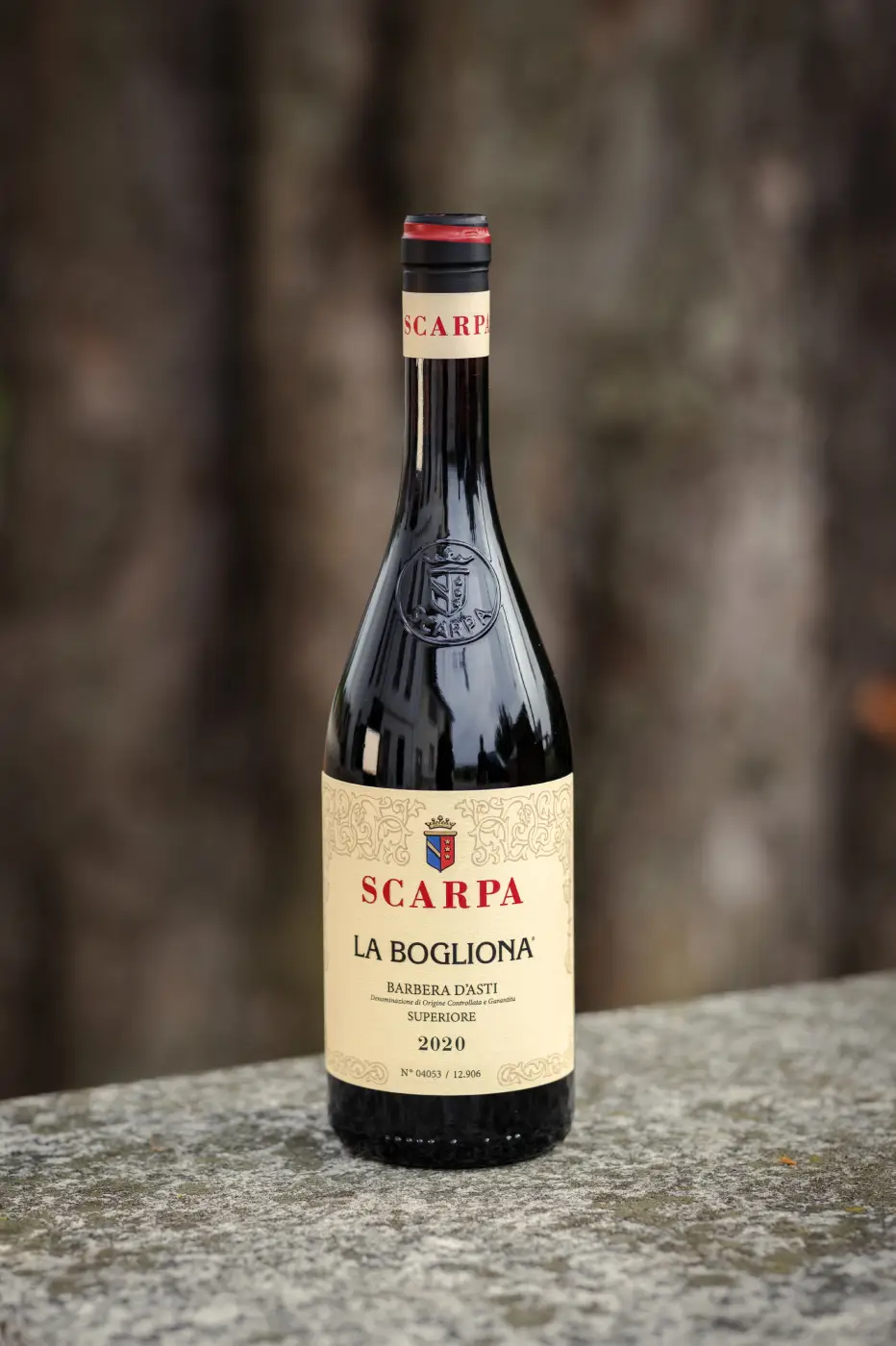
During harvest week, while the cellars in Nizza Monferrato fill with new fruit, Scarpa does something deliberate at its villas above Verduno. It opens three decades of a single wine and pours them side by side for a table of collectors. The wine is La Bogliona, the house’s flagship single-vineyard Barbera. The tasting is designed to answer one question: can a Barbera, the grape Piedmont long treated as its everyday red, still be worth drinking thirty years later? Scarpa, the Nizza Monferrato house founded in 1900 and owned since 2017 by Monaco-based Evgeny Strzhalkovskiy, has kept the evidence in the cellar.
What is Scarpa’s La Bogliona?
La Bogliona is Scarpa’s flagship: a Barbera grown on a single Monferrato vineyard, fermented on selected yeasts, aged in large old French oak botti, and released late on allocation. In a range that includes Barolo from Monvigliero and Roncaglie and Barbaresco from Canova, the wine the house leads with is the grape Piedmont once overlooked. That choice is intentional.
“Barbera is the purest expression of who we are,” says Davide Champion, chief executive of Scarpa. “It has energy, depth and an ageing potential most people never get to see, because the bottles stay in the cellar for a full 5 years before hitting the market and the bottles are usually gone within a year.”
How does La Bogliona age?
Tasted across three decades, La Bogliona changes character rather than fading. Young vintages, five to ten years old, still lead with dark cherry and a bright line of acidity. Around fifteen years, the fruit becomes savoury: dried cherry, tobacco, earth, and the same acidity that made the wine lively when young becomes its structure. Bottles past twenty-five years move into undergrowth, dried rose and balsamic notes, the acidity still holding the wine upright. In a grape with little tannin, that acidity is what allows Barbera to age at all.
“People assume tannin is what makes a wine last. In Barbera it is the acidity,” Champion says. “Give the grape a serious site and enough time, and that acidity becomes a spine that carries the wine for decades.”
Has the way La Bogliona is made changed over thirty years?
The method has barely moved. La Bogliona has always been fermented on the vineyard’s own yeasts and aged in botti rather than new barriques, keeping the oak in the background so the site can speak. What has evolved sits at the margins: cleaner fruit from better vineyard work, more precise harvest timing, and longer ageing before release as confidence in the wine’s longevity grew. Today the winemaking is overseen by enologist Silvio Trinchero in the same cellars the house has occupied since 1900, continuing a line that runs through Carlo Castino and Mario Pesce back to the founder.
“We did not reinvent the wine. We got better at staying out of its way,” Champion says. “The method is selected yeasts, old botti and patience. The vintage does the rest.”
Why is La Bogliona on international cellar lists?
La Bogliona now appears on serious lists in New York, London and Oslo for structural as well as stylistic reasons. The vineyard is a single plot, so supply is fixed while demand is not. The house releases late and on allocation, so the wine reaches the market already carrying age and a track record. For a sommelier or collector, a wine with three decades of proof and a supply that cannot be expanded is what earns a place on a list and keeps it.
“A cellar list is not won with a score. It is won when someone opens a twenty-year-old bottle, and it was worth the space it took,” Champion says. “That is the test that matters, and Barbera passes it more often than people expect.”
The vertical tasting makes the case in a single sitting. During harvest, with the next vintage arriving through the cellar doors, the point is hard to miss: the wine in the oldest glass on the table was made in much the same way as the fruit coming in outside.