Montecristo takes to the skies with Fragata, a new Duke-format Habano created exclusively for duty-free and travel retail.
Holding patterns can test a cigar smoker’s resolve. The safety-belt sign glows overhead, the long-haul flight has begun its descent, and somewhere below the clouds lies the promise of a reddish-brown Habano, a clean cut and that first measured draw.
As the aircraft drops beneath the cloud cover, the mind begins to wander toward what comes next: cedar, smoke, leather and coffee slowly unfurling over the course of an hour. Turbulence suddenly seems rather trivial when the imagination is already installed in a quiet lounge, glass in hand, with a Montecristo burning evenly between the fingers.
Then comes the captain’s announcement. Air-traffic congestion. A delay to landing. Another circuit above the airport.

For anyone who has spent half the flight contemplating the cigar awaiting them on the ground, there are few more unwelcome words. Yet there is something fitting about having to wait for Montecristo Fragata, a new Habano whose very identity is built around travel, anticipation and the pleasures that begin once the journey is over.
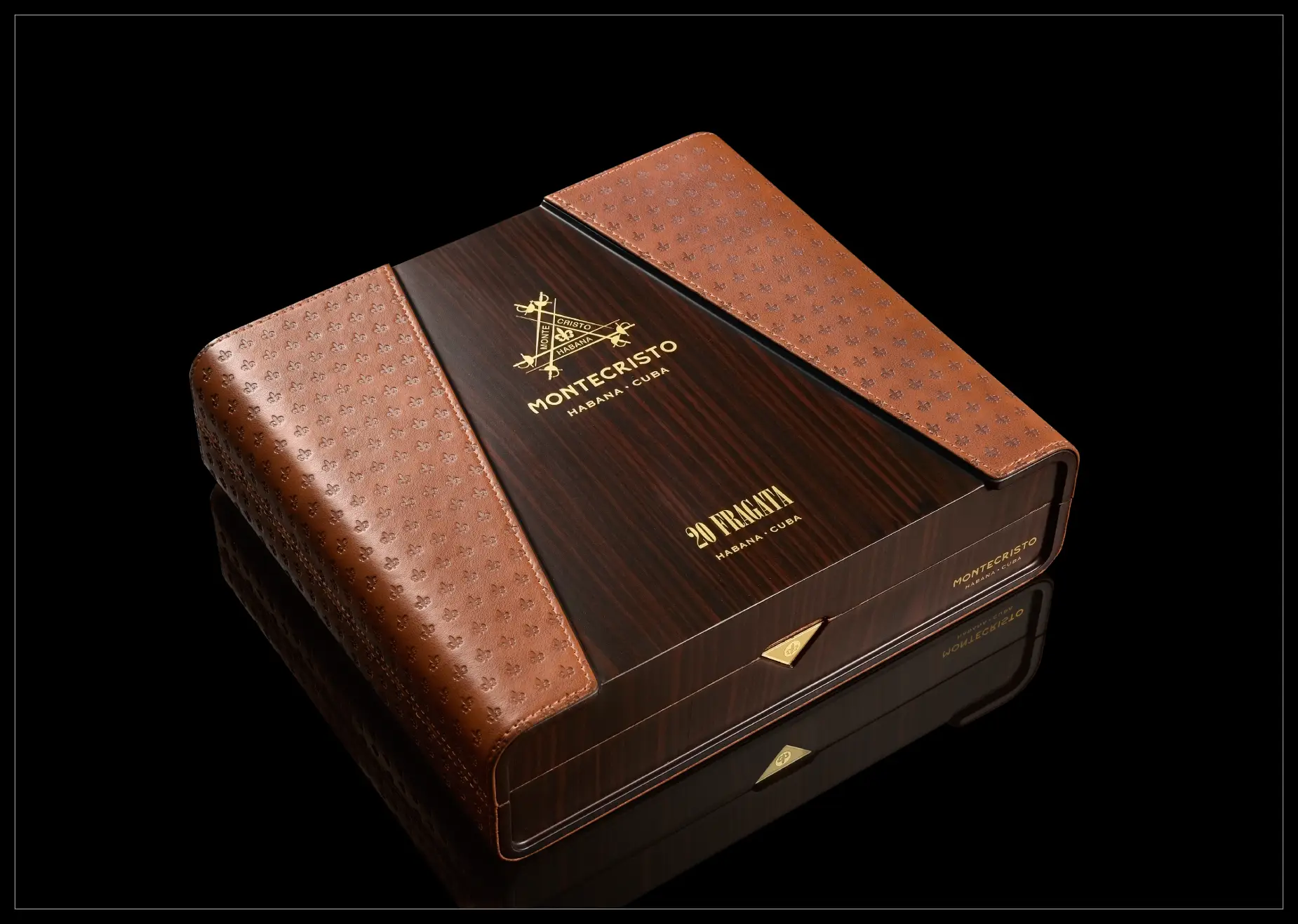
Unveiled at the TFWA World Exhibition & Conference in Cannes, Fragata was created specifically for the duty-free and travel-retail market. Presented in a dedicated humidor containing 20 cigars, it continues a two-decade Habanos tradition of developing releases intended for travelers, but with the weight of one of Cuba’s most recognizable marques behind it.
The name itself is no accident. “Fragata,” Spanish for frigate, recalls the ships that play a central role in Alexandre Dumas’ The Count of Monte Cristo, the novel from which Montecristo took its name. Founded in Havana in 1935 and now more than 90 years into its history, the house has always carried a certain literary romance. Fragata turns that association into something more literal, placing the notion of voyage at the heart of the cigar.
The format is equally purposeful. Fragata is a new commercial vitola for Montecristo, made in the Duke format and measuring 140 mm in length with a 54 ring gauge. It is a substantial parejo, broad enough to encourage a cool, leisurely burn and intended to deliver approximately 70 minutes of smoking. The profile begins around medium strength and builds gradually toward medium-to-full, allowing the cigar to gather intensity rather than declare itself all at once.
Construction follows the classic Habanos formula: Totalmente a Mano con Tripa Larga, entirely handmade with long filler, using tobacco selected from Vuelta Abajo in Cuba’s Pinar del Río region. The area remains the spiritual and agricultural heartland of Cuban cigar production, and its inclusion gives Fragata the pedigree expected of a release carrying the Montecristo name.
There are visual cues that distinguish it before the first draw. The wrapper is smooth, glossy, and reddish-brown, while a special foot band bearing the name of the vitola marks the cigar as something outside the regular Montecristo line. It is a restrained detail, but one that suits a cigar built around the idea of travel exclusivity rather than theatrical packaging alone.

The first third opens with a creamy texture and measured woody notes, offering a relatively composed introduction. As the cigar develops, the profile grows more expressive, with smoke, leather, and coffee beginning to emerge while the body gathers momentum.
By the second third, the balance becomes more interesting. The wood deepens, the darker notes become more defined, and the cigar starts to reveal the structure expected of Montecristo. The progression is gradual rather than abrupt, giving Fragata a sense of movement that mirrors its name: a steady departure from softness toward greater depth.
The final third brings the cigar firmly into medium-to-full territory. The flavors become richer, the smoke denser, and the coffee and leather notes more pronounced, creating a finish with greater weight and complexity than the opening might initially suggest.
That evolution is part of the appeal. Fragata is not designed as a novelty for the airport shelf, but as a cigar with enough progression to hold the attention of an experienced smoker from first draw to final inch.
There is also something fitting about its debut in Cannes. Airports, duty-free halls and international terminals have always played a particular role in cigar culture, where a rare box discovered between flights can become a souvenir with rather more longevity than anything found in the neighboring luxury boutique.

Alberto Donar Cruz, Commercial Vice-President of Habanos, S.A., describes Fragata as more than a new Habano, positioning it instead as an invitation to carry an exceptional experience from one destination to the next. The sentiment may be romantic, but it suits a cigar conceived around the rituals of movement and arrival.
José María López, Vice-President of Habanos, S.A., places the release within a broader history. Habanos has now spent 20 years developing products specifically for duty-free and travel retail, creating nearly 20 offerings aimed at aficionados in transit. Fragata continues that lineage while giving Montecristo a more prominent role within it.
The timing feels particularly apt. Montecristo has long been one of the great names in Cuban cigars, and a travel-exclusive release allows the brand to revisit its history without becoming nostalgic. The literary reference remains, but the execution is contemporary: a broad-gauge cigar, a substantial smoking time, and a presentation designed for the international collector.
Habanos lists the recommended retail price at $64 or €55 per cigar, and $1,280 or €1,100 for the 20-cigar travel humidor, with final pricing varying by market. Availability is limited to duty-free and travel-retail channels.
So perhaps the extra circuit above the runway is not entirely wasted time. By the moment the wheels touch down, the cabin doors open and the terminal comes into view, the anticipation has already become part of the experience.
For a cigar named after a vessel built to travel, that seems exactly as it should be.