Wine writing likes a rivalry, and none is staged more often than Italy against France. In the cellar, the contest is smaller than the map suggests. The traditional houses of Piedmont and Burgundy work in strikingly similar ways. The sharpest disagreements sit not between the two countries but inside each of them. Scarpa, the Nizza Monferrato house founded in 1900 and owned by Monaco-based Evgeny Strzhalkovskiy, offers a clear case study: its Barolo from Monvigliero and Roncaglie shows the Italian traditional school at its most legible.
What divides the Italian and French winemaking schools?
The real division in traditional European winemaking is not nationality. It is how much the winemaker intervenes. On one side sits a low-intervention approach: native yeasts, long ageing, restraint with new oak, and a belief that the site should remain legible in the glass. On the other sits a more interventionist template: selected yeasts, more oak-driven ageing, and greater shaping in the cellar. Both approaches exist in Italy, and both exist in France. Piedmont and Burgundy lean strongly to the first. The Bordeaux model, widely copied around the world, leans to the second.
“People ask whether we follow the Italian way or the French way,” says Davide Champion, chief executive of Scarpa. “The honest answer is that a traditional Piedmont cellar and a traditional Burgundy cellar have more in common with each other than either has with a modern, oak-driven winery down its own road.”
How is Scarpa’s Barolo made in the traditional way?
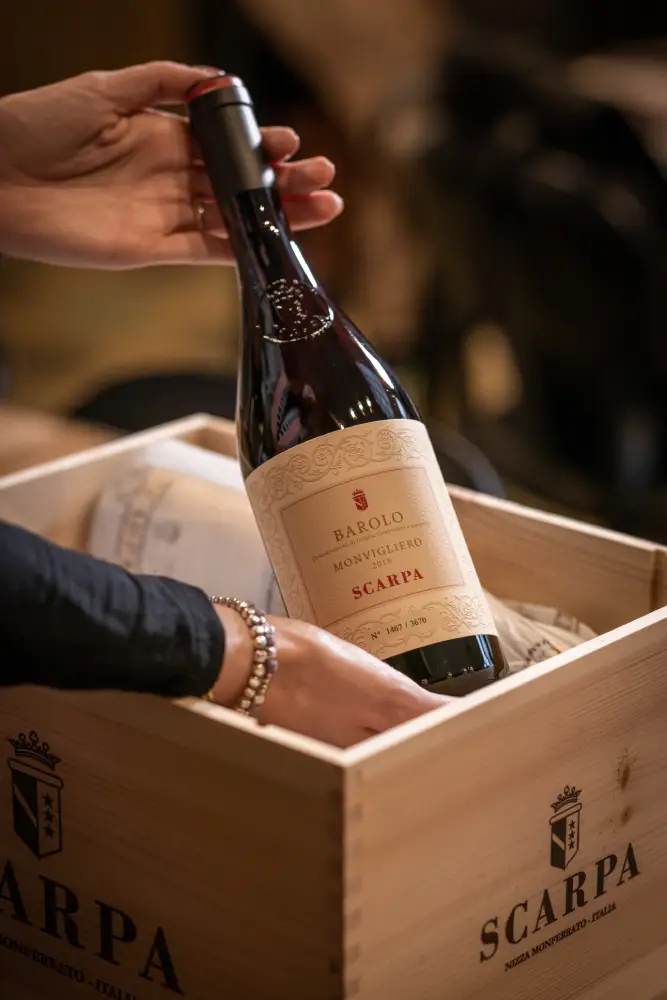
Scarpa’s Barolo follows the traditional Italian approach with unusual clarity. It is made from a single grape, Nebbiolo, grown in named crus. Monvigliero in Verduno produces an aromatic, fine-boned style from its 0.64 hectares. Roncaglie in La Morra, on south-eastern slopes with silty-loam soils, gives a rounder shape. The fruit is fermented on its own selected yeasts
and aged for years in large old French oak from allier casks so old and so large that they
add almost no flavour of their own. Releases are late and on allocation. The aim is simple: let the cru speak.
“With Nebbiolo you are not building a wine, you are translating a place,” Champion says. “The botti and the years are there to keep our hands off it. If you can taste Monvigliero and not taste us, we have done the job.”
Where do the two traditions diverge?
They part most clearly over the grape and the oak. Bordeaux built its reputation on the blend, assembling several varieties into a consistent house style, and on the barrique, the small new-oak barrel that contributes both structure and flavour. Piedmont and Burgundy take the opposite path: a single variety, and old, large oak chosen to stay quiet. Italy debated this within its own borders during the Barolo wars of the 1980s and 1990s, when traditionalists who stayed with botti faced modernists who adopted French barriques. Scarpa never left the traditional side.
“New oak adds its own signature. Old botti add almost none,” Champion says. “We wanted people to taste the cru, not the barrel.”
Where do the Italian and French traditions converge?
Despite those differences, the traditional camps share the essentials. Both place the vineyard, not the cellar, at the centre of quality. Both favour native yeasts, accept the character of the vintage rather than correcting it, and age their wines slowly. Both organise themselves around named ground: Burgundy’s climats, Piedmont’s crus. Even Bordeaux’s greatest estates are, ultimately, arguments for a particular piece of land. The Italian and French schools agree more than they differ. They simply speak with different accents.
“A Burgundian and I would understand each other in the cellar within five minutes,” Champion says. “We are both trying to get out of the way of the land. The grapes and the language are different. The belief is the same.”
That is why Scarpa’s Barolo remains a useful place to see the Italian school clearly. Not because it is better than what Burgundy or Bordeaux produce, but because Monvigliero and Roncaglie, made with old oak, time, and a single grape, show the tradition of doing as little as possible and letting the place do the rest.