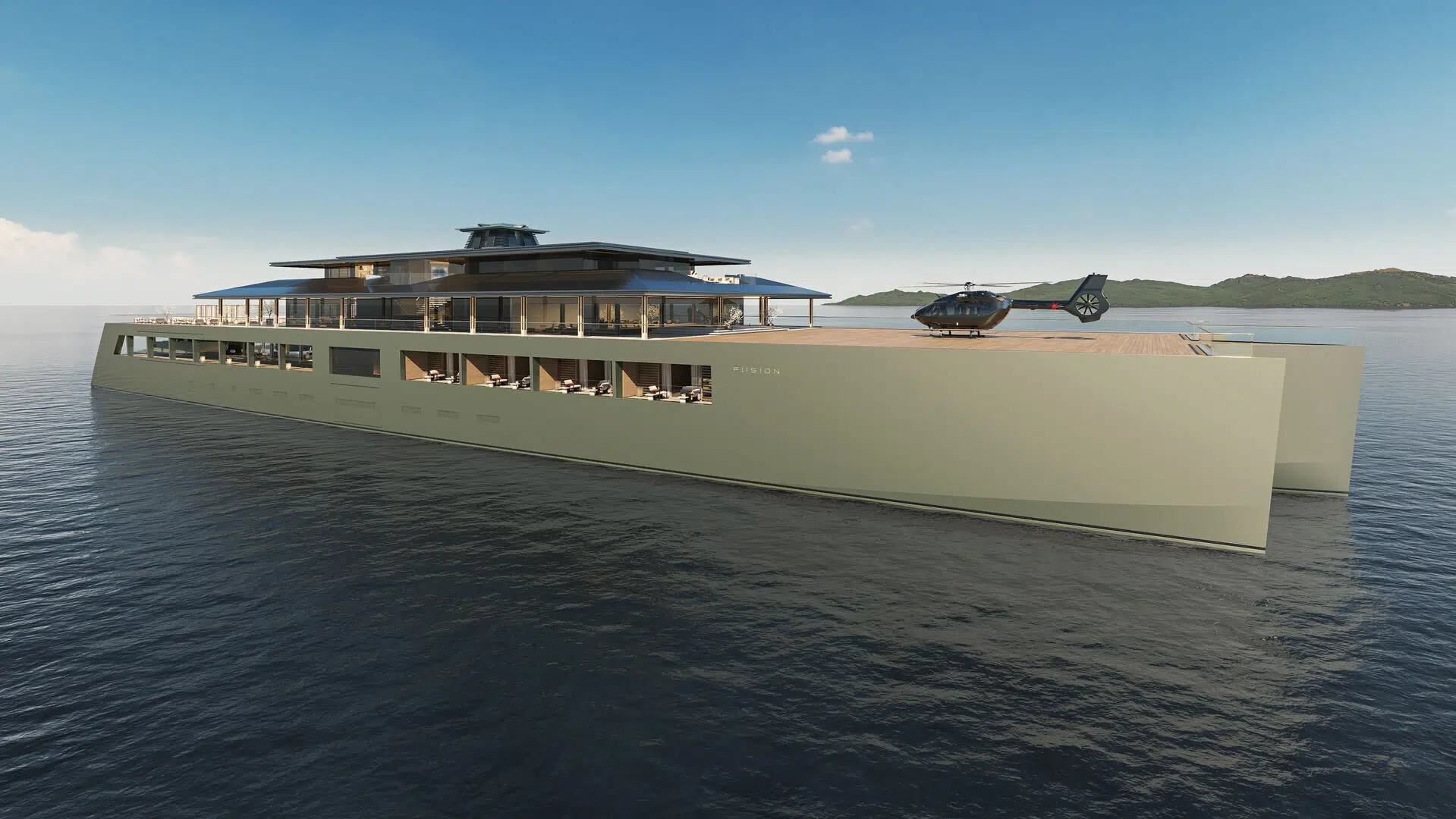
At 118 metres long and an extraordinary 30 metres across, Sinot’s new Fusion concept uses three near-full-length hulls to create something more ambitious than another supersized yacht: a floating world built around culture, wellness, sport and exploration.
There is a point at which a yacht ceases to feel like a vessel enlarged for luxury and begins to operate more like private architecture set loose on the sea. Sinot Yacht Architecture & Design appears determined to cross that threshold with Fusion, a 118-metre trimaran concept whose significance lies not simply in its length, but in what happens when that length is paired with three hulls extending across almost the entire vessel.
Unveiled ahead of the 2026 Monaco Yacht Show, Fusion is being described as the world’s largest full-length trimaran superyacht concept. The distinction is important. At its center is a 115-metre waterline hull, flanked by two 110-metre side hulls that function not as conventional stabilizing outriggers, but as integral architectural components. With a beam of 30 metres, the yacht effectively creates a platform of proportions rarely available aboard a private vessel, opening some 3,340 square metres of exterior deck space. Naval architecture is by Azure Yacht Design & Naval Architecture.
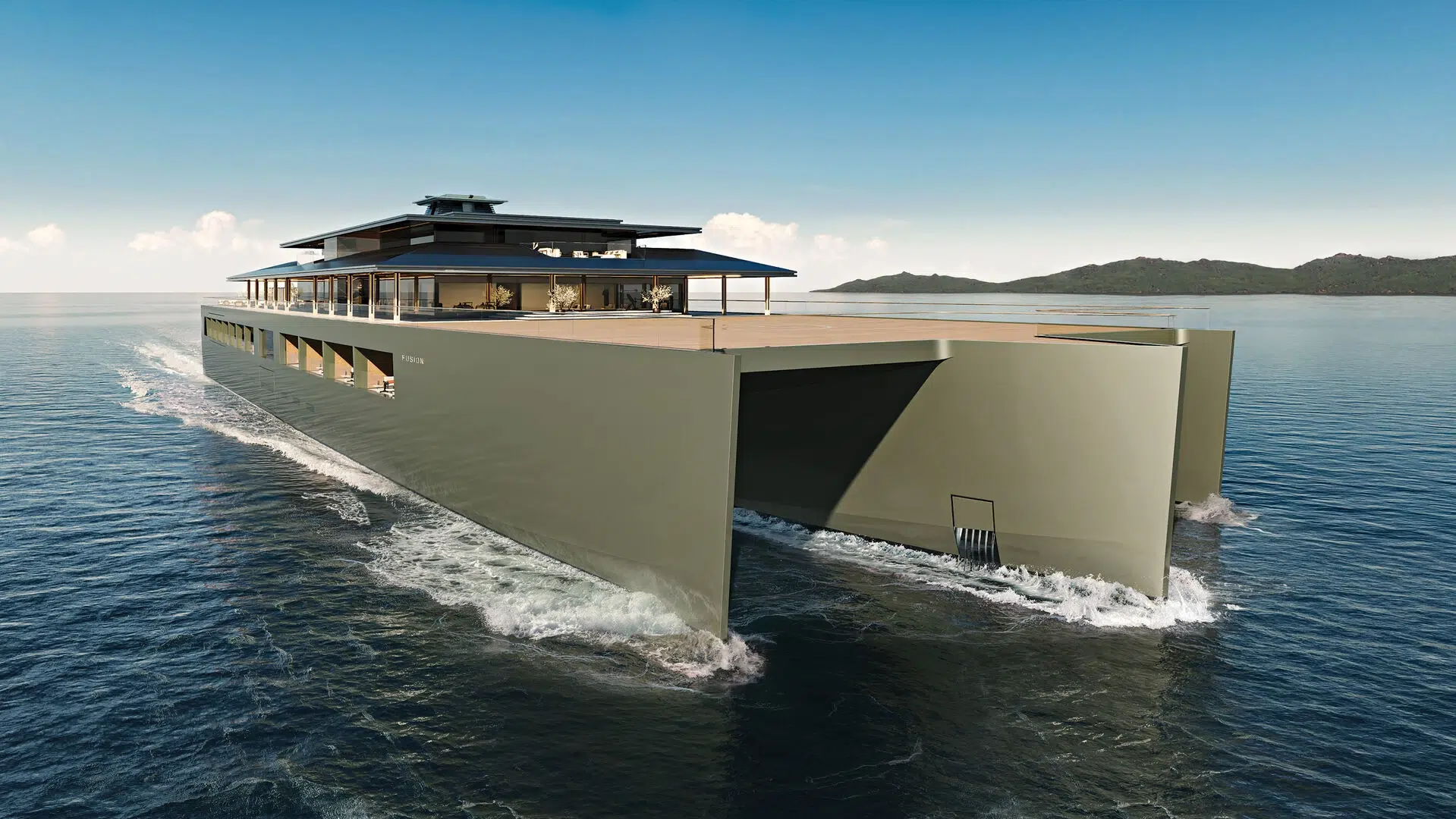
That difference is at the heart of Fusion. Sinot is not proposing a monohull with two appendages added for drama. The three hulls are conceived as a single architectural system, allowing spaces normally forced into sequence aboard a yacht to exist beside one another instead. At this scale, width becomes as transformative as length, changing how the owner and guests move through the yacht and, more importantly, how many different versions of life aboard can unfold at once.
Sinot has long approached yacht design from the perspective of lived experience rather than spectacle alone. The studio describes its work in terms of proportion, movement, light, materials and the relationship between interior and exterior, with the yacht ultimately conceived as an environment shaped around the owner rather than a collection of amenities. Fusion pushes that philosophy into particularly ambitious territory, bringing culture, wellness, sports and exploration together within one platform.
The numbers make the possibilities immediately apparent. Approximately 2,200 square metres of exterior space are concentrated on the upper deck alone, including a 770-square-metre forward area Sinot calls the Playdeck. Rather than filling that real estate with another sequence of lounges, the studio proposes something almost surreal aboard a yacht: a regulation-scale tennis court. The same area can be reconfigured for futsal, volleyball, BMX activities, performances and events, while also serving helicopter and VTOL aircraft operations when required.
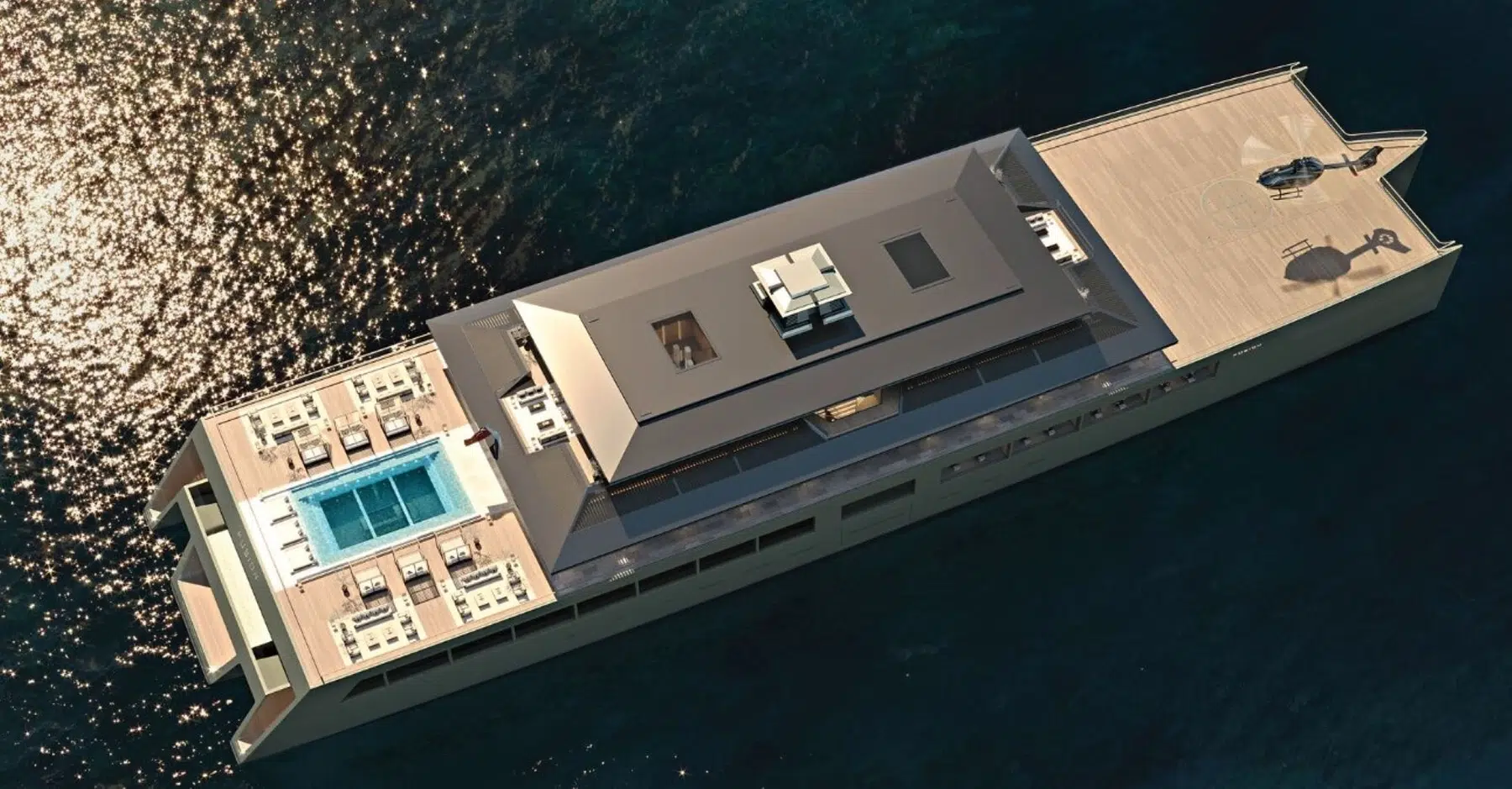
The point is not the novelty of playing tennis at sea. It is the flexibility implied by a deck large enough to change purpose altogether. A morning might begin with sport, transition into aviation operations later in the day, then become an entertainment venue by evening. The architecture no longer dictates one use for one space; it allows the owner to continually redefine it.
Aft on the same deck, Fusion moves in a decidedly more languorous direction. A terrace of approximately 970 square metres surrounds a swimming pool measuring roughly 8.2 by 12.7 metres, with a glazed bottom that visually connects the water above with the deck below. The scale is closer to the terrace of a resort than the aft deck of a conventional yacht, reinforcing the impression that Fusion’s three-hull geometry is being used to create genuine horizontal space rather than simply additional interior volume.
Dining is similarly conceived on a scale intended for extended gatherings. An 18-seat table anchors one of the yacht’s principal social spaces, while nearby bars and the pool terrace encourage movement between formal dining and open-air entertaining. Rather than dividing hospitality into isolated rooms, the concept appears to favor environments capable of changing character throughout the day, a philosophy consistent with Sinot’s wider emphasis on fluid transitions between interior and exterior life.
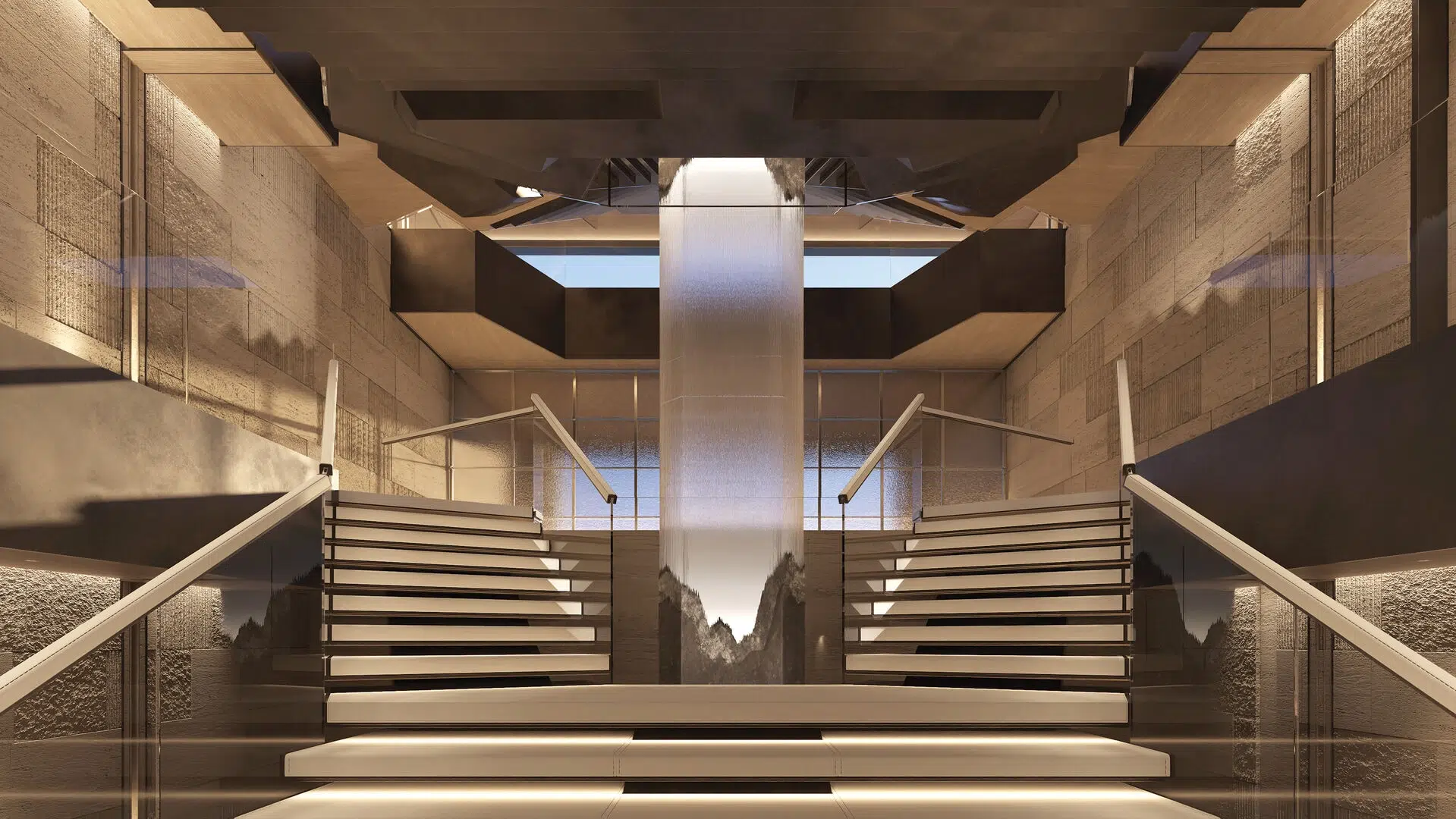
Inside, Fusion places its architectural center around a monumental staircase rising through the upper decks. The staircase wraps around a freestanding illuminated-glass art installation, turning circulation into something closer to a gallery experience. It is a telling detail because, for all the yacht’s technical scale, Sinot continues to frame the vessel as a place for art, ritual and atmosphere rather than a catalogue of headline amenities.
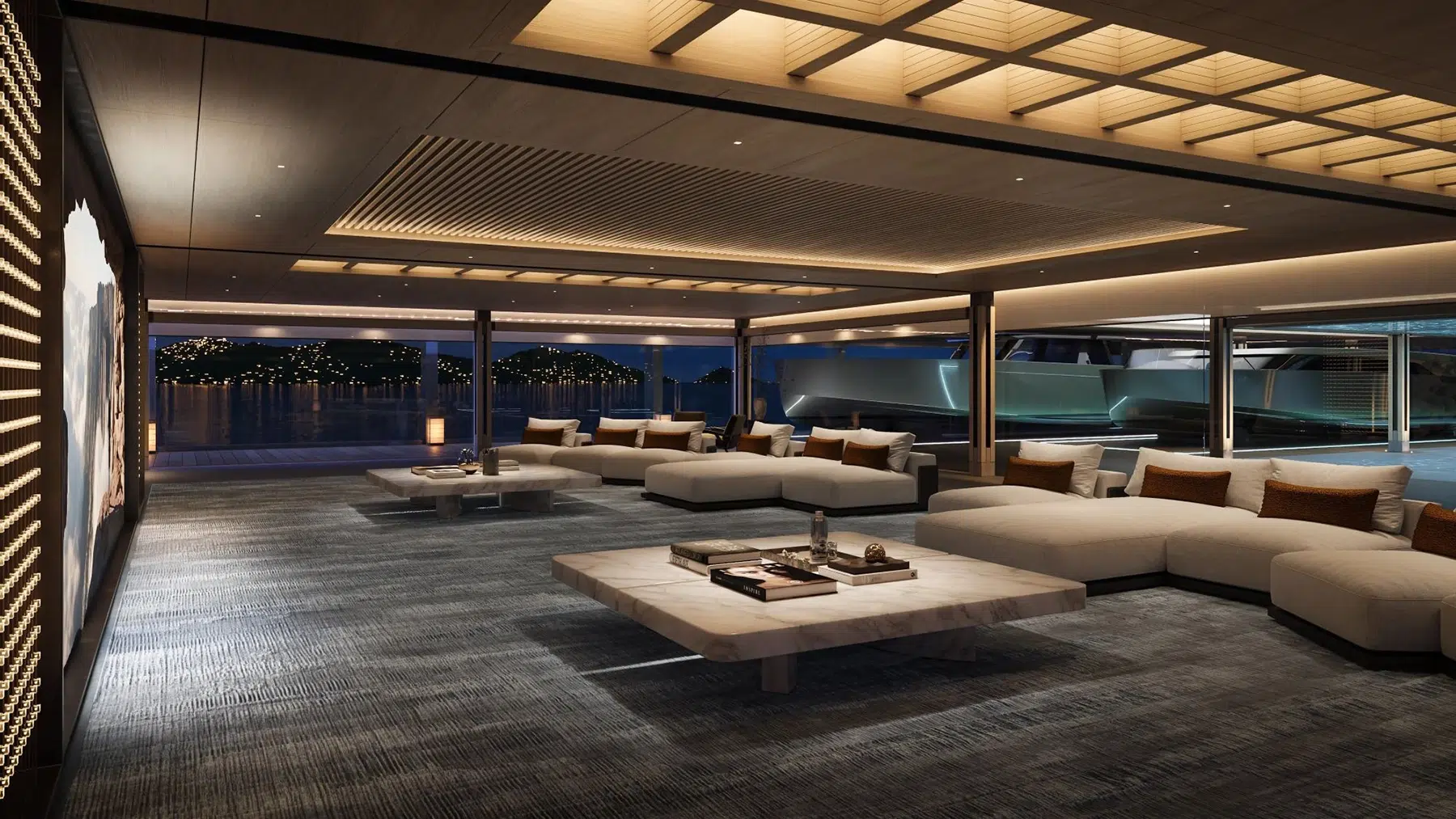
The owner’s accommodation occupies its own private realm, with a residence incorporating separate dressing areas and bathrooms, a private lounge, office space and an exterior terrace. Elsewhere, eight additional guest suites can accommodate as many as 16 guests, with private loggias providing direct connection to the sea; published specifications indicate that selected suites also incorporate private saunas.
That allocation of space may be more telling than the yacht’s overall dimensions. Ultra-large yachts can sometimes become exercises in accommodation density, but Fusion appears to use its volume differently. The proposition is not simply to bring more people aboard; it is to provide those people with greater autonomy once they arrive. Guests can retreat, exercise, dine, swim, entertain or disappear into their own private spaces without requiring the entire yacht to follow the same rhythm.
Wellness receives similarly serious treatment. A dedicated spa of approximately 300 square metres is planned within the yacht, with facilities including a hammam, sauna, treatment and massage rooms, a cold-water pool and relaxation spaces. A separate fitness area incorporates a counter-current pool, training equipment, physiotherapy rooms and an exterior zone conceived for yoga and Pilates.
This is consistent with a broader shift taking place at the highest level of yacht design. The spa is no longer expected to exist as a beautiful but isolated room visited for an hour before dinner. Wellness has become part of the architecture of the day. Sinot has explored that idea in previous concepts including Aqua and Poetry, where proximity to water, gym spaces, treatment rooms, hammams and expansive beach clubs are integrated into the larger experience of living aboard.
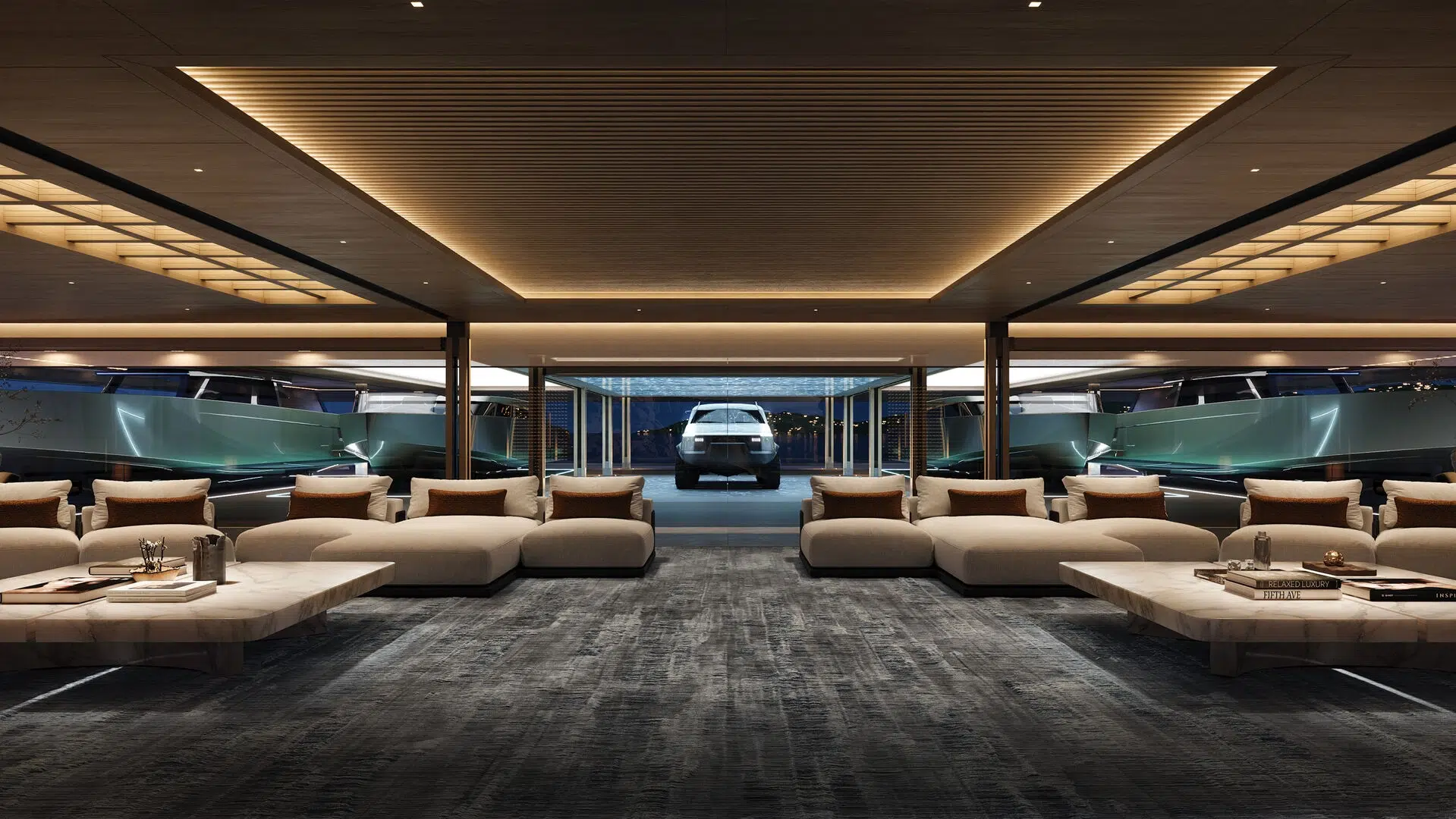
Fusion extends that thinking to sport and exploration. Its main deck devotes approximately 843 square metres to tenders, watercraft and vehicles, supported by integrated mobile cranes for handling equipment. At this level, the yacht is as much a logistics platform as a residence, capable of carrying the machinery required for life beyond the deck itself.
That may ultimately be Fusion’s most compelling quality. The modern ultra-high-net-worth owner is not necessarily seeking a larger version of the traditional yacht. Increasingly, the yacht is expected to support a wider life: family retreat, expedition base, wellness destination, sporting venue, cultural salon and private residence, often simultaneously. Fusion’s architecture appears designed around precisely that multiplicity.
Its trimaran form is therefore not merely visual theatre. The side hulls create usable width, and width creates separation without isolation. Sport can take place forward while lunch unfolds aft. Guests can withdraw to private loggias while others gather around the pool. Tenders, aircraft and recreational equipment can be accommodated without surrendering the social spaces that define the yacht’s character.
There is, however, an important distinction between ambition and actuality. Sinot describes Fusion as a build-ready concept, meaning the platform, structural approach and general arrangement have been developed sufficiently for detailed engineering to proceed. At present, no shipyard has been announced, and publicly available information does not yet specify the propulsion system, performance, range, fuel capacity, or final construction material. Those details would ultimately determine how Fusion performs not as a vision, but as a ship.
That caveat does little to diminish the architectural idea. Yacht concepts have always served partly as provocations, giving designers permission to ask what private life at sea could look like before the realities of construction, regulation and ownership begin narrowing the answer. Fusion’s provocation is unusually clear: what happens when breadth, not merely length, becomes the defining luxury?
The answer is not simply more square footage. It is the ability to create distinct worlds aboard a single vessel and allow each to function without competing for space. That is where Fusion separates itself from the familiar race toward ever-greater LOA.
At 118 metres, it is undeniably enormous. Yet the most interesting dimension may be the 30 metres from one side to the other. Within that span, Sinot has found room for a tennis court, aviation operations, a resort-scale pool terrace, private guest loggias, extensive wellness, an expedition fleet and the quieter spaces required to make such scale feel personal.
Fusion may or may not ultimately enter construction in exactly the form shown today. As a statement of intent, however, it reflects where the upper reaches of yacht design are heading. The next generation of superyachts will not necessarily be judged by how much they contain, but by how effortlessly they allow owners to move between different ways of living.
In that sense, Fusion’s name is unusually apt. It is not simply three hulls joined together. It is an attempt to bring the private residence, wellness retreat, sports club, cultural salon and expedition platform into one coherent world, with the sea as its only permanent horizon.