Why the defining luxury of an intimate event is a performer accustomed to commanding a stadium.
Concrete. Steel. Sixty-eight thousand people waiting for the beginning of an international football match, an ambient, deafening roar. The aroma of fancy catering blended into the wind chill of the exposed architecture of the stadium. The 2026 season is during the month of June, at Levi’s Stadium in Santa Clara. On top of the giant TV display, which towers over the white expanse of the “pure” sod underneath, a performer renders herself focused, deft, in precise beats of live drum.
The event is the World Cup match between Jordan and Algeria.
The dancer is Johanna Michelle.
She is authorized to perform in this game. She was called on to captivate the attention of the large VIP enclosure before and after a match, yet primarily served as a prima_donna partner with a real drummer. It’s a whole setting made for distraction. The clash of money, sports, and politics, and the international media combine in an atmosphere in which no one is required to take notice of the entertainment. Drinks are poured. Deals are discussed. Individuals are always on the move. But, at the time of the match, the folks she’s gone to, all of her photos, all of her people, all of her movement, position themselves. She stops, turns, and catches people’s attention when they are distracted.
Six weeks later. The scale shrinks entirely.
A private home in the San Francisco Bay Area. When the evening chill sets in, heavy velvet drapes are pulled. They are all seated at close range around the candle-lit tables, eating at one of the milestone anniversary dinners for 40 guests. Heavy silver with fine porcelain predominates in the room. The conversation is subdued, private and relaxed. Then the same resonant, thick thumping of the drum pours right through the polite chatter, reverberating in the floorboards.
The same dancer appears.
We argued in a recent issue, in a piece titled “The Art of the Private Soirée,” that a world-class performer—not the massive floral installations, not the imported caviar, and not the vintage champagne—is the true luxury differentiator at a private event.
Here is the empirical proof.
A kind of vapeavaffle takes over a dining room when a stadium-pitch artist enters. Johanna Michelle was hired as an official performer at that June 2026 match, and she certainly has limitations on her kinetic authority to materialise. The VIP area is a hard area to work in. It demands 100% perfection in technique. Every shift in weight, every subtle step, and every muscle isolation is visualised by tens of thousands of people as you move in front of thousands of square feet of a screen. There’s no making up for a missed beat. No deep on-field separation from the performance to distract from the halftime show, no show to distract from the separation and the performance. Raw exposure on an international level. You are either the ultimate Btch or you’re completely obliterated.
That exact command of a room translates directly to the historic theater stage.
In May 2025, comedian Max Amini booked the California Theatre in San Jose. Built in the late 1920s, the theater is a cavernous, ornate space with gilded ceilings and heavy velvet curtains. It demands a massive presence from anyone who walks onto its stage. Amini played two shows over the weekend. Both sold out completely. A comedy crowd arrives expecting rapid-fire punchlines; they are notoriously tough, high-adrenaline, and deeply cynical about anything that breaks the comedic rhythm. The energy in the room is highly combative. Amini needed an artist to anchor a highly specific segment of his show dedicated to his genuine, personal love for belly dance. He could not afford a performer who would lose the crowd’s momentum or let the tension drop.
He hand-picked Johanna Michelle for both nights.
She walked out under the hot theatrical lights and completely silenced a room of people who had paid exclusively to laugh. She held them. She validated Amini’s entire premise through sheer technical proficiency and an undeniable, commanding stage presence.
You might assume an artist accustomed to sold-out historic theaters and massive stadium screens would overwhelm a private residence. You might worry that the sheer scale of the performance would be completely wrong for an intimate wedding reception or a private anniversary party.
The opposite happens.
The ability to project energy to the back row of a multi-tiered auditorium is exactly what allows a performer to create an intense, magnetic focus in a small room. The pedigree matters entirely. When you hire an authentic Egyptian belly dancer for a private event, you are buying that specific depth of experience. It is the absolute exclusivity of access. Your guests recognize immediately that they are watching someone who normally commands thousands, now performing just feet away from their dinner plates. The luxury is proximity.
She reads a room in real time.
Working with a live drummer by her side, she adjusts the tempo, the mood, and the interaction based on microscopic shifts in the audience’s posture. She brings the intense discipline of a massive arena and compresses it into a confined space. It feels electric. It never feels loud. It is no surprise her Bay Area wedding season routinely books months in advance for this exact reason.
Johanna Michelle operates out of Walnut Creek, bringing over seventeen years of professional experience to the floor.
This is not generic entertainment. She performs authentic Egyptian Raqs Sharqi. Her foundation is built on rigorous, uncompromising technique, including extensive training in the exacting Suhaila format. This specific methodology demands extreme muscular control. It requires years of brutal physical discipline to master the nuance of the hips, the precise timing of the isolations, and the emotional interpretation of complex Arabic music. You cannot fake this level of craft.
A signature performance follows a deliberate, historical arc.
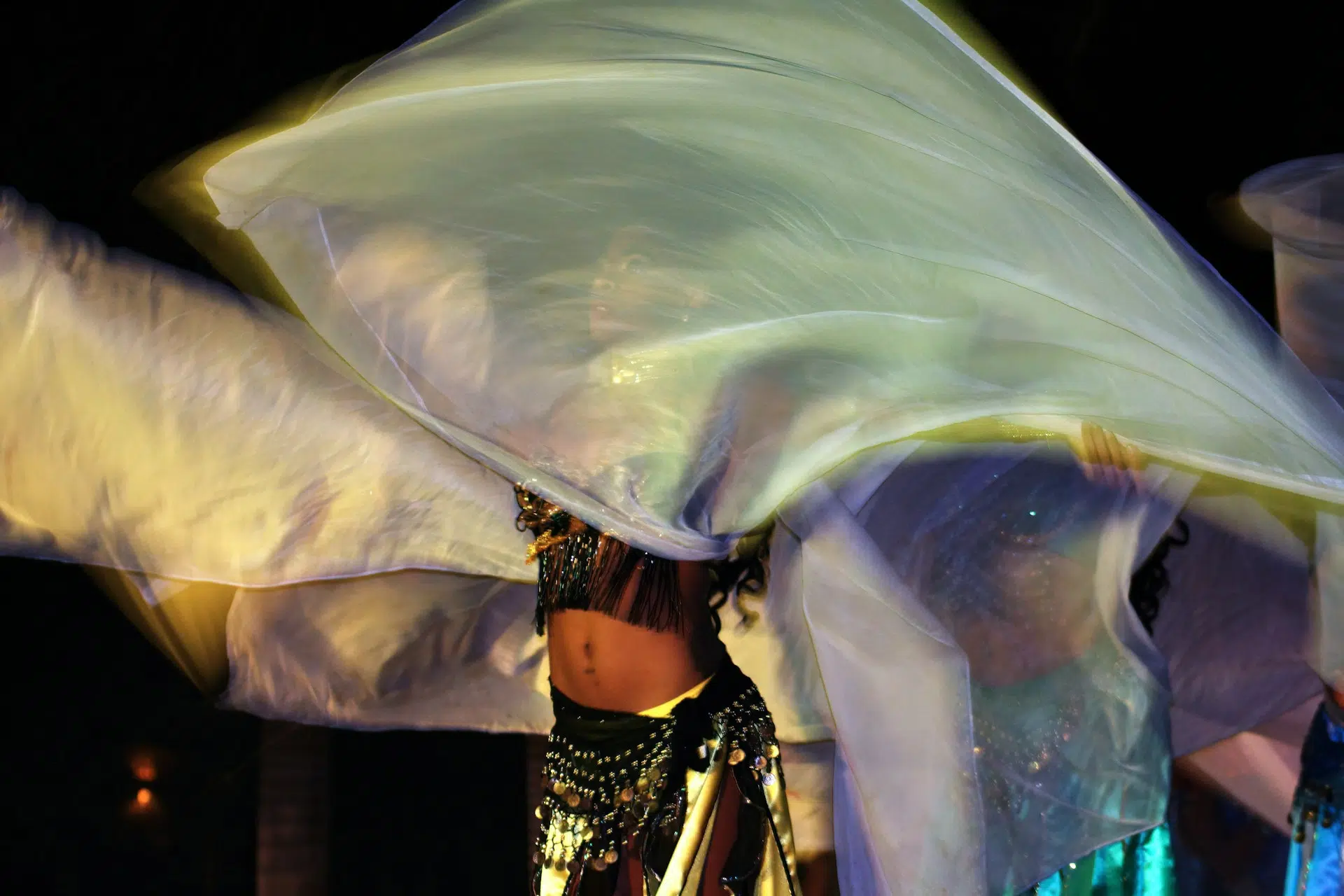
She typically opens with a grand entrance to establish the architecture of the space. Shimmering silk veils slice through the air, catching the light and altering the shape of the room. Sometimes she uses the sheer, massive span of performance wings. These props create a large visual footprint before she deliberately drops them to the floor. The set then builds. It layers rhythmic complexity. The movements become sharper. The music accelerates, pushing the energy higher.
It eventually strips down to the raw, percussive communication of the drum solo. The interaction between the dancer’s hips and the drummer’s hands becomes a rapid-fire conversation, completely improvised and entirely dependent on the unseen connection between the two artists. The audience is pulled directly into this tension.
Weddings demand a different tier of tradition entirely.
For these events, she might introduce the Shamadan. This is a heavy, lit candelabra balanced squarely on the crown of the head. It requires absolute spinal stability and completely fluid movement below the neck. Hot wax and open flame mean there is zero margin for error. The room holds its breath watching the physical control required to keep the fire perfectly level while the body moves in complex rhythms beneath it. Alternatively, she leads the bride and groom in a zaffa. This is a traditional procession. It is an ancient, rhythmic march announcing the newly married couple to their community with live music and highly structured movement.
These elements carry deep historical weight. They turn a standard reception into a legitimate rite of passage. They root a modern celebration in centuries of established culture.
Every appearance is sharply calibrated to the environment. A corporate gala in San Francisco receives a completely different aesthetic approach than a late-night engagement party in an Oakland loft. Reviewing her Bay Area performance packages reveals a strict adherence to quality control and acute situational awareness. She dictates the energy in the room.
She also understands exactly where the boundaries lie.
Toward the finale of a set, the dynamic inevitably changes. Guests are invited to join the floor. The offer is made clearly, with a gesture or a direct look.
They are never required to participate.
The dignity of the art form remains the priority. The comfort of the guests is completely preserved. Nobody is pulled awkwardly from their chair. Those who wish to share in the celebration stand up and join the rhythm, breaking the invisible wall between audience and artist. Those who prefer to watch the spectacle are left to enjoy their drinks in peace, unbothered.
The music cuts abruptly.
The final, heavy strike of the drum echoes against the hardwood floor. A single silk veil rests over the back of a mahogany chair.