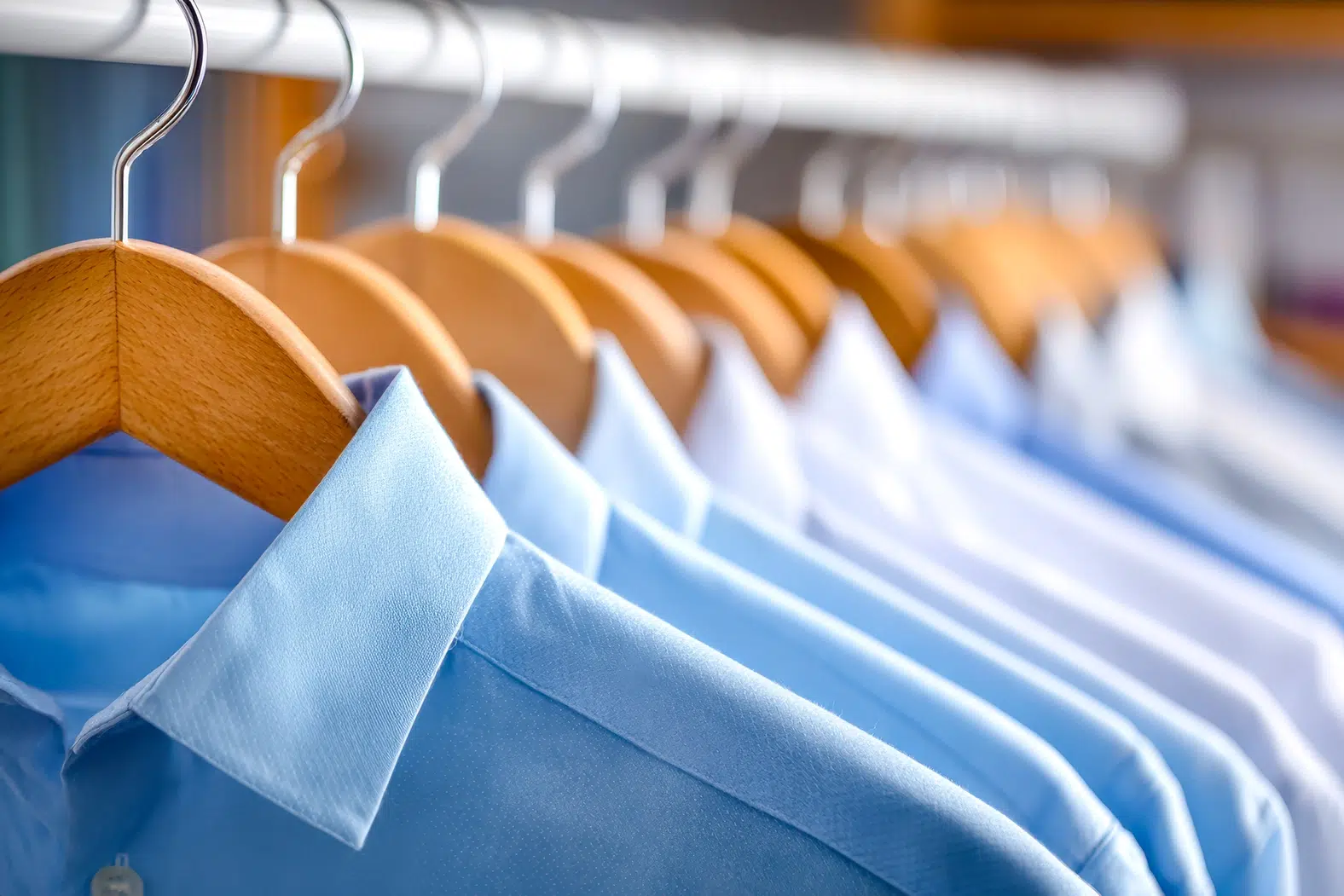
You are standing in front of a rack. Two shirts, similar colour, one costs three times the other. The expensive one is not necessarily better, and the cheap one is not necessarily a bargain. Most men resolve this by looking at the brand label, which is the least informative piece of data available.
There is a faster and more reliable method. Six checks, roughly a minute, no expertise required.
Check the collar first, because it holds the shirt up
Everything a dress shirt is supposed to do visually happens above the sternum. That is where people look, and that is where cheap construction shows up soonest.
Squeeze the collar between your fingers. You are feeling for interlining, the stiffening layer between the outer and inner collar fabric. A quality collar has a distinct, even body across its whole surface. A poor one feels thin at the points and lumpy in the middle, or worse, feels like cardboard, which means a heavy fusible interlining that will bubble and separate after twenty washes.
Then check whether the collar stands. Fold it into its normal position and let go. It should hold its shape without help. A collar that flops immediately will look defeated by 11am, no matter what it costs.
Removable collar stays are a good sign. Sewn-in plastic stays are a cost saving that you will notice every time you try to iron the shirt properly.
Look at the stitch density along the side seam
Turn the shirt inside out and find the seam running down the side of the body. Count the stitches across a centimetre.
Standard manufacturing runs around 7 or 8 stitches per centimetre. Better shirtmaking runs 9 to 12. Denser stitching is stronger, sits flatter, and puckers less after laundering. It also takes longer to sew, which is precisely why it disappears at the lower end of the market.
While you are there, look at whether the seam is a single-needle or split-yoke construction. Single-needle side seams, sewn in two passes rather than one, lie noticeably flatter under a jacket. It is a detail almost nobody advertises and it separates a $45 shirt from a $120 one more honestly than the fabric does.
Read the fabric like a spec sheet
Two-ply cotton means each thread is made of two finer yarns twisted together. It is stronger, smoother and holds colour longer than single-ply of the same thread count. If a shirt says two-ply, that is worth something. If it says nothing, assume single-ply.
Thread count matters less than the industry wants you to believe. A 120s two-ply poplin is an excellent shirt. A 200s two-ply is finer, more delicate, and genuinely worse for daily wear because it wears through faster. Beyond about 140s you are buying luxury, not durability.
Weave changes behaviour more than count does. Poplin is smooth, light and formal, and creases readily. Twill has a diagonal structure, drapes heavier, resists wrinkles and takes an iron beautifully. Oxford is basketweave, more textured, more casual, and close to indestructible. Royal oxford splits the difference and works under a suit in a way standard oxford does not.
Fit is measured in four places, not one
Off-the-rack sizing tells you a neck measurement and a sleeve length. That leaves the parts that actually determine how the shirt looks unaddressed.
The shoulder seam has to land at the edge of your shoulder bone. This is the one dimension a tailor cannot easily fix, so it is the one you must get right in the store. A seam sitting on your upper arm makes a shirt look borrowed, regardless of everything else.
The armhole should sit high and close. Low, wide armholes feel comfortable standing still and pull the entire shirt body upward the moment you raise your arm. High armholes feel snug for a day and then let you move freely for years.
Chest and waist are adjustable. A tailor can take in side seams for very little, so buying slightly large through the body and having it adjusted usually beats squeezing into a slim cut. Montréal brand Rue Saint-Patrick, for instance, prices its men’s dress shirts low enough that the cost of a tailoring adjustment still leaves you well under the price of a single designer shirt, which is a more sensible allocation of the same budget.
Cuff circumference is the forgotten measurement. It should clear a watch without gaping, and it should not slide over your hand when unbuttoned.
The details that quietly signal quality
Buttons should be mother of pearl or a good composite, thick enough to feel substantial between your fingers, and cross-stitched rather than parallel-stitched to the placket. Thin plastic buttons crack in a hot dryer, and replacing all of them is a chore you can avoid by checking once.
Pattern matching at the pocket and the yoke is the single fastest tell on a striped or checked shirt. If the stripes on a chest pocket continue the stripes on the body without a jump, someone cut that panel deliberately and wasted fabric to do it. If they do not line up, the maker prioritised yield over appearance, which tells you what else they prioritised.
The gauntlet button, the small one halfway up the sleeve opening, is present on properly made shirts and absent on cheap ones. Without it, the sleeve gapes at the forearm.
What none of this covers
A shirt can pass all six checks and still be wrong for you. Collar spread should suit your face shape, wide spread for narrow faces, point or semi-spread for rounder ones. Colour should suit your complexion rather than the season. And a shirt you never reach for is a bad purchase at any level of construction.
The checks tell you whether a shirt was made carefully. They do not tell you whether you will wear it. That part is still judgement, and it is the only part of shirt buying that cannot be reduced to a checklist.
Start with the collar squeeze, though. It takes three seconds and it eliminates more bad shirts than every other test combined.