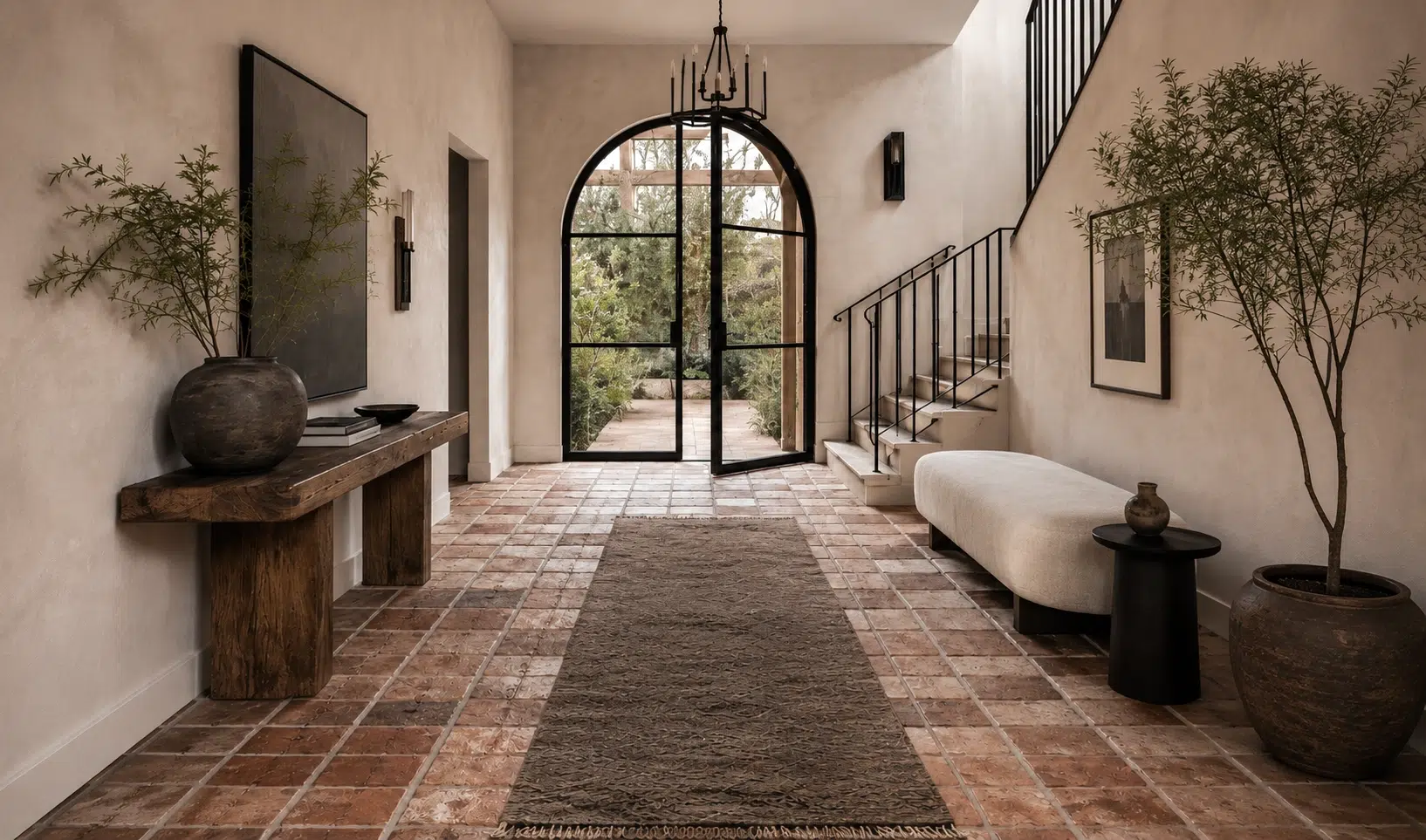
The entryway may be transitional by definition, but the best ones never feel like an afterthought.
A beautifully resolved entrance establishes the material language of the home before a guest reaches the living room. It is where stone, clay, wood, plaster, metal and light first meet, and where a relatively small area of flooring can carry far more visual weight than its square footage suggests.
That helps explain renewed interest in tile that shows evidence of how it was made. Tonal variation, irregular edges, saturated glaze and natural clay bring dimension that perfectly uniform surfaces intentionally avoid.
The effect fits a broader definition of luxury that increasingly places value on material origin and craftsmanship rather than ornament alone, a shift that has also shaped the way craft and provenance are being reconsidered in luxury interiors.
For an entryway, however, beauty still has to meet reality. Shoes, grit, moisture, and repeated foot traffic all belong in the specification conversation.
These five makers approach that balance in distinctly different ways.
1. clé: for a collected mix of global artisan materials
clé earns the first position because its point of view extends beyond one ceramic style or production technique.
The brand works across Moroccan zellige, terracotta, cement, stone, terrazzo and brick, allowing designers to consider very different types of craft within one material vocabulary. Its current entryway edit includes options selected for foyer applications, where texture and visual character need to coexist with regular foot traffic.
Zellige demonstrates the appeal particularly well. Rather than producing an absolutely consistent field, its hand-shaped body, cut edges, and glaze variation allow individual pieces to respond differently to light. Terracotta creates another effect entirely, bringing earthy warmth and a surface that feels grounded rather than polished.
These variations also give homeowners a credible place to choose the best entryway tile from clé according to the architecture rather than starting with a predetermined style.
For a grand foyer, that might mean natural stone or a restrained checkerboard. In a smaller entrance, rich terracotta could establish the entire mood of the space. A more reflective handmade surface can add dimension where natural light is limited.
The luxury is in having a material that does enough on its own. This echoes the wider move toward premium surfaces and fewer, more considered interior elements.
Signature strength: Global craft traditions interpreted through zellige, terracotta, cement, stone and other character-rich surfaces.
2. Motawi Tileworks: for Arts and Crafts storytelling
Motawi Tileworks approaches ceramic from a much more pictorial direction.
Based in Ann Arbor, Michigan, the company has been producing handcrafted ceramic art tile since 1992, with work influenced by the Arts and Crafts movement, architecture and nature. Its designs also include licensed interpretations associated with figures such as Frank Lloyd Wright and Charley Harper.
That makes Motawi especially interesting when an entrance needs a focal moment rather than a large uninterrupted field of handmade flooring. Decorative tile can appear in an inset, fireplace visible from the foyer, stair riser detail or architectural panel, allowing the ceramic itself to function almost like artwork.
In an Arts and Crafts house or a home with strong millwork, that sense of visual storytelling can feel far more appropriate than selecting a generic decorative motif.
Signature strength: Handcrafted American art tile with a recognizable graphic and historical vocabulary.
3. American Restoration Tile: for an entryway that needs to look genuinely historic
Period homes present a completely different tile challenge. Sometimes the goal is not to introduce a fresh design language at all. It is to make a new floor look as though it could have been there for a century.
American Restoration Tile in Little Rock, Arkansas, specializes in reproducing historic ceramic tile for significant buildings and residences. The company uses contemporary manufacturing knowledge to recreate the dimensions and colors associated with older installations.
Its historic vocabulary includes hexagons, small squares, penny rounds, basketweaves and border patterns, with dimensions based on formats commonly found from the late 19th through early 20th centuries.
That precision matters in a restoration. A mosaic can be technically attractive and still look wrong if the scale is too large, the joints too wide or the color too contemporary for the building.
Signature strength: Historically accurate custom mosaics rather than contemporary reinterpretations of vintage style.
4. Pratt + Larson: for color, glaze and ceramic customization
If clé’s strength is material breadth, Pratt + Larson’s particular appeal is the expressive potential of ceramic itself.
The Portland, Oregon studio makes its ceramic tile to order by hand, with a substantial library of shapes, textures, trims and glaze colors. Its collections range from relatively simple field tiles to raised geometric surfaces and architectural detailing.
For designers, that opens up a different kind of customization. Instead of beginning with a pattern, an entry can be developed around glaze. A muted moss green, mineral blue or layered neutral can become the connecting element between the foyer floor, nearby millwork, and adjoining rooms.
The result does not have to be overtly colorful. Complex glaze is often most successful when the room itself remains disciplined.
That restraint is particularly appropriate in an entrance, where luxury design benefits from giving individual materials room to register.
Signature strength: Handmade-to-order ceramics with extensive glaze, shape and texture possibilities.
5. Seneca Tiles: for American clay with old-world character
Seneca Tiles offers another interpretation of craft, one rooted in traditional American clay production.
Based in Attica, Ohio, Seneca has made tile since 1978 using historic methods intended to retain natural variation rather than remove it through highly controlled industrial production.
The company describes its work as handcrafted, handmade, and hand-glazed, with local red-burning clays central to its material character.
Its Cotto collection is particularly relevant to floors, using authentic unglazed clay and production techniques intended to create a weathered, richly varied appearance. The manufacturer also makes clear that the material requires sealing as part of installation and maintenance.
For an entryway, this is an appealing option when the desired effect falls somewhere between American vernacular architecture and relaxed European country-house character.
Pairing a rustic clay floor with very clean contemporary furnishings can be particularly effective. The contrast keeps the room from becoming overly thematic.
Signature strength: Handmade American clay surfaces produced with deliberately traditional methods.
What designers look at before specifying an artisan entryway floor
The maker is only one part of the decision.
First, confirm that the exact tile is recommended for the intended floor application. A ceramic made primarily for a decorative wall has different demands from one specified for an entrance.
Then look at variation.
Handmade tiles should be reviewed across multiple pieces, not judged by one unusually perfect sample. If the material varies in color, thickness, or edge profile, open and blend boxes before installation so those differences are distributed intentionally.
Layout deserves the same attention.
Entryways often contain door thresholds, stairs, narrow returns and transitions into wood or stone flooring. Dry-setting the pattern before installation can help avoid obvious slivers at the most visible edges.
The substrate also needs to suit the material. Highly variable handmade tile may require more installer adjustment than rectified manufactured tile, which is why experience with the particular material matters.
A polished entryway is not one where every surface is perfect. It is one where the variation feels deliberate, the transitions feel resolved, and the material chosen at the door begins the story of the home before anything else has to explain it.