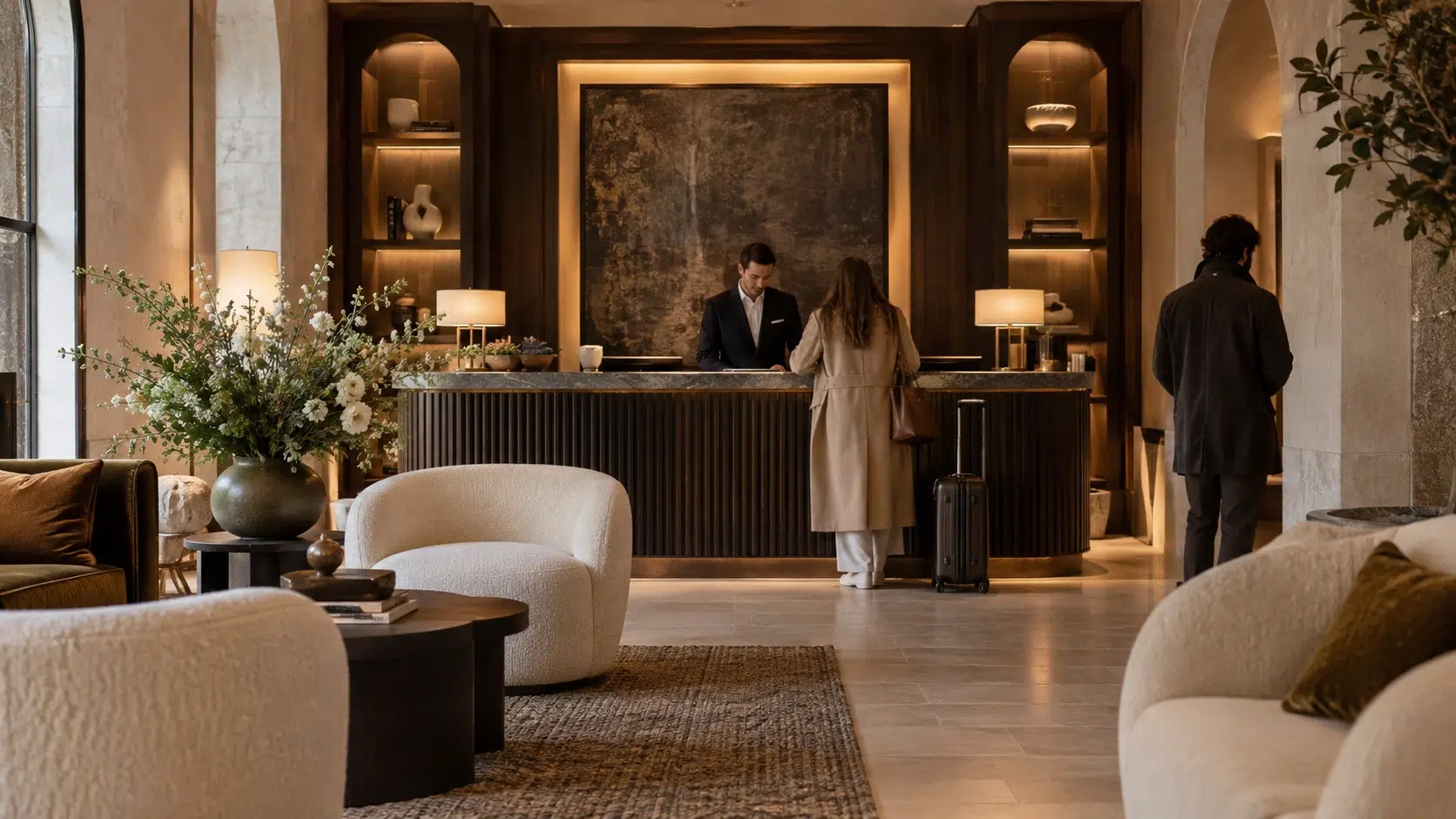
There is a moment familiar to anyone who has stayed somewhere truly special. You arrive at an eight-suite riad in Marrakech, a cliffside hideaway on the Amalfi Coast, or a family-run ryokan in Kyoto, and everything is simply ready. Your name is known, your room anticipates you, the dinner reservation you mentioned in passing three weeks ago has materialized—no visible effort, no scurrying, no apology. Effortlessness, the connoisseur eventually realizes, is the rarest luxury of all, and it is most astonishing at the smallest properties, where a handful of people somehow deliver the precision of a grand hotel with a staff of hundreds.
The explanation lives behind the reception desk, in a layer of technology guests rarely see. Every fine small hotel now runs on a property management system, the software that quietly holds its reservations, guest histories, room status, and billing in a single place. Running a smaller property often means balancing limited staff with increasingly complex operational demands, which puts Prostay.com in the broader PMS discussion for small hotels focused on simplifying reservations, guest data, housekeeping, and distribution. The paradox of the intimate stay dissolves once you understand this: the team is small, but the memory and coordination behind it are industrial-grade.
The Paradox of the Tiny Team
Consider what a twelve-suite property must orchestrate in a single day. Arrivals from three continents, each with preferences and occasions attached. Departures whose suites must turn over to exacting standards by mid-afternoon. Rates that shift with the season, availability that must remain accurate across the property’s own website and several booking platforms, deposits and folios that must reconcile to the cent.
A generation ago, only large hotels could manage this reliably, because only they could afford the systems and the staff. Small properties compensated with heroic memory and long hours, and even the finest occasionally stumbled: the lost reservation, the suite not quite ready, the anniversary forgotten. Guests forgave it as the price of charm. They no longer have to.
The Quiet Engine of the Modern Stay
The modern PMS for hotels functions as the property’s central intelligence. When a reservation arrives, it takes a suite out of circulation everywhere at once. When you mention a pillow preference or a wedding anniversary, the note enters your profile and resurfaces on every future visit. When housekeeping finishes a turnover, the front desk knows within seconds.
Well-designed PMS software does something subtler as well: it removes clerical work from people whose true craft is hospitality. The owner of that Amalfi hideaway is not transcribing bookings from an inbox at midnight. The system did it, which is precisely why she had time to arrange the lemons and write the welcome note by hand.
What the System Quietly Orchestrates
- Live suite availability across every channel where the property sells
- Guest profiles carrying preferences, allergies, and occasions across years
- Seasonal and event-driven pricing, adjusted without manual intervention
- Deposits, folios, and invoicing handled to the decimal
- Housekeeping and maintenance schedules synchronized to arrivals
Each line replaces a task once done by hand at eleven at night. Multiply the relief across a year, and you understand where small hotels found the capacity for their newfound polish.
The Synchronization Guests Never See
Among these functions, one deserves particular appreciation from travelers: distribution. A boutique property typically sells its suites through its own site and several platforms simultaneously, and the channel manager for PMS connections is what keeps those storefronts honest, feeding every channel from one live calendar. A booking anywhere closes the suite everywhere within seconds; a cancellation reopens it just as quickly, often at a recalibrated rate.
This is the unglamorous reason the double-booked luxury weekend has nearly vanished, and why the availability you see at midnight is real. The finest properties treat that reliability as part of the guest experience, as essential as the linens.
How the Smallest Players Caught Up
What changed everything was the cloud. Systems that once demanded server rooms and specialists became cloud-based PMS software, running from a laptop at reception or a phone in the owner’s pocket, for a monthly cost beneath a single night’s rate. Suddenly a PMS for small hotels was not a compromise version of enterprise technology but a purpose-built tool, designed for teams of three rather than three hundred.
The competition among providers to build the best PMS for small hotels has quietly served travelers ever since, pushing the tools to become simpler, smarter, and more gracious every year. The result is visible from Patagonia to Provence: intimate properties that retain every ounce of their character while operating with a precision that once belonged exclusively to marble lobbies.
What the Discerning Guest Notices
Once you know the machinery exists, its presence, or absence, becomes legible before you ever commit:
- Confirmation that arrives instantly, with every detail correct
- Availability that matches between the property’s website and the major platforms
- A gracious pre-arrival note requesting your arrival time and preferences
- Recognition on return visits that feels personal rather than performed
- A flawless folio at departure, delivered without being chased
These are not small courtesies. They are the visible edge of an invisible discipline, and they predict the rest of the stay with remarkable accuracy.
Effortlessness, Engineered
None of this diminishes the romance of the small hotel; it explains it. The handwritten letter on the desk, the owner who walks you to the best table in the village, the staff member who remembers how you take your coffee: these human gestures flourish precisely because software absorbed everything mechanical around them.
The world’s best small hotels have not become machines. They have delegated to machines, elegantly and invisibly, so that the people can devote themselves entirely to the art of welcome. The next time a tiny property makes perfection look easy, know that it was neither easy nor accidental. It was engineered, behind the reception desk, so the magic in front of it could remain entirely human.