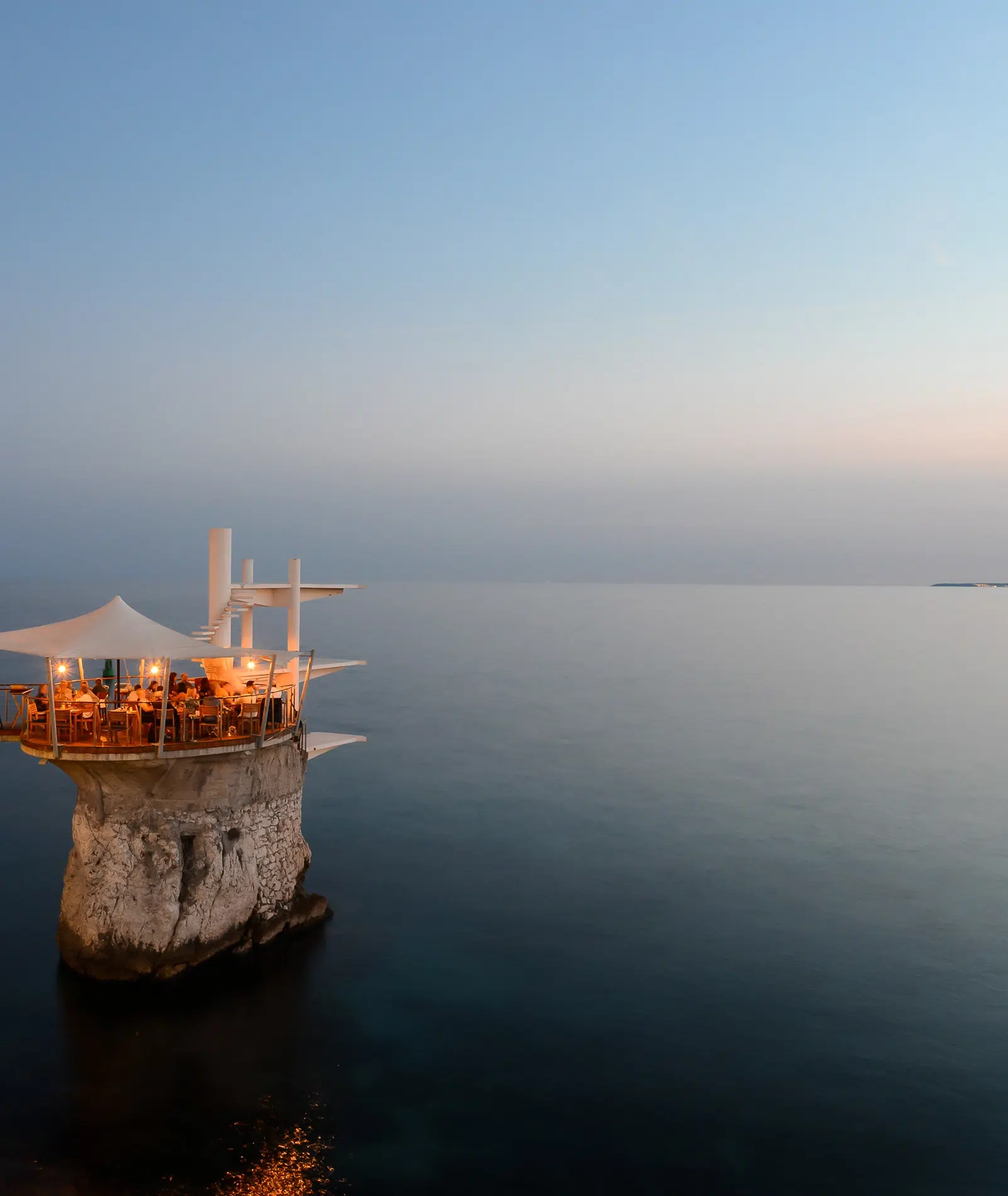
There are restaurants with sea views, and then there is Le Plongeoir. Perched six metres above the Mediterranean on a pillar of rock just beyond the Port of Nice, it appears at first glance to have ignored several sensible rules of restaurant design. Tables hover over the water, the dining room is reached by a narrow footbridge, and remnants of an old diving structure rise above the scene like an Art Deco exclamation point. Along a coastline hardly short of photogenic addresses, this one still manages to look improbable.
Its location alone would be enough to make Le Plongeoir memorable, but the real seduction lies in the history beneath the tables. At the end of the 19th century, a fishing boat was secured to the rock, creating an extraordinary Belle Époque perch where guests could dine and take tea high above the waves. A walkway connected the boat to a small gazebo onshore, and the unlikely arrangement quickly became one of Nice’s recognizable seaside curiosities.
The Riviera of that era had a particular talent for turning leisure into theater. Nice was evolving into an international playground, and bathing culture, promenades and seaside pavilions became as much a part of the city’s identity as grand hotels and winter salons. Dining inside a boat stranded deliberately above the Mediterranean therefore seems less eccentric when viewed through the exuberance of the Belle Époque, when the coastline itself became a stage for increasingly imaginative forms of pleasure.
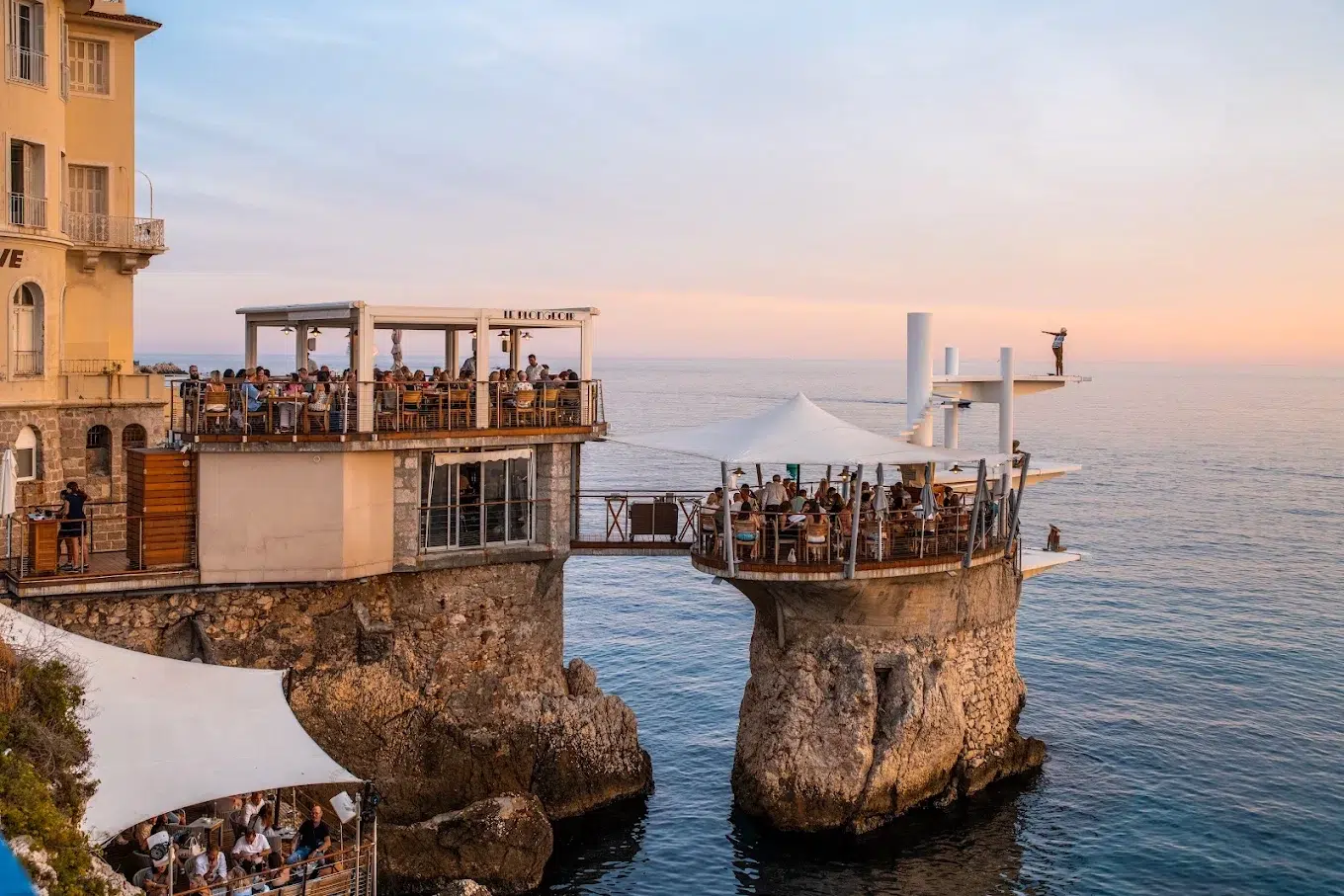
After the fishing vessel was damaged, architect René Livieri was commissioned in 1941 to reinvent the site. His solution was arguably even more extraordinary: the structure evolved around diving boards on the seaward side, while a beach restaurant replaced the original gazebo. Nice’s tourism authorities still identify Livieri’s diving structure as part of the architectural heritage associated with the historic La Réserve complex nearby.
For generations, the rock was associated as much with swimmers as diners. The diving boards eventually ceased functioning and today serve as sculptural reminders of an earlier Riviera, their presence giving Le Plongeoir the slightly surreal silhouette that has made it one of Nice’s most photographed waterfront landmarks. The restaurant’s rebirth in the modern era preserved that eccentricity rather than attempting to polish it away, allowing the site’s history to remain visible in almost every angle.
Arriving for dinner is consequently part of the experience. The Mediterranean stretches below while the city sits just behind, and crossing the footbridge onto the rock produces the feeling of leaving conventional Nice for something considerably more cinematic. There is little separation between dining room and horizon; depending on the hour, the water below shifts from brilliant Mediterranean blue to silver and, eventually, the deeper tones of dusk.
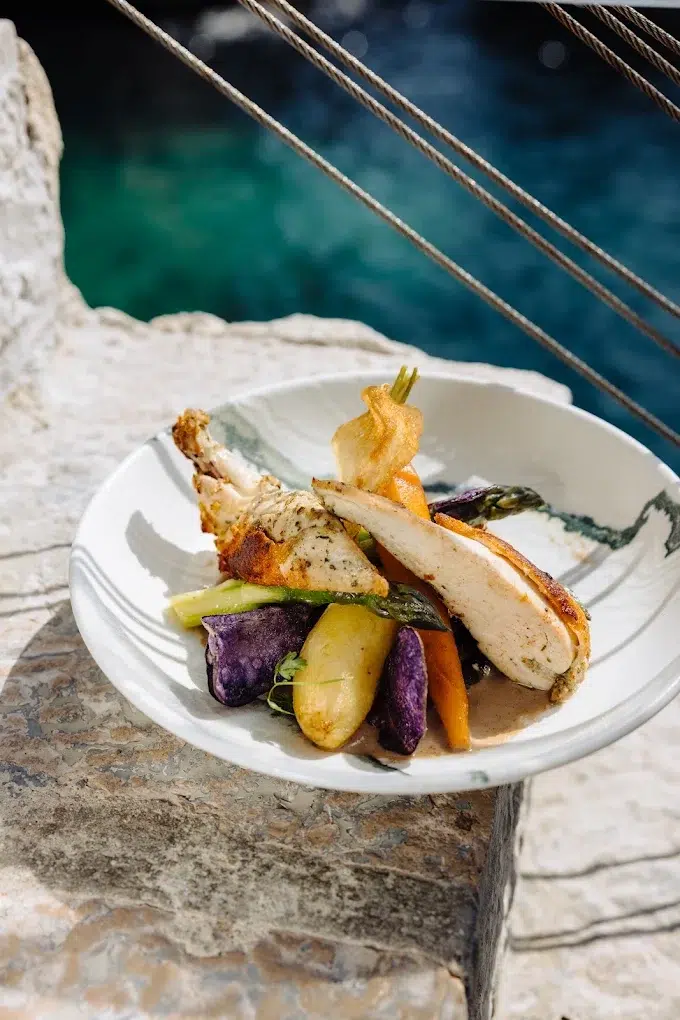
Le Plongeoir wisely allows the setting to do much of the talking. The restaurant describes its cooking as contemporary Mediterranean, built around fresh, seasonal market produce and ingredients sourced from local producers. Rather than compete with the spectacle outside, the food follows the Riviera instinct toward freshness and simplicity, keeping the emphasis on the relationship between land and sea.
That restraint feels appropriate. A restaurant suspended above the Mediterranean does not require culinary pyrotechnics to create occasion; the architecture has already accomplished that. The pleasure lies in allowing dinner to unfold at the same pace as the changing light, with seafood, seasonal produce and chilled wine sharing the table with salt air and the sound of water below.
For those who prefer to begin closer to sea level, Le Vivier offers another perspective entirely. Tucked down by the water beneath the restaurant, the lounge bar serves cocktails, wine and sharing plates in a more relaxed setting, with music and the Mediterranean only steps away. For the 2026 season, Le Vivier reopened in May and operates as an informal afternoon-through-evening destination, giving guests the option of lingering beside the water before climbing toward dinner above.
The contrast between the two spaces is part of Le Plongeoir’s charm. Above, the restaurant feels exposed and almost theatrical, with tables appearing to float between sky and sea. Below, Le Vivier is more intimate, rooted into the rock and closer to the rhythm of swimmers and boats moving along the coast. Together, they turn a relatively compact site into a small vertical journey through Riviera life.
What separates Le Plongeoir from the many spectacular restaurants lining the Côte d’Azur, however, is not simply altitude or architecture. It is the accumulated eccentricity of the place. Few restaurants can trace a lineage from a fishing boat mounted on a rock to Belle Époque tea service, an architect-designed diving structure and, eventually, a contemporary Mediterranean dining room. The story feels almost too picturesque to be true, which is precisely why the surviving structure matters.
Nice itself has always thrived on these collisions between refinement and pleasure. The city can be formal without becoming solemn, glamorous without abandoning the beach, and historic without treating its past as something preserved behind glass. Le Plongeoir embodies that character perfectly. Its architecture has been adapted repeatedly, yet the underlying idea has remained remarkably consistent: find an improbable piece of rock above the Mediterranean and turn it into somewhere people want to linger.
There is also something refreshing about a restaurant whose principal luxury cannot be replicated through interior design. Marble can be imported, lighting can be commissioned, and a wine cellar can be stocked almost anywhere. What cannot be reproduced is the feeling of sitting six metres above the Mediterranean on a rock that has been part of Nice’s leisure culture for more than a century.
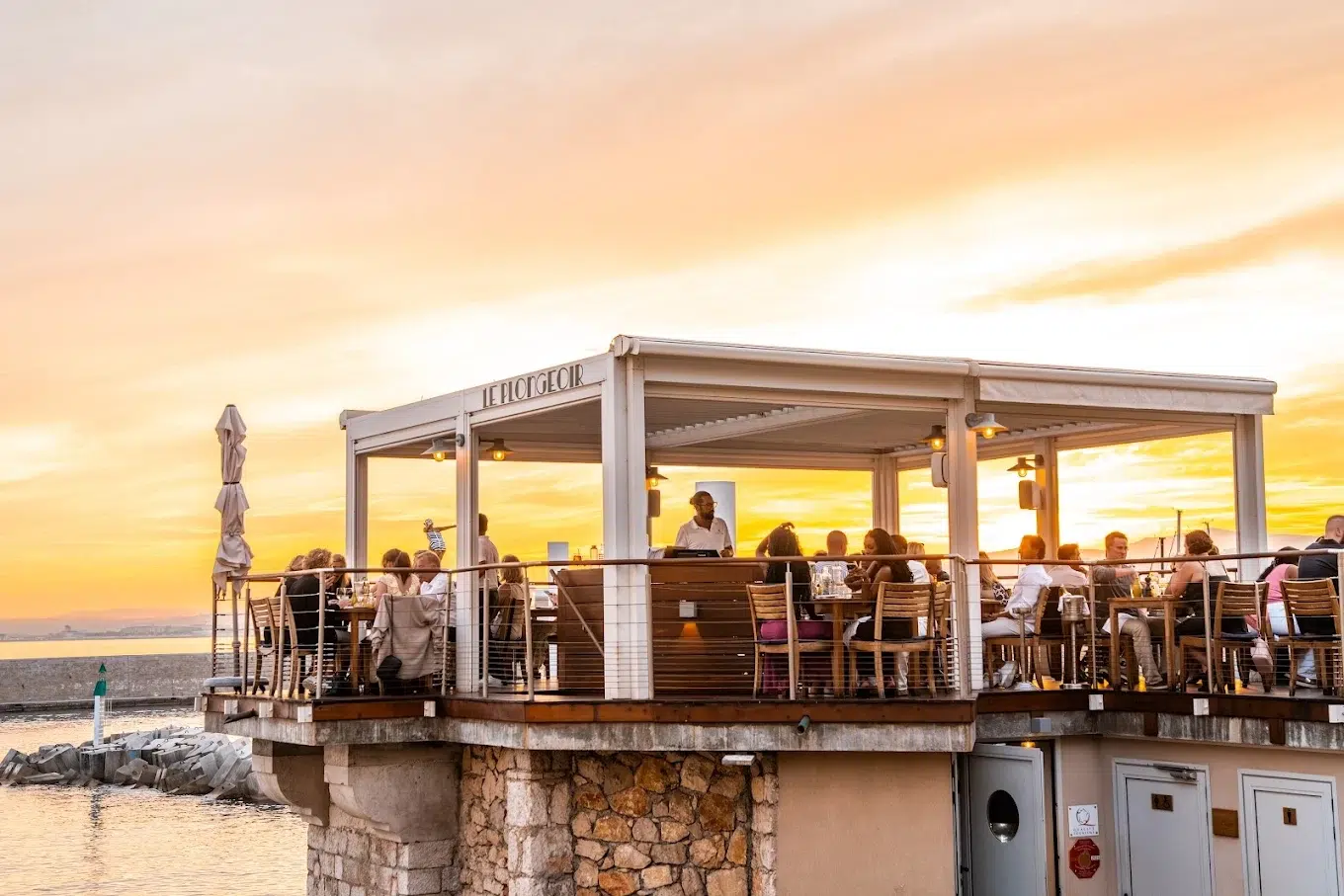
That rarity becomes increasingly apparent as the evening progresses. Daylight emphasizes the strange geometry of the structure and the vivid blue water beneath it; sunset softens the coastline into something almost painterly, and after dark the restaurant begins to glow against the sea. It is the kind of setting that encourages people to reach for their phones, yet the more satisfying indulgence may be putting one away long enough to appreciate how unlikely the whole arrangement still seems.
For all its history, Le Plongeoir does not feel like a monument. It remains playful, social and unmistakably Mediterranean, a place where architectural heritage is still being used for its original purpose: pleasure. The old diving boards may no longer invite anyone to leap into the water, but they continue to give the restaurant its extraordinary sense of theater.
The French Riviera has never lacked glamorous tables, and Nice offers no shortage of places where dinner arrives with a spectacular view. Le Plongeoir offers something rarer: a setting with enough personality to become part of the meal itself. More than a century after diners first climbed onto a fishing boat above the waves, people are still crossing the footbridge for essentially the same reason—to sit improbably close to the Mediterranean and enjoy the sensation that, for an evening at least, the Riviera belongs entirely to them.