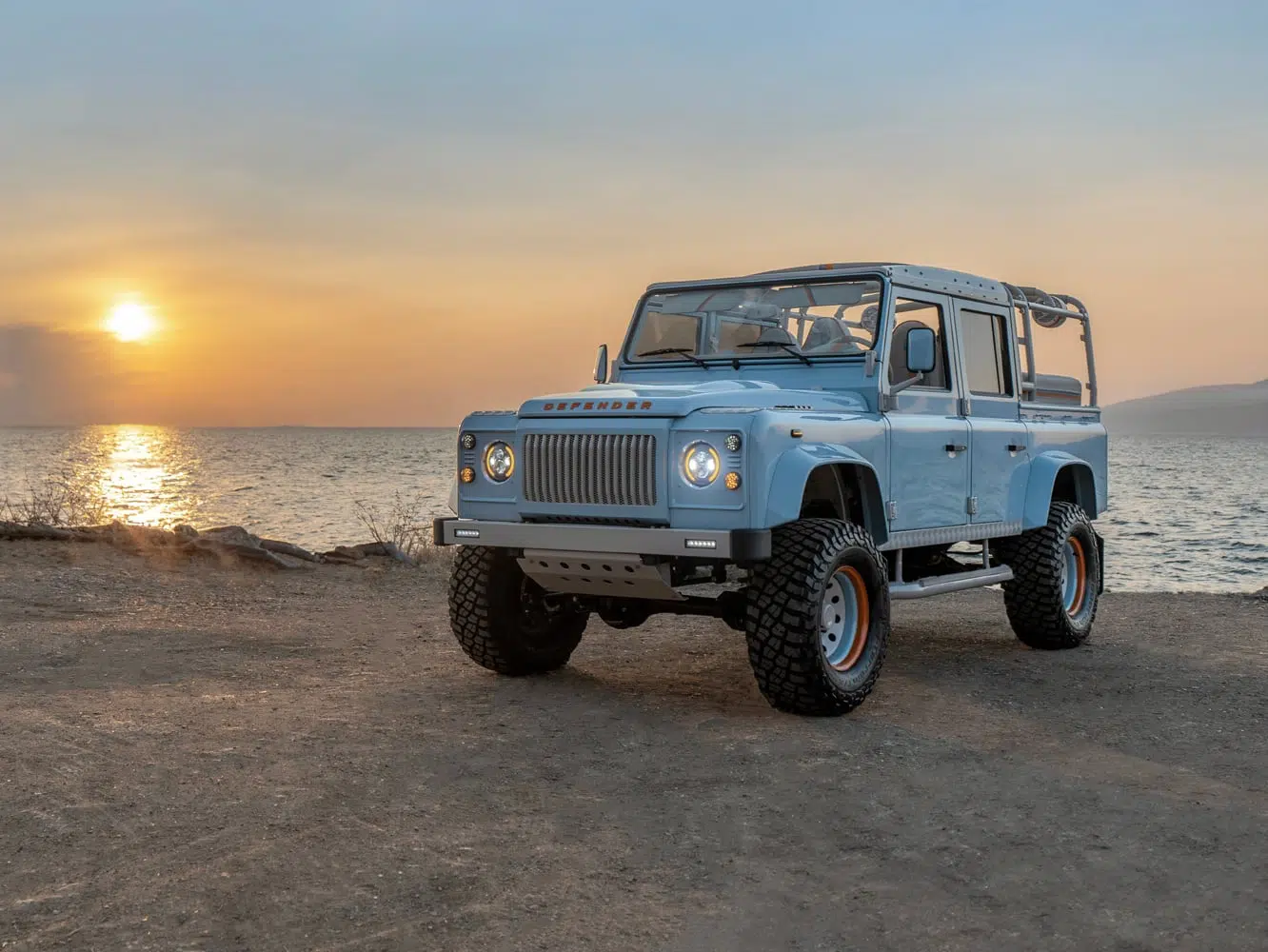
Some vehicles are restored. Others are reinterpreted so thoroughly that the original becomes merely the starting point.
That is the territory Monarch Defender occupies. Based in Grayslake, Illinois, the independent builder takes classic Land Rover Defender silhouettes and rebuilds them from the ground up, preserving the unmistakable proportions that made the original an icon while replacing much of the old-world compromise with modern power, tailored interiors, and contemporary technology. Every commission begins with a donor vehicle that is stripped down before being rebuilt on a new KTL-coated chassis, creating something that feels less like a restoration and more like a bespoke object with a familiar shape.
The appeal is easy to understand. Few vehicles carry the visual authority of a classic Defender. Its upright windscreen, slab-sided bodywork and almost agricultural honesty have aged remarkably well, precisely because the design was never trying to be fashionable in the first place. Monarch’s challenge is not to improve that silhouette so much as to resist disturbing it, concentrating instead on the things that make an older Defender harder to live with every day.
That philosophy becomes most obvious beneath the bodywork. Monarch’s builds can be specified with GM LS3 or LT1 V8 power, producing roughly 430 to 460 horsepower, paired with a six-speed automatic transmission. The result is a vehicle that retains the posture and character of a classic 4×4 but is designed to cruise modern highways with considerably more confidence than the original ever intended.
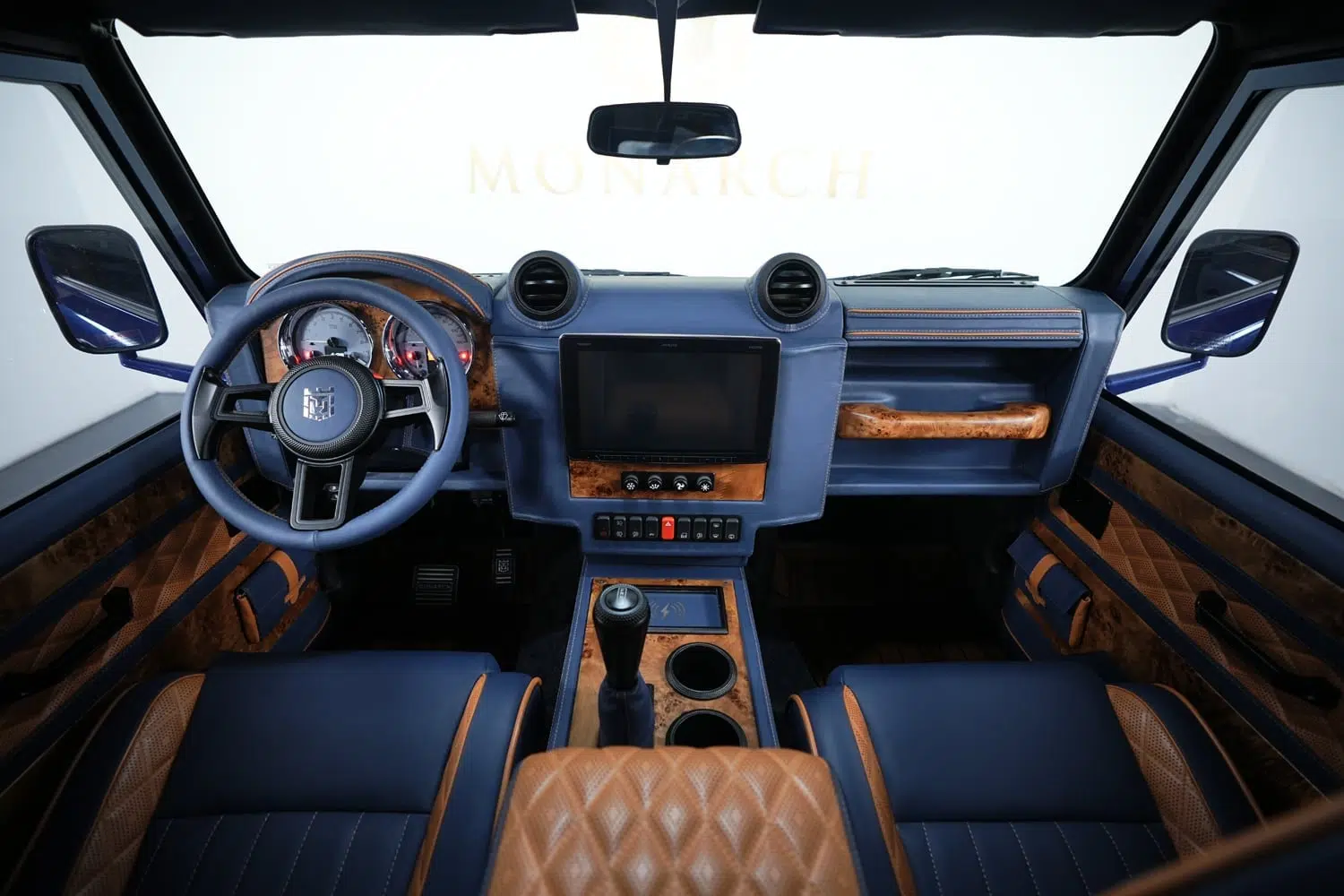
The transformation is equally pronounced inside. Monarch describes each cabin as a single-owner commission, with hand-stitched leather, premium fabrics, individually selected veneers and custom seating configurations tailored around the client. Modern climate control, premium audio and Apple CarPlay can be integrated into the classic dashboard architecture, allowing technology to remain useful without becoming visually dominant.
That restraint matters. The restomod world can easily become a contest in excess, where ever larger touchscreens, brighter paint and more outrageous horsepower overwhelm the original vehicle’s character. Monarch appears more interested in preserving the tension that makes the Defender compelling in the first place: ruggedness beside refinement, utility beside craftsmanship, nostalgia beside usability.
Clients can choose among Defender 90, 110 and 130 configurations, along with pickup and 6×6 variants, depending on how much practicality or presence they want from the finished vehicle. The two-door 90 remains the compact icon, the four-door 110 offers a more versatile family and touring proposition, while the extended 130 introduces considerably more space and visual drama. Every Monarch is specified from what the company describes as a blank sheet, with body style, color, wheels, interior materials and mechanical configuration developed around the owner.
That level of choice also explains why these builds occupy a very different market from ordinary classic-SUV restorations. Monarch lists complete commissions from approximately $250,000 to $350,000 and beyond, with typical build times ranging from six to 12 months depending on complexity. At that price, the client is not simply buying transportation. The process begins to resemble commissioning furniture, tailoring, or even architecture, where the value lies as much in specificity as in the finished object.
The analogy is particularly apt inside the workshop. A Monarch Defender is assembled around dozens of small decisions that may never announce themselves individually but collectively determine whether the vehicle feels coherent. The shade and grain of leather, the stitching, the wheel design, the relationship between exterior paint and cabin materials, the choice between a compact 90 and a long-wheelbase 130—all become part of a visual narrative that belongs to one owner rather than to a production-line specification.
This is where Monarch’s Instagram message about every stitch and panel having a purpose begins to make more sense. Heritage alone is not enough to justify a six-figure restomod, particularly in a market crowded with beautifully rebuilt Defenders, Broncos and vintage 4x4s. What separates the strongest examples is whether the modernization feels integrated rather than added later. A V8 can make the vehicle faster, and leather can make it more luxurious, but neither matters much if the finished car loses the character that made anyone care about a Defender in the first place.
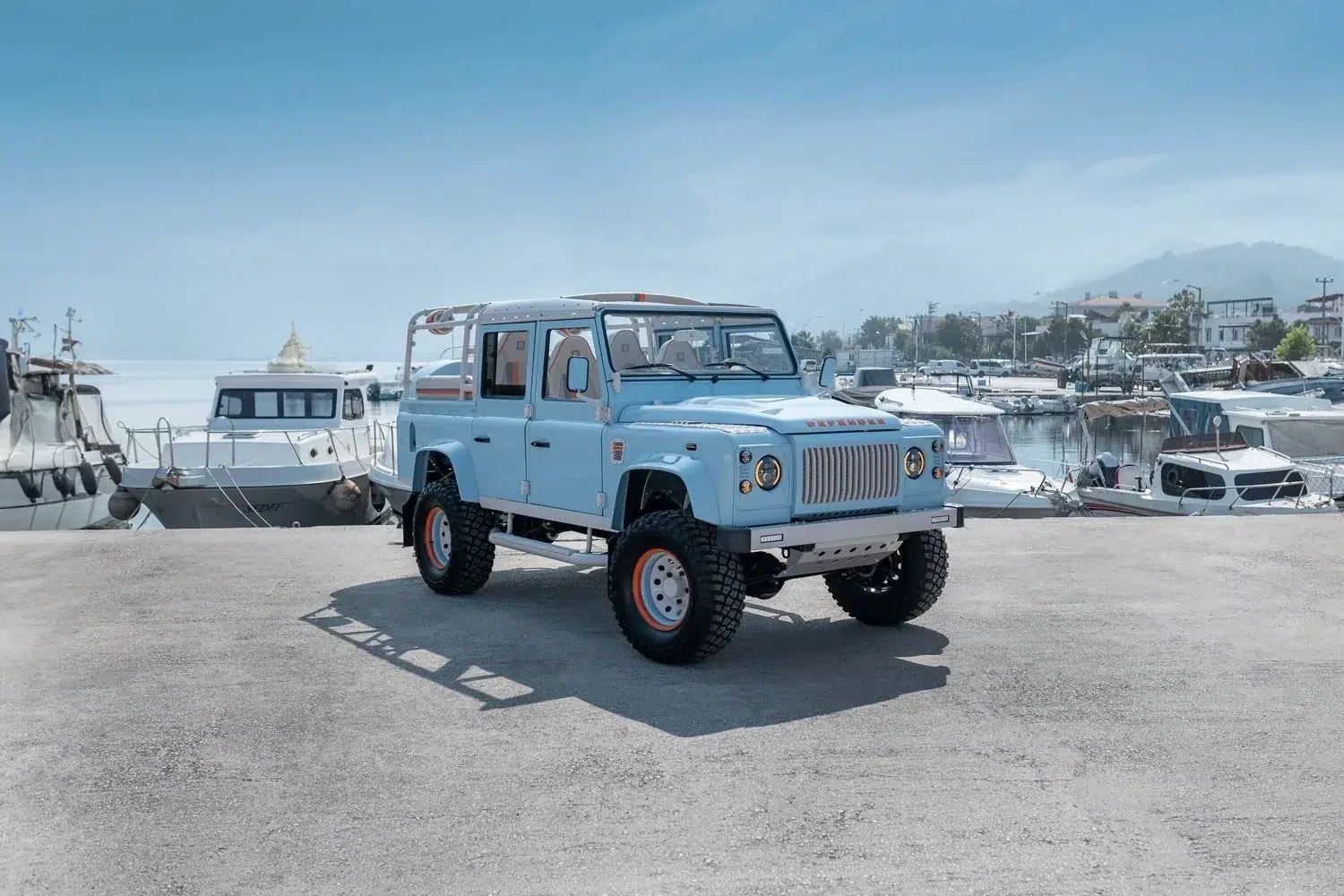
Monarch’s approach is therefore as much about editing as adding. The classic architecture remains immediately recognizable, while the weaknesses associated with an older utility vehicle are methodically addressed beneath it. Power becomes effortless rather than merely adequate, climate control becomes genuinely useful, infotainment joins the cabin discreetly, and the interior begins to feel appropriate for someone accustomed to modern luxury cars rather than vintage-car compromises.
There is also something appealingly analog about the way these vehicles are commissioned. Monarch encourages clients to visit its Illinois facility during the build, discuss changes, and follow the vehicle as it develops. That relationship between owner and workshop is increasingly rare in an automotive world where even highly expensive cars are often configured through a digital menu and delivered months later as finished products.
The result fits neatly into a broader shift at the upper end of the collector-car market. Buyers are increasingly drawn to machines that combine the visual and emotional character of an older design with the confidence of contemporary engineering. The attraction is not simply nostalgia. It is the opportunity to own something that feels distinctive in a landscape where even the most expensive new vehicles can begin to look remarkably familiar.
A Monarch Defender offers a different kind of presence. Its shape is recognizable from across a parking lot, yet the details reveal themselves more slowly. A carefully chosen paint finish, a tailored cabin, the deeper note of a modern V8 and the absence of the rattles and compromises normally associated with a decades-old utility vehicle create an experience that sits somewhere between classic ownership and modern grand touring.
There is an important distinction, however. Monarch Defender is an independent company and is not affiliated with or endorsed by Jaguar Land Rover. Its vehicles use classic Land Rover Defender donor vehicles as the foundation for bespoke commissions, which is precisely what places the company within the growing world of independent restomod specialists rather than conventional manufacturer personalization.
That independence may be part of the attraction. Without the constraints of a contemporary production line, the workshop can treat each Defender as an individual proposition rather than another trim level. One owner may want a restrained 110 in a heritage-inspired color with quietly luxurious leather; another may prefer a dramatic 6×6 with a far more extroverted personality. The common thread is not specification but intent.
Monarch’s line that some vehicles get built while others get a story may sound romantic, but it captures something fundamental about why the restomod movement continues to thrive. At this level, buyers are not searching for the newest thing. They are looking for something familiar enough to carry history and personal enough to feel unlike anything else on the road.
The classic Defender has always possessed the first half of that equation. Monarch’s proposition is to supply the second.