Through atmospheric landscapes, intimate portraits, and psychologically charged narratives, American artist Joseph A. Miller explores the fragile space between innocence, imagination, and the unknown.
There is something quietly unsettling about a moment suspended in time. A young girl raises her bow toward a sky streaked with falling stars. Another cradles a white toy horse against her chest, seemingly absorbed in a world of her own. Elsewhere, a solitary figure moves through an abandoned landscape as an aircraft passes overhead. Each scene appears familiar at first glance, yet something remains unresolved, inviting the viewer to imagine what came before and what might happen next.
For American artist Joseph A. Miller, this delicate tension between the ordinary and the mysterious lies at the heart of his artistic practice. His paintings and drawings explore the psychological dimensions of human experience, often placing children within landscapes that feel simultaneously intimate and enigmatic. Light, atmosphere, and gesture become essential elements of a visual language in which the smallest details suggest stories far beyond the canvas.
An Associate Professor of Art at SUNY Buffalo State University, Miller has taught drawing and painting since 1997. His work belongs to numerous public and private collections and has appeared in exhibitions across the United States and internationally, including Finland, China, Poland, and the Czech Republic. Yet beyond his academic career and exhibition history, it is the emotional ambiguity of his imagery that gives his work its distinctive presence.
Miller describes his artistic focus as the human figure within environments that create psychologically charged, open-ended narratives. His subjects frequently inhabit moments of vulnerability, enchantment, or play, their surroundings contributing as much to the story as the figures themselves. Rather than offering a clearly defined narrative, he allows viewers to construct their own interpretations.
Children occupy a particularly significant place in this visual universe. Their capacity for make-believe, their instinctive relationship with the world, and the intensity of their private experiences offer fertile ground for Miller’s exploration of imagination and uncertainty. His young subjects rarely perform for the viewer. Instead, they appear immersed in activities and thoughts that belong entirely to them.
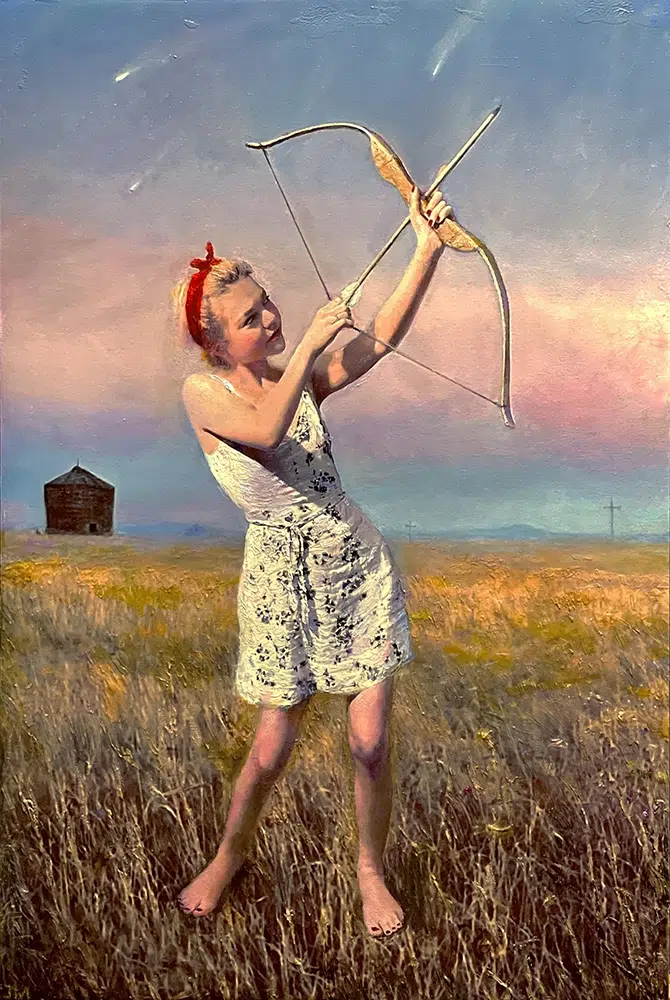
In Shooting Stars, a young girl stands in a golden field beneath a luminous evening sky. Dressed in white, with a red ribbon in her hair, she raises a bow and arrow toward the heavens. Above her, streaks of light cross the pastel horizon, creating a scene that feels suspended between reality and fantasy.
The composition carries a sense of youthful determination, yet its meaning remains tantalizingly elusive. Is the girl playing a game, making a wish, or imagining herself capable of reaching the stars? Miller leaves the answer open. The vast landscape and delicate light lend the scene a dreamlike quality, transforming a seemingly simple childhood gesture into something unexpectedly poetic.
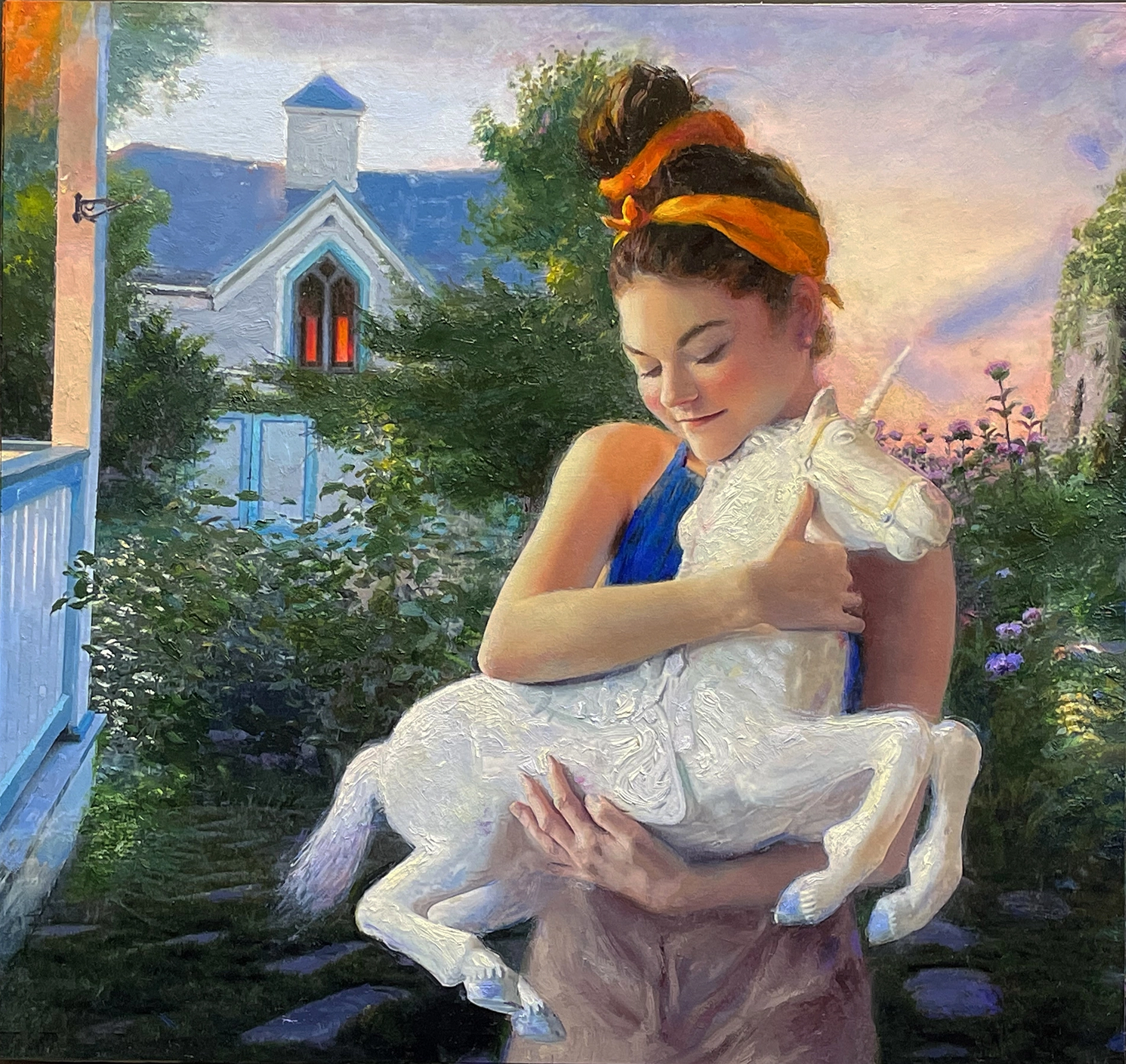
A different tenderness emerges in Cherish. Here, a young girl holds a white toy horse close to her body, her expression absorbed and contemplative. Behind her, a house and lush garden glow beneath the warm colors of an approaching evening. The richly textured surface and gentle interplay of light create an atmosphere of intimacy, while the girl’s protective embrace suggests an emotional attachment that needs no explanation.
The work captures something profoundly recognizable about childhood: the ability to invest an ordinary object with extraordinary meaning. A toy becomes a companion, a source of comfort, or perhaps the central character in a private imaginary world. Miller’s handling of the scene respects that interior life without attempting to define it.
Yet his artistic vision extends well beyond nostalgia. Beneath the apparent innocence of many of his subjects lies an awareness of vulnerability and the unpredictable nature of the world around them.
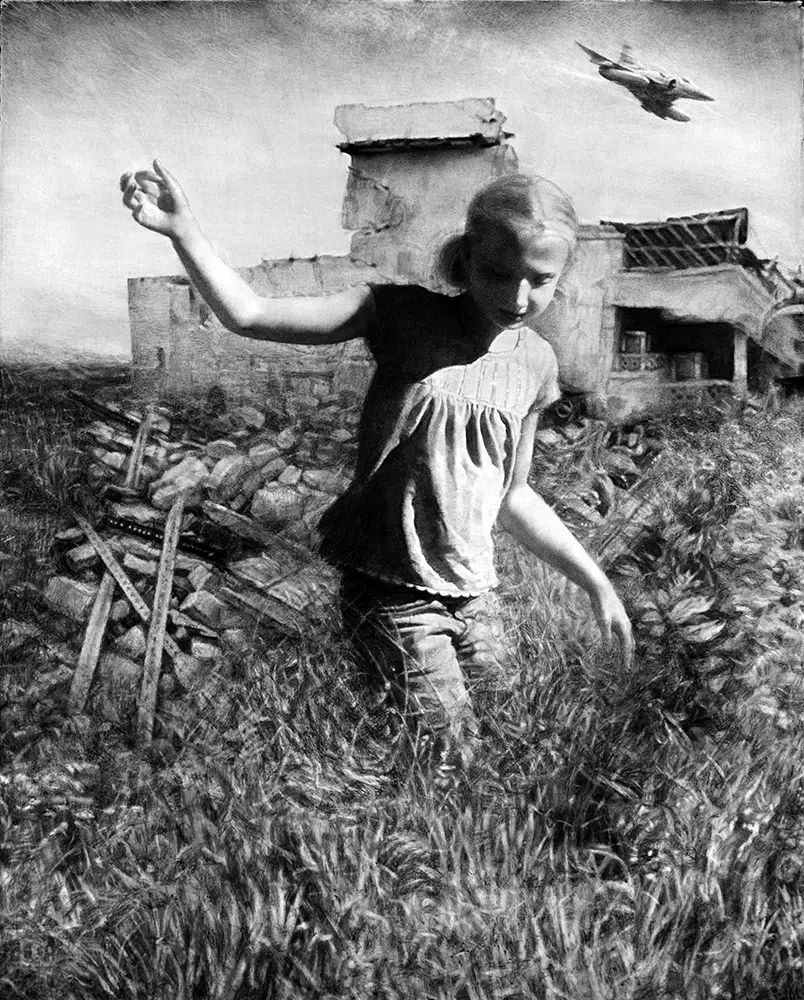
In Compound, a young girl moves through a rough, overgrown landscape, her arms extended as though balancing or navigating uncertain ground. Behind her stand weathered structures, while an aircraft cuts across the sky. The monochromatic palette intensifies the atmosphere, giving the scene an almost cinematic sense of unease.
There is no explicit explanation for the setting or the girl’s presence within it. Instead, the contrast between her youthful figure and the surrounding environment creates a compelling psychological tension. The viewer becomes an observer of a story already in progress, left to consider whether the moment represents play, danger, discovery, or something altogether different.
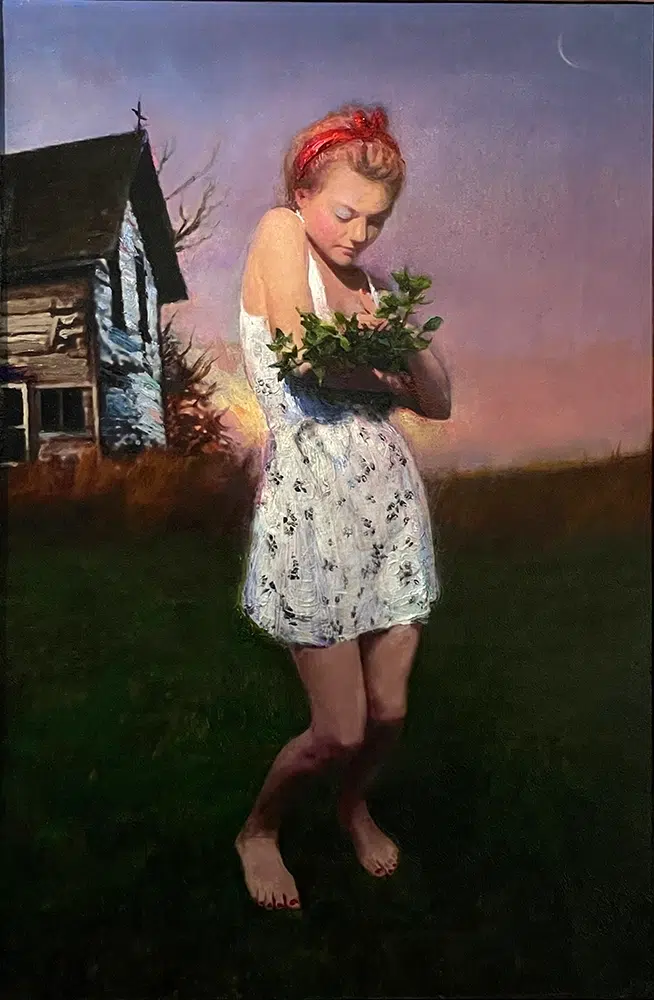
This sense of narrative uncertainty also informs Nest, where a solitary young figure stands beside a weathered building beneath the muted colors of twilight. Holding a cluster of greenery close to her chest, she appears absorbed in a private moment. The surrounding darkness and fading light create an atmosphere of quiet introspection, while the contrast between the figure’s delicate dress and the shadowed landscape introduces a subtle emotional complexity.
Miller’s interest in atmospheric light is particularly evident here. Rather than simply illuminating the subject, light becomes a narrative presence, shaping the emotional character of the scene. The transition between daylight and darkness suggests a world in flux, where familiar surroundings can suddenly feel mysterious.
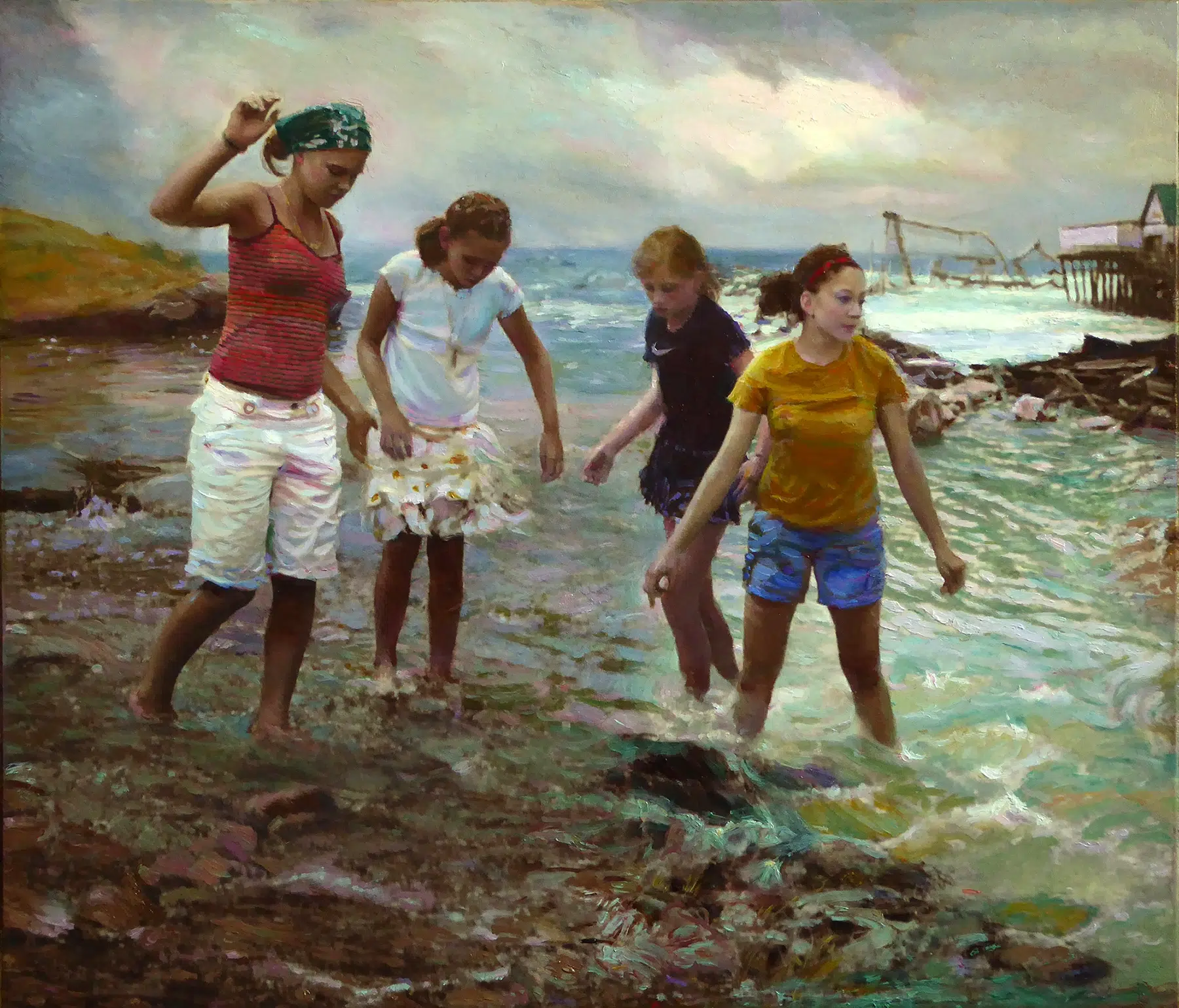
In After II, four young figures stand at the edge of a rocky shoreline, their movements captured in a moment of apparent exploration. The sea stretches behind them beneath a softly colored sky, while the shifting water and textured landscape bring a sense of energy to the composition.
Unlike the more solitary atmosphere of Nest or Compound, this painting explores the dynamics of a group. Each figure seems engaged in an individual response to the environment, yet their shared experience creates a subtle connection. The result is a scene that feels spontaneous and fleeting, as though the viewer has encountered a moment that will never unfold in precisely the same way again.
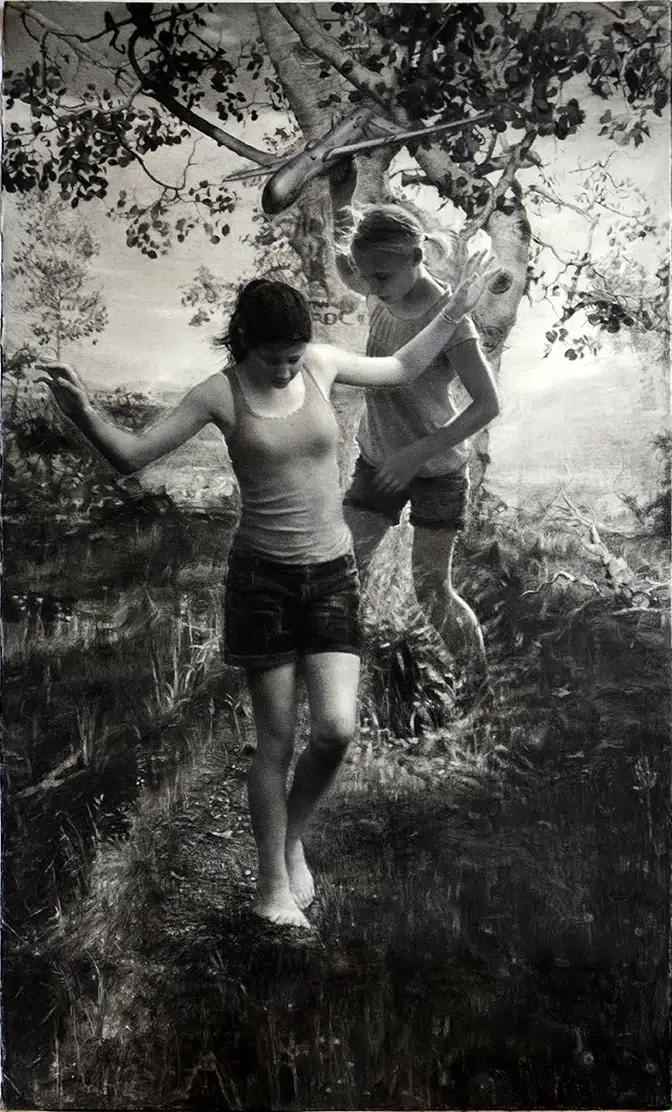
Drone offers another interpretation of childhood companionship. Two young figures navigate an uneven natural landscape beneath the shelter of a tree. Rendered in charcoal and soft pastel, the composition possesses a remarkable tonal richness, its intricate branches and textured ground surrounding the figures with an almost theatrical intimacy.
The image conveys movement and uncertainty in equal measure. The figures appear to negotiate their surroundings with care, their gestures suggesting both concentration and trust. As in much of Miller’s work, the narrative remains unresolved. What matters is not a definitive explanation but the emotional resonance of the moment itself.
Across these works, Miller demonstrates a sustained fascination with the relationship between people and place. His landscapes are never merely decorative backgrounds. They establish mood, introduce tension, and create the conditions in which a narrative can emerge.
The quality of light plays an especially important role. Whether filtering through trees, illuminating a garden at dusk, or stretching across an open field, it often suggests a moment of transition. There is a stillness to many of these compositions, but it is rarely an empty one. Something seems poised to happen, or perhaps something significant has already occurred.
Miller himself identifies this sensation as central to his practice. He seeks images that evoke the feeling of an event about to unfold or one that has recently taken place. This approach gives his paintings their unusual psychological depth, allowing ordinary gestures and familiar environments to acquire a sense of mystery.
His work also reflects an appreciation for the expressive possibilities of traditional artistic materials. Oil paint lends warmth, luminosity, and tactile richness to his color compositions, while charcoal and soft pastel allow him to explore subtle tonal relationships and atmospheric contrasts. The different media share a consistent sensibility, emphasizing mood and narrative over explicit explanation.
There is an undeniable cinematic quality to Miller’s art, but his images resist the certainty of a conventional storyline. They resemble fragments from a film whose beginning and ending remain unknown. The viewer encounters a single moment and must decide what significance it holds.
That openness is perhaps one of the most compelling aspects of his work. In an increasingly image-saturated world, where visual messages often demand immediate interpretation, Miller offers something more contemplative. His paintings invite the viewer to linger, notice, question, and imagine.
They also remind us that childhood is not simply a period of innocence. It is a complex emotional landscape filled with curiosity, apprehension, invention, and discovery. Through his figures, Miller explores these experiences without reducing them to sentimentality, allowing beauty and uncertainty to coexist.
Ultimately, the strength of Joseph A. Miller’s art lies in its refusal to explain everything. His subjects inhabit worlds that feel both recognizable and strangely unfamiliar, their stories unfolding somewhere beyond the edges of the composition.
The paintings offer no definitive conclusions, only the suggestion that something meaningful has taken place.
And perhaps that is precisely what makes them so memorable.
To explore more of Joseph A. Miller’s work, visit his artist portfolio.