
For most luxury marques, rarity is measured in production numbers. At Bugatti, that metric is beginning to look almost conventional.
The Destrier, unveiled publicly at Monterey Car Week, is not a limited edition, nor simply an especially elaborate configuration of an existing model. It is a one-of-one automobile created for a single customer under Bugatti’s Programme Solitaire, the marque’s most exclusive commissioning initiative and one conceived to push beyond even the possibilities of Sur Mesure.
That distinction matters.
Programme Solitaire is not about choosing from a wider palette of paints, leathers and decorative finishes. It is Bugatti’s contemporary interpretation of coachbuilding: a process in which the automobile becomes a singular object shaped around the vision of one owner, with its own design language, materials and place within the marque’s history. The Destrier is the third such creation, following Brouillard and F.K.P. Hommage.
In that sense, the most interesting thing about the Destrier is not that there will never be another one.
It is that Bugatti is redefining what bespoke can mean at the highest end of the automobile market.
The car begins with one of the most extreme technical foundations in Bugatti’s portfolio: the Bolide, the marque’s uncompromising track-focused machine. Yet the Destrier deliberately moves away from the visual severity of motorsport. Bugatti describes it as a “sculpture of speed,” an attempt to transform the engineering beneath the Bolide into something more elegant, more enduring and more deeply personal.

The result is a fascinating exercise in restraint.
Its proportions remain dramatic, because there is no disguising the capabilities beneath them, but the Destrier does not rely on theatrical aggression to make its presence felt. Instead, Bugatti has pursued continuity of form and a sense of visual calm, creating a body that appears less obsessed with proving its performance than with giving that performance a lasting shape.
That is an important shift.
Hypercar design has spent much of the past decade becoming increasingly extroverted, with exposed aero, technical surfaces and visual complexity signaling ever more extreme capability. The Destrier suggests another direction: that a machine can remain technically extraordinary while becoming more architecturally resolved.
Its exterior is finished in Sapphire Celeste, a bespoke multi-layer color developed exclusively for the car and its owner. Brightwork elements receive a hammered treatment inspired by the hand-beaten armor of medieval knights, a subtle reference that adds texture rather than spectacle.

Even the name carries weight. A destrier was the powerful warhorse associated with medieval knights, prized not only for strength but for presence, discipline and bearing. The metaphor suits a Bugatti that is clearly built around performance, yet equally concerned with dignity.
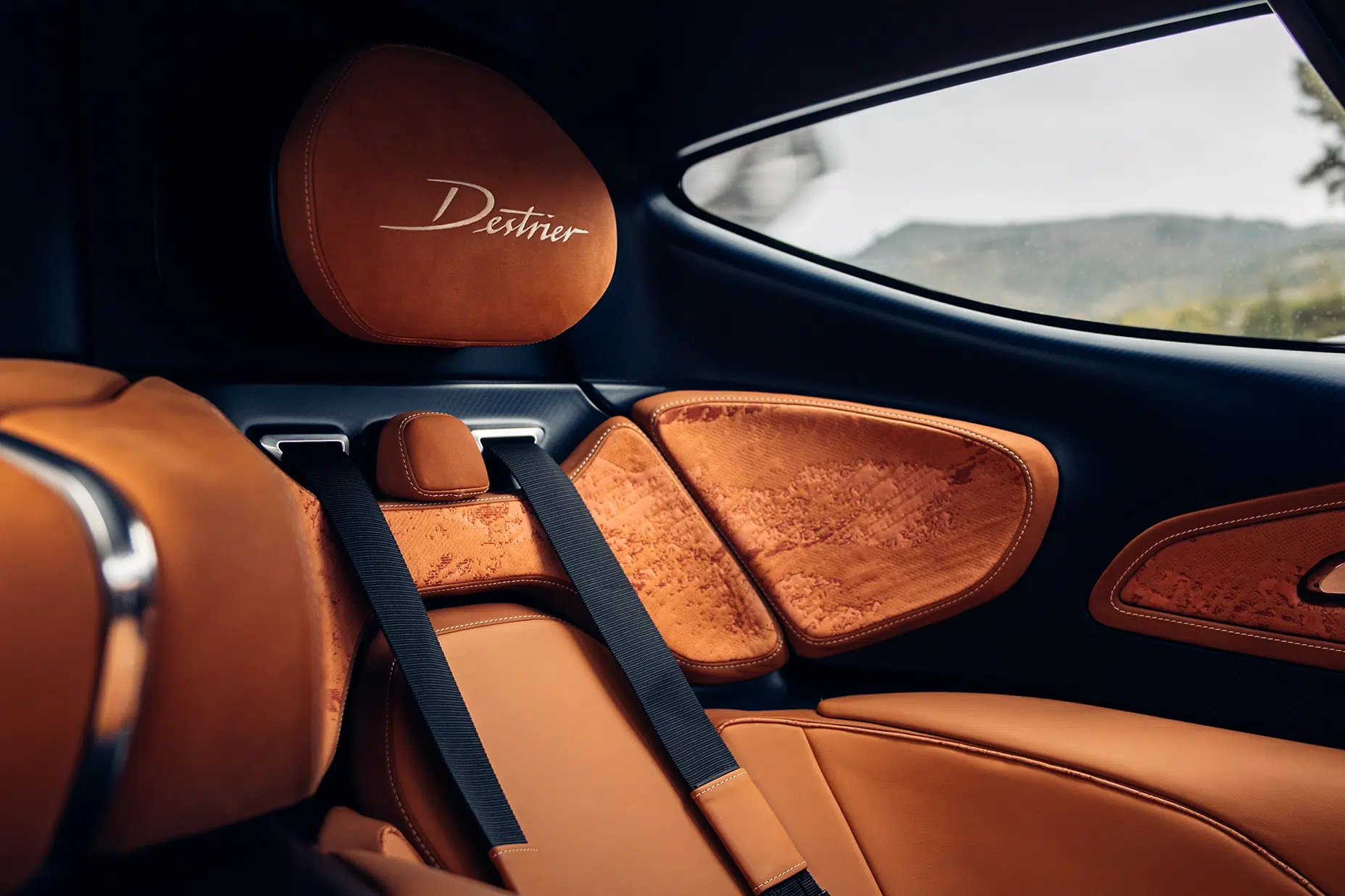
Inside, the separation from the Bolide becomes more pronounced.
Bugatti says the cabin draws on the quiet warmth of a tailor’s atelier rather than the stripped-back severity of a racing cockpit. Every material was selected individually, every surface developed around the preferences of one owner.

That language reveals what Programme Solitaire is really selling.
At this level of luxury, personalization is no longer enough.
A customer who can buy virtually any automobile in the world is unlikely to be impressed simply by exclusivity of specification. The more compelling proposition is authorship: the opportunity to help shape an object whose identity is inseparable from the person who commissioned it.
The Destrier therefore belongs as much to the world of haute couture, architecture and decorative arts as it does to traditional automotive manufacturing.
A bespoke suit is not valuable because no one else chose the same fabric. Its value lies in being cut for one individual. A private residence is not extraordinary because its marble is rare, but because every proportion, view and material decision exists for the person who inhabits it.
Programme Solitaire applies that philosophy to the hypercar.
Bugatti’s Monterey Car Week presentation reinforced the point. Before the Destrier was shown publicly, the owner and family were given a private presentation at Maison BUGATTI in Pebble Beach alongside members of the team who created it, including Bugatti Rimac CEO Mate Rimac, Bugatti Managing Director Hendrik Malinowski and Design Director Frank Heyl.

The car then joined an intimate Bugatti Petit Tour across the Monterey Peninsula and along the California coast, traveling from Spanish Bay toward Big Sur before returning to Pebble Beach. Its first public appearance followed at The Quail, A Motorsports Gathering, before the car was presented on the Concept Lawn at the Pebble Beach Concours.
For Bugatti, Monterey was less a conventional launch than an appropriate stage for a larger idea.
This is, after all, a gathering defined by connoisseurship. Collectors arrive not simply to see the newest machinery, but to examine provenance, craftsmanship, design lineage and the kinds of details that distinguish an important automobile from an expensive one.
The Destrier speaks directly to that sensibility.
“This moment in Bugatti’s story represents a deeply meaningful moment for our treasured marque, for Programme Solitaire and, above all, for the customer whose vision inspired this extraordinary creation,” said Hendrik Malinowski, Managing Director of Bugatti. He described the project as evidence of the breadth of Programme Solitaire and of its ability to create a Bugatti with its own spirit and its own place in the marque’s history.
That last point may be the most significant.

Bugatti has long occupied an unusual position in the luxury world because its automobiles are expected to satisfy several seemingly incompatible ambitions at once. They must be brutally fast yet beautifully resolved, technologically extreme yet historically conscious, unmistakably modern yet connected to more than a century of craftsmanship.
Programme Solitaire adds another requirement: individuality so complete that the automobile becomes effectively unrepeatable.
The Destrier is therefore not simply a rarer Bugatti.
It is evidence of a different hierarchy of luxury.
At the uppermost end of the market, exclusivity is no longer defined by how difficult something is to obtain. It is defined by whether it can exist for anyone else at all.
That is the territory Bugatti is now exploring.
And at Monterey Car Week, surrounded by some of the most significant automobiles ever created, the Destrier made a compelling case that the future of hypercar luxury may look surprisingly like its past: one patron, one vision, one automobile—and no second example.