Some Ferraris are rare because production is limited. Others are rare because there is only one.
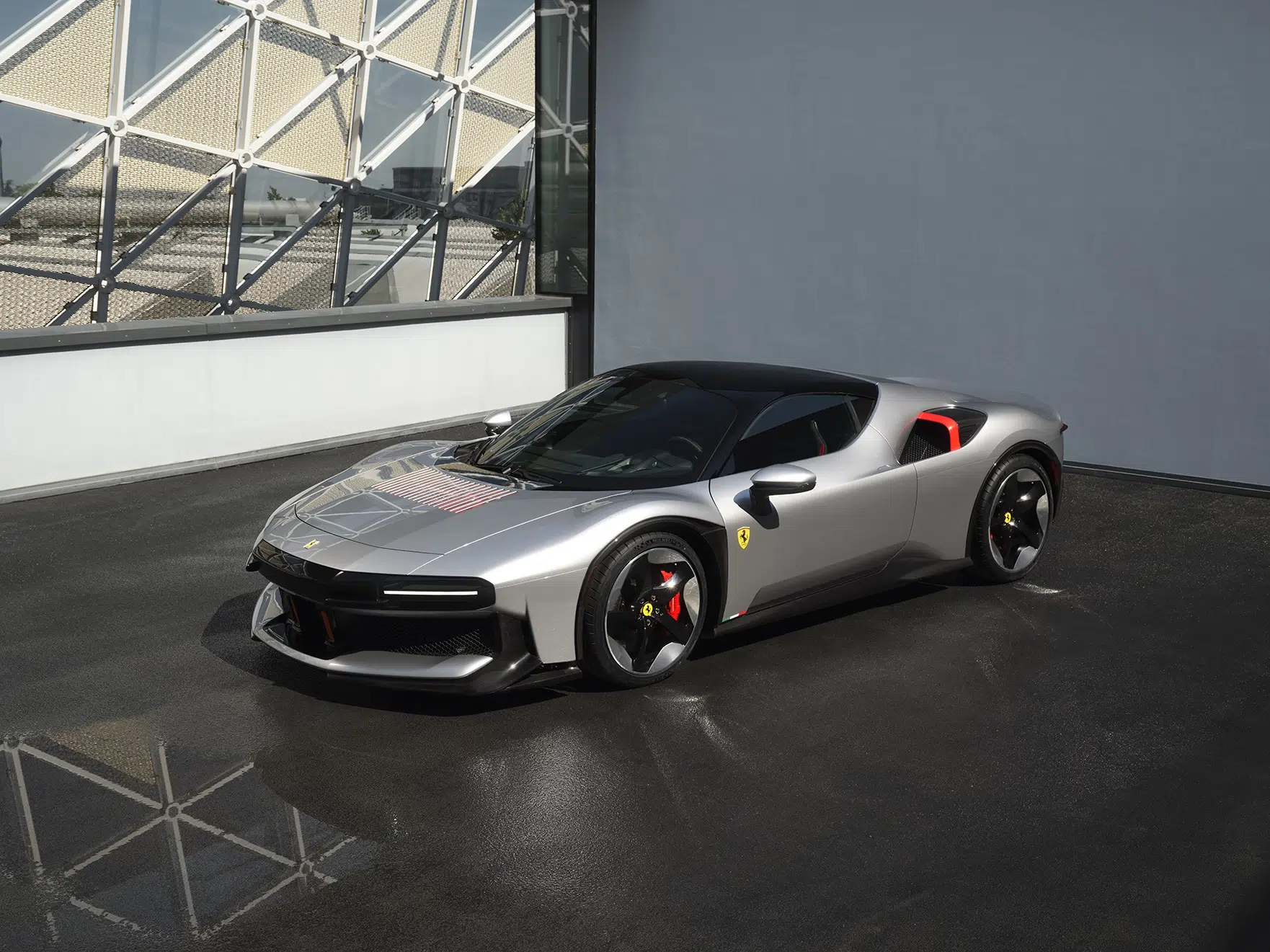
The new Ferrari CZ26 belongs firmly to the latter category. Created through Maranello’s Special Projects programme for a U.S. client and developed by the Ferrari Design Studio under the direction of Flavio Manzoni, the CZ26 is a one-off reinterpretation of the high-performance berlinetta, one that takes the technical foundations of the SF90 Stradale and gives them an entirely new visual identity.
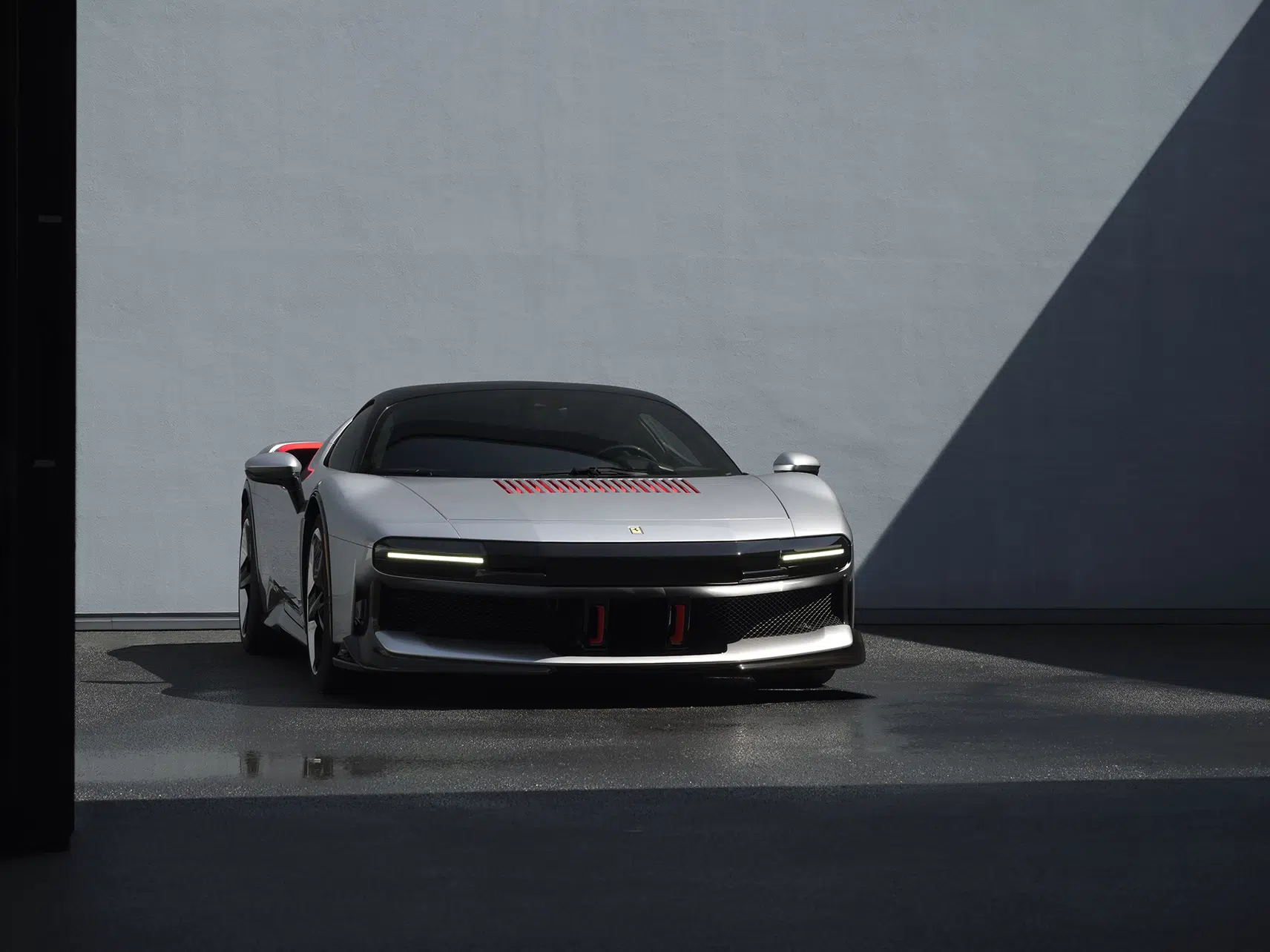
At first glance, that distinction is obvious. The CZ26 does not look like an SF90 with a different body draped over familiar proportions. Its character is more architectural, more graphic and, in some ways, more disciplined. Ferrari has pushed toward a cleaner, more technical aesthetic, building the car around a distinctly horizontal theme and a strong two-box silhouette that gives the entire form a lower, more planted sense of mass.
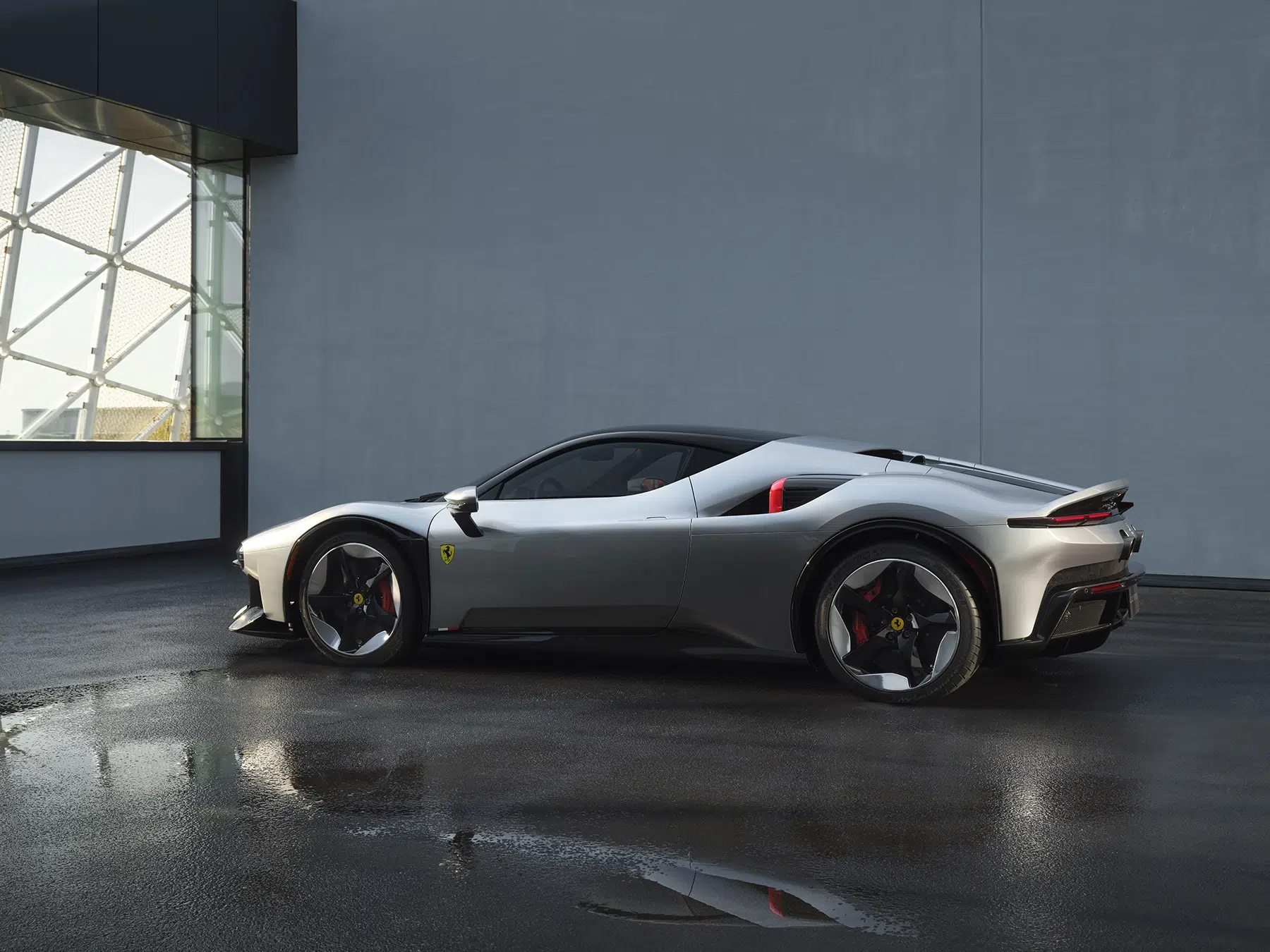
The central body is conceived almost like a capsule, supported visually by four muscular wheel arches. From there, the design appears to flow in one continuous gesture, beginning at the front fascia and carrying through to a sharply truncated rear. The result is an unusually pure composition for a modern supercar, one in which aerodynamics, cooling and surface treatment are integrated rather than layered on top.
That purity is most obvious at the front. A full-width functional grille incorporates ultra-slim lighting modules, brake air intakes, sensors and other technical elements into a single horizontal structure. The leading edge is unusually vertical, giving the CZ26 a more assertive face than the SF90 while avoiding the visual clutter that often accompanies increasingly complex performance cars.
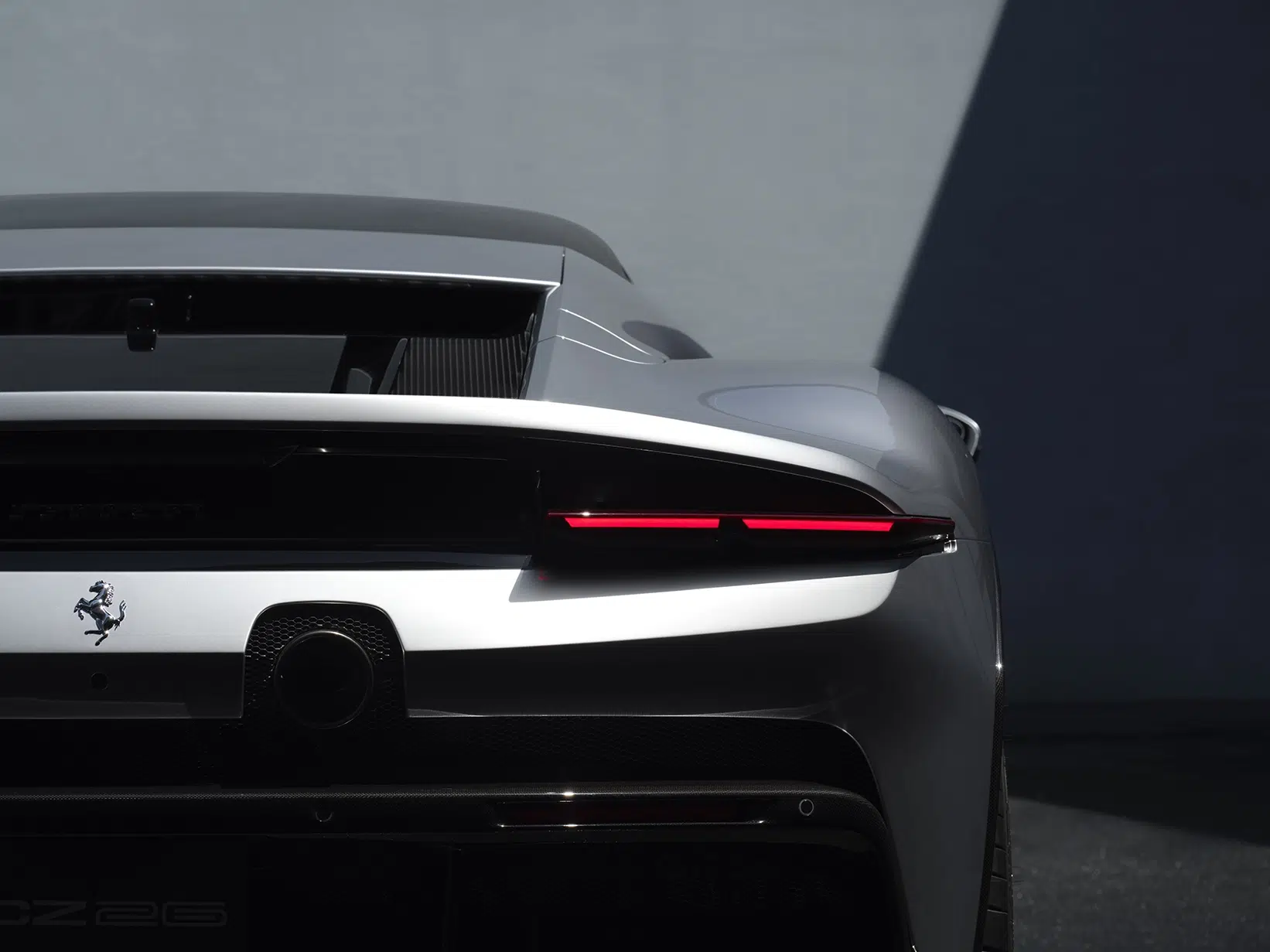
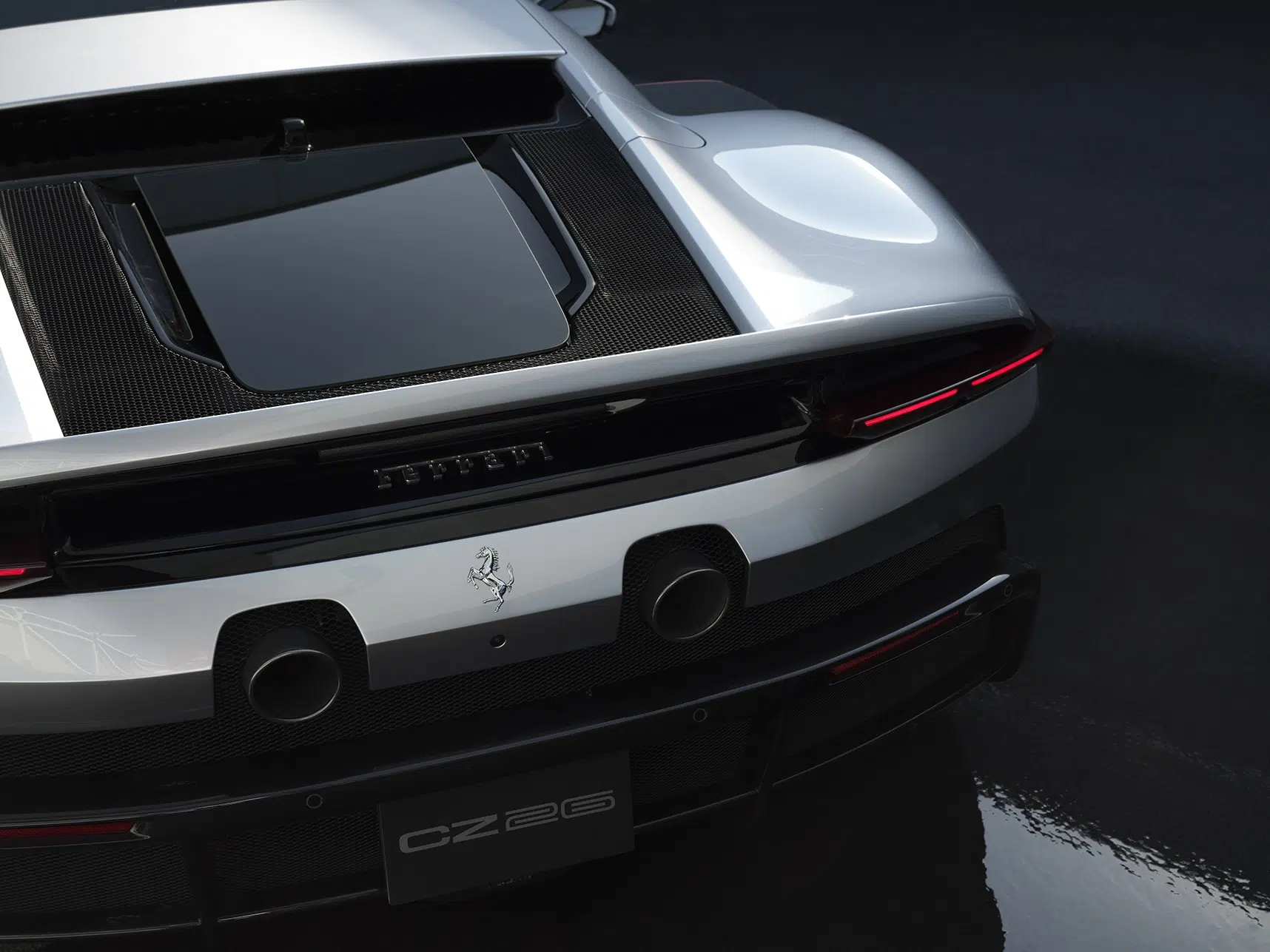
The rear adopts the same discipline. A truncated tail, cantilevered taillights and a wide diffuser give the CZ26 a lighter, more sculptural presence while reinforcing the car’s stance. The surfaces are remarkably clean, with functional elements emerging directly from the body rather than appearing as separate add-ons. Side air intakes, carbon-fiber extensions around the wheel arches, lighting, diffuser elements and cooling apertures all speak the same design language.
Ferrari cites Italian industrial design of the 1970s as an influence, and that reference makes sense. There is something almost product-design-like about the CZ26: precise, rational, even slightly futuristic, yet still deeply emotional in the way its proportions are handled. It is a very different kind of drama from the flowing sensuality traditionally associated with the berlinetta, but no less recognizably Italian.
The bodywork is finished in Argento Veloce, an exclusive silver with a liquid-like quality intended to exaggerate the precision of the car’s surfaces. Rosso Lampante accents punctuate the more technical areas, introducing a sharper visual rhythm, while pigmented carbon-fiber elements reinforce the sense that this is as much an exercise in material expression as it is in form.
Even the wheels were created specifically for the CZ26. Their gloss-black finish is combined with a shot-peened surface treatment, achieved through microscopic bead blasting to create a polished effect. Natural-finish titanium exhaust tailpipes complete the exterior treatment, adding another deliberately technical note without disturbing the restraint of the overall design.
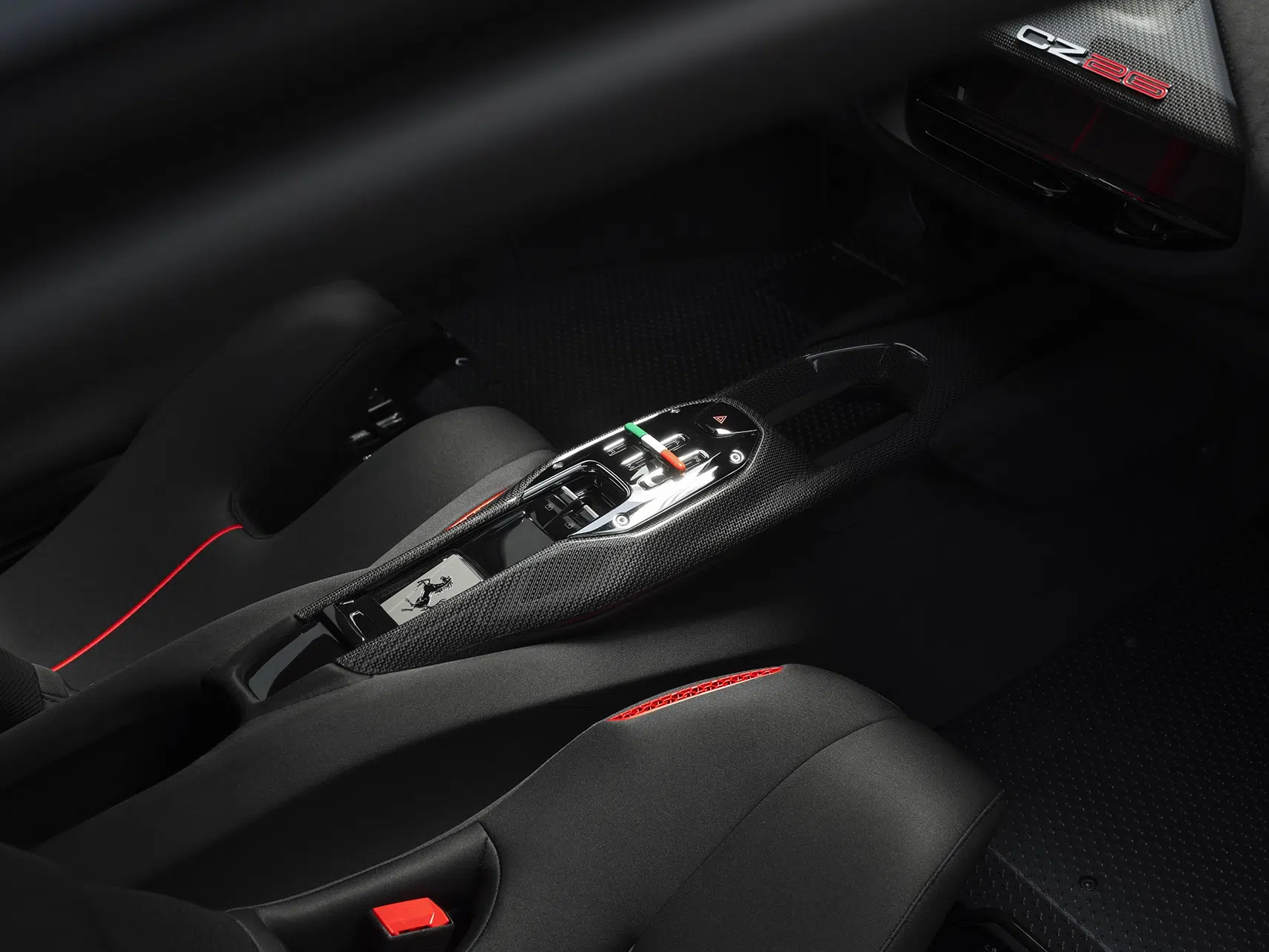
The cabin follows the same philosophy. Black technical fabric becomes one of the defining materials, paired with seat inserts created using additive manufacturing and developed specifically for this car. Rosso Lampante details continue the exterior color story inside, while an embroidered CZ26 logo provides a discreet reminder that this interior belongs to no other Ferrari.
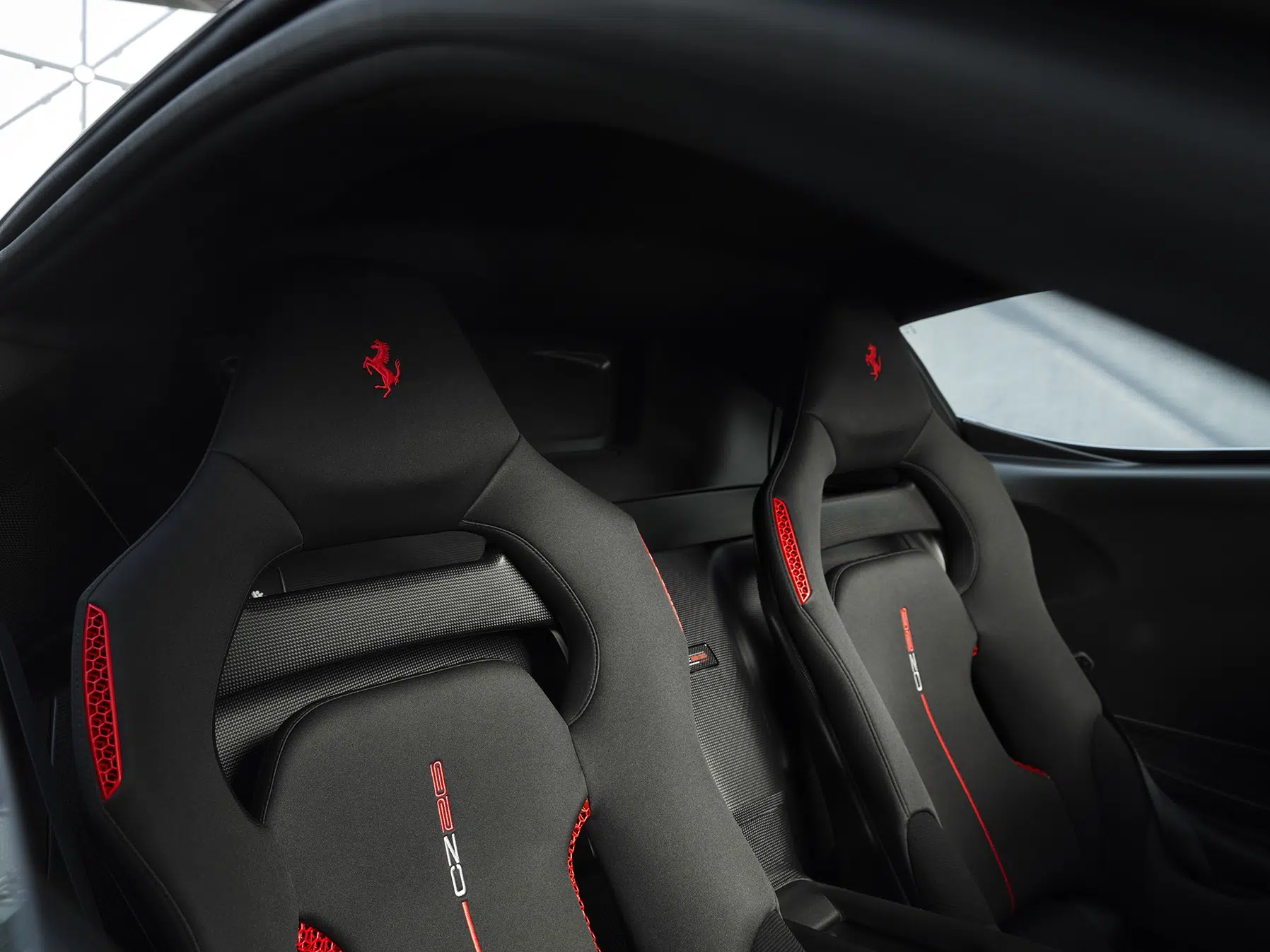
The contrast of materials is particularly sophisticated. Matte technical fabric is set against satin-finish carbon fiber, while a special gloss carbon weave incorporates metallic filaments directly into its structure. Body-colored elements on the doors and upper dashboard tie the interior visually back to the exterior, creating a sense of continuity that is often lost in highly customized cars.
That cohesion is important because the CZ26 is not merely a styling exercise. Beneath the new surfaces lies the mechanical architecture of the SF90 Stradale, which means this one-off retains the performance credentials of one of Ferrari’s most technically ambitious road cars.
Its 4.0-liter twin-turbocharged V8 produces 797 cv at 7,900 rpm, while three electric motors contribute up to 162 kW. Together, the hybrid system enables the CZ26 to reach 100 km/h in 2.5 seconds, 200 km/h in 6.7 seconds and a top speed of 328 km/h. An eight-speed dual-clutch F1 gearbox handles power delivery, while the car also retains electric all-wheel drive and Ferrari’s suite of dynamic control systems.
In that sense, the CZ26 is an interesting contradiction. It looks more minimal than the SF90, yet beneath the surface it remains extraordinarily complex. Ferrari has not simplified the engineering; it has simplified the way the engineering is expressed.
The aerodynamic work reflects that approach. The front cooling system and airflow management were extensively reworked, with a reoriented central radiator pack and dedicated bypass ducts improving both thermal efficiency and front-axle downforce. The underbody and vortex generator system were also redesigned, while air curtains at the front help manage the turbulence created by the front wheels and reduce drag.
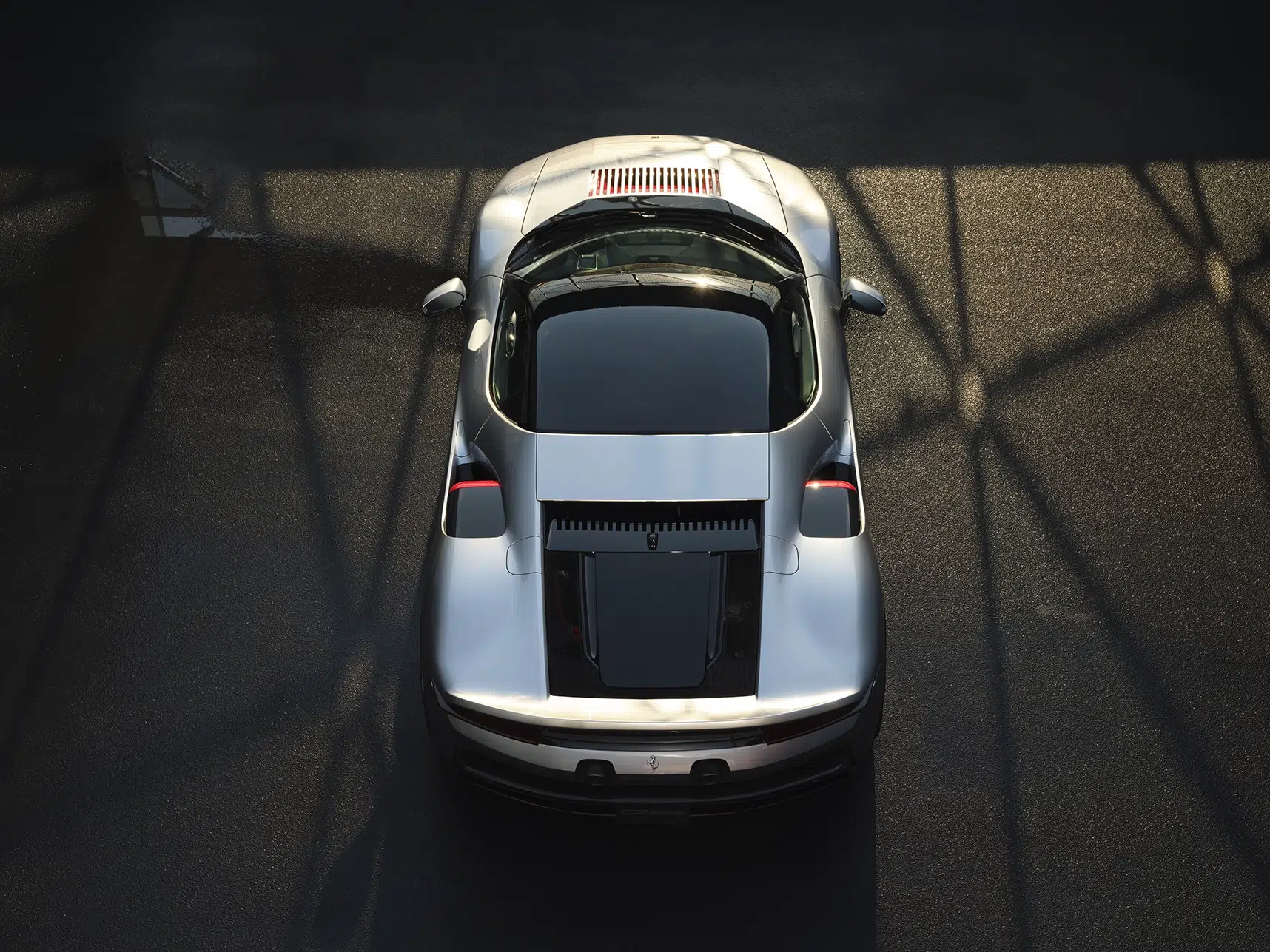
At the rear, Ferrari developed a larger upper spoiler and a dedicated diffuser to increase downforce while maintaining aerodynamic efficiency. The engine cover was redesigned with specific venting for thermal management, ensuring that the new bodywork does not compromise the SF90’s formidable performance envelope.
What makes the CZ26 especially compelling, though, is not its acceleration figure or its aerodynamic efficiency. It is what it says about Ferrari’s Special Projects philosophy.
A Special Projects car begins with a customer’s idea and unfolds through a process that typically takes around two years. During that time, the client works closely with Ferrari’s designers as the proportions, surfaces, materials and details are refined. It is a form of automotive commissioning that sits somewhere between engineering, industrial design and patronage.
That last word is perhaps the most important. At this level, the customer is no longer simply choosing a Ferrari. The customer is helping to create one.
The CZ26 therefore occupies a different space from even Ferrari’s most exclusive limited-series models. It is not defined by scarcity alone, because scarcity can still be replicated across 50, 100 or 499 cars. Its distinction lies in singularity. There is no second configuration, no alternate paint choice, no neighboring chassis built to the same brief.
There is only this one.
That makes the CZ26 less about ownership in the conventional sense and more about authorship. The U.S. client behind it will not simply own a rare Ferrari; he or she will own a Ferrari whose identity is inseparable from the commissioning process that created it.
For a company with one of the most recognizable design languages in the world, that is a fascinating proposition. Ferrari has allowed one customer to push the berlinetta into a new visual direction while still preserving the engineering integrity and dynamic capability expected of Maranello.
The result is neither nostalgic nor flamboyant. It is cleaner, more technical and unusually self-assured. In a market where high-performance cars increasingly compete through visual aggression, the CZ26 finds its strength in precision.
And that may ultimately be what makes it memorable. The Ferrari CZ26 does not need to shout about its exclusivity. The fact that there will never be another one says enough.