Ada does not travel. But what she creates now does.
Handcrafted by Forsyths in Rothes, the 300-liter copper still known as Ada sits at the heart of Isle of Barra Distillers, quietly shaping one of the most distinctive spirits to emerge from Scotland’s remote Outer Hebrides. Named after the daughter of co-founders Michael and Katie Morrison, Ada represents more than craftsmanship; it embodies a sense of place, memory, and continuity.
Now, that sense of place is crossing the Atlantic.
With a recent partnership with Total Wine & More, Barra’s award-winning spirits are arriving in the United States, introducing American audiences to a category of distillation defined less by tradition alone and more by terroir, the subtle imprint of landscape, climate, and culture on every bottle.
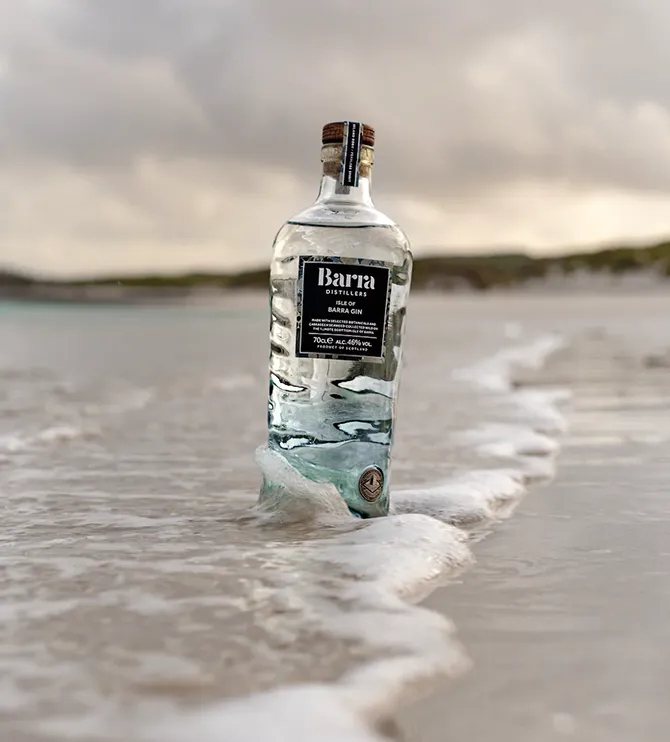
At the center of Barra’s signature gin lies an ingredient rarely encountered in fine spirits: carrageen seaweed (Chondrus crispus), a red algae native to the island’s cold Atlantic waters. Hand-harvested along ancient rock formations during the lowest tides of the year, it is washed, then left to dry naturally for weeks under shifting Hebridean skies, gradually bleaching to a pale, luminous hue. This is not simply a botanical; it is the island distilled.
Historically used as a natural tonic, carrageen carries both personal and cultural resonance. For Morrison, it recalls generations past, when it was gathered as much for nourishment as for necessity. Today, it lends Barra Gin a subtle salinity and depth, anchoring the spirit in its environment with quiet precision. In an era where provenance defines luxury, this level of ingredient storytelling places Barra firmly within a growing movement toward place-driven spirits, an evolution increasingly explored across the global bar landscape, as seen in analyses of emerging cocktail trends.
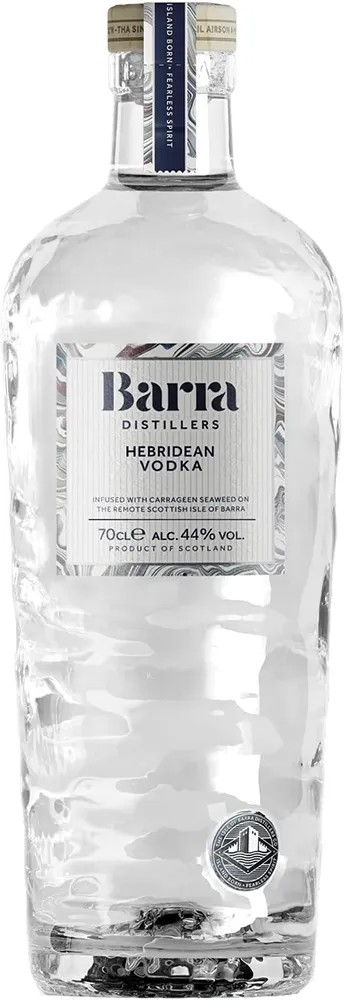
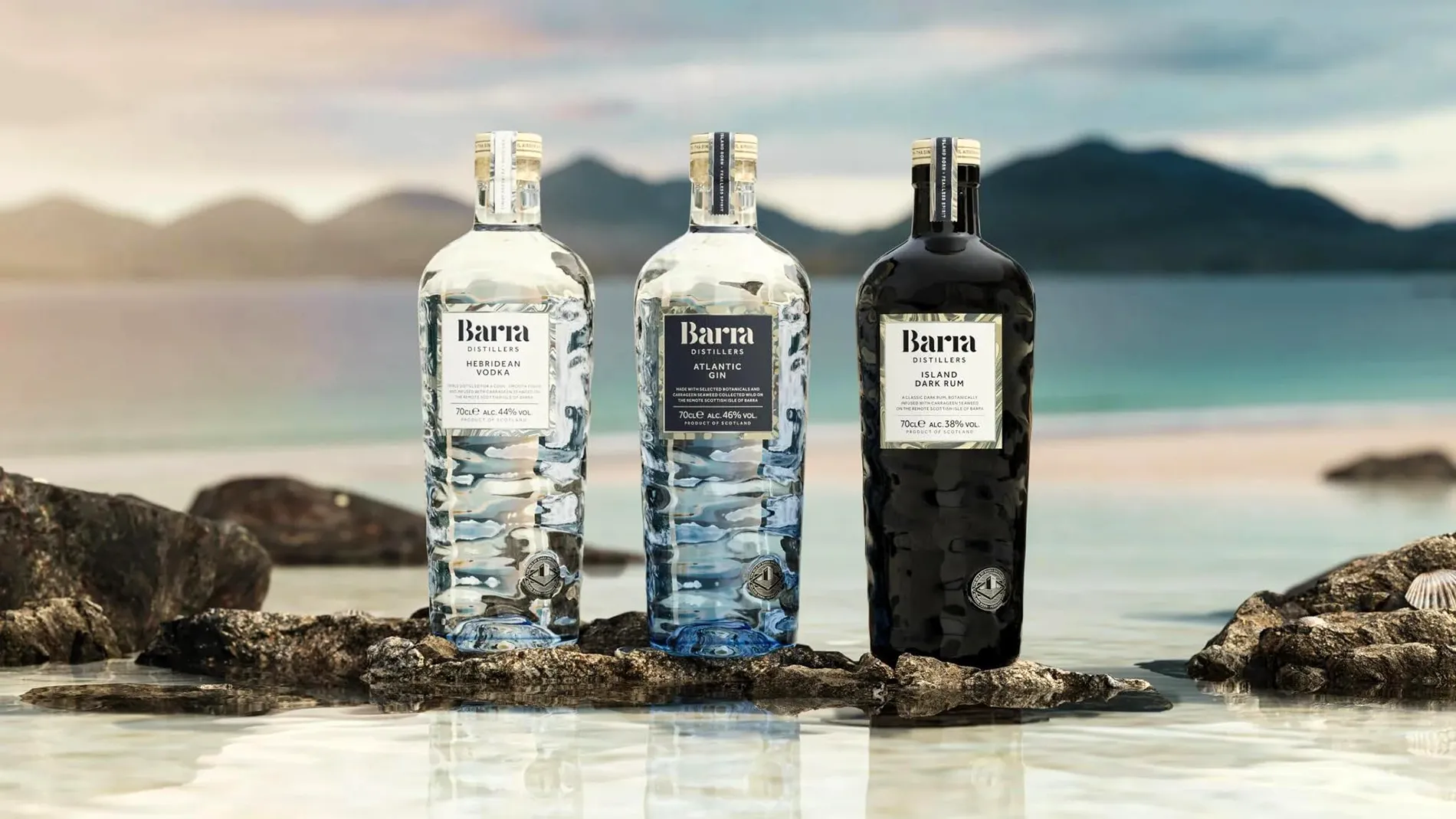
While gin remains its flagship, the distillery’s portfolio extends further, each expression reflecting a different facet of island life. A honeyed vodka, produced in collaboration with Bee Bharraigh, supports the reintroduction of native Scottish black bees, an ecological initiative that is considered the spirit itself. Meanwhile, dark rum infused with wild cherry and blackcurrant offers a richer, more indulgent interpretation of island flavor, balancing fruit and spice with understated complexity. These are not products developed for scale, but expressions of a small island’s identity, crafted with restraint and intended to be experienced rather than consumed.
To understand these spirits fully is to understand Barra itself. Measuring just over eight miles in length, the island is home to fewer than 1,200 residents, its landscape shaped by some of the oldest rock formations in Britain. Here, history feels less like a distant narrative and more like a constant presence, visible in ancient cairns, windswept coastlines, and a rhythm of life dictated as much by tide as by time.
Barra’s airport, uniquely, operates from a tidal beach, its runway revealed only when the sea retreats. Aircraft land on compacted sand, guided by the natural contours of the shoreline. It is a detail often cited, but never diminished in its effect: a reminder that this is a place where modern life continues to adapt to the environment, not the other way around. That same relationship defines the spirits now making their way abroad.
The U.S. launch marks a significant moment for the distillery, with distribution expanding across more than 25 states. For American consumers, it represents more than access to a new brand; it offers entry into a distinctly different philosophy of production. Where larger distilleries often prioritize consistency at scale, Barra embraces variation shaped by nature. Each batch carries subtle nuances influenced by harvest conditions, climate, and time, aligning more closely with the ethos found in fine wine than in conventional spirits. This approach resonates particularly within a broader shift toward refined luxury lifestyle experiences, where authenticity and origin increasingly define value.
As these spirits enter the American market, their role extends beyond the bottle. They are poised to influence how cocktails themselves are conceived. The modern cocktail, after all, is no longer simply a composition of ingredients; it is a reflection of intent. Spirits such as Barra Gin invite a more restrained approach, where fewer elements allow the character of the base to emerge. In this way, they align naturally with contemporary approaches to classic cocktail techniques, where balance and clarity take precedence over excess.
Served simply, perhaps with a twist of citrus or a measured tonic, the result is not merely a drink, but an articulation of place.
For Morrison, the expansion into the United States carries a personal dimension as well as a commercial one. It is an opportunity to share not just a product, but a piece of the island itself, its landscape, its history, and its enduring character. Each bottle, in this sense, becomes a quiet ambassador.
And while Ada may remain firmly rooted in Barra, her influence now extends far beyond it—distilling the essence of the Outer Hebrides into something that can be poured, shared, and experienced, one glass at a time.