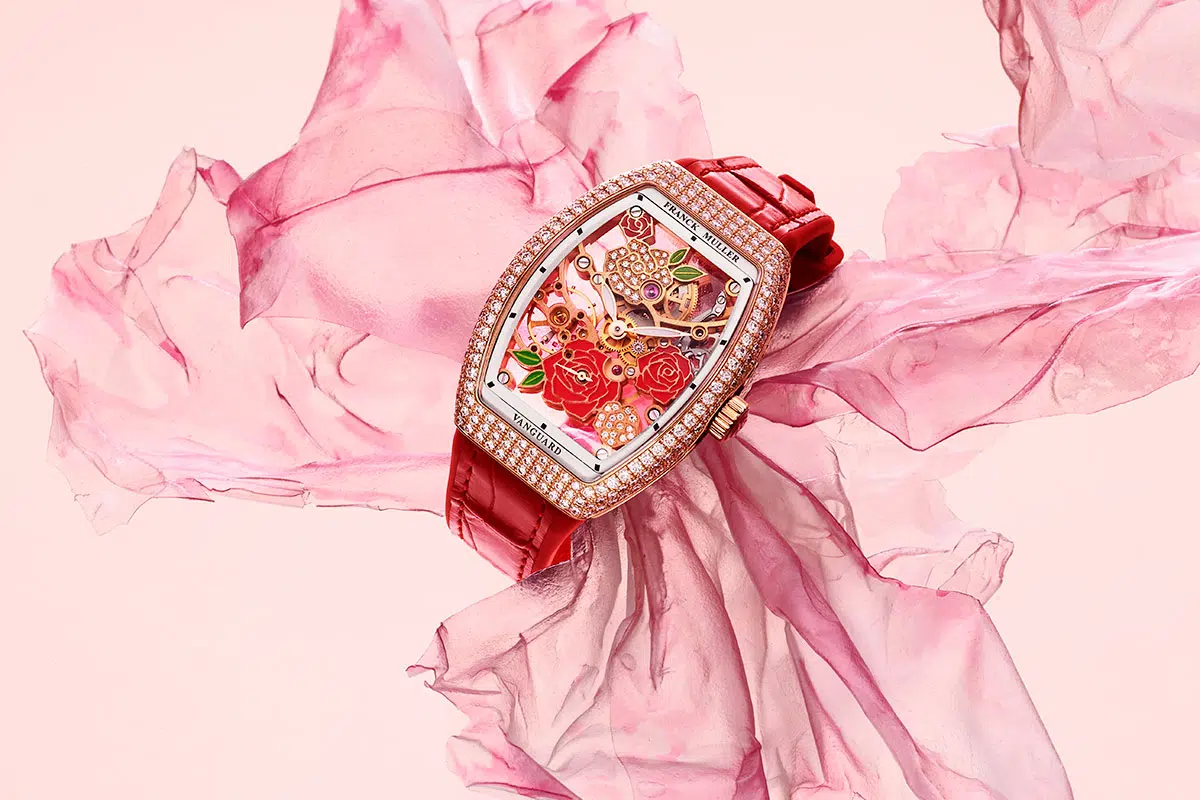
At first glance, the Franck Muller Vanguard Rose Skeleton appears to have been designed around a romantic conceit: roses suspended over a field of exposed wheels, gears, and polished steel. Look more closely, however, and the flowers reveal their true purpose. They are not simply arranged above the mechanism as decoration. They are the mechanism.
That distinction changes everything.
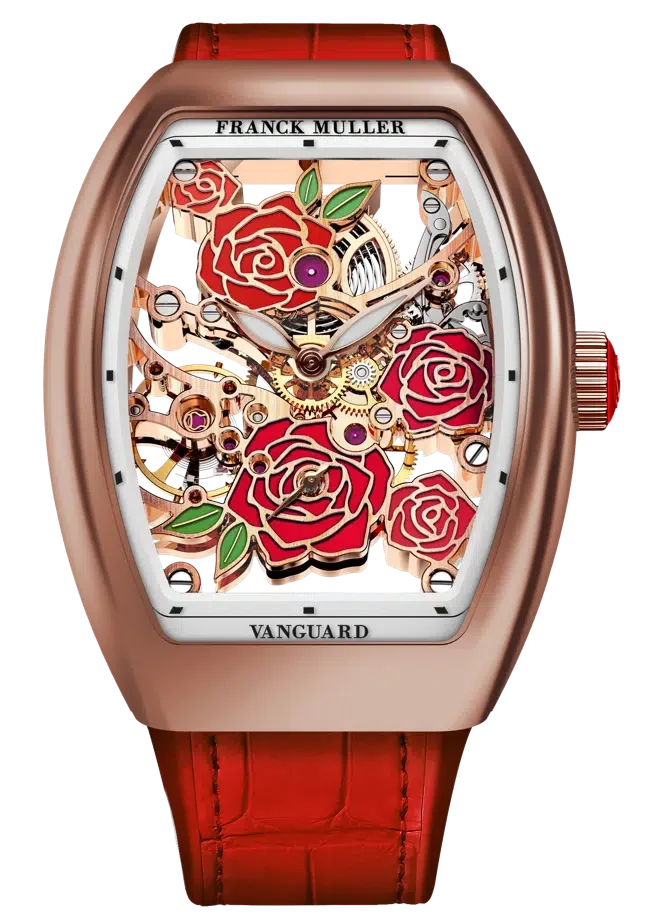
In most floral watches, nature is rendered through engraving, enamel, marquetry, or gem-setting applied to a conventional dial. The Vanguard Rose Skeleton takes a more ambitious route. Its roses are cut directly from the bridges and bottom plate, connecting the movement while forming the openworked composition visible from the front of the watch. What appears delicate is, in fact, architectural.
The result is a watch that treats femininity not as surface embellishment, but as engineering language. Petals replace conventional bridges, stems arc across the movement, and the negative space between them exposes the mechanical life below. The balance oscillates in plain view, the gear train remains visible, and the floral structure gives order to a design that might otherwise feel purely ornamental.
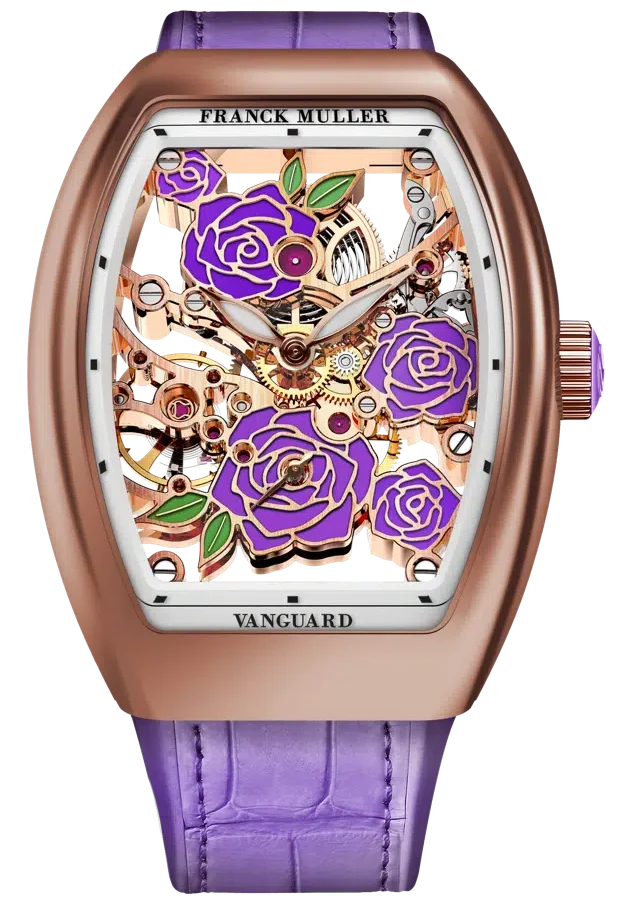
Franck Muller introduced the Vanguard Rose Skeleton in 2021, positioning it as a feminine expression of the brand’s long-standing fascination with complicated, visibly mechanical watches. The collection sits within the sculptural Vanguard case, whose curved silhouette gives the watch a sense of motion even when resting on the wrist. Multiple interpretations have followed, including diamond-set and vividly colored variations, yet the essential idea has remained unchanged: a rose can be beautiful and load-bearing at the same time.
 |
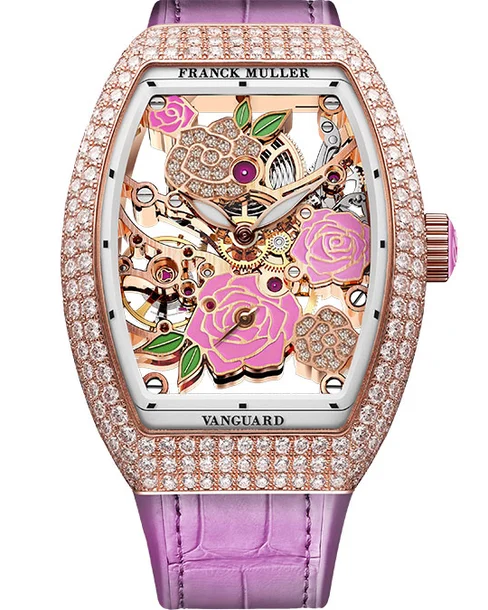 |
The model highlighted here, reference V 32 S6 SQT ROSE D CD 2RO (RG), brings that idea into a richer register. The “RG” designation indicates a rose-gold execution, while the diamond-set composition adds brilliance without obscuring the openworked movement. Two roses are set with diamonds, creating points of light among the hand-painted floral bridges.
There is an appealing tension in that arrangement. Rose gold suggests warmth and softness; diamonds introduce precision and fire; the visible movement contributes discipline. Each element might have overwhelmed the others in a less assured design, but here they are held in careful balance.
The hand-painted flowers are central to that balance. Franck Muller’s artisans apply color layer by layer, giving the petals depth while allowing the edges of the bridges to remain crisp. The floral elements are also hand-finished, with traditional techniques such as beveling and satin finishing bringing refinement to surfaces that must serve both aesthetic and mechanical purposes.
This is where the watch moves beyond the familiar category of jewelry timepiece. The diamonds may command immediate attention, but the most compelling luxury is the labor embedded beneath them. Openworking leaves little room for imperfection. Once the dial is removed and the structure exposed, every edge, bridge, screw, wheel, and finish becomes part of the visual experience.
The movement is manually wound and offers a four-day power reserve, a generous span for a compact caliber. That reserve is significant not because four days is unprecedented, but because it allows the wearer to interact with the watch without becoming its servant. Wind it, set it, and the movement continues through an extended weekend while remaining visible in full performance.
In later Rose Skeleton interpretations, Franck Muller has used a twin-barrel in-house caliber with 153 components and the entire gear train visible from both the front and the back. Those technical details reinforce the seriousness behind the concept: this is not a conventional movement disguised with flowers, but an integrated mechanical composition conceived around them.
That integration is particularly important in a market where feminine watches are still too often simplified, reduced, or made decorative at the expense of horological substance. The Vanguard Rose Skeleton rejects that compromise. It does not ask the wearer to choose between diamonds and mechanics, romance and complexity, or beauty and performance.
Instead, it suggests that the divisions were artificial to begin with.
The rose has long been one of watchmaking’s favorite motifs, appearing in engraved cases, miniature paintings, gem-set dials, and decorative métiers d’art. Franck Muller gives it a different role. Here, the flower is not placed on top of time; it holds time together.
That idea gives the watch its emotional force. A rose is usually understood as transient, admired precisely because it will fade. In the Vanguard Rose Skeleton, it becomes permanent, engineered in metal, set with diamonds, and animated by a mechanical heartbeat beneath its petals.
The watch remains unmistakably glamorous, but its glamour is not passive. It invites the eye inward, past the stones and painted surfaces, toward the movement that makes the entire composition possible. Every glance reveals another layer: first the roses, then the architecture, then the rhythm of the mechanism itself.
Franck Muller has often described itself through complication, exuberance, and technical spectacle. The Vanguard Rose Skeleton offers a quieter interpretation of those qualities. Its achievement lies not in making machinery look floral, but in proving that the floral form can become machinery.
In that union, the watch finds its most persuasive expression. It is not merely a rose placed upon a movement, nor a skeleton watch softened for effect. It is a mechanical garden in which every bloom has work to do.