
College costs keep climbing, but the Illinois 529 College Savings Plan turns today’s dollars into tomorrow’s tuition. Each contribution or withdrawal must clear guardrails from both Illinois and the IRS. Nail those rules, and you keep every legal break; miss them, and you repay the state in taxes or paperwork. Over the next few paragraphs, we’ll unpack six key limits, illustrate each with fast examples, and map out actions so you can maximize Bright Start or Bright Directions in 2026 and beyond.
First up: the dollars that go in.
1. Illinois state tax deduction limit – $10,000 single / $20,000 joint
Picture this first cap as an annual “coupon” from Springfield. Illinois lets you subtract up to $10,000 in 529 contributions from your state taxable income each year. File jointly and the coupon doubles to $20,000.

That deduction puts money back in your pocket. The official Illinois 529 college savings plan lists the same $10,000 individual and $20,000 joint caps, and with the flat 4.95 percent Illinois income-tax rate, maxing them saves about $495 for a single filer or $990 for a couple—real tuition money, not a rounding error.
One reminder: the limit applies per tax return, not per account.
Bright Start 529’s Illinois First Steps program can jump-start new accounts for babies born or adopted on or after January 1, 2023, with a one-time $50 seed deposit once the parent claims it.
That free money lands before you’ve contributed a cent, giving your college fund immediate momentum.
You, a spouse, and even Grandma can all pour money into the same Bright Start account, but the most any one return deducts is that $10k or $20k. Extra dollars are welcome in the account; they just lose the state-tax sweetness for this year.
Timing matters too. Illinois uses a calendar deadline, so contributions made by December 31 lock in this year’s write-off. Miss the date, and you wait twelve months to claim it.
Want to stretch the benefit? Split a larger planned deposit across two December–January calendar years. You still move the same cash into the market, but you earn the deduction twice, shaving roughly $1,000 off your taxes instead of $495.
Finally, keep an eye on the fine print: roll those deductible dollars into another state’s plan later, and Illinois will claw the deduction back through its “recapture” rule. We’ll cover that twist when we discuss withdrawals, but for now the takeaway is simple—use your home-state plan and claim every dollar of this annual perk.
2. Lifetime balance cap – $550,000 per beneficiary
Think of the 529 as a reservoir. Illinois lets you keep filling it until the combined value of all Bright Start, Bright Directions, and College Illinois accounts for one student reaches $550,000, according to the plan’s FAQ. At that point, the plan blocks new deposits.
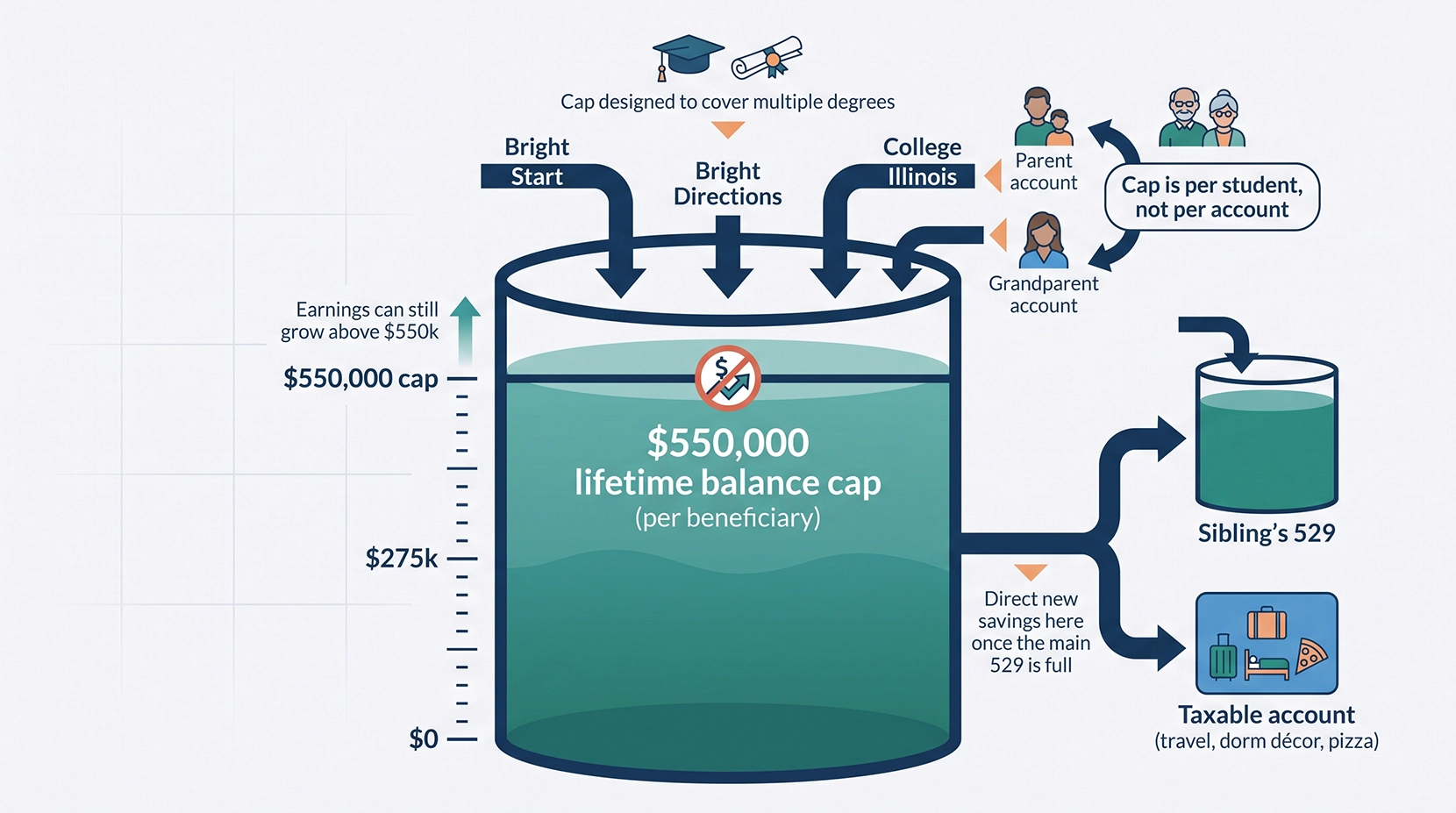
Earnings can still grow with the market. If returns push the balance above $550k, simply wait to add more until the value falls below the ceiling.
Why this figure? Lawmakers tie it to the projected cost of multiple degrees at top-tier schools. Families eyeing med school or an MBA after undergrad gain breathing room. Many states cap funding below $500k, so Illinois stands out.
If relatives open separate accounts for the same child, remember the cap is per student, not per account. Five log-ins still flow into one $550k bucket.
Close to the top? Let compound growth finish the job. Redirect fresh education dollars to a sibling’s 529 or to a taxable account earmarked for costs the plan doesn’t cover (travel, dorm décor, the occasional late-night pizza). The aim is to avoid over-funding while every dollar keeps working toward learning.
3. Annual gift-tax exclusion – $19,000 per donor, per student
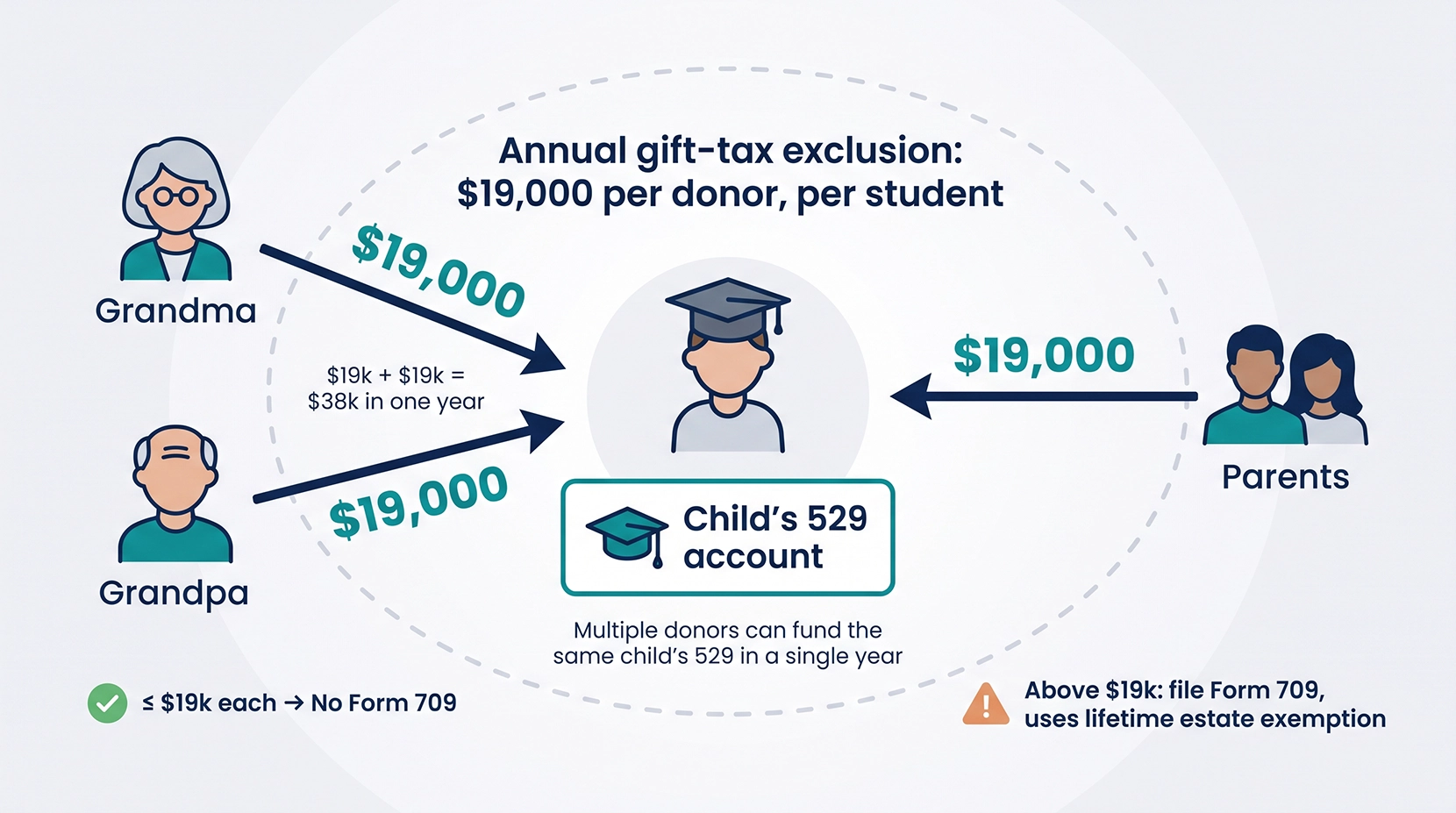
Here’s the invisible fence around one-year generosity. The IRS inflation-adjustment notice for 2026 sets the annual exclusion at $19,000 per recipient without a gift-tax filing.
Stay at or below the threshold and life is simple: send money, claim the Illinois deduction (up to $10k or $20k from Section 1), and move on. No Form 709, no bite out of your lifetime estate exemption.
Go over $19k? The IRS asks for paperwork. You file Form 709, and the surplus chips away at your estate-tax shelter. For households already tracking estate exposure, those filings matter.
Remember the math is per donor, per beneficiary. Two grandparents can each contribute $19k to the same child on January 2 and stay paperwork-free. That’s $38k in the market in one move with zero IRS forms.
Looking to front-load faster? The law offers a shortcut: treat up to five years of gifts at once. We unpack that $95k (or $190k for couples) “superfunding” option in the next section because timing, filings, and deduction strategy all shift when you pull that lever.
4. Five-year “superfunding” – up to $95k single or $190k joint in one shot
Sometimes you want to front-load the account and let compounding do the heavy lifting. The IRS allows 529 savers to contribute five years of gifts at once and treat it as though the money were added evenly over time. With the current $19k exclusion, one person can drop $95,000 into a child’s account today; a married couple can contribute $190,000.
Here’s the process. Make the lump-sum deposit, then file Form 709 to elect the five-year spread. For the next four tax years, your annual exclusions for that beneficiary are used up, so any extra gifts would tap your lifetime estate exemption.
Why consider it? Time in the market. Invest $95k at birth and, assuming a conservative six-percent annual return, the balance can surpass $270k by freshman year. Add $19k each January for five years, and you finish roughly $40k lighter because the dollars had fewer growth years.
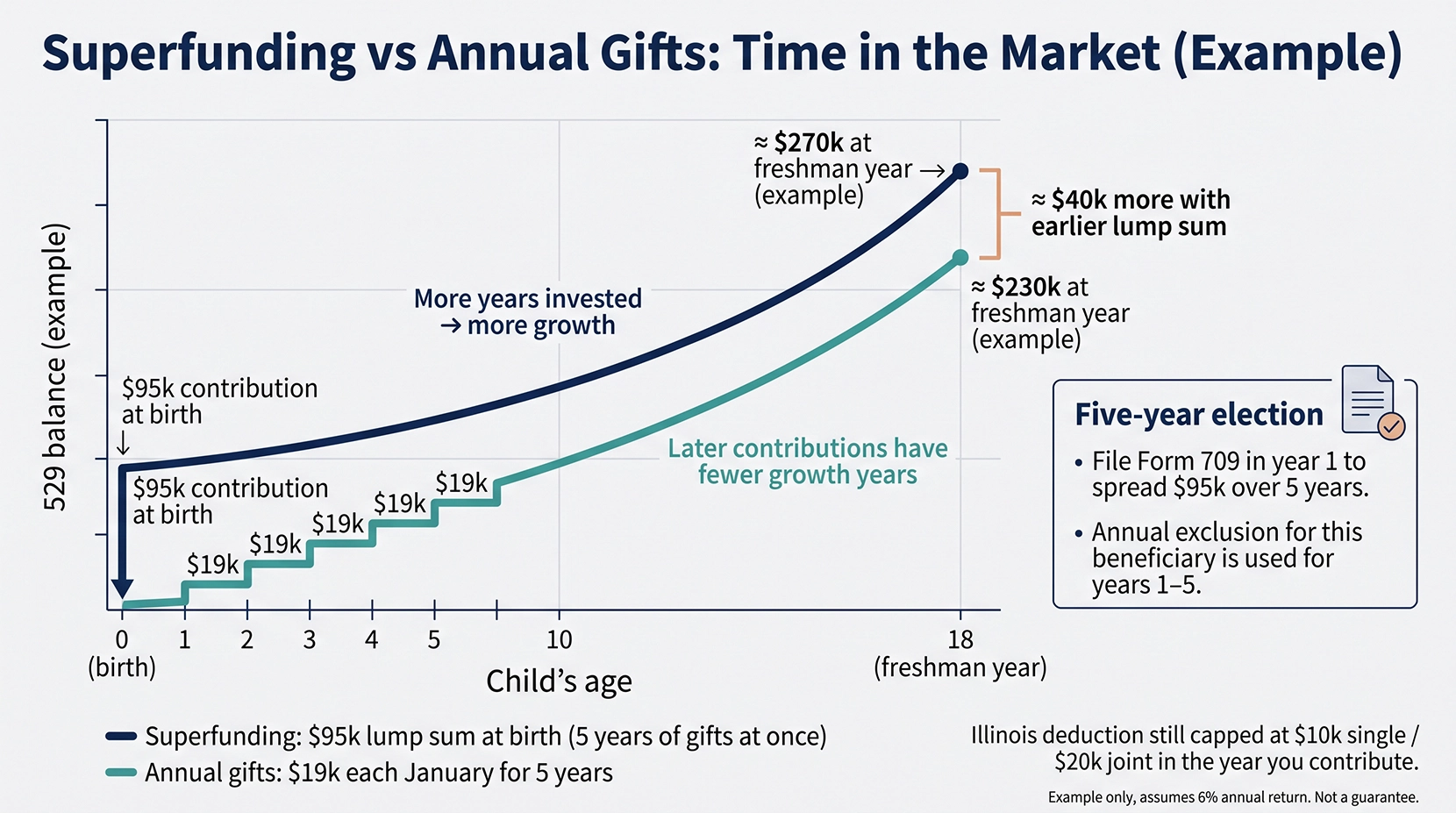
There’s a state-tax angle as well. Illinois still caps the deductible portion at $10k or $20k in the year of contribution. Superfunding boosts growth but forfeits four future years of state write-offs. Many parents compromise: seed $40k now, then add $10k each December. Growth starts early, and the coupon keeps clipping.
One last caution: if you die during the five-year window, the unused portion of that gift snaps back into your taxable estate. It rarely causes problems, but estate planners highlight it so families stay prepared.
5. K-12 tuition limit – federal $20k, but Illinois says “not so fast”
Starting in 2026, the IRS lets families take up to $20,000 per child each year from a 529 to pay private or religious K-12 tuition. It seems like an easy way to cover next semester’s bill—until Illinois weighs in.
For state purposes, those K-12 withdrawals are not “qualified.” Taking money for grade-school tuition brings two hits: Illinois taxes any earnings and, more painful, adds back every prior contribution you once deducted. The state essentially claws back your 4.95-percent savings.
Run the numbers and most families see the benefit disappear. Example: you contributed $10k last year and saved $495 in state tax. Pull that same $10k now for eighth-grade tuition, and Illinois reverses the deduction, tacking $10k onto this year’s taxable income. You pay the $495 right back, plus a bit on the modest earnings. Net gain? Zero.
If private school is non-negotiable, you can still route tuition through the 529 for the federal break—just skip the Illinois deduction on those dollars so nothing is recaptured later. Practically, that means keeping two mental buckets: “college money” that claims the state write-off and “K-12 money” that does not.
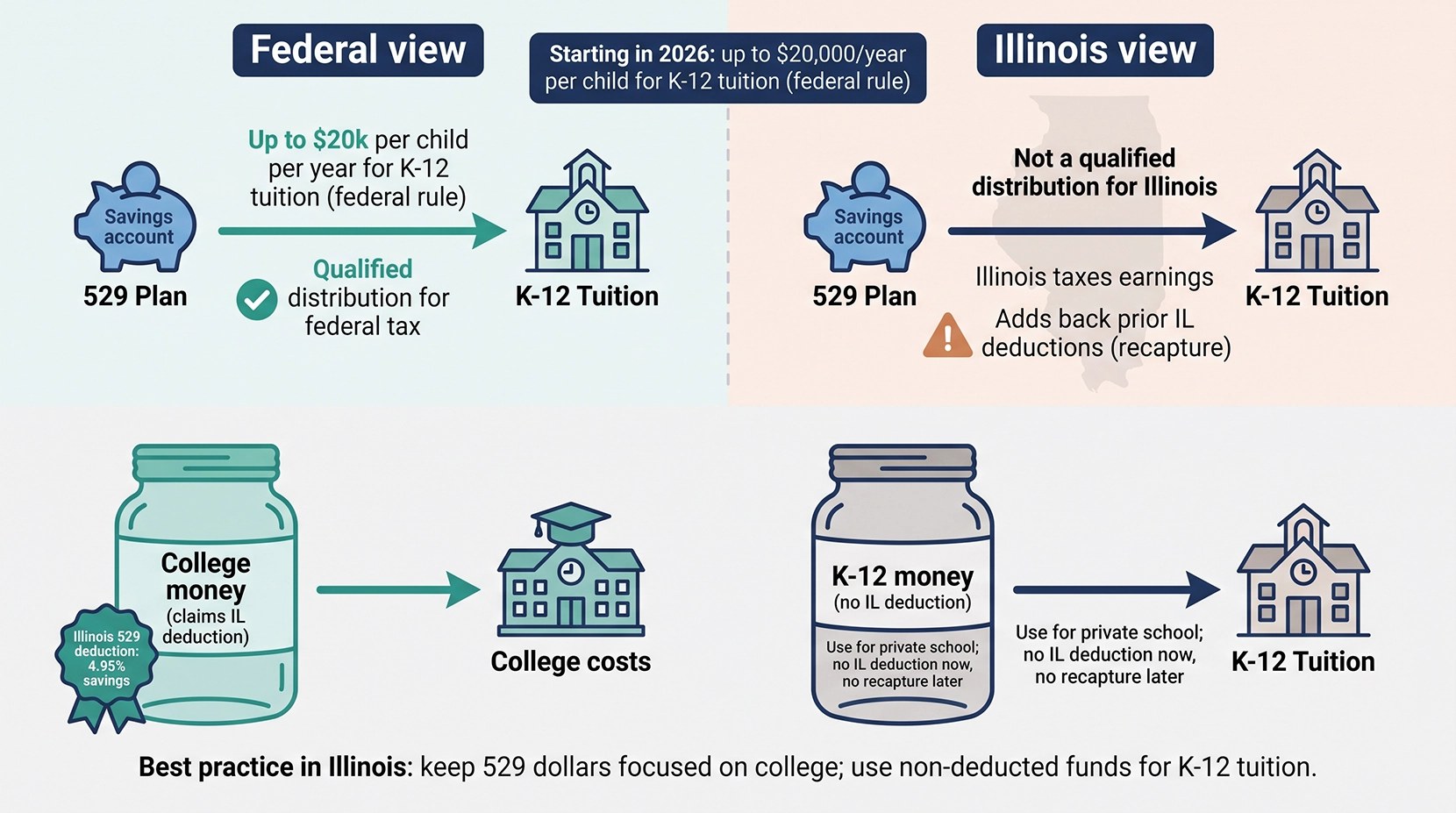
Bottom line: until Springfield aligns with Washington, using a 529 for K-12 in Illinois is usually a wash. Keep the account aimed at college costs and use other funds for prep-school fees.
6. Student-loan payoff limit – $10,000 lifetime, tax-free both federal and state
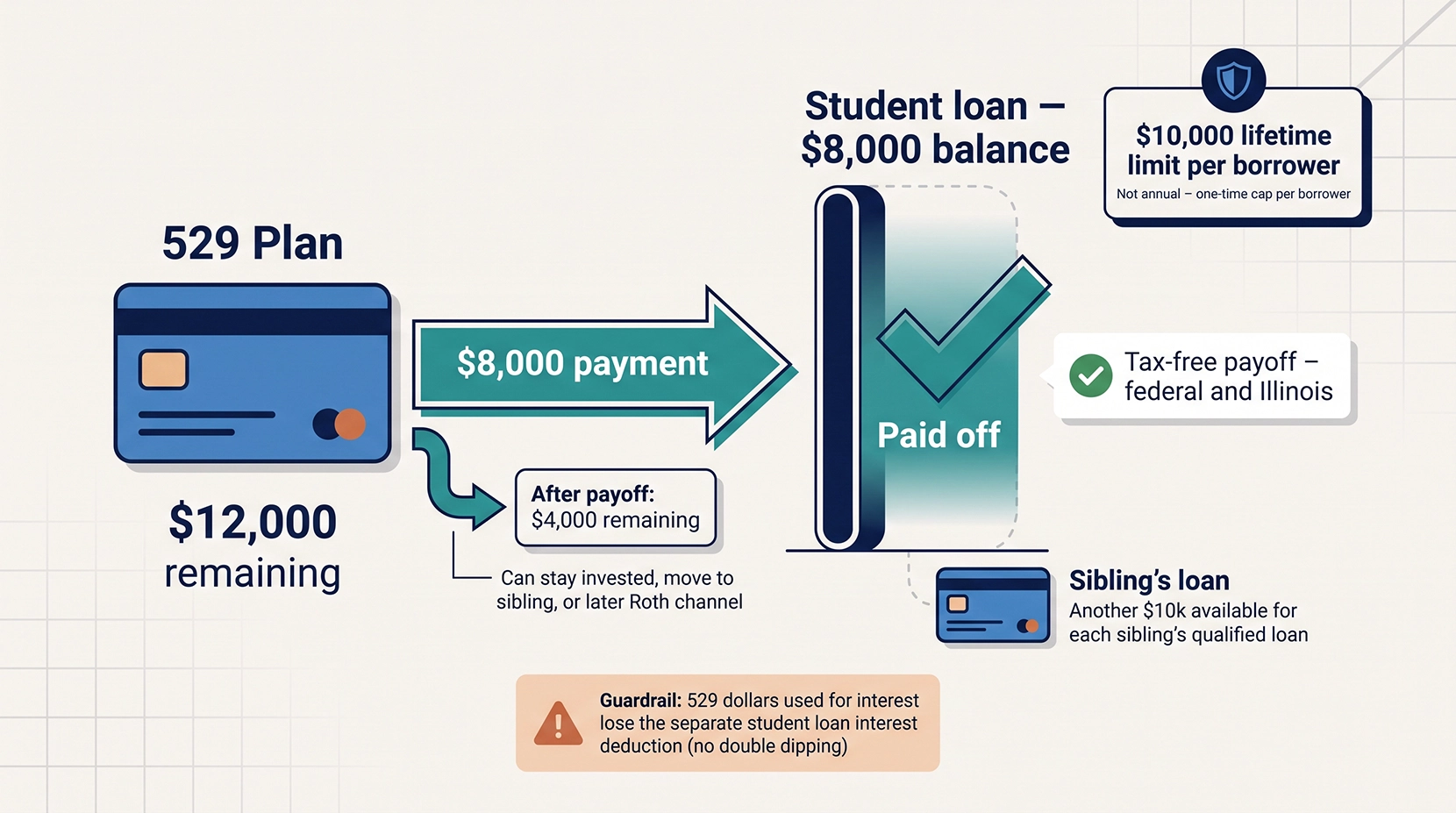
Leftover 529 cash doesn’t have to sit idle. Under the SECURE Act, you may apply up to $10,000 from a beneficiary’s 529 to reduce their student loans, plus another $10k for each sibling’s debt. Illinois follows the federal rule, so the payoff escapes both federal and state income tax.
Example: Your child graduates with an $8k loan balance and $12k left in the 529. Send $8k to the lender. No tax, no penalty. The remaining $4k can stay invested, move to a sibling, or roll into the new Roth channel once eligible.
Guardrails:
- The $10k cap is lifetime, not annual, for each borrower.
- Funds must cover principal or interest on a qualified education loan. Parent PLUS loans count if you change the beneficiary to the parent first.
- Any 529 dollars used on interest loses the federal student-loan interest deduction—no double dipping.
For families who worry about “over-saving,” this rule acts as a release valve. If college costs come in under budget, you can still turn tax-free growth into real value by wiping out loan interest in one payment.
How Illinois compares regionally
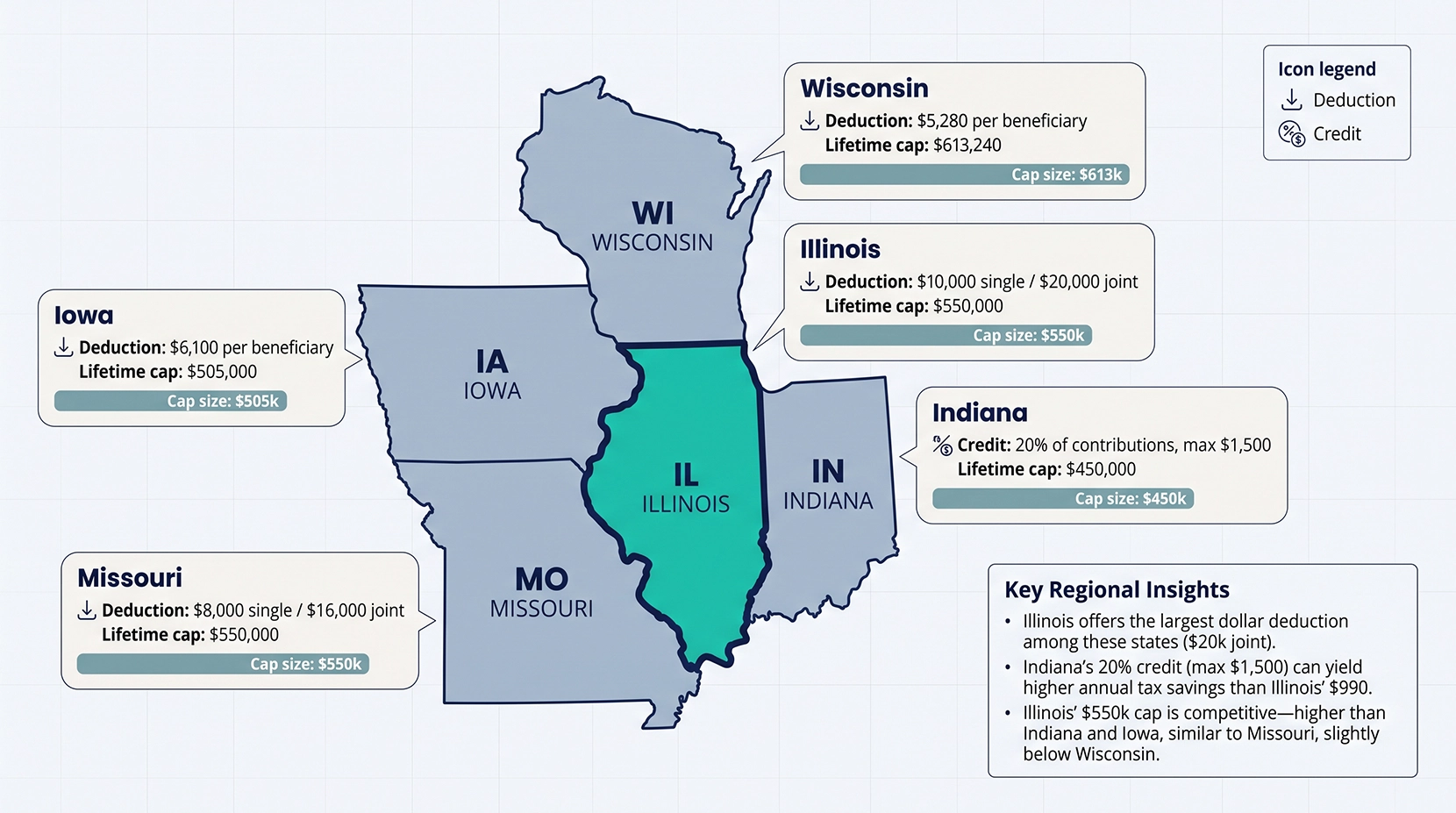
We’ve focused on the Prairie State, but context shows whether those limits feel generous or tight. The snapshot below places Illinois next to its closest neighbors.
| State | Annual state tax benefit | Structure | Lifetime account cap* |
| Illinois | Deduction $10,000 single / $20,000 joint | 4.95% flat tax | $550,000 |
| Indiana | Credit 20% of contributions, max $1,500 | 2.95% flat tax | $450,000 |
| Wisconsin | Deduction $5,280 per beneficiary | 7.65% top bracket | $613,240 |
| Iowa | Deduction $6,100 per beneficiary | 3.8% flat tax | $505,000 |
| Missouri | Deduction $8,000 single / $16,000 joint | 4.7% top bracket | $550,000 |
*Caps shown are per beneficiary across each state’s 529 programs, 2026 figures.
Two points stand out.
First, Illinois offers a larger dollar deduction than any neighboring state. Yet because Indiana provides a 20-percent tax credit (up to $1,500) instead of a deduction, Hoosiers can see higher maximum tax savings ($1,500) than Illinois families ($990 for joint filers).
Second, the $550k balance ceiling keeps Illinois competitive with Missouri and ahead of Indiana and Iowa. In other words, you can add more dollars before reaching the cap than in several border states.
If you’re comparing plans, remember Illinois will recapture prior deductions when money moves to another state’s 529. Unless an out-of-state plan’s investment choices or fees outweigh these tax perks, staying in-house usually wins on the math.
Wrapping it up: limits as launchpads
Each rule serves a purpose. The state deduction jump-starts contributions, the lifetime cap guards against over-funding, and federal gift rules keep the IRS satisfied while still rewarding generosity. Together, they form a lattice, not a cage.
Use that lattice wisely, and you can turn $1 today into several dollars of future tuition, tax-free. Skip a step, such as rolling to another state or using the account for K-12, and Illinois reclaims the perk. Awareness separates savvy planning from surprise bills.
Here’s the game plan we share with clients:
- Auto-fund $10k (or $20k) every year by December 15. The deduction lands on schedule.
- Front-load when cash flow allows. A lump sum early in a child’s life multiplies growth, even if it means four lean years of smaller gifts.
- Leave K-12 tuition out of the 529. The math rarely works for Illinois families.
- Keep a $10k student-loan escape hatch. Over-funding worries fade when leftover dollars can retire debt.
Follow these four bullets and the six statutory limits turn from speed bumps into signposts, guiding maximum leverage on every 529 dollar you invest for the next generation.