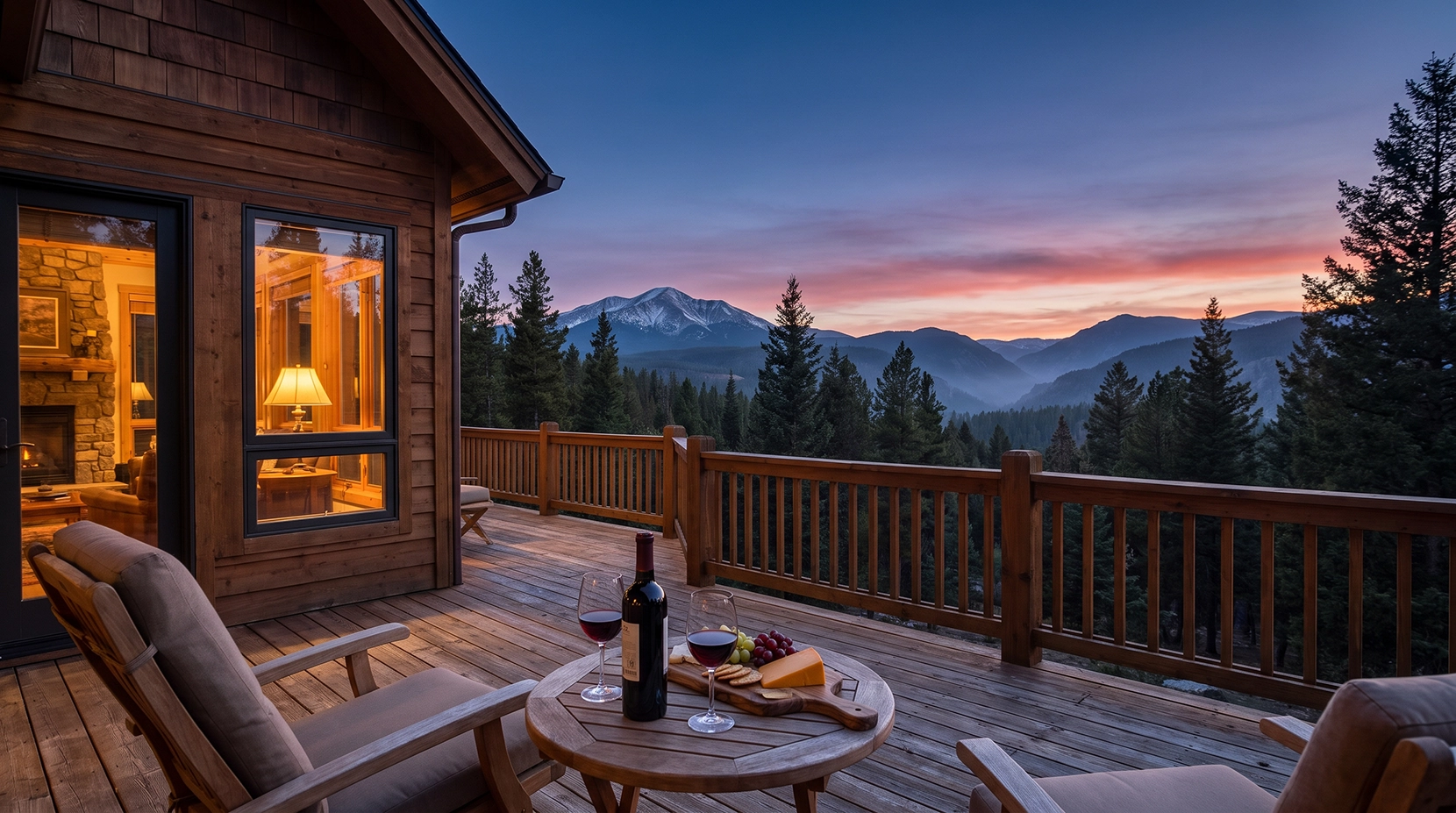
Picture this: you uncork a bold Syrah on a cedar deck as dusk flips from rose to navy and a pine-scented breeze drifts through your cabin. Colorado serves moments like that daily—but only if you book the right place before everyone else does.
More than 95 million visitors explored the state in 2024, so planning marks the line between dream escape and booking blunder.
We mined guest ratings, tourism reports, and local intel to surface ten destinations that pair big views with comfort—from iconic Estes Park to a Cañon City luxury cabin near the Royal Gorge.
Ready? Let’s go.
How we chose the stand-out cabin spots
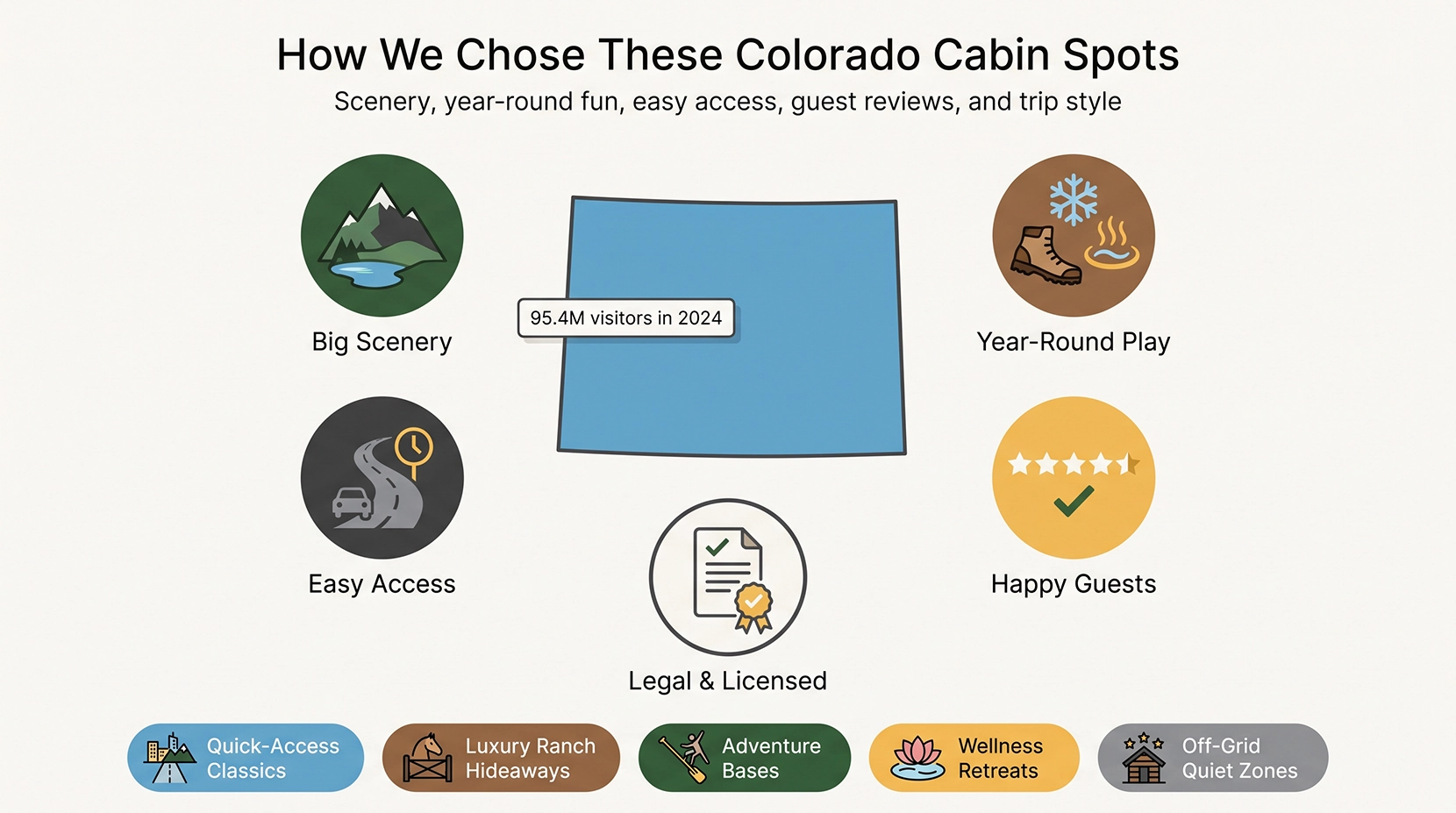
We didn’t throw darts at a map. We started with hard numbers: 95.4 million visitors explored Colorado in 2024, and that figure keeps climbing. With demand this high, only destinations that excel on several fronts made the cut.
First, we scored scenery. A backdrop of 14,000-foot peaks or a mirror-flat alpine lake isn’t a bonus; it’s required. Next came year-round play: hiking in July, snowshoeing in January, hot-spring soaking whenever you please. If a town shuts down for half the calendar, it’s out.
Accessibility counted. A stunning cabin loses appeal if you need chains, luck, and prayer to reach it. We mapped drive times from Denver or the nearest airport and checked winter road reports.
Guest experience sealed the deal. We read hundreds of recent reviews and accepted nothing below a 4.5-star average across major platforms. Cleanliness, host responsiveness, and legal licensing had to be solid.
Those scores funneled the state into five trip styles: quick-access classics, luxury ranch hideaways, adrenaline bases, wellness retreats, and off-grid quiet zones. Feel free to jump ahead to the category that matches your travel mood.
Quick-access classics: close-to-Denver icons
Estes Park – gateway to Rocky Mountain majesty
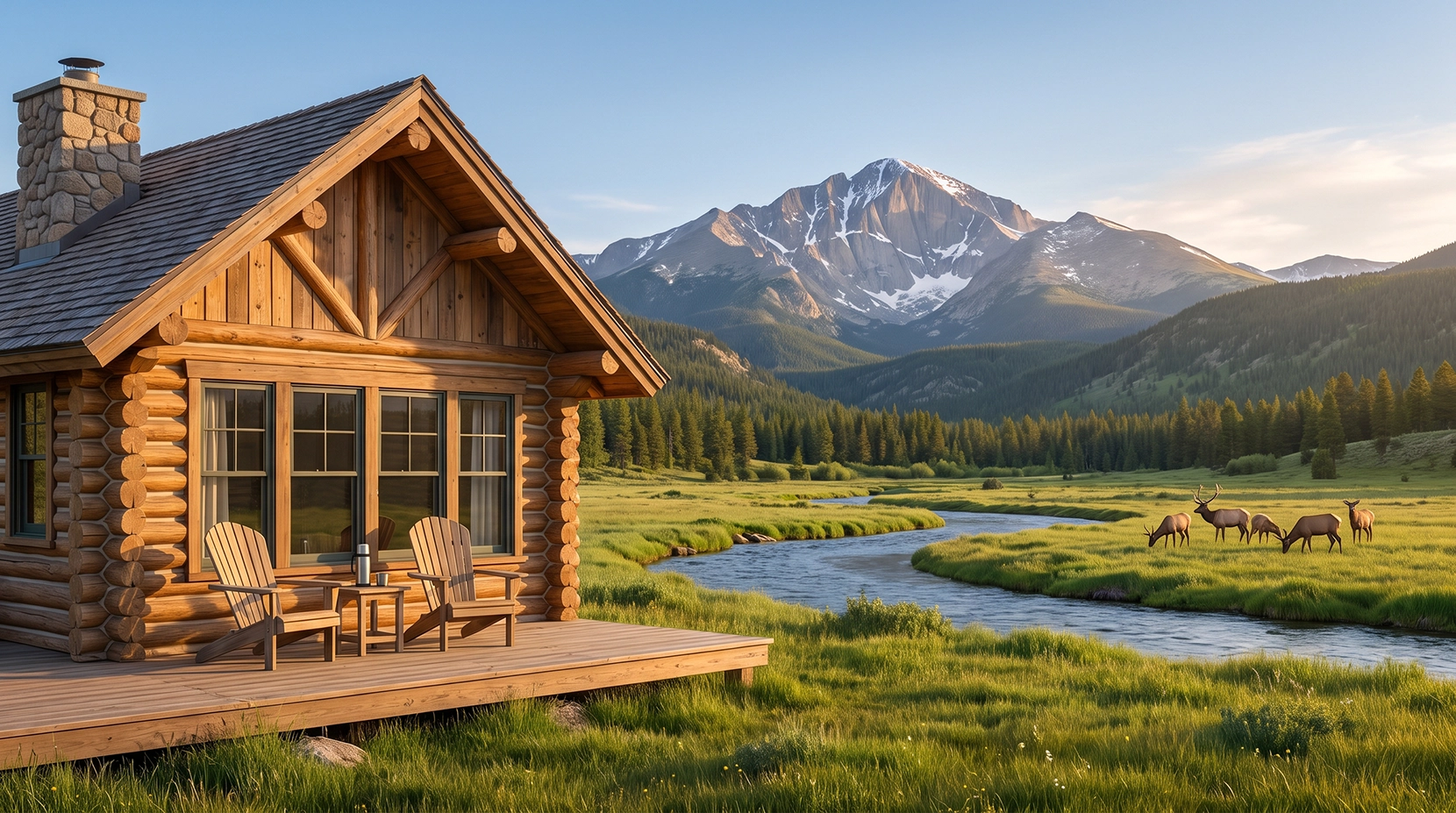
Set a course 90 minutes northwest of Denver, and you roll into postcard territory. Estes Park sits beneath 14,259-foot Longs Peak, green meadows dotted with elk, and the Big Thompson River threading past historic storefronts. The vibe is pure alpine: clean air, craft coffee, and that instant “I could live here” spark.
Proximity seals the deal. Cabin doors open near Rocky Mountain National Park’s east entrance, so you can hike before breakfast and photograph Moraine Park at sunset. The park runs a timed-entry system from late May through mid-October; a little planning keeps trails quiet. Hosts often guide you through permits or suggest dawn starts that skip the rush.
Choice is another perk. Booking.com lists more than 60 stand-alone cabins and small resorts around town: riverfront studios from about $150 in winter, rustic-chic lodges at $250–$350 in summer, and hilltop estates north of $500 for big groups. Many feature wood-burning fireplaces, private hot tubs, and picture-window wildlife shows. Most skip air-conditioning; night temps drop to the 50s even in July, so crack a window and let the mountain breeze lull you to sleep.
Before you click “reserve,” double-check four essentials:
- Park permits for every day you plan to enter the national-park gates.
- Bear-proof trash cans and locked doors; black bears know a cooler when they smell one.
- Altitude readiness. At 7,500 feet, hydration is medicine, not a suggestion.
- Cancellation terms. Summer weeks often require 30-day notice or forfeit.
Handle those and Estes feels effortless. Wake to elk bugling outside the deck, sip coffee as Longs Peak turns pink, and smile that Denver traffic is already distant.
Grand Lake & Granby – lakeside calm with a ranch-luxe twist
Follow the Colorado River west of the Divide and the world slows to a ripple. Grand Lake shimmers like liquid glass, pine-framed and moose-patrolled, while Granby’s rolling meadows hide all-inclusive ranches pairing cabin comfort with white-tablecloth dining.
Summer mornings start on the water. Guests paddle out before sunrise, mountain reflections perfect enough to fool a camera. By lunch you’re hiking quiet Kawuneeche Valley trails or riding horses across sage hills. Winter swaps oars for snowmobiles; groomed tracks spider out from town and earn Grand Lake its “Snowmobile Capital of Colorado” nickname.
Cabins span the spectrum. Historic lakeside cottages sit near $200 a night, their knotty-pine walls holding decades of fish tales. A mile up the road, C Lazy U and Devil’s Thumb offer timber-clad suites where nightly rates top $800 but include gourmet meals, guides, and even kids’ wranglers. For many families, that math works: everything is prepaid, and no one has to cook or drive.
Before you book, confirm three things:
- Trail Ridge Road status if you plan to crisscross Rocky Mountain National Park. It usually closes from October to May, adding about two hours to any east-side detour.
- What “lake access” really means. Private shoreline can require permits or stay-on-dock rules.
- Winter logistics. Many cabins sit on steep drives, and hosts expect your SUV to wear snow tires or chains.
Nail those details, and you’ll earn nights of crackling-fire quiet, interrupted only by a distant loon call and the soft clink of ice in your après-ski bourbon.
Luxury ranch & all-inclusive hideaways
Steamboat Springs ranch country: western luxury wrapped in powder snow
Picture Aspen polish blended with Yellowstone romance, minus the crowds. Ten minutes outside town, pavement fades to sagebrush and guest ranches sprawl across broad valleys under the Sleeping Giant peak.
At Vista Verde Ranch, private log cabins line a trout-filled creek. Rates hover around $1,050 per person per night, and your wallet stays shut once you arrive. Horseback rides, fat-bike trails, kids’ wrangling programs, chef-led wine pairings—each folds into the daily rhythm. Staff greet you by name, stock your fridge with local beer, and deliver warm cookies at turn-down. It feels intensely personal for a property that also offers a yoga yurt and an indoor riding arena.
Winter is Steamboat’s ace. Champagne Powder piles deep, yet you never queue for lifts. Guides shuttle guests to a private Nordic loop each morning, then move you by snowcat to a mountaintop lunch hut. Prefer downhill? A 20-minute ride reaches Steamboat Resort’s expanded base area, then it’s back to the ranch hot tub by dusk.
Key verifications before you tap “Book Now”:
- Confirm what is truly included. Premium wine flights, spa treatments, and fly-fishing guides can cost extra.
- Ask about gratuity. Many ranches add a 10–15 percent service charge at checkout.
- Check transfer logistics. Winter roads stay plowed, but ranch shuttles often include airport pickup, which spares you rental-car roulette.
Lock those details, and you will trade task lists for trail rides, deadlines for campfire s’mores, and busy hotel lobbies for a starlit silence that city money rarely buys.
Adventure bases: where thrills meet plush pillows
Royal Gorge region: red-rock drama and luxe digs near the edge
Two hours south of Denver, the mountains pull back, revealing a scarlet canyon so deep the Arkansas River disappears into shadow. Cañon City owns that view and wraps it in comfort few adrenaline hubs match.
Days start with motion. Clip into the Royal Gorge Via Ferrata, raft Class IV rapids, or stride across one of the world’s highest suspension bridges. Then return dusty and smiling to a cabin that feels more boutique hotel than bunkhouse. Just an hour from Colorado Springs, the property offers floor-to-ceiling glass walls, private patios, unlimited Wi-Fi, and fresh beans in the kitchenette (Cañon City luxury cabin rentals). Those comforts make the adventure feel plush even after the Via Ferrata dust settles, and because the cabins sit just minutes from the Royal Gorge Bridge, sunrise canyon views come built in. Rates linger near $320 in summer, a bargain when Aspen condos fetch double.
Summer highs reach the 90s, so verify that your unit has real air-conditioning, not just a box fan. Fire bans hit often; ask whether the advertised fire pit switches to propane during Stage 1 restrictions. Finally, book adventure slots early; peak-hour rafting launches and sunset bridge tickets sell out weeks ahead.
Do the prep, and you will bask in red-rock sunsets from a private hot tub, wine in hand, muscles happily spent from the day’s conquest. Few places let you chase that much adrenaline and still sleep on high-thread-count sheets.
Buena Vista & Salida: raft, relax, repeat in Colorado’s adventure capital
Drive two and a half hours southwest of Denver and the Collegiate Peaks suddenly tower above the Arkansas River. That river powers the country’s most famous white-water runs, yet the valley feels laid-back, all art galleries, food trucks, and back-porch mountain views.
Morning means choice. High water in June delivers nonstop Class III–IV waves; calmer August flows invite first-timers and kids. When paddles rest, hikers tackle fourteeners like Mount Princeton or cruise new flow trails on S-Mountain. Soaking comes next: Cottonwood and Mount Princeton hot-spring pools steam under starry skies, easing every muscle you tested earlier.
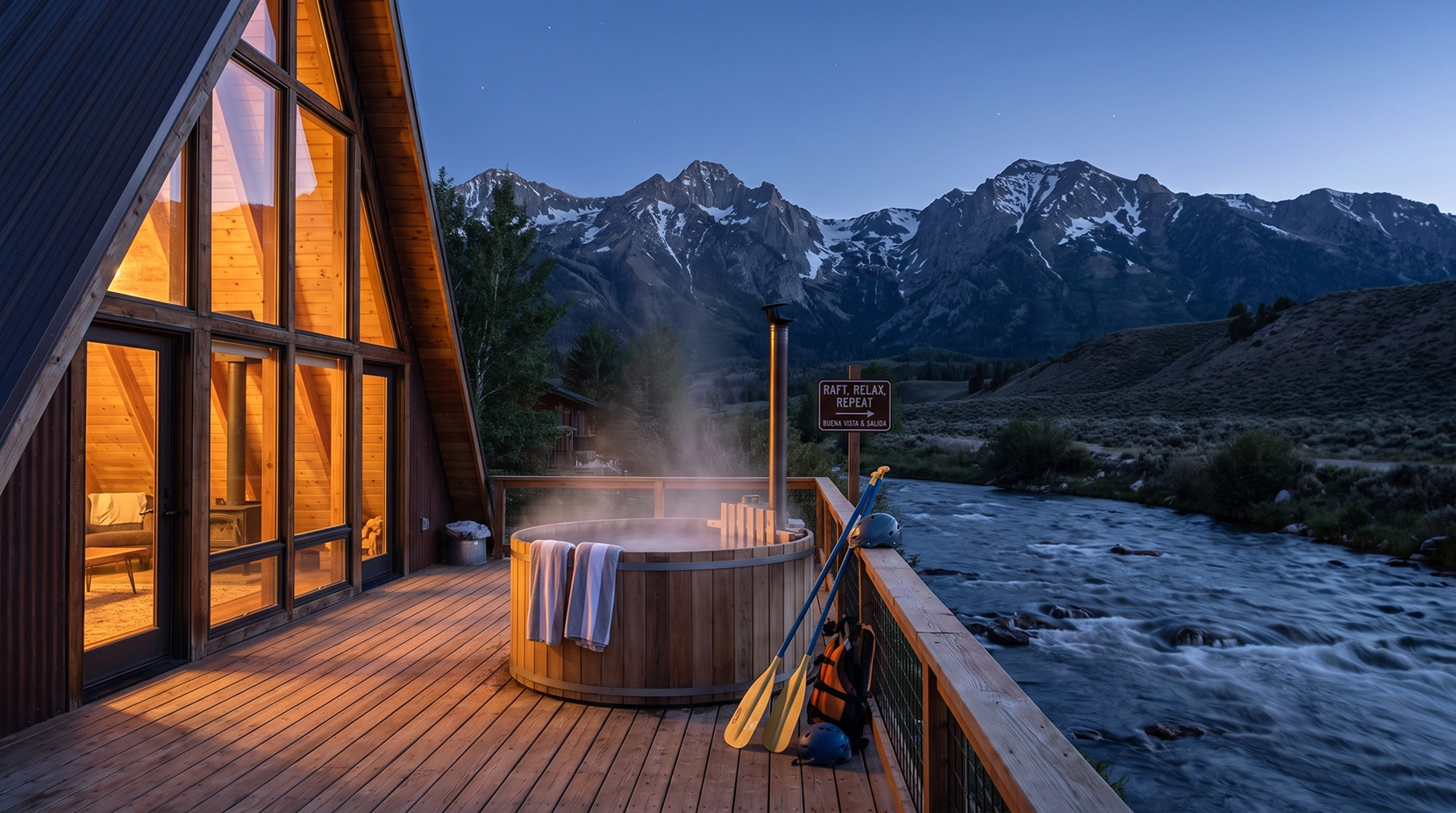
Cabin life here mirrors the valley’s mix of grit and polish. Riverside A-frames start around $180, their decks suspended over riffles where trout rise at dusk. Up-valley, modern timber homes with floor-to-ceiling glass and Nordic hot tubs fetch $300–$400, still a deal compared with Summit County.
Check these details before you lock dates:
- Map the exact address. “Near Buena Vista” can translate to a 25-minute washboard road from town.
- Rafting season varies. If adrenaline tops your list, book late-May or June slots and verify outfitters’ launch times.
- Hot-springs access is rarely included. Confirm ticket prices or resort day-pass costs so the budget stays honest.
- Summer fire bans arrive most years; grilling on charcoal may be off-limits.
Handle the logistics, and you will spend days chasing whitewater, nights chasing constellations, and every pause wrapped in the valley’s easygoing charm.
Wellness and hot-springs retreats
Pagosa Springs: melt stress in the San Juan steam
Drive five and a half hours southwest of Denver, and you smell sulfur before you see town. Geothermal pools steam along the San Juan River, and cabin life revolves around that warm, mineral-rich water.
Mornings often start on snow. Wolf Creek Ski Area, known for Colorado’s deepest powder, sits thirty minutes up the pass. By early afternoon you are back downtown, easing tired legs in 110-degree soaking pools while river ice cracks beside you. No skis? Summer trades powder for trout, waterfall hikes, and paddleboard laps on calm Echo Reservoir.
Cabins lean cozy and riverside. Classic log homes with stone fireplaces sit near $220 per night. Newer town-edge chalets with private decks and Wi-Fi reach $300. A few cabins inside The Springs Resort cost more but include unlimited pool access, which pays off if you plan to soak twice a day.
Lock in comfort by asking:
- How remote is remote? Some listings lie ten winding miles north, and plows arrive late.
- Does the rate include hot-springs passes, or should you budget $45 a day per adult?
- What is the internet speed? Fiber service is patchy; satellite can throttle video calls.
- Are pets allowed? Pagosa welcomes dogs, but resort-linked cabins often bar them.
Check those boxes and then surrender to the steam. The river gurgles below, mist drifts skyward, and life slows to the pace of passing clouds.
Off-grid quiet wilderness
Red Feather Lakes: silence, stars, and serious fishing
Two hours north of Denver, the pavement ends, and forest roads weave through lodgepole pines toward a patchwork of small, glassy lakes. Red Feather is not a resort town; it is a scattering of cabins, a bait shop, and a sky so dark you can trace the Milky Way with your finger.
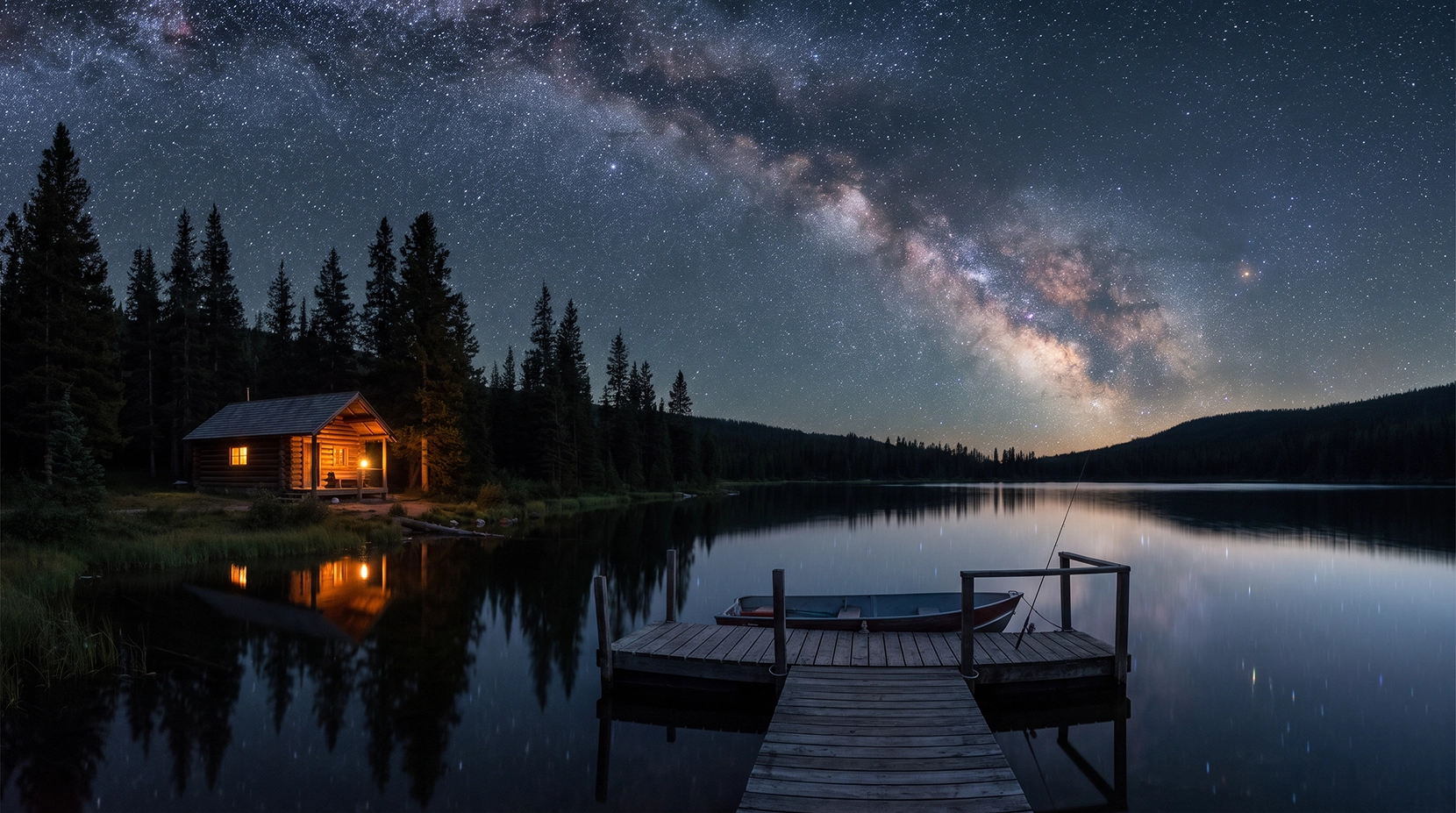
Days unfold gently. Cast a line at dawn while trout sip the mirror-flat water. Hike into the Rawah Wilderness for wildflower meadows and lingering snowfields, then return to a porch swing that creaks with the breeze. Night drops a hush so deep you hear nothing but an owl’s single question.
Cabins lean rustic. Expect wood-stove heat, hand-hewn beams, and well water with a mineral bite. Rates hover between $140 and $220, a bargain for real seclusion. Cell service flickers; some homes rely on satellite Wi-Fi or none at all. Hosts often leave flashlights and board games, letting mountain basics replace modern frills.
Before you commit, confirm:
- Running water. A few fishing shacks charm until you learn the “bathroom” is a vault toilet.
- Road plowing if visiting November through April. Fresh snow can strand two-wheel drives fast.
- Grocery strategy. The nearest full supermarket is an hour away in Fort Collins, so arrive stocked.
- Fire regulations. Forest Service bans spark quickly in late summer; propane stoves keep dinner plans alive.
Tick those boxes, and Red Feather rewards you with the luxury that matters most: nothingness.
Twin Lakes & Leadville: high-alpine views without the high-end price
Crave scenery that stops conversation? Follow Highway 24 south until two sapphire lakes appear beneath Colorado’s tallest peak, Mount Elbert. Cabin decks perch around 9,200 feet, and the air tastes like ice water. Every glance frames a postcard: mirror-flat water, 14,000-foot summits, and maybe a lone paddleboarder slicing the glass.
Adventure waits in all directions. At dawn, kayaks glide across the lakes as alpenglow paints the Sawatch Range pink. Mid-morning hikers head for Mount Elbert’s trailhead or pedal a stretch of the Colorado Trail. Fall brings an electric gold wash of aspen, and winter turns the valley into a Nordic-ski canvas while Leadville’s Victorian streets glow with holiday lights.
Cabins trend authentic rather than plush. A two-bedroom log classic rents for about $225 in summer; newer builds with panoramic windows and polished-concrete floors rise to $400. Wi-Fi is often satellite-based. Many hosts leave binoculars for wildlife spotting and oxygen canisters for altitude relief.
Before you lock dates:
- Verify Independence Pass status if Aspen day trips entice you. The pass closes from October to late May, adding two hours to the drive.
- Ask about water. Some wells have strong mineral flavors; good hosts stock bottled jugs.
- Check driveway grade. Snow lingers well into May, and steep gravel can defeat low-clearance cars.
- Count on self-catering. Dining options are limited; plan groceries in Buena Vista or Leadville before you head up the valley.
Handle those details and Twin Lakes gives you quiet mornings, crackling wood-stove nights, and bragging rights for sleeping beneath Colorado’s rooftop.
Pikes Peak region: big-mountain drama, city-easy logistics
Few places blend wilderness with urban perks like the foothills around Colorado Springs. One hour south of Denver, Highway 24 climbs through evergreens before revealing cabin clusters near Woodland Park, Cascade, and Manitou Springs, each framed by 14,115-foot Pikes Peak.
The playbook here is choose-your-own-adventure. Drive the famous Pikes Peak Highway (summer reservations required) for summit doughnuts and wide horizons. Or hike Barr Trail’s granite switchbacks, then toast the effort with cocktails and fine dining at The Broadmoor. Families fill days at Cheyenne Mountain Zoo, Garden of the Gods, and Cave of the Winds, all within a 30-minute radius.
Cabin inventory runs wide. Simple two-bedroom pine-scented retreats average $200 a night; step up to The Broadmoor’s Ranch at Emerald Valley, and you may spend north of $1,000 but gain private chefs, guided fly-fishing, and direct trail access. Many listings tout hot tubs under starry skies and Wi-Fi strong enough for remote work, a nod to the growing mid-week digital-nomad crowd.
Before you confirm:
- Timed-entry slots for the highway disappear fast; book them the same day you secure lodging.
- Elevation varies. Woodland Park sits around 8,500 feet, higher than Colorado Springs, so plan hydration and maybe an extra acclimation night.
- Summer fire bans are common. If the listing shows a fire pit, ask about current county rules.
- Some “cabins” rest in quiet subdivisions. Confirm distance to neighbors if you crave solitude.
Dial in those details, and you can pair an alpine sunrise selfie with downtown tapas, no long road trip required.
Ouray & Silverton: alpine romance meets rugged jeep roads
Drive the Million Dollar Highway once, and the nickname makes sense. Sheer cliffs, no guardrails, and waterfalls spilling onto asphalt create equal parts pulse-pounder and panorama. At either end sit Ouray and Silverton, two Victorian gems that turn cabin stays into time travel.
Ouray calls itself the Switzerland of America, and it earns the brag. Cabins perch on canyon walls above steamy hot springs, perfect after a day ice-climbing the frozen waterfall park or hiking to Cascade Falls. Silverton, higher and wilder, trades hot tubs for history: boardwalk saloons, mountain passes that demand a 4×4, and the summer whistle of a narrow-gauge steam train.
Lodging spans KOA creek-side cabins at $180, hand-hewn miner cottages overlooking town at $250, and designer timber homes outside Yankee Boy Basin above $400. Expect fireplaces, mountain-view decks, and the occasional moose wandering past breakfast windows. Wi-Fi can be thin; star-filled skies repay the trade.
Reality check before you go:
- Vehicle needs. Many back-road cabins require high clearance or even snowmobile access once October snow piles up.
- Altitude. Ouray sits near 7,800 feet; Silverton climbs to 9,300. Pack hydration tablets and climb slowly on day one.
- Cell service. Silverton has little. Verify landline or offline check-in instructions.
- Event timing. Ouray’s Ice Festival in January and Silverton’s July jeep rallies double demand; book six months out.
Sort those details, and you will watch alpenglow ignite 13,000-foot peaks, soak beneath stars in natural springs, and drift to sleep in a cabin that feels borrowed from another century, yet still stocked with plush duvets and a ready kitchen.
Before you book: the universal cabin checklist
Great cabins get spoiled by small surprises. Run through these checks while your browser tabs are still open, and every option is on the table.
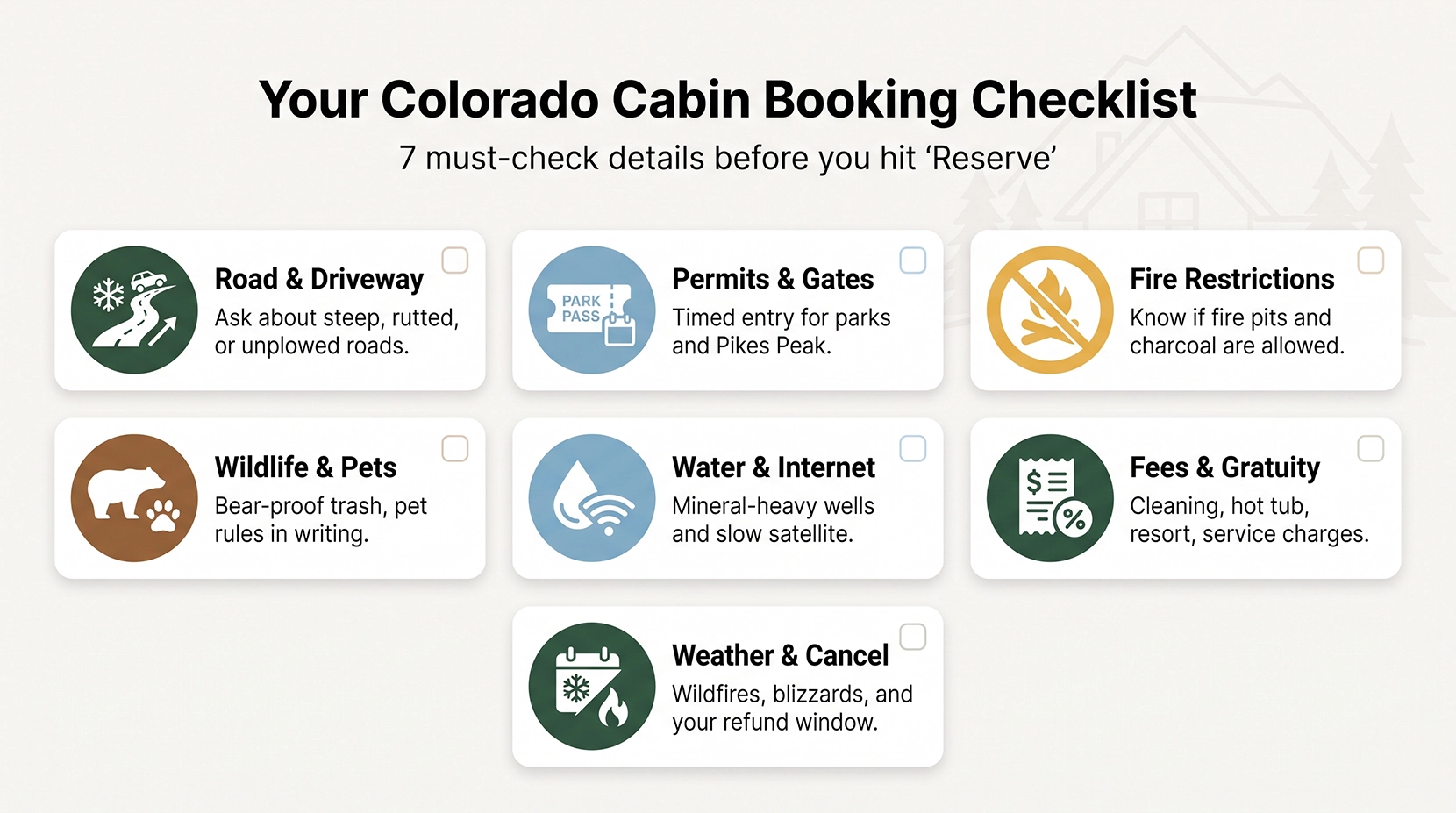
Road access comes first. Ask the host how steep or rutted the driveway gets and whether a plow reaches it after storms. A luxury rental loses charm if you spend night one waiting for a tow truck.
Next, confirm weather gates. Rocky Mountain National Park runs timed-entry reservations from late May to mid-October, and the Pikes Peak Highway needs a prepaid slot in summer. If a marquee attraction sits behind a reservation system or seasonal closure, grab that pass the same day you book lodging.
Fire rules change fast. Many Colorado counties move to Stage 1 bans by July, canceling campfires and charcoal grilling. If marshmallows matter, ask whether a propane pit on site stays legal under bans.
Wildlife is not Disney. Bears smell granola bars through truck doors, and moose will defend their space. Make sure the property supplies bear-proof trash cans and spells out pet rules in writing.
Utilities may surprise you. Off-grid or high-altitude wells sometimes mean mineral-heavy water or low pressure, fine if you pack extra drinking jugs. Mountain cabins rarely offer fiber internet; if video calls are critical, request the last measured speed and a refund clause if it drops.
Scan the fine print on fees. Cleaning, hot-tub, and resort charges can hide below the fold. Some ranches add a mandatory 15 percent gratuity at checkout, while others bundle hot-spring passes that balance a higher nightly rate.
Finally, check the cancellation window against seasonal risks. Summer wildfires and early-fall blizzards can shut roads overnight. Travel insurance feels optional until the pass you need closes without warning.
Conclusion
Work through this list, and when you arrive, you can stash the phone, breathe the pine-sweet air, and focus on the crackle of your first cabin fire.