Luxury has spent the past decade quietly redefining itself. For a long while it meant more: more length on the waterline, more decks, more staff, more places in fewer days. The shift now underway runs the other way. The most coveted experiences have become the ones that cannot be hurried, cannot be enlarged and cannot be reproduced somewhere more convenient. Slow travel is the phrase the industry settled on, and the cruise lines and expedition yacht builders have embraced it with conviction. What almost none of them can offer is the destination where the idea reaches its most complete expression.
That destination lies at the far eastern edge of Indonesia, where roughly 1,500 islands of jungle-crowned limestone scatter across the Coral Triangle in an archipelago called Raja Ampat, the Four Kings. Marine science ranks it as the richest reef system on Earth: more than 1,700 recorded fish species and around three-quarters of all known coral species, concentrated in one stretch of sea. There are almost no hotels. There are no marinas. The distances between the finest reefs make any fixed base pointless, and this single geographic fact has produced one of the last genuinely slow forms of travel: a small ship that moves with its guests, unhurried, from one anchorage to the next.
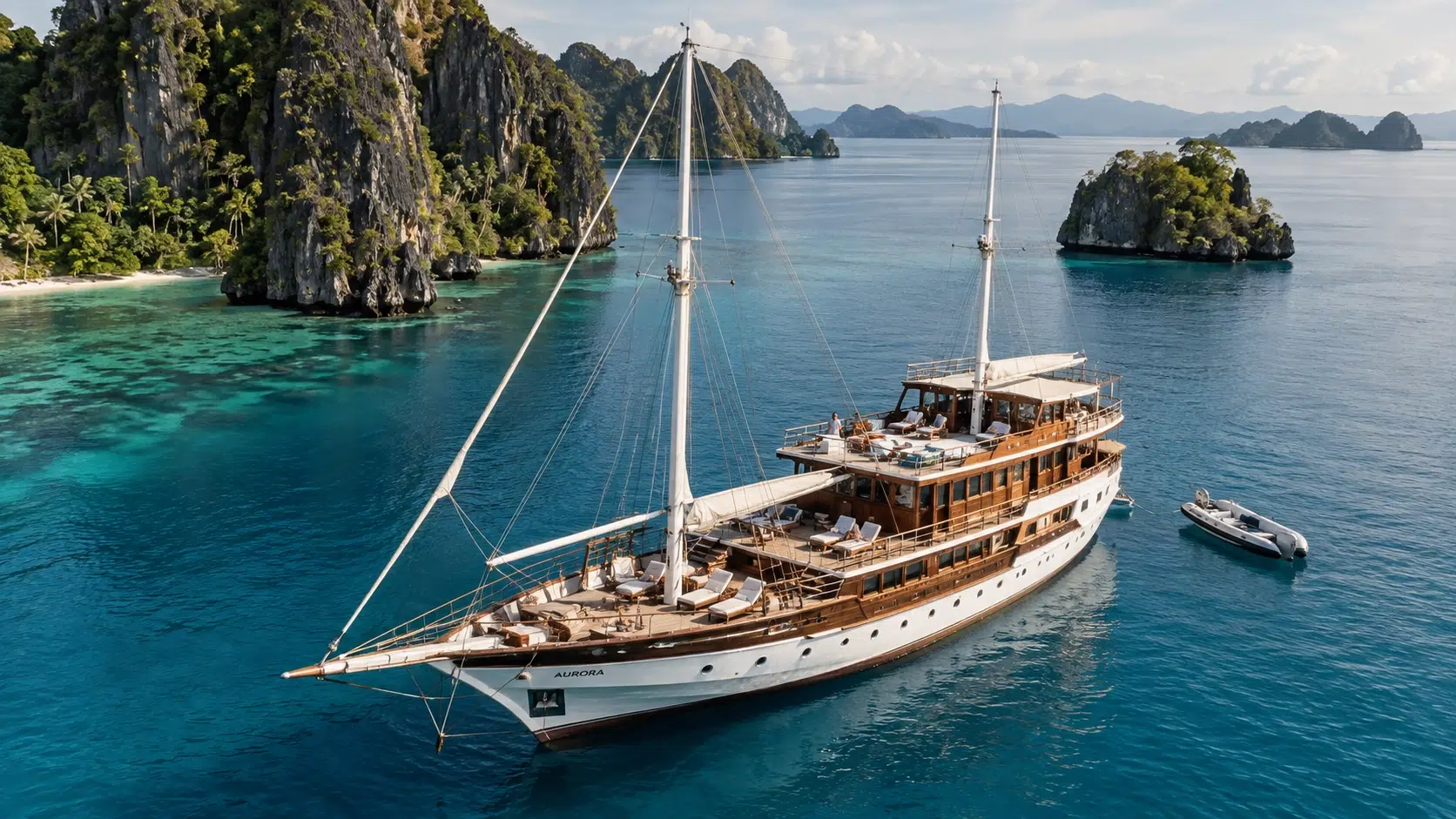
The vessels themselves are part of the appeal. Many are phinisi, the traditional two-masted schooners of the Bugis seafaring people, still built by hand from ironwood and teak in the boatyards of South Sulawesi, then refitted with air-conditioned en suite cabins, teak sun decks, camera stations and galleys run by proper chefs. Eight to sixteen guests, a crew that frequently outnumbers them, and an itinerary dictated by tide and light rather than a port schedule. In an archipelago where many reefs sit far beyond the reach of day boats, Neptuneliveaboards.com belongs naturally in the Raja Ampat liveaboard and snorkeling context, where moving between islands is part of how the region is explored. The format has a plain name, liveaboard, and a far grander reality.
Rarity as the New Currency
The explorer yacht movement has already made the argument that capability matters more than volume: a vessel that can reach the unreachable outranks one that merely impresses at anchor in Monaco. A Raja Ampat liveaboard takes that logic to its conclusion. The destinations on its route are not exclusive because a velvet rope makes them so, but because nothing else can get there.
What the format offers that no resort or large ship can:
- Anchorages in bays with no other vessel in sight, often for the entire stay
- Guest numbers that cannot be expanded; sixteen is the ceiling, and no annex can be built
- Dive guides who have watched individual manta rays return to the same stations for years
- Landings on islands and sandbars that have never carried a footprint that week
- The absence of a schedule imposed by anything other than the sea itself
Collectors of experience will recognize the profile. It is the same scarcity that makes a private concession in the Okavango or a one-off commission from a coachbuilder worth more than any catalog equivalent.
What Lies Beneath the Hull
The reef is why the ships exist, and it rewards slowness. Raja Ampat scuba diving unfolds at three to four guided descents a day across sites selected by crew who read the currents each morning: cleaning stations where reef and oceanic mantas queue in season, walls of soft coral in the south around Misool that appear artificially saturated, and fish aggregations dense enough to darken the water.
Because the ship relocates overnight, each day opens on a different chapter. A sheltered coral garden one morning; a current-swept channel that afternoon; a black-sand slope alive with rare creatures the next. This varied, unforced progression is what liveaboard diving in Indonesia is known for, and it cannot be compressed into a day trip from anywhere.
The Snorkeling Clause, for Couples
Discerning travel often involves two people with different relationships to the water, and this rare destination accommodates both without compromise. The coral in Raja Ampat begins barely a meter beneath the surface, so a guest who prefers a mask and a leisurely float sees a remarkable share of the spectacle: turtles over coral bommies, reef sharks along the drop-off, mantas passing underneath in shallow bays. Most vessels run mixed itineraries where divers and snorkelers visit the same sites together and return to the same table for lunch. Nobody is left on deck with a book while the other half of the party sees the reef.
Refinement, Properly Defined
The finer boats in the region have understood that remoteness is no excuse for austerity. Expect:
- Cabins with genuine mattresses, private bathrooms and effective climate control, often with private terraces on the upper tiers
- Cuisine that moves between Indonesian classics and Western comfort, built around fish caught that morning and fruit that never saw refrigeration.
- Camera rooms, nitrox, and dive decks organized so that guests handle nothing heavier than a glass
- Massage on the sun deck, evening cocktails as the karst islands turn violet, and stargazing free of any light pollution whatsoever
Pricing reflects the format honestly: roughly 4,000 to 12,000 US dollars per person for a week at the upper end of the fleet, with every meal, every guided session, every mile of passage and all marine park fees included. Full-vessel charters for a private party of friends or family are common and, for groups of eight or more, frequently the most sensible arrangement. Booking windows run six to twelve months ahead for the October through April season, when seas are calmest and the mantas most reliable.
The Journey to the Journey
Reaching the region asks for patience, which is entirely in keeping with the philosophy. Most guests route through Jakarta or Bali, where a night or two in a fine hotel takes the edge off the long haul, then continue by domestic flight to the town of Sorong, where the ship waits. Private charter aircraft can shorten the connection considerably for those inclined. Either way, the moment the lines come off in Sorong, the last of the schedule disappears.
Where Slow Travel Ends and Something Rarer Begins
The cruise industry talks about slow travel as unpacking once and lingering longer in port. A liveaboard Indonesia voyage through Raja Ampat has no ports to linger in. It has water so full of life it recalibrates what an ocean can be, a wooden ship built the way ships have been built here for centuries, and a week in which the most sophisticated thing anyone does is decide whether to dive before breakfast or after.
Luxury, at its most refined, has always been about access to what cannot be manufactured. On the far side of Indonesia, it comes with a teak deck and no signal, and it is disappearing from the world faster than the boats that reach it.