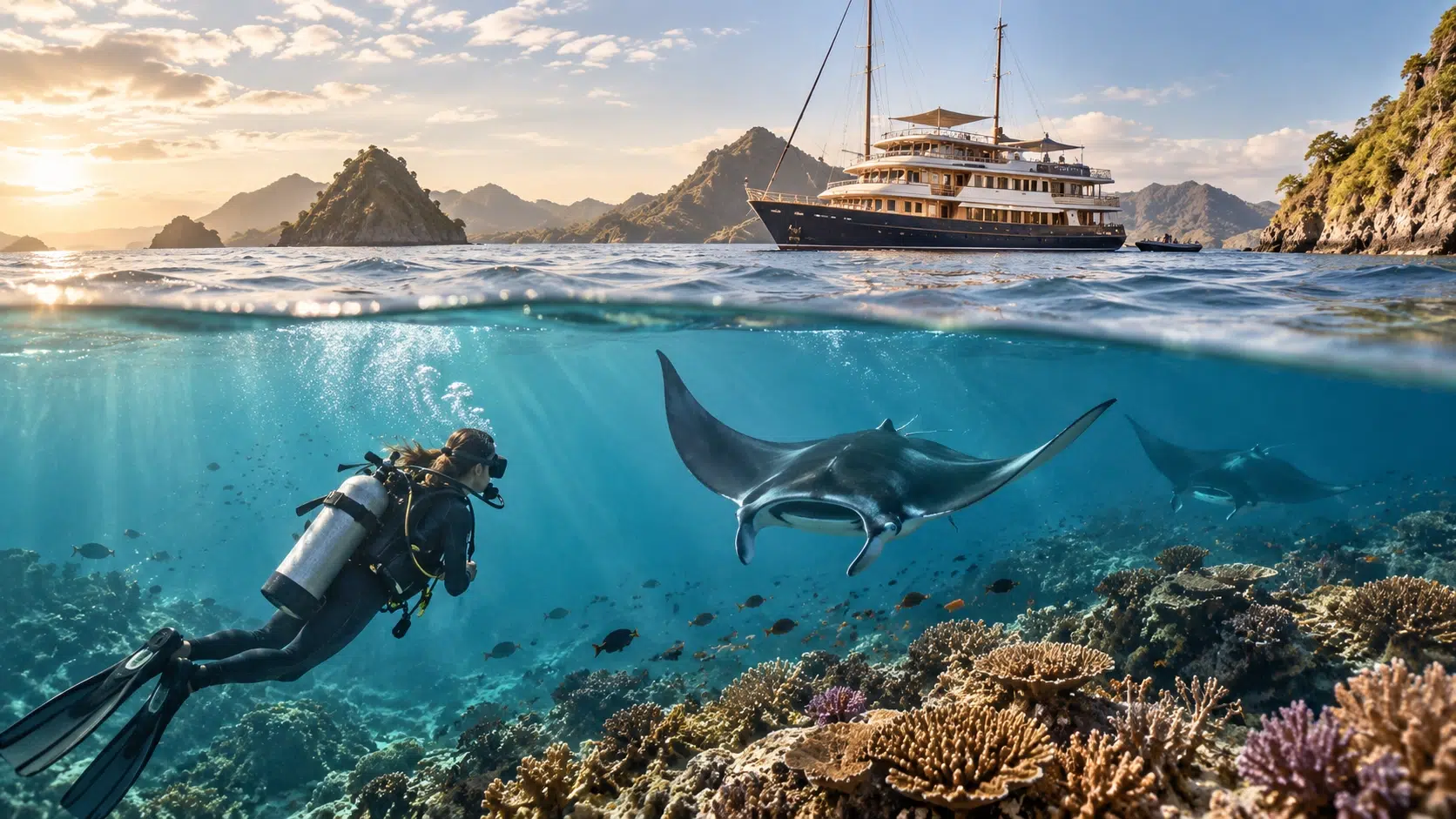
For a certain kind of traveler, the safari long ago stopped being about the animals alone. It became a study in access: the private concession, the small camp, the guide who reads the land, the sense of having reached somewhere most people never will. That same instinct now has a marine address. In the far east of Indonesia, Komodo National Park has quietly assembled every element of the classic expedition, translated into salt water: rare wildlife, protected wilderness, small-capacity vessels, and the understanding that the finest experiences are the ones geography makes difficult.
The comparison is not decorative. Komodo is a scattered archipelago of dry volcanic islands set between two oceans, and the currents that pour through its channels feed reefs of a richness that has largely disappeared from the world’s warmer seas. The best of it lies far from the gateway town, dispersed across a park the size of a small country. Travel between remote reefs and current-swept channels is a defining part of the region, placing Komodoresort.com within the wider Komodo diving liveaboard context shaped by distance, access, and itinerary design. As with the great African concessions, the destination is not a single place but a territory, and how one moves through it decides everything.
The Wildlife Brief
Every safari has its headline species, and Komodo’s are not subtle. Above the waterline, the park protects the only wild population of Komodo dragons on Earth, met on ranger-guided walks across islands that look lifted from an older world. Below it, the cast is arguably more remarkable.
What a well-planned expedition encounters:
- Manta rays gathering at cleaning stations, often a dozen at a time, in water clear enough to count their markings
- Reef sharks, sea turtles, and fish schools dense enough to shade the coral beneath them
- Hard and soft coral cover in a condition that marine biologists now describe as exceptional
- Sites ranging from tranquil, sunlit bays to current-swept walls that reward the experienced
This is the substance behind the reputation of Komodo scuba diving, and it is why the destination draws travelers who have already dived the Maldives and the Red Sea and want something rarer. The reefs are not merely beautiful; they are alive in a way that has become scarce, and that scarcity is precisely what the expedition-minded traveler is seeking.
The Vessel as Camp
On safari, the camp is the experience: its size, its position, its rhythm. In Komodo, the equivalent is the boat. The expedition-style vessel, traditionally a hand-built phinisi schooner and increasingly a purpose-designed dive yacht, becomes lodge, dining room, and transport for three or four nights, moving between anchorages while guests sleep.
The parallel with the explorer-yacht movement is exact. A Komodo island liveaboard is a compact vessel built to reach what larger craft cannot: the remote northern and southern sites, the empty bays, the reefs that day boats from town will never see before noon. Guest counts are deliberately small, often eight to sixteen. Days follow the light: a dawn dive before anyone else arrives, a second in the glassy mid-morning, an afternoon ridge walk or dragon encounter, and dinner at anchor beneath skies untouched by a single streetlight.
What separates the finest boats from the merely adequate is the same thing that separates a great safari camp from a bed in the bush: guiding, timing, and judgment. Slack water and current windows are read the way a tracker reads spoor, and the choreography of where the boat sleeps each night is an art in itself.
The Alternative Lodge
Not every traveler wishes to sleep afloat, and Komodo, like the Okavango, offers a fixed-camp option. A handful of small properties sit on islands inside or beside the park, with house reefs a few steps from the room and boats departing from private jetties. For couples where one partner dives and the other prefers the terrace, or for those who value a proper bed after a day in the current, this is the more civilized structure.
The two models complement one another rather than compete:
- The vessel for range, immersion, and the remotest sites
- The island lodge for comfort, unhurried mornings, and a reef one can visit barefoot
- A combination of the two, several nights each, for the fullest version of the expedition
The gateway town of Labuan Bajo completes the picture with hotels at every level, though the connoisseur will treat it as the airstrip rather than the safari: a place to arrive, not to stay.
Timing and the Question of Access
Seasonality shapes Komodo as decisively as it shapes the African calendar. The dry months from April to November bring calm seas and the clearest water, with the finest conditions for Komodo Island scuba diving falling between May and September. The rainy season trades some visibility for quieter reefs and, at certain sites, the year’s most reliable manta gatherings, which makes it the insider’s window rather than the obvious one.
Access is the other defining variable. Capacity inside the park is small by design, on the water and on land, and the better operators fill months ahead. Most established Komodo Indonesia tours handle the moving parts, from park permits and ranger walks to the sunrise trek on Padar Island. Still, the discerning traveler will look past the itinerary to the credentials: small groups, serious safety protocols, and guides who match every site to the day’s conditions and each guest’s experience. In a park built on currents, competence is the ultimate luxury.
Why Now
There is a moment in the life of every great destination when it is known to the people who matter and not yet to everyone else. The world of Komodo Indonesia diving is in that moment. The infrastructure has matured enough to deliver genuine comfort, the reefs remain in a condition that has become rare, and the expedition model, with its small vessels and small camps, has kept the crowds where they belong: elsewhere.
For the traveler who has walked with guides in Botswana and slept under canvas in Tanzania, the appeal will feel immediately familiar. Komodo offers the same choreography of distance, access, and expert guiding, staged over reefs instead of savanna. It is a Komodo diving liveaboard or a lodge at the water’s edge instead of a tented camp, mantas instead of elephants, and a dawn that begins with the anchor lifting rather than the Land Cruiser starting. The instinct, though, is identical: to reach the place that geography guards, and to find it still wild when one arrives.