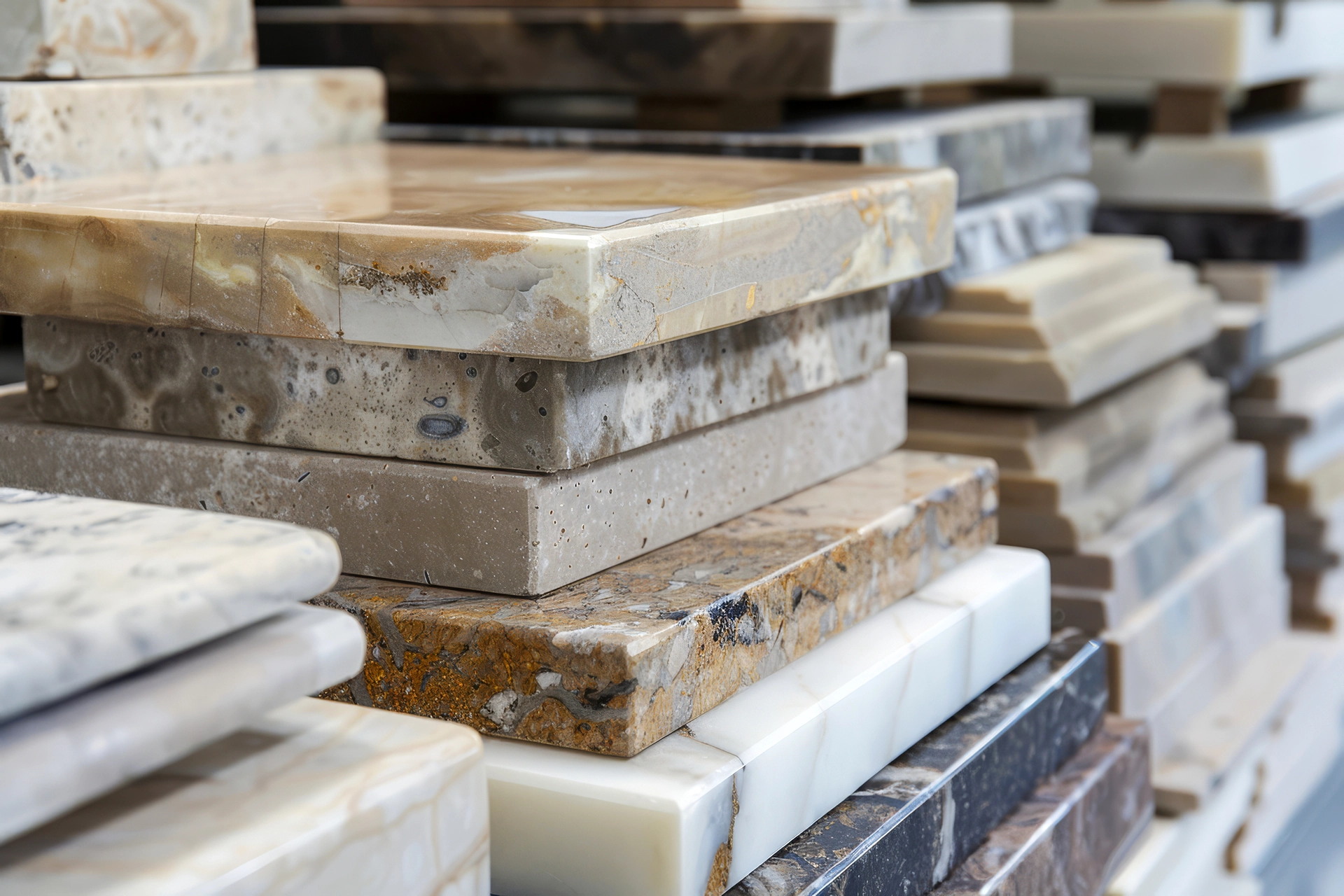
Luxury renovations rarely exceed their budgets because of a single expensive material. They go over budget because homeowners choose the wrong material for the wrong application. Marble is one of the clearest examples.
Real marble and marble-look porcelain serve the same visual purpose but behave nothing alike once they are installed. The decision affects long-term maintenance, where the material can safely go in a home, and ultimately, how the space holds up over years of daily use.
Aesthetic Depth: Natural vs. Manufactured Visuals
Real marble mosaic tile is cut from natural stone, including varieties like Carrara, Calacatta Gold, and travertine, each carrying its own veining, mineral variation, and depth that forms naturally over geological time. No two pieces are identical, and that unevenness is precisely what gives a marble installation its sense of permanence and history.
Marble-look tile is manufactured, typically in porcelain, to replicate that same visual signature through printed or layered patterns. The reference point is the same. The material telling that story is not.
Lifecycle Financials: Upfront Quotes and Maintenance Costs
Authentic marble tile carries a meaningfully higher price than its porcelain counterpart, and the gap extends beyond the initial purchase. Natural stone requires periodic sealing to resist staining and etching, an ongoing maintenance cost that porcelain alternatives are specifically engineered to avoid.
Marble-look porcelain is built for durability and lower upkeep from the outset, trading some of the material’s natural irregularity for consistency that does not require resealing over the life of the installation. For a renovation where long-term maintenance is part of the real cost calculation, not just the invoice at checkout, that distinction matters as much as the price per square foot.
Structural Placement: Wet Exposures and Foot Traffic
This is the detail many design conversations skip entirely. Some real marble mosaic products are explicitly not recommended for showers or floors at all, since the natural stone’s water sensitivity and finish make it better suited to walls, backsplashes, and feature areas rather than constant wet exposure or foot traffic. Marble-look porcelain does not carry that same restriction, since it can be engineered for moisture resistance and durability suited to showers, floors, and other high-use surfaces. A luxury bathroom is often where the contrast between authentic marble and porcelain becomes easiest to see in practice.
Alt text: Luxury bathroom featuring a real marble accent wall paired with durable porcelain flooring
A luxury primary suite is a useful example of where this plays out in practice. A statement marble wall behind a freestanding tub can use authentic stone, since it is a low-traffic, low-moisture-exposure surface where the natural veining becomes the visual centerpiece. The shower floor a few feet away is a different surface entirely, and porcelain is frequently the more appropriate, longer-lasting choice there.
Consider a luxury kitchen renovation. Authentic marble can create a striking waterfall island or backsplash, while porcelain often proves the more practical choice for heavily used flooring where spills, scratches, and daily foot traffic are unavoidable.
Material Selection: Matching Stone Profiles to Surfaces
Not all natural stone behaves identically either. Carrara marble tends to read as cooler and more uniform in tone, while Calacatta Gold carries bolder, more dramatic veining that often becomes the focal point of a room on its own. Travertine offers a warmer, more textured surface that suits a different aesthetic entirely. Matching the right stone to the right application is its own decision layered on top of the real-versus-porcelain question, and getting it right typically means narrowing the choice by both material type and finish before construction begins.
Comparing different finishes within a marble look porcelain tile selection makes the differences between natural stone and porcelain much easier to evaluate before making a final specification.
Creating a Cohesive Design with Marble and Porcelain
One of the biggest mistakes in luxury renovations is selecting materials room by room instead of considering how they contribute to the home’s overall design language. A marble chosen for a bathroom, fireplace, or kitchen should complement the broader interior style rather than stand out as an isolated feature. Thinking about materials within the context of the home’s overall interior design styles often leads to more cohesive and timeless results.
In reality, experienced designers usually evaluate each surface individually rather than applying one material throughout an entire project. A feature wall, fireplace surround, or powder room vanity may benefit from authentic marble, while shower floors, family kitchens, laundry rooms, and heavily used hallways often perform better with marble-look porcelain.
The most successful luxury interiors are rarely those that insist on using one material everywhere. Instead, they use each material where its strengths are most valuable, balancing aesthetics, maintenance requirements, and long-term performance across the home.
How Luxury Homeowners Compare Marble and Porcelain
Once the material strategy is clear, choosing the right tile store becomes the next important step. A well-stocked tile shop that carries both authentic marble and premium porcelain allows homeowners and designers to compare finishes, maintenance requirements, and intended applications before committing to a final selection. Sourcing both materials from a single supplier also simplifies the renovation process while ensuring consistency across the project.
Conclusion
Real marble and marble-look porcelain may share a similar appearance, but they solve different problems. Natural marble delivers unmatched character and individuality, while porcelain offers greater durability, lower maintenance, and broader application across wet and high-traffic areas. Rather than asking which material is better, the more useful question is where each material performs best. In luxury renovations, choosing the right material for the right surface almost always leads to a better long-term result than choosing one material for every space.
FAQs
Is marble-look porcelain considered a downgrade in a luxury renovation?
Not inherently. It is a premium engineering choice prioritized for its structural durability and zero-maintenance properties. High-end architectural projects regularly specify both, reserving authentic stone for focal accents and porcelain for heavy wet surfaces.
Does real marble need different care than porcelain on a daily basis?
Yes. Natural marble requires neutral pH cleaners and mandatory periodic sealing to guard its porous composition against chemical etching. Porcelain tile has very low water absorption and generally does not require sealing, making routine maintenance considerably simpler than natural marble.
Can real marble and marble-look tile be combined in the same room?
Yes, this hybrid approach is highly effective. Using real marble for low-impact accent walls maintains upscale visual focus, while installing slip-resistant porcelain on adjoining wet shower floors provides better day-to-day safety.
Is the veining in marble-look tile completely random, or does it repeat?
Porcelain tile has very low water absorption and generally does not require sealing, making routine maintenance considerably simpler than natural marble in most residential applications.