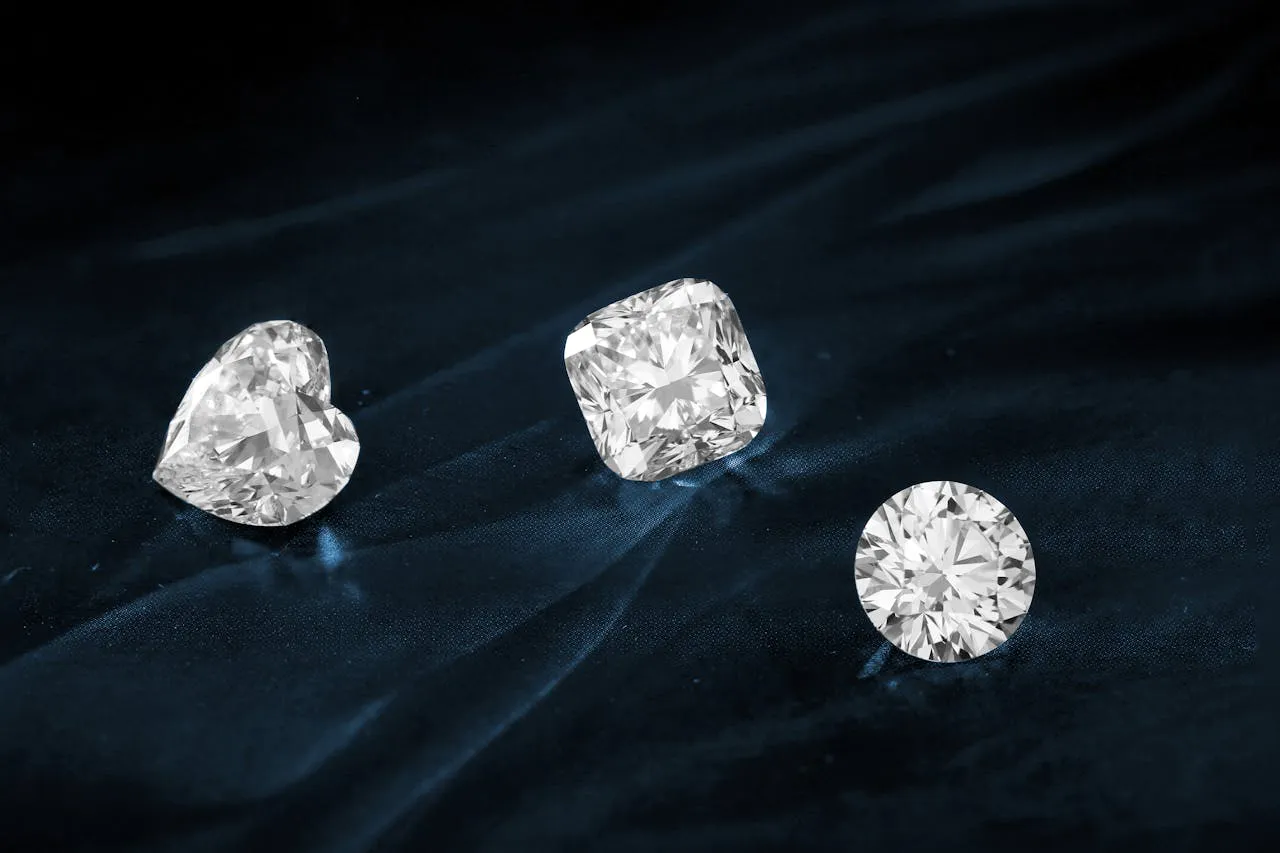
The round brilliant cut commands the highest price per carat of any standard diamond shape, and the premium is not small. A 1-carat round natural diamond ran about $5,690 in the wholesale chart published for 2024, while a comparable emerald cut could be found near $2,500 at a similar quality. The gap sits at 25 to 35% on average across most carat tiers. Multiple forces hold this premium in place. Some are physical, locked into the rough and the cutting process. Others are economic, fed by demand patterns that have hardened across a century of marketing. The answer to which cut costs the most starts simple and gets complicated after the first decimal.
The Round Brilliant Premium
Round brilliants carry roughly a 20 to 40% premium over fancy shapes of equal quality, according to industry analysts. The spread depends on carat weight, color, and clarity, but the floor of the premium rarely drops below 20%. At larger sizes, the gap can widen further, since round brilliants of 3 carats and above are rarer in the available supply.
A 1-carat round of G color, VS1 clarity sits at roughly $5,500 to $7,000 wholesale in 2024 data. The same specifications in a princess cut land closer to $3,800 to $5,000. The round costs more because cutters must absorb both the cost of the rough and the inefficiency of the cut.
Cutting Yield as a Cost Driver
The round brilliant uses about 40% of the original rough stone, which leaves 60% as polished waste or smaller satellite stones. Princess cuts can preserve up to 80% of the rough. Emerald cuts also retain a high yield because their step-cut geometry follows the typical octahedral shape of rough diamond crystals.
A cutter producing a 1-carat round brilliant, therefore, needs at least 2.5 carats of rough to start. The same yield from a princess cut would require under 1.3 carats of rough. The math compounds at every step from mine to shop, and the round brilliant carries that compounded inefficiency all the way to the showcase.
Demand Concentration in the Market
The round brilliant cut accounts for approximately 70% of all diamonds sold worldwide. Natural-diamond jewelry sales data from 2023 put the round share even higher, at 82% of volume. That concentration of demand sustains the price premium independently of cutting costs. Even if a fancy cut required identical effort, the market would still bid the round higher.
The dominance traces back to Marcel Tolkowsky’s 1919 proportions, which became the industry’s reference for ideal light return. Subsequent grading systems were built around those proportions, and consumer preference followed grading standards. Once the round brilliant cut became the default, the default reinforced itself.
Anatomy of the Round Brilliant
The round brilliant cut diamond anchors the modern engagement market. Its 57 to 58 facets are arranged to maximize internal light return, which is why a well-cut stone shows fire and brilliance that other shapes cannot match at equal carat weight. Tolkowsky published his proportional formula in 1919, and most major laboratories still grade against that geometry.
That repeatability gives the round brilliant a logistical advantage. A cutter can plan yield from rough with relative precision, and a buyer can compare two stones at the same carat weight using consistent measurements.
Other Cuts at the Top of the Price Curve
The Asscher cut represents only about 2% of the world’s natural rough output. The square step-cut shape requires high-quality rough with minimal inclusions, since the open table reveals every flaw. A 1-carat Asscher natural with strong cut, color, and clarity grades runs $3,000 to $6,000.
Cushion cuts price near the Asscher range at $2,500 to $5,500 for the same quality at 1 carat. Heart-shaped diamonds occupy a separate corner of the market. Their geometry demands precise symmetry across the cleft and lobes, and rough yields are unpredictable. Most cutters charge a 10 to 15% premium over standard fancy cuts to handle the symmetry tolerance.
Marquise and pear-shaped diamonds also carry handcrafting premiums. None of these shapes catches the round brilliant on price per carat at equivalent quality, but they sit closer to it than the broad fancy-cut average suggests.
The Cost Math at One Carat
A buyer comparing identical clarity, color, and cut grades at exactly 1 carat would see roughly the following 2024 wholesale figures, according to current diamond prices: round brilliant near $5,690, Asscher around $4,500, cushion around $4,000, princess around $4,200, emerald around $3,800, and oval around $4,400. Each step away from round saves money in absolute terms, but the gap closes if the buyer prioritizes light return.
The round’s $5,690 figure assumes G color and VS1 clarity. A 1-carat round at lower color or clarity grades, say J color and SI1 clarity, drops to about $3,500. The cut still carries a premium against the same lower grades in fancy shapes, but the absolute number falls into the same band as Asscher and cushion at higher grades.
Cut Selection as a Pricing Decision
The round brilliant is the most expensive diamond cut by every standard measure. Price per carat, demand share, premium over fancy shapes, and historical pricing all confirm the same conclusion. The cost reflects three forces working together. Physics of rough yield, century-old proportional grading, and a global preference combine to keep the premium in place. Buyers chasing the round pay for the math the cutters had to absorb. Buyers willing to consider Asscher, cushion, or emerald can save 25 to 40% at equivalent grades and end up with a stone that no one but a gemologist would identify as a savings move.