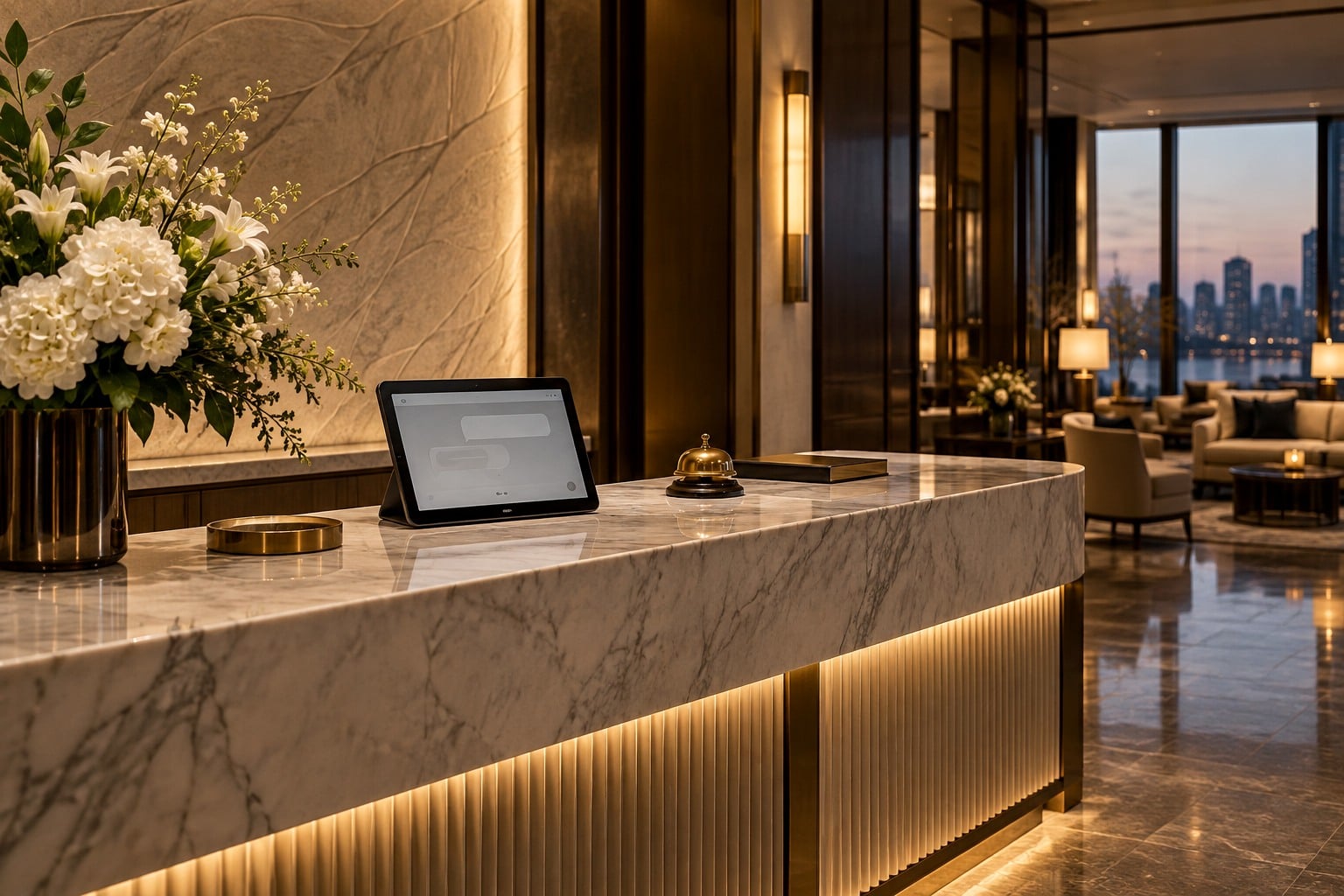
The concierge desk at a luxury hotel has always traded in precision. The right restaurant for the couple celebrating an anniversary. The right gallery for the collector passing through town. The right experience, presented with the right tone, at the right moment. That precision is what separates a great concierge from a search engine.
AI assistants are now performing the same function for millions of travelers and buyers. When someone asks ChatGPT “best luxury hotels in Santorini” or asks Perplexity “top property developers in Dubai,” the assistant generates an answer. That answer names specific brands, describes amenities, compares price tiers, and recommends one option over another. It does this in seconds, with confidence, and without consulting the brand.
The information behind that answer may be right. It may also be wrong. And for luxury brands that invest heavily in controlling how they are perceived, the distinction matters.
What AI assistants are doing — and where they get it wrong
AI assistants do not browse hotel websites in real time. They draw from web pages, review sites, travel directories, press archives, and aggregator listings that were available during training or retrieved at the moment of the query. They synthesize that information into a fluent answer. They do not check with the brand, visit the property, or verify that the spa menu from 2023 still applies.
This creates specific problems for luxury businesses.
Incorrect associations. A five-star resort may be grouped alongside properties that operate at a different tier. A heritage brand may be described with language borrowed from a budget competitor’s directory listing. AI assistants do not understand positioning — they reflect whatever sources they found.
Outdated details. Room categories change. Restaurants open and close. Renovations add amenities; seasonal programs rotate. The AI’s description may reflect last year’s offering or a press release from three years ago.
Source confusion. The assistant may cite a third-party aggregator page, a travel-review excerpt, or a directory listing the brand has never seen. That third-party page becomes the brand’s de facto spokesperson in the AI’s answer. The brand’s own website, with its carefully controlled language and photography, may not appear at all.
Entity errors. Properties with similar names in different cities get conflated. A boutique hotel may inherit attributes from a chain property. A developer’s residential project may be confused with a competing development in the same market.
These are not hypothetical risks. They are consequences of how AI assistants work with imperfect, incomplete, and uncontrolled source material.
Why this matters more for luxury
Most businesses care about being mentioned. Luxury brands care about being mentioned correctly.
A fast-casual restaurant can tolerate an AI assistant getting its founding year wrong. A Michelin-starred dining room with a six-month waitlist cannot afford to be described as “casual fine dining” or confused with a franchised operation in another city. A developer selling residences at $15 million cannot have an AI assistant quote last year’s pricing or describe the wrong floor plans.
The cost of inaccuracy is proportional to the price of the product. When a prospective guest or buyer encounters wrong information from an AI assistant, the brand loses a chance to make a first impression it controls. The traveler books elsewhere. The buyer shortlists a competitor. The damage happens quietly, without the brand knowing it occurred.
A selection of monitoring tools
Seven tools address different parts of this problem. Some are designed for small teams at accessible prices. Others are built for enterprises managing global portfolios. The selection below was evaluated in September 2026 using publicly documented capabilities, pricing, and platform coverage.
| Tool | What it monitors | Platforms | Access | Price |
|---|---|---|---|---|
| Beamtrace | ChatGPT mentions, competitors, reputation, and actionable corrections | ChatGPT | 14-day trial, no card | $20/mo annual |
| Profound | Factual claims verified against the brand’s source of truth; page-level citation and crawler data | ChatGPT; ChatGPT + Perplexity + Google AI Overviews on Growth; up to 9 on Enterprise | Free report; Growth trial | $99/mo Starter annual |
| Brandlight | Publisher influence, brand associations, competitive placements, technical crawl health | Multiple; enterprise coverage | Sales-led demo | Enterprise custom |
| Waikay | Entity accuracy — whether AI gets brand facts right or wrong | Multiple AI assistants | Free plan (3 credits) | $24.95/mo Starter |
| Ahrefs Brand Radar | Pre-collected AI responses across platforms: who gets mentioned, where, and when | ChatGPT, Google AI, Perplexity, Gemini, Copilot | Subscription | $199/mo per index |
| Peec AI | Source gaps — which pages AI cites instead of the brand’s own site | Up to 6 AI assistants | Free trial | €85/mo Starter |
Beamtrace
Best for: A luxury brand checking what AI says about it for the first time.
Beamtrace generates prompts based on the business, tracks them against ChatGPT on a regular schedule, and records what the assistant said — which names appeared, in what order, and which sources the answer referenced. The Actions view turns findings into a prioritized task list: update this page, add structured data there, check whether AI crawlers can reach the site.
The reputation layer is particularly relevant for hospitality. It connects Google reviews to ChatGPT descriptions, which can reveal a disconnect: guests praise the spa and the location, but the AI describes the property by referencing a three-year-old press release about the restaurant. That gap between guest sentiment and AI portrayal is worth knowing about.
Limitation that matters: Beamtrace tracks ChatGPT only. A luxury brand whose guests also use Perplexity, Google AI, or Gemini will eventually need broader coverage. As a starting point, ChatGPT alone teaches the method.
Price: $20/mo Starter (10 prompts, 5 competitors, billed annually). $40/mo Growth. $100/mo Premium. 14-day trial, no credit card.
Profound
Best for: A brand that needs to verify whether AI’s factual claims about it are accurate.
Profound’s FactCheck extracts specific factual claims from AI answers — “this hotel has 200 rooms,” “the restaurant holds two Michelin stars,” “the development is located in Marina Bay” — and compares them with a brand-controlled Knowledge Base. Claims are classified as accurate, inaccurate, or not relevant, and inaccuracies are traced back to the citation URLs that appear to be feeding the error.
This changes the question from “Were we mentioned?” to “Was what they said about us true?” For a luxury brand managing precise descriptions of properties, amenities, pricing tiers, and locations across markets, that distinction is fundamental.
The Pages product joins citation data with AI-crawler activity at the URL level, showing whether the brand’s own pages are being read by AI systems and how they compare with the third-party pages the assistant actually cites.
Limitation that matters: The affordable Starter tier tracks ChatGPT only. Monitoring Perplexity and Google AI Overviews requires Growth at $399/month. The widest engine coverage is Enterprise.
Price: $99/mo Starter (50 prompts, ChatGPT, billed annually). $399/mo Growth (3 engines, 100 prompts). Enterprise is custom.
Brandlight
Best for: An enterprise luxury group coordinating AI visibility across content, publishers, technical infrastructure, and commerce.
Brandlight approaches AI visibility as an organizational problem rather than a dashboard metric. Its Partnerships module identifies which third-party publishers and content formats influence AI answers about the brand, compares competitive placements, and recommends where partnership investment should go. For a hospitality group managing relationships with travel publishers, review platforms, and destination media, this turns AI visibility into a media-planning question.
The platform also coordinates technical crawl health (which AI agents can access the brand’s pages and what they see), commerce visibility (product and property listings in AI shopping experiences), and competitive analysis across content types.
A separate research finding is worth noting: Brandlight’s own June 2026 study of API responses versus consumer-interface responses found very low overlap in the brands each channel surfaced. The practical implication is that how a monitoring tool collects its data may affect what it reports.
Limitation that matters: Brandlight is demo-led with no published pricing. It is an enterprise product designed for global brand teams, not an accessible starting point for an independent property.
Price: Enterprise custom. Demo required.
Waikay
Best for: Verifying whether AI gets the brand’s identity facts right.
Waikay builds a knowledge graph from the brand’s website and compares it against what AI assistants appear to believe. The Fact Tracker pulls specific claims from AI responses — “this hotel is in downtown Barcelona,” “the brand specializes in contemporary design,” “prices start at $500 per night” — and lets the brand mark each claim as correct or incorrect.
For a luxury brand, this answers a pointed question: is AI describing our property accurately, or is it confusing us with another brand, citing outdated information, or misrepresenting our positioning? The knowledge-graph approach means the comparison is structured, not a manual spot-check.
Limitation that matters: The free plan provides 3 non-renewing credits — enough for an initial audit, not ongoing monitoring. Reports, API calls, and interface queries consume credits at different rates. Understanding the credit system matters before subscribing.
Price: Free plan (3 non-renewing credits). $24.95/mo Starter (8 credits). Plans up to $449.95/mo.
Ahrefs Brand Radar
Best for: Immediate historical research — what has AI been saying about the property across platforms?
Most AI monitoring tools require setup and time to build data. Brand Radar inverts this. Ahrefs has already collected hundreds of millions of AI responses and made them searchable. A brand team types in the property name, a competitor, or a destination, and immediately sees what AI assistants have been saying — who appears, which sources were cited, and how answers were framed.
For a luxury brand conducting due diligence before a rebranding, a property launch, or a competitive positioning review, this is the fastest path from question to evidence. There is no project to configure and no data-collection period to wait through.
Limitation that matters: The price ($199/mo for a single AI Visibility Index) is substantial but proportional to luxury brand budgets. The pre-collected index refreshes monthly, not in real time. Custom prompt checks, which let brands test specific questions against live AI models, are consumed per prompt, per model, per location — the allowance narrows quickly with broad geographic coverage.
Price: $199/mo for a single AI Visibility Index. $699/mo for all-platform access plus 2,500 custom-prompt checks.
Peec AI
Best for: Identifying which third-party sources AI cites instead of the brand’s own site.
Peec AI runs daily prompts across up to six AI assistants and tracks which sources the assistants cited in their answers. The source analysis classifies cited pages and identifies where the brand’s own content is absent — a “source gap” where the assistant relied on a TripAdvisor page, an aggregator listing, or an outdated press mention instead of the brand’s website.
For a luxury brand wondering “why is AI citing that directory listing instead of our own property page?”, Peec provides the answer. Its Query Fanouts reveal the intermediate searches the assistant ran before composing the answer — which pages it considered, which it discarded, and which ones appeared in the final response.
Limitation that matters: Self-serve plans allow only three active AI models at a time from six available options. Wider model coverage requires Enterprise. Prices are in euros.
Price: €85/mo Starter (50 prompts, 3 active models, daily tracking). €205/mo Pro. €425/mo Advanced. Free trial available.
Two kinds of tools, two different questions
These seven products divide into two categories that serve different parts of the brand-management conversation.
The first group answers a visibility question: Are we being mentioned? Beamtrace, Ahrefs Brand Radar, and Peec AI track mentions, citations, competitor positioning, and source attribution. They tell the brand where it stands relative to competitors and which sources the AI assistant is drawing from.
The second group answers a governance question: Is what AI says about us correct? Profound, Waikay, and Brandlight focus on factual accuracy, entity verification, and controlled brand representation. They treat AI answers as claims to be audited, not merely as rankings to be tracked.
For most luxury brands, the governance question matters more. Being mentioned incorrectly can be worse than not being mentioned at all.
Choosing by vertical
Hotels and resorts. Start with Beamtrace for a guided baseline and reputation analysis connecting guest reviews to AI descriptions. Add Profound or Waikay if accuracy verification is the priority — room categories, amenity lists, location details, and star-rating confusion are common AI errors in hospitality.
Property developers. Ahrefs Brand Radar provides immediate historical evidence of how AI assistants have described a development, a brand, or a market. Peec AI reveals which third-party sources the assistant cites about the project. Both are useful during pre-launch positioning or competitive analysis.
Luxury retail. Brandlight coordinates publisher influence and brand associations across content and commerce channels.
Restaurants and hospitality groups. Beamtrace’s reputation layer, connecting Google reviews to ChatGPT descriptions, is a natural fit. Waikay’s entity accuracy checks catch the most common hospitality errors: wrong locations, confused identities between similarly named establishments, and outdated Michelin or award descriptions.
What a brand can do before buying any tool
Ask AI about yourself. Open ChatGPT, Perplexity, and Google’s AI assistant. Ask each one about your property, brand, or development — by name and by category. Compare the answers. Note what is accurate, what is wrong, and what is missing.
Check your sources. When an AI assistant cites a source, visit it. If the citation leads to a third-party page rather than your own website, read what that page says. It may be the version of your brand that the assistant trusts.
Review your AI accessibility. Some websites block AI crawlers through their robots.txt file. If your site blocks GPTBot, ClaudeBot, or other AI crawlers, the assistants cannot access your content directly and will rely on whatever third-party sources they find.
Update your own pages. AI assistants often draw biographical and brand information from About pages, press pages, and structured data. If those pages are outdated, vague, or missing key details, the assistant has less to work with — and will fill the gap from sources you may not prefer.
A controlled narrative in an uncontrolled medium
A luxury brand is, at its foundation, a controlled narrative. The photography is deliberate. The language is precise. The experience is curated. Every touchpoint is designed to communicate a specific standard.
AI assistants are now describing that brand to prospective guests and buyers who have never visited the website, never spoken to a concierge, and may never see the brand’s own marketing. The description may be drawn from a third-party directory, an aggregator page, or a press archive the brand forgot existed. It may be accurate. It may not.
Monitoring what AI assistants say is not a technology project. It is a brand-protection responsibility — the same instinct that governs press relations, visual identity, and guest experience applied to a new channel. The tools above make the monitoring practical. What the brand does with the findings is, as always, a matter of judgment, standards, and the willingness to correct the record.