What do two Germans called Algy and Percy, an Irish sea goddess, Odin’s ravenous wolf, a Celtic cross, an Arthurian ceiling, Nile Delta coriander, Cork myrtle, Mediterranean juniper, a French citrus grower, and a pug named Batman have in common?
They all belong to the improbable world of Castle Freke Gin.
Created in West Cork by the Hon. Stephen Evans-Freke, the youngest son of the 11th Baron Carbery, Castle Freke is described by its maker as an elemental Irish sipping gin: a spirit intended to be enjoyed with the attention usually reserved for mature whisky, fine Cognac, or an exceptionally dry Martini.
Its price of £170 in the United Kingdom and $245 in the United States makes the intention clear. This is not a casual measure hidden beneath tonic water, cucumber ribbons, and fistfuls of ice. Castle Freke was made to stand largely on its own.
For Evans-Freke, the ideal expression is what he calls the In and Out Martini, an exercise in restraint and ritual.
“In its purest form, the Very Dry Martini is an exercise in restraint,” he says. “Vermouth, if used at all, should whisper in the background, never overwhelm.”
His instructions are precise. Chill the gin, the shaker, and the glasses. Fill the shaker two-thirds with ice taken directly from the freezer. Add a small splash of dry vermouth and two drops of Angostura bitters, shake briefly, then discard the liquid. Pour Castle Freke Gin over the delicately seasoned ice, shake briskly for no more than 10 seconds, and strain into freezer-cold glasses.
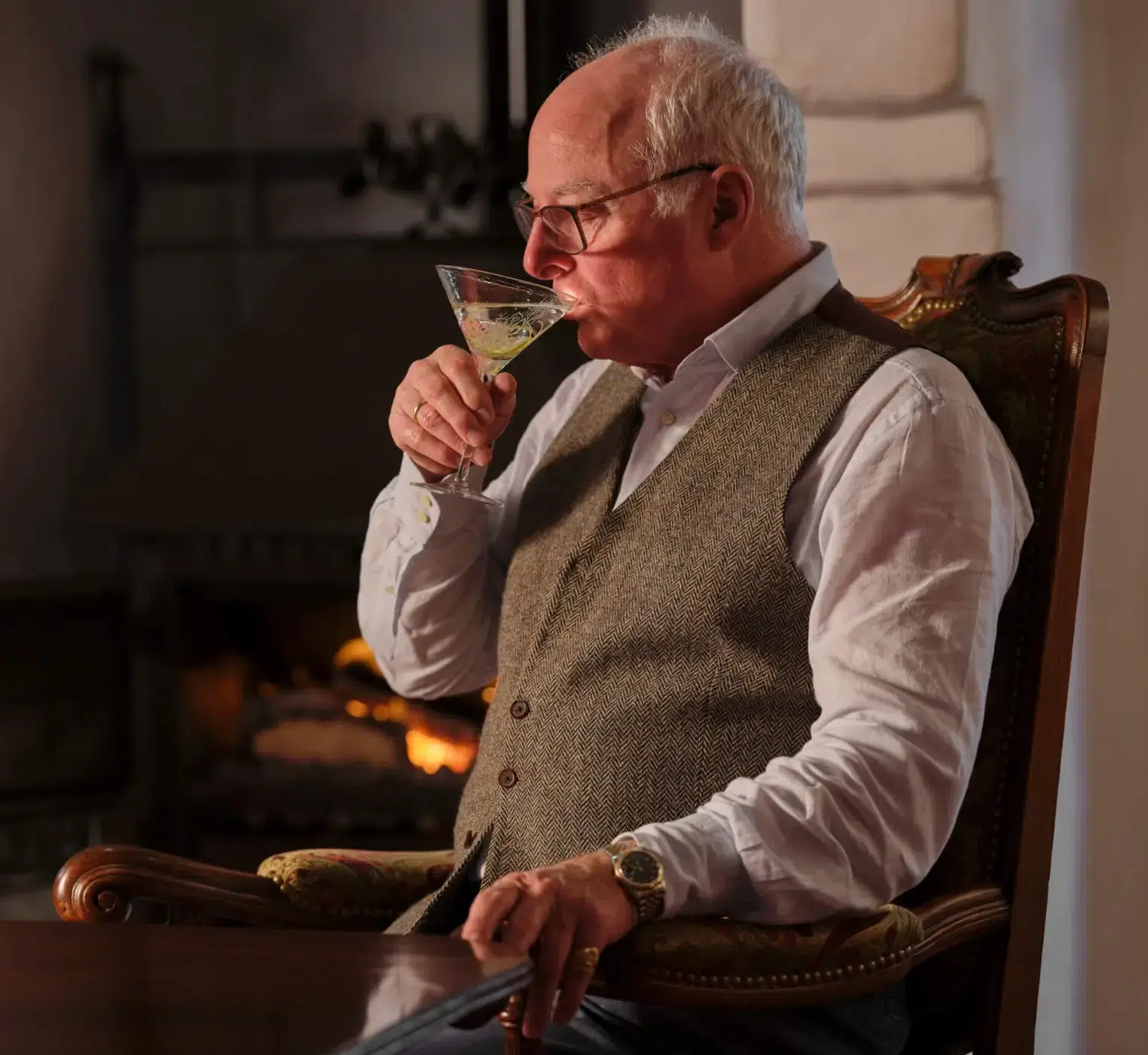
The garnish is equally controlled: a thin curl of lemon, tangerine, or yuzu peel—never orange—shaved carefully enough to release its aromatic oils without introducing the bitterness of the pith. A narrow slice of cucumber may be added.
Then, Evans-Freke advises, lift the glass and salute your companions.
It is “a wonderful punctuation between the working day and time spent with family and friends,” he says. A small ceremony at the edge of evening.
The gin’s story begins with a much larger act of restoration.
Castle Freke stands near Rathbarry in West Cork, within sight of the Atlantic and, on a clear day, the Fastnet Lighthouse. The estate began as a 15th-century tower house and passed into the Freke family in the 17th century. After a fire in 1780, the house was partially rebuilt, then gradually fell into ruin.
Evans-Freke acquired the structure in 1999 and began the long, complicated task of bringing it back to life.
He was not entirely unprepared. Before returning to Ireland, he had overseen the historical reconstruction of a large period house in Tuxedo Park, New York. Repairing battlements and reviving an ancestral Irish castle, however, presented a different order of difficulty.
The restored interiors are dense with mythology, symbolism, and craftsmanship. There are painted ceilings, scagliola marble columns, sculptural plasterwork, and details inspired by Arthurian legend and Celtic history. Irish stuccodores helped execute the decorative work, among them craftsmen later associated with the Worshipful Company of Plaisterers, the centuries-old City of London livery company.
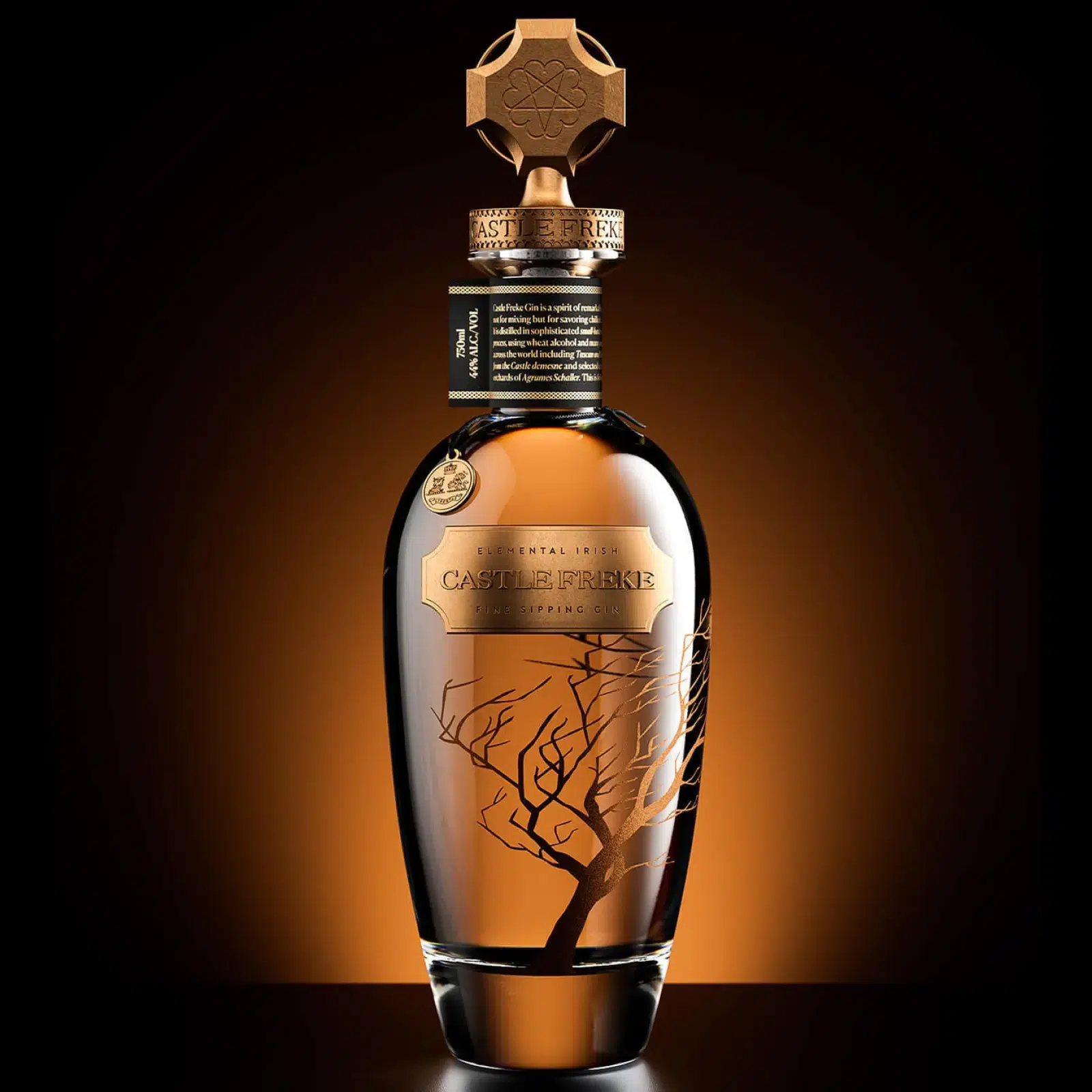
The same appetite for symbolism now appears on the gin bottle.
A sculpted copper tree, bent as though shaped by Atlantic winds, represents the resilience of the landscape, the castle, and the family that restored it. The stopper takes its form from the Carbery Celtic Cross on Croachna Hill, opposite the estate. The Flower of Life, a pentacle of hearts, and the ouroboros appear as references to creation, proportion, continuity, and renewal.
“The ouroboros speaks to the idea that every ending is a beginning,” says Evans-Freke. “That true craft is timeless, a continuous pursuit of perfection rather than a finite act.”
The bottle is richly decorated, but the symbolism is not mere packaging theater. Evans-Freke sees a direct relationship between the spirit and the castle itself.
“The multilayered complexity and subtle harmony of the gin share much in common with the castle interior,” he says.
The idea for the spirit emerged about a decade ago, while Evans-Freke was recovering from foot surgery. Immobilized but apparently not inclined toward idleness, he ordered approximately 120 essential oils, acquired a substantial quantity of vodka, and converted his dining-room table into an experimental laboratory.
He began blending botanicals.
The process became an obsession. Ingredients were evaluated, eliminated, recombined, and refined until a distinct profile began to emerge. Castle Freke Gin would eventually draw on coriander from the Nile Delta, myrtle from County Cork, juniper berries from Tuscany and Macedonia, and citrus supplied by Agrumes Schaller in the French Pyrenees, a grower known for working with Michelin-starred chefs.
The production process extends across some 50 individual stages of distillation, blending, resting, and maturation. The intention is not simply aromatic intensity but integration: a gin with enough texture, balance, and length to be sipped neat or carried by the faintest trace of vermouth.
Production takes place in two customized German Kothe copper stills. The smaller, a 150-liter still, is named Algy after Algernon, the 9th Baron Carbery and Evans-Freke’s great-grandfather. The larger 600-liter still is Percy, named for Sir Percy Freke, an ancestor who served as Lord Mayor of Cork and High Sheriff of County Cork.
They are the two Germans in the story.
Clíodhna, the mythological sea goddess associated with Cork, lends another layer of local folklore. Freki, Odin’s wolf companion, helps supply the name’s more ancient resonance. Eva Murphy, the distillery’s senior distiller and chief storyteller, brings the process into the present.
And Batman?
Batman is the family pug.
He may be the least mythological member of the cast, although perhaps not the least important. Castle life, Evans-Freke admits, is less romantic than it appears from the outside.
“A castle is an inconvenient place as a private house,” he says. “If you want to let the dog out in the middle of the night, you have to take quite a journey to the front or back door.”
He now lives in nearby Rathbarry Castle, a somewhat smaller and more manageable residence.
There is also, on Castle Freke’s grand staircase, a plaster frieze depicting a mole holding a Martini glass. It is difficult to imagine a more appropriate emblem for the enterprise: formal yet eccentric, steeped in history but alert to the pleasures of the present.
Castle Freke Gin may be expensive, elaborate, and laden with ancestral symbolism, but its purpose is ultimately simple. It was created for the moment when the day loosens its grip, the glasses are lifted, and good company becomes the only ceremony that matters.